The flower of life symbolism refers to the meanings connected with a geometric pattern made from overlapping circles that form a flower-like design. Today, many people associate this symbol with harmony, connection, balance, and the relationship between different parts of existence. It appears in artwork, jewelry, tattoos, home decoration, meditation spaces, and modern spiritual communities across the United States.
The design attracts attention because it combines mathematical structure with artistic beauty. Unlike many symbols that depend on a specific story or tradition, the flower of life is often interpreted through geometry itself. Its repeating circles create a sense of order, connection, and unity that many people find meaningful.
In modern American culture, the symbol is often used as a personal expression rather than a fixed religious sign. Some people display it to represent creativity, personal growth, or an appreciation for patterns found in nature. Others use it simply because they admire its visual design.
Understanding the flower of life requires looking at its appearance, historical development, cultural connections, and the different ways people interpret it today.
Quick Answer
Flower of life symbolism commonly represents connection, harmony, and the idea that all parts of life are linked together in modern American culture. Historically, the geometric pattern has been connected with sacred geometry traditions, artistic design, and philosophical ideas about creation and order.
TL;DR
- Represents connection, balance, and universal patterns.
- Built from overlapping circles and geometric structure.
- Appears in ancient art and modern design.
- Used widely in American tattoos and decor.
- Carries different meanings across communities.
- Often viewed as artistic rather than religious.
What The Flower Of Life Symbol Looks Like
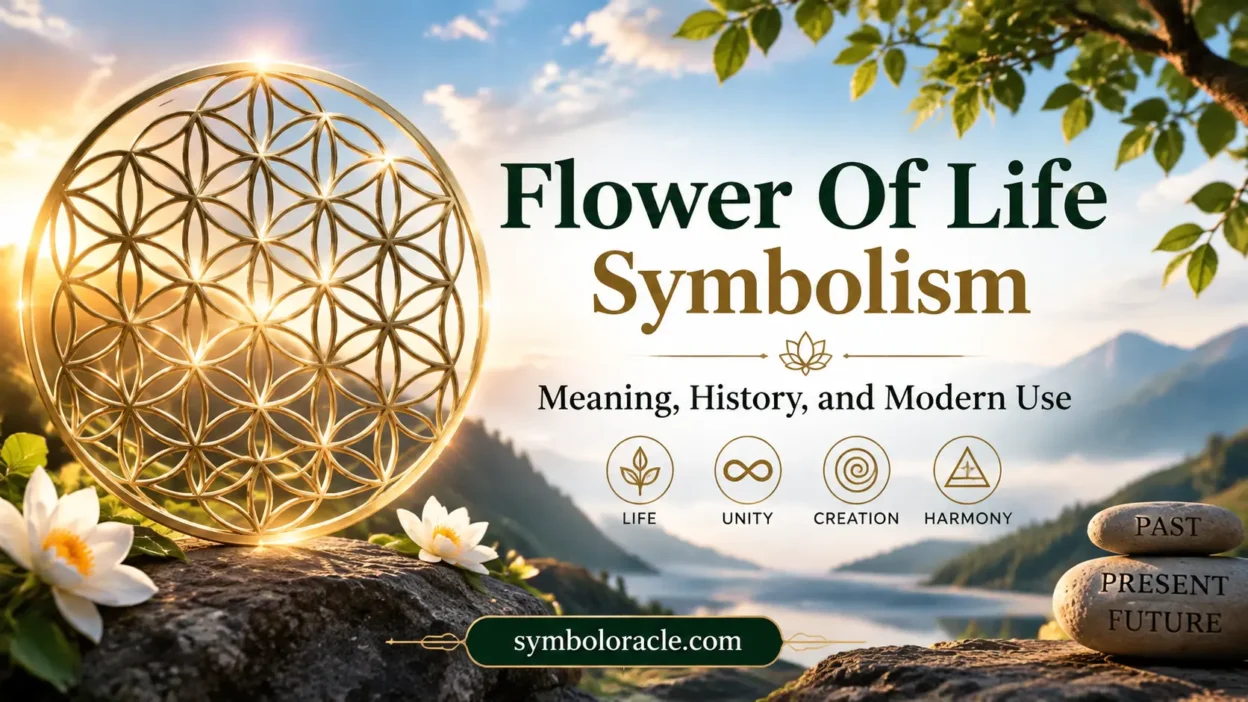
The flower of life is a circular geometric pattern created by placing multiple circles so that each circle overlaps with others at equal points. The result is a repeating design that resembles petals, flowers, or a network of connected shapes.
The basic form usually begins with one circle surrounded by additional circles arranged evenly around it. As more circles are added, the pattern becomes more complex while maintaining symmetry.
Many people notice that the design has a natural quality. The circles can remind viewers of flower petals, bubbles, cellular structures, or repeating forms found in nature. However, the symbol itself is a human-made geometric pattern rather than a direct representation of a specific plant.
In the United States, people commonly encounter the flower of life on:
- Wall art and home decorations
- Yoga and meditation products
- Jewelry and accessories
- Tattoos
- Clothing designs
- Artwork and digital graphics
Its visual balance is one reason it has become popular among people interested in design, mathematics, and personal symbolism.
What It Commonly Means In The United States
In contemporary American culture, the flower of life is most often associated with connection and harmony. Many people interpret the connected circles as a reminder that individuals, communities, and nature are part of larger systems.
The symbol is also frequently linked with creativity and growth. Because the pattern develops from one simple circle into a larger structure, some people see it as representing expansion, learning, and personal development.
Common modern interpretations include:
| Context | Meaning in the USA | Common Associations | Notes |
|---|---|---|---|
| Home Decor | Balance and harmony | Interior design, calm spaces | Often chosen for visual appeal |
| Tattoos | Personal growth and connection | Identity, self-expression | Meaning depends on the wearer |
| Jewelry | Unity and creativity | Fashion, personal beliefs | Usually symbolic rather than religious |
| Meditation Spaces | Focus and reflection | Mindfulness, spiritual practices | Used as a visual aid |
Unlike symbols tied to a single American tradition, the flower of life has flexible meanings. A person wearing it as a necklace may view it as a reminder of personal values, while another person may appreciate it purely as an elegant geometric design.
Ancient Roots And Early Symbolic Connections
The history of the flower of life is complex because the modern interpretation of the symbol developed later than some of the ancient examples of similar geometric patterns.
Geometric circle designs have appeared in various cultures for thousands of years. Ancient builders, artists, and philosophers often used circles and repeated patterns to represent ideas such as order, balance, and the structure of the world.
Some examples of flower-like geometric patterns have been found in historical locations, including decorative artwork and architectural designs. However, modern claims that the exact flower of life symbol was universally recognized by ancient civilizations should be treated carefully. The meaning attached to the symbol today often comes from later interpretations rather than a single documented ancient explanation.
The connection between geometry and symbolism has existed for centuries. Many cultures viewed mathematical patterns as reflections of organization in nature, architecture, and the universe.
This relationship helped create the foundation for what modern communities call sacred geometry.
Sacred Geometry And The Meaning Of Order
Sacred geometry is a tradition of interpreting geometric forms as meaningful patterns connected with creation, balance, and structure. Within this tradition, the flower of life is often considered an important symbol because of its repeated circles and symmetrical design.
People who study sacred geometry often connect the symbol with ideas such as:
- The relationship between individual parts and the whole
- Natural patterns and mathematical balance
- The organization of space and form
- Creativity and design principles
The term “sacred” does not always mean religious. For many modern users, it refers to the belief that certain patterns have philosophical or personal significance.
In the United States, sacred geometry has become popular through art communities, wellness spaces, and creative industries. Many people approach these designs as sources of inspiration rather than strict spiritual teachings.
Cultural Interpretations Around The World
The flower of life is interpreted differently depending on the cultural setting. Some communities connect it with spiritual ideas, while others focus mainly on its artistic and mathematical qualities.
In some Eastern traditions, circular patterns are associated with balance, cycles, and interconnectedness. Similar ideas appear in mandala designs, where geometric arrangements are used for meditation and reflection.
In Western artistic traditions, geometry has often represented perfection, proportion, and intellectual exploration. Architects, artists, and designers have used geometric forms to create visual harmony.
Modern interpretations combine many of these influences. A person in the United States may encounter the flower of life through meditation practices, graphic design, fashion, or decorative art without following any particular cultural tradition.
Because of this variety, the symbol does not have one universal meaning. Its interpretation depends heavily on the individual and the context where it appears.
Emotional And Psychological Meaning
Symbols often become meaningful because of the feelings they create. The flower of life is frequently chosen because its structure gives viewers a sense of balance and organization.
The repeated circles may create associations with:
- Stability
- Connection
- Creativity
- Wholeness
- Personal reflection
From a psychological perspective, humans naturally recognize patterns and symmetry. Balanced designs can feel visually pleasing because the brain often responds positively to organized shapes.
For some people, seeing the flower of life serves as a reminder to look for relationships between different areas of life. It can represent the idea that personal experiences, relationships, and goals are connected rather than isolated.
However, the emotional meaning is personal. The symbol does not automatically create a specific feeling for everyone who sees it.
Flower Of Life In American Culture And Everyday Design
In the United States, the flower of life has become a recognizable design element in modern lifestyle and creative spaces. Unlike national symbols, religious icons, or traditional emblems with officially defined meanings, this geometric pattern is usually interpreted personally.
Many Americans encounter the symbol through wellness culture, handmade crafts, interior design, and artistic communities. Its balanced structure makes it appealing for people who want visual elements that suggest organization, calmness, or creativity.
In home decoration, the flower of life is often displayed on:
- Wall paintings
- Posters
- Furniture designs
- Decorative panels
- Meditation areas
- Garden artwork
For some homeowners, it represents a peaceful environment or an appreciation for natural patterns. Others simply choose it because the symmetrical design fits modern and minimalist styles.
The symbol also appears in creative industries because geometric patterns have become popular in contemporary fashion, digital art, and branding. Designers often use circular structures because they communicate movement, unity, and visual balance.
Why People Choose Flower Of Life Tattoos
The flower of life is a popular tattoo design because it combines artistic appeal with personal meaning. Tattoo culture in the United States often focuses on symbols that allow individuals to express identity, beliefs, memories, or personal journeys.
People may choose this design to represent:
- A connection between different life experiences
- Personal transformation
- Creativity and imagination
- A sense of balance
- Appreciation for mathematics or nature
For some tattoo owners, the symbol represents a spiritual outlook. For others, it reflects an interest in geometry, art, or the beauty of repeated patterns.
The meaning of a flower of life tattoo depends on the person wearing it. Two people can have nearly identical tattoos while attaching completely different stories to them.
Placement can also influence interpretation. A small wrist tattoo may represent a private reminder, while a large back or chest design may serve as a major artistic statement.
Religious And Spiritual Interpretations
The flower of life is sometimes connected with spiritual ideas, but it is not a central symbol of most major religions. Its modern spiritual associations mainly come from sacred geometry movements and personal interpretations.
Some people connect the pattern with concepts found in different traditions, such as:
- Creation and the structure of existence
- The relationship between humans and nature
- Balance between physical and spiritual life
- Reflection and meditation
However, these interpretations vary widely. The symbol does not have one official meaning shared by all religious groups.
In some spiritual communities, the flower of life is viewed as a representation of universal connection. In other settings, it is appreciated only as an example of geometric art.
A careful understanding separates personal belief from historical fact. While people may find spiritual value in the symbol today, its modern meanings have developed through many different influences rather than one single religious origin.
Flower Of Life In Jewelry And Fashion
Jewelry is one of the most common ways people use the flower of life symbol in daily life. Necklaces, rings, bracelets, and earrings featuring the design are popular among people who enjoy symbolic accessories.
In fashion, the symbol often communicates:
- Individual style
- Interest in geometric art
- Connection with creative communities
- Personal philosophy
Many Americans wear symbolic jewelry without following a specific belief system. A person may choose the flower of life because they like its appearance, while another may wear it as a meaningful personal reminder.
The design works well in jewelry because its circular structure can be adapted into many sizes and materials, including:
- Silver
- Gold
- Wood
- Glass
- Stainless steel
Its flexibility has helped it remain popular in both casual and artistic fashion markets.
Digital Culture And Modern Symbol Use
The internet has expanded how people discover and share symbols. The flower of life appears frequently in digital artwork, social media posts, online communities, and creative platforms.
Modern online uses include:
- Graphic design projects
- Digital illustrations
- Meditation content
- Artistic backgrounds
- Educational geometry visuals
Social media has also contributed to the spread of symbolic designs. People often share images of patterns that represent personal values, creativity, or lifestyle choices.
However, online popularity can sometimes simplify complex symbols. A design may become associated with trends without users understanding its historical background.
This does not make modern interpretations invalid. Instead, it shows how symbols naturally change as they move between cultures, generations, and technologies.
Common Misunderstandings About The Symbol
Because the flower of life has become popular in spiritual and wellness communities, several misconceptions have developed around it.
One common misunderstanding is that the symbol has one universally accepted ancient meaning. In reality, interpretations have changed over time, and many modern explanations come from recent spiritual movements rather than clearly documented historical sources.
Another misunderstanding is that everyone who uses the symbol shares the same beliefs. In practice, people use it for many reasons, including:
- Artistic appreciation
- Personal expression
- Cultural interest
- Decorative purposes
The symbol should also not automatically be classified as belonging to one religion, movement, or group. Its meaning depends on the person, community, and situation where it appears.
Controversies And Modern Misuse
Like many popular symbols, the flower of life has sometimes been surrounded by exaggerated claims. Some online discussions attach specific supernatural abilities or guaranteed effects to the design.
These claims are not supported by historical evidence. The symbol can carry personal meaning, encourage reflection, or inspire creativity, but its effects depend on individual interpretation rather than proven powers.
Another challenge is cultural oversimplification. When symbols move across cultures, they can sometimes lose their original context or become commercial products.
A balanced view recognizes both sides:
- The flower of life has genuine artistic and philosophical importance.
- Some modern claims about it go beyond documented history.
Understanding this difference allows people to appreciate the symbol without confusing personal belief with established historical information.
How The Meaning Of Flower Of Life Has Changed Over Time
The meaning of the flower of life has evolved as different communities adopted and reinterpreted the design.
Earlier uses of geometric patterns often focused on:
- Mathematical order
- Artistic beauty
- Architectural design
- Philosophical ideas about structure
Modern uses often emphasize:
- Personal identity
- Wellness culture
- Creativity
- Connection
- Self-reflection
This evolution is common with symbols. Meanings are not always fixed forever; they develop as people use symbols in new environments.
In the United States especially, symbols often become part of personal storytelling. A design that once belonged mainly to artistic or philosophical discussions can become a tattoo, gift, decoration, or personal reminder.
Flower Of Life Symbolism In Different Contexts
| Context | Common Interpretation | Modern American Use |
|---|---|---|
| Tattoos | Personal growth and connection | Identity expression |
| Jewelry | Balance and creativity | Everyday symbolic fashion |
| Home Decor | Harmony and visual order | Interior decoration |
| Meditation | Reflection and mindfulness | Wellness spaces |
| Art | Geometry and beauty | Creative expression |
Frequently Asked Questions
What Does The Flower Of Life Symbolize?
The flower of life commonly symbolizes connection, harmony, and the relationship between different parts of life. In modern American culture, people often use it as a personal symbol rather than a fixed religious sign.
Is The Flower Of Life A Religious Symbol?
The flower of life is not an official symbol of most major religions. Some spiritual communities use it for personal reflection, but many people appreciate it simply as geometric artwork.
What Does A Flower Of Life Tattoo Mean?
A flower of life tattoo may represent personal growth, creativity, connection, or appreciation for geometric patterns. The meaning depends on the individual who chooses the design.
Why Is The Flower Of Life Popular In Modern Design?
The symbol is popular because its symmetrical pattern works well visually and can represent ideas such as balance and organization. Designers use it in art, clothing, jewelry, and decoration.
Does The Flower Of Life Have Ancient Origins?
Geometric circle patterns similar to the flower of life have appeared in historical artwork, but many modern explanations of its meaning developed more recently. The exact symbol’s interpretation has changed across different periods and cultures.
Is The Flower Of Life Connected To Sacred Geometry?
Yes, the flower of life is commonly associated with sacred geometry traditions. These traditions view certain geometric patterns as meaningful representations of order, structure, and balance.
Conclusion
The flower of life is a geometric design that has developed many interpretations across art, culture, spirituality, and personal expression. In the United States, people most often connect it with harmony, connection, creativity, and visual balance rather than one specific belief system.
Its history shows how symbols change as they move between communities. From geometric artwork to tattoos, jewelry, and modern design, the symbol continues to gain new meanings while maintaining its recognizable circular structure.
Ultimately, flower of life symbolism is shaped by the person who uses it. For some, it represents personal reflection and connection; for others, it is simply a beautiful example of human creativity and design.