Alstroemeria symbolism centers on friendship, mutual support, loyalty, and lasting affection. Commonly called the Peruvian lily or lily of the Incas, this colorful South American flower is especially meaningful when someone wants to express care without the romantic intensity associated with red roses.
In the United States, alstroemeria frequently appears in friendship bouquets, congratulations arrangements, wedding flowers, and thoughtful gifts for someone facing a difficult period. Its multiple blossoms, varied colors, and long vase life make it an appealing visual metaphor for relationships that remain steady over time.
Its meaning isn’t based on one ancient religious tradition. Instead, the flower’s symbolism developed through European flower-language customs, commercial floristry, and modern interpretations of its physical qualities.
Quick Answer
Alstroemeria symbolism most commonly represents friendship, mutual support, loyalty, and enduring affection in modern American culture. It can also communicate devotion, encouragement, good fortune, or appreciation, depending on the flower’s color and the occasion.
TL;DR
- Alstroemeria primarily symbolizes friendship, loyalty, and mutual support.
- Its meaning is usually affectionate without being strongly romantic.
- The plant is native to South America, especially Chile and Brazil.
- Different colors can suggest joy, admiration, sincerity, or commitment.
- Americans often use it for celebrations, encouragement, weddings, and friendship gifts.
- Claims about ancient Inca meanings should be treated cautiously.
What Alstroemeria Looks Like
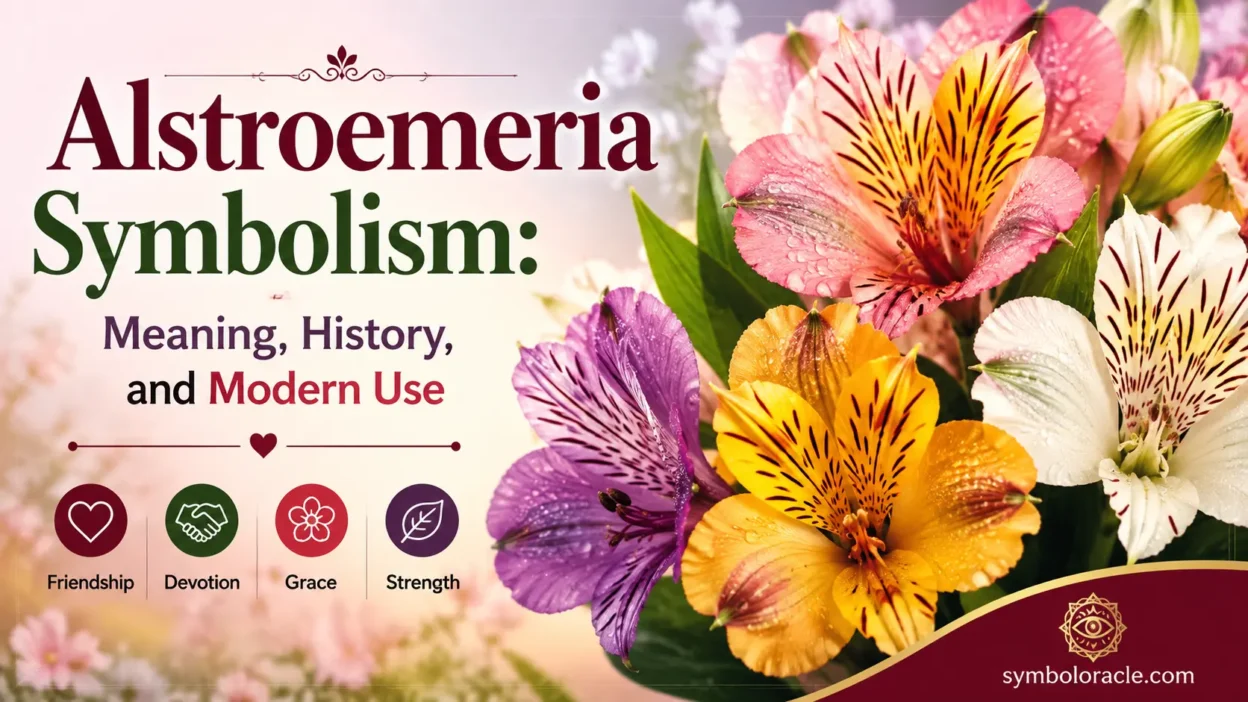
Alstroemeria produces clusters of funnel-shaped, lily-like flowers at the tops of slender stems. Each bloom usually has six petal-like segments, with the inner ones often marked by dark streaks, speckles, or narrow lines.
The flowers appear in white, yellow, orange, peach, pink, red, lavender, and purple. Many cultivars combine several shades in one bloom, such as pink petals with yellow centers and burgundy markings.
Although its common names include Peruvian lily and lily of the Incas, alstroemeria isn’t a true lily from the genus Lilium. It belongs to the Alstroemeriaceae family and grows from fleshy underground structures. Its natural range extends across much of South America, with especially important groups of species in Chile and Brazil.
The flower’s clustered shape contributes to its modern symbolism. A single stem can hold several blossoms facing different directions, which lets people read it as a representation of connected individuals supporting one another.
Alstroemeria Meanings at a Glance
| Context | Common Meaning in the USA | Typical Use | Important Note |
|---|---|---|---|
| Friendship | Loyalty and mutual support | Friendship bouquets | Its strongest modern association |
| Appreciation | Gratitude and recognition | Thank-you arrangements | Suitable for personal or professional gifts |
| Encouragement | Strength and continued support | Recovery or difficult transitions | Warmer and less formal than some sympathy flowers |
| Romance | Devotion and growing affection | Dating and anniversary bouquets | Usually gentler than red roses |
| Celebration | Success and good fortune | Graduations, promotions, new homes | Bright colors reinforce an optimistic message |
| Remembrance | Enduring affection | Memorial or condolence flowers | Best used with a personal note |
These meanings are conventions rather than strict rules. Floral symbolism varies among regions, families, florists, and individual recipients.
What It Commonly Means in the United States
The clearest American interpretation of alstroemeria is dependable friendship. It communicates more than casual friendliness, though — the flower is generally associated with a relationship in which people encourage, understand, and remain present for one another.
That makes it appropriate for close friends, siblings, mentors, coworkers, and long-distance companions. It can express a message such as “I value our bond,” “Thank you for standing by me,” or “I am supporting you.”
Recent American flower guides continue to feature alstroemeria in arrangements celebrating long-term friendship and platonic affection. Pink varieties, in particular, are often combined with yellow flowers to create bouquets centered on trust, fondness, and companionship.
Unlike flowers strongly tied to one occasion, alstroemeria is flexible. It doesn’t automatically suggest a proposal, funeral, apology, or religious ceremony — the sender defines the message through the color, accompanying flowers, and written card.
Friendship and Mutual Support
Friendship is more than a convenient marketing meaning attached to alstroemeria. Several characteristics of the flower help explain why the association feels convincing.
Each stem carries a group of individual blooms. The flowers remain distinct, yet they’re supported by the same structure — a pairing that has encouraged interpretations involving community, cooperation, and people growing together without losing their individuality.
Its relatively long vase life strengthens the idea of durability. Depending on its condition and care, cut alstroemeria can remain attractive for approximately one to two weeks, making it a natural choice for representing a relationship that survives distance, changing circumstances, or periods of limited contact.
The flower is particularly suitable for friendships built through shared challenges. It can recognize someone who offered practical help, listened without judgment, or remained dependable during a stressful period.
Loyalty, Devotion, and Lasting Affection
Alstroemeria can also represent devotion, but the nature of that devotion depends on context. In a bouquet for a friend, it suggests loyalty. Between romantic partners, it can express patient affection and continued commitment. In a family arrangement, it may represent a bond maintained across generations or distance.
This flexibility separates it from more emotionally specific flowers. A red rose usually carries a recognizable romantic message, while a white lily may be associated with purity, mourning, or religious ceremonies. Alstroemeria leaves more room for the sender to communicate affection in a personal way.
For a newer relationship, pink or peach alstroemeria can suggest growing fondness without making an intense declaration. For a long-term partner, red or deep pink varieties can reinforce themes of commitment and companionship.
Modern flower-language guides consistently connect the flower with friendship, devotion, strength, and mutual understanding, though the exact wording varies.
South American Origins and Botanical History
Alstroemeria is native to South America rather than Europe or North America. Species occur from southern Venezuela through countries including Peru, Bolivia, Brazil, Chile, Argentina, Paraguay, and Uruguay, with Chile and Brazil containing major centers of diversity adapted to different climates and growing cycles.
The genus was formally published in 1762 and named in honor of Swedish naturalist Clas Alströmer, a friend and associate of Carl Linnaeus. Accounts differ in minor details about how seeds reached Linnaeus, but Alströmer’s connection to the plant is preserved in its scientific name.
European gardeners valued the flowers for their unusual markings and bright colors. Later breeding produced numerous hybrids with stronger stems, longer flowering periods, and shades suited to the cut-flower industry.
As alstroemeria became more familiar in European and American gardens, it entered the broader language of floral gifts. Its current symbolic identity reflects several stages layered on top of one another: South American botanical origins, European classification and cultivation, and modern international floristry.
From Botanical Curiosity to Flower-Language Symbol
Nineteenth-century interest in floriography encouraged people in Europe and North America to associate plants with emotions, personal qualities, and hidden messages. Flowers could be combined into small bouquets that communicated affection, rejection, remembrance, gratitude, or grief.
These systems were never completely standardized. Different flower dictionaries frequently assigned different meanings to the same plant, and interpretations also shifted according to color, arrangement, regional custom, and the writer compiling the dictionary.
Some modern guides attribute meanings such as “beloved” or quiet devotion to alstroemeria within Victorian flower language. The broader association with friendship appears to have become more prominent through later floral culture rather than through one universally followed Victorian definition.
This distinction matters because flower meanings are cultural conventions, not scientifically fixed properties. The most accurate interpretation is usually the meaning shared by the sender and recipient.
How Its Meaning Evolved in American Culture
In contemporary American life, floral symbolism is less like a secret code and more like an added layer of intention. People rarely expect recipients to decode every flower in a bouquet — instead, they choose blooms whose appearance and commonly advertised meanings support the occasion.
Alstroemeria fits this approach particularly well. It’s colorful, widely available, long-lasting, and less expensive than many large focal flowers. Florists can use it as a supporting flower or group several stems into a full arrangement.
Its symbolism has expanded beyond traditional friendship bouquets, then. Americans now use it for birthdays, graduations, promotions, housewarmings, recoveries, appreciation gifts, anniversaries, and informal celebrations.
Social occasions such as Galentine’s Day have strengthened its association with close platonic relationships. Its message feels affectionate and intentional without copying the romantic language of Valentine’s Day roses.
What Different Alstroemeria Colors Can Represent
Color meanings are modern guidelines rather than universal rules. The overall arrangement and personal preferences of the recipient matter more than any rigid floral dictionary.
Pink commonly represents affection, kindness, fondness, and caring friendship — suitable for close friends, sisters, mothers, partners, and anyone receiving a gentle expression of appreciation.
Yellow suggests optimism, happiness, encouragement, and good wishes, working well for birthdays, congratulations, recovery gifts, and friendships with an energetic or cheerful character.
Orange can communicate confidence, motivation, enthusiasm, and celebration — a strong choice for promotions, graduations, new ventures, or someone entering a new stage of life.
White often represents sincerity, thoughtfulness, respect, or a fresh beginning, appearing in weddings, sympathy arrangements, minimalist decor, and bouquets intended to feel calm rather than dramatic.
Red generally emphasizes affection, commitment, and emotional closeness. It can be romantic, but it’s less strongly coded than a red rose and can also honor a close family relationship.
Purple is often associated with admiration, individuality, creativity, and dignity, suiting recipients with a distinctive personality or arrangements designed to feel sophisticated.
Modern flower-language sources openly acknowledge that interpretations vary, especially when color is involved. These associations should be viewed as tools for personal expression rather than binding definitions.
Weddings, Anniversaries, and Relationship Milestones
Alstroemeria is popular in wedding arrangements because it can represent companionship as well as affection. Marriage isn’t only a romantic commitment — it also involves cooperation, patience, shared responsibility, and friendship, and the flower’s established associations fit that broader view of partnership.
White, blush, peach, and pale pink cultivars blend easily with roses, lisianthus, carnations, eucalyptus, and seasonal greenery. Brighter varieties may be used in summer weddings, multicultural celebrations, or informal outdoor ceremonies.
For anniversaries, alstroemeria can recognize the friendship within a long-term relationship — especially appropriate when the sender wants the bouquet to feel warm and personal rather than formal or extravagant.
The flower can also mark nonromantic milestones. Friends may exchange it when celebrating years of friendship, completing a shared project, moving to different cities, or reconnecting after a long separation.
Sympathy, Recovery, and Encouragement
Alstroemeria isn’t among the most traditional American funeral flowers, but it can appear in condolence and remembrance arrangements. Its message in this setting is usually enduring affection, support for the grieving family, or gratitude for the life of the person being remembered.
White, lavender, and soft pink varieties create a restrained appearance, while brighter colors may be chosen when the arrangement is meant to celebrate the deceased person’s character.
It’s also suitable for someone recovering from illness, disappointment, or emotional strain. Yellow and orange varieties can offer encouragement without implying that the recipient should ignore the seriousness of the situation.
The most meaningful sympathy bouquet is one accompanied by clear words. Because alstroemeria doesn’t have one universally recognized mourning meaning, a short note helps explain whether the flowers represent remembrance, companionship, gratitude, or continued support.
Emotional and Psychological Meaning
Psychologically, alstroemeria communicates connection without possession. Its friendship-centered identity makes it useful when affection needs to be expressed without creating romantic pressure or demanding an emotional response.
The clustered flowers can suggest a social support system: several people, experiences, or personal strengths contributing to one life. This interpretation is particularly relevant during periods of transition, when people depend on relationships while developing greater independence.
The flower can also represent resilience. Many cultivated varieties produce numerous blooms over an extended season, while cut stems remain presentable longer than many delicate flowers — traits that symbolically support messages about persistence and steadiness.
These interpretations come from observation and cultural use rather than clinical psychology. The flower has no universal effect on mood, but its bright colors and supportive associations can help a gift feel hopeful and attentive.
Tattoos, Jewelry, Decor, and Digital Culture
In tattoo culture, alstroemeria is usually chosen to honor a friendship, supportive family member, or relationship that endured hardship. A single stem may represent one specific bond, while several stems can represent a group of friends, siblings, or chosen family.
Color changes the emphasis. Pink can suggest affection, yellow can celebrate friendship, red can mark commitment, and purple can convey admiration or individuality. Black-and-gray designs focus more on the flower’s form and personal story than on traditional color associations.
Alstroemeria also appears in botanical jewelry, stationery, wall art, wedding invitations, and home decor. Its striped petals give designers more visual detail than simpler flower shapes.
In social media posts, the flower may accompany friendship anniversaries, birthday tributes, recovery messages, or photographs celebrating a supportive community. In these settings, a caption usually provides the symbolism rather than expecting viewers to recognize it automatically.
Cross-Cultural Context and the “Lily of the Incas” Name
Names such as Peruvian lily and lily of the Incas connect alstroemeria with its South American origins. They don’t mean every species comes from Peru, nor do they prove the flower had one established symbolic role throughout the Inca world.
The genus includes plants native to many South American countries, with substantial diversity in Chile and Brazil. The common names simplify this broad geographic history for English-speaking gardeners and flower buyers.
Reliable evidence for a single ancient Inca meaning attached to alstroemeria is limited. Claims that it universally represented an Inca deity, sacred promise, or specific religious principle shouldn’t be presented as established history without documentation.
In South America, the flowers can carry local botanical, regional, ecological, or personal importance. Those relationships shouldn’t be replaced by a generalized story invented for modern flower marketing.
Common Misunderstandings About the Flower
One common misunderstanding is that alstroemeria is a true lily. Its flowers resemble lilies, but it belongs to a different botanical family.
Another is that its symbolic meanings are ancient and universal. Friendship and mutual support are widely recognized modern associations, but floral meanings change across time and communities.
Some online explanations claim each of the six petals represents a specific quality — usually understanding, humor, patience, empathy, commitment, and respect. This can be a thoughtful contemporary interpretation, but it shouldn’t be described as an established botanical fact or documented ancient tradition.
Color charts can also be overstated. A yellow flower doesn’t automatically mean friendship in every culture, and a red bloom doesn’t always indicate romance — personal associations, family traditions, and the occasion may override conventional meanings.
Finally, the flower’s South American origin shouldn’t be reduced to decorative references to the Incas. Respectful symbolism distinguishes verified botanical history from imaginative storytelling.
Choosing Alstroemeria as a Meaningful Gift
Alstroemeria is an effective gift when the intended message involves appreciation, loyalty, encouragement, or sustained affection.
Choose pink for a caring friend or family member, yellow for congratulations, orange for motivation, white for respectful support, red for commitment, and purple for admiration. Mixed-color arrangements can communicate several ideas at once.
Consider the recipient’s preferences before relying on symbolism. Someone who loves orange flowers may appreciate them more than a theoretically “correct” symbolic color. Likewise, a recipient unfamiliar with flower meanings may understand the gift only through the message written on the card.
A simple explanation makes the gesture more personal: “I chose these because they represent friendship and support.” That sentence gives the flowers a clear meaning while leaving room for the relationship’s individual history.
Frequently Asked Questions
Is alstroemeria a symbol of friendship?
Yes — friendship, loyalty, and mutual support are its most common meanings in contemporary American floral culture. What makes it especially fitting for close friends is that it does the rare thing of expressing lasting affection without ever tipping into romantic territory, which is exactly the gap most flower symbolism leaves unfilled.
What does an alstroemeria tattoo mean?
Most often, an enduring friendship, a supportive relationship, or chosen family — the kind of bond someone wants marked permanently precisely because it wasn’t temporary. It may also commemorate a specific person who offered strength, understanding, or companionship during a period the wearer didn’t get through alone.
Does alstroemeria have a religious meaning?
No single one comparable to the lotus, white lily, or passionflower — its symbolic weight comes from modern floral culture rather than scripture or ritual. That doesn’t stop it from being used personally to represent faithfulness, gratitude, community, or spiritual support; it just means that meaning is chosen, not inherited.
Is alstroemeria appropriate for romantic relationships?
Yes, particularly when the relationship is built on friendship and steady companionship rather than intensity. Pink and red varieties can express affection or devotion without carrying the urgency of a red rose — a gentler register that suits partnerships defined by comfort as much as passion.
Does alstroemeria symbolize good luck?
Some modern floral traditions connect it with prosperity, achievement, and good fortune, which is why bright yellow or orange stems show up so often at graduations, promotions, new jobs, and housewarmings — occasions where the sender wants to say “onward” as much as “congratulations.”
Can alstroemeria be used in sympathy flowers?
Yes. White, pale pink, or lavender alstroemeria can express support, remembrance, and enduring affection, though because it isn’t universally recognized as a mourning flower, a short accompanying note does real work here — it tells the grieving family exactly what the gesture means instead of leaving them to guess.
Is the flower really connected to the Incas?
Only by name, not by documented tradition. “Lily of the Incas” reflects the plant’s South American origin and lily-like appearance, but it shouldn’t be treated as proof of a specific ancient Inca religious meaning — that’s a marketing flourish riding on a real botanical history, and the two are worth keeping separate.
Conclusion
Most flowers earn their symbolism from a single striking trait — a rose’s thorn, a lily’s purity, a sunflower’s face turned toward the sun. Alstroemeria earns its meaning from something quieter: a cluster of separate blooms sharing one stem, each facing its own direction, none of them upstaging the others. That’s not a dramatic image, but it’s an unusually accurate one — most real friendships look exactly like that up close.
That’s also why the flower resists being pinned to one occasion the way a rose or a lily is. It doesn’t insist on romance, mourning, or celebration. It simply says this relationship has held, and lets the sender decide what kind of relationship that is — a decades-long friendship, a new partnership finding its footing, a family bond stretched across distance, or gratitude for someone who stayed when leaving would have been easier.
Given with a plain, honest note, alstroemeria stops being simply an attractive bouquet and becomes a fairly precise instrument: not for declaring a feeling, but for acknowledging one that was already there, sustained by patience and shown up for again and again.