Jester symbolism centers on humor, uncomfortable truth, social freedom, and the unpredictable line between wisdom and foolishness. Although the familiar figure comes from European court culture, Americans now encounter jesters in playing cards, Mardi Gras imagery, tattoos, fantasy stories, political satire, fashion, and horror-inspired entertainment.
The jester attracts attention because the character contains a contradiction. He looks ridiculous but may understand a situation better than everyone else. He serves authority while mocking it, creates disorder while exposing hypocrisy, and uses laughter to communicate ideas that would sound dangerous if spoken seriously.
As a result, the image can feel playful, rebellious, intelligent, unsettling, or tragic. Its meaning depends on whether the jester is entertaining a crowd, criticizing power, hiding emotional pain, or creating chaos for personal amusement.
Quick Answer
Jester symbolism commonly represents humor, truth-telling, rebellion, and unpredictability in modern American culture. Historically, the court jester also represented the unusual freedom to criticize powerful people through jokes, performance, and apparent foolishness.
TL;DR
- Jesters often represent truth disguised as comedy.
- Their foolish appearance can conceal intelligence.
- Court traditions connected jesters with protected criticism.
- American culture links them with satire and unpredictability.
- Tattoos may express rebellion, duality, or hidden sadness.
- Dark portrayals can suggest manipulation and chaos.
What a Jester Is and How the Image Is Recognized
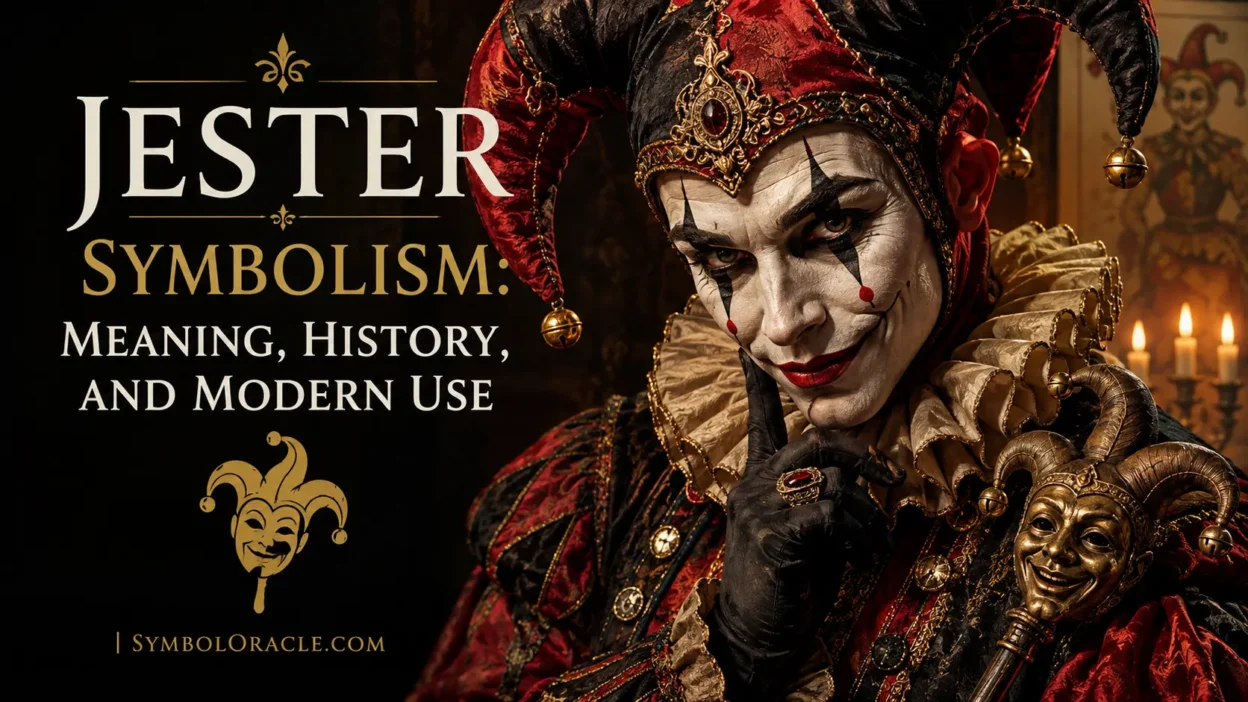
A jester is traditionally shown as a comic entertainer associated with a royal or noble court. The most recognizable image includes a multicolored costume, pointed hood, bells, exaggerated shoes, and a small staff known as a marotte, sometimes carved with a miniature head resembling the performer himself.
Actual entertainers didn’t all wear one standardized uniform. Much of the familiar appearance was shaped by medieval and Renaissance artwork, stage costumes, festival traditions, and later popular culture. Still, the deliberately unusual clothing made the figure visually separate from nobles, servants, soldiers, and religious officials.
That separation is essential to the symbolism. The jester belongs inside the social order but doesn’t visually conform to it. He’s present at court, yet his clothing marks him as someone operating under different rules. This insider-outsider position helps explain why the figure can symbolize independence, observation, and criticism.
Modern versions vary considerably. A cheerful jester may appear on a parade float or playing card, while a dark jester may wear black-and-red clothing, a distorted mask, or an unnatural smile — shifting the meaning from public amusement toward danger, deception, or psychological instability.
The Core Meanings of the Jester
The jester carries several related meanings rather than one fixed definition.
Humor is the most obvious. The figure represents entertainment, jokes, music, physical comedy, and relief from seriousness. In a positive context, the jester reminds people that laughter can reduce tension and make difficult circumstances easier to face.
Truth-telling comes from the idea that a comic performer can say what formal advisers cannot. Humor softens criticism, letting an uncomfortable observation reach its target without sounding like an open challenge.
Rebellion appears because the jester breaks rules of speech, clothing, posture, and etiquette. He may mock respected customs or imitate people of higher status. This doesn’t always mean political revolution — more often, it represents temporary freedom from social expectations.
Wisdom hidden inside foolishness is another central meaning. The jester may pretend not to understand while recognizing the real problem, his exaggerated foolishness exposing the more serious foolishness of proud rulers, dishonest officials, or self-important members of society.
Unpredictability develops from his refusal to behave conventionally. People don’t know whether he’ll tell a joke, reveal a secret, insult someone, or reverse the meaning of a conversation.
In darker contexts, these same traits can curdle into dishonesty, humiliation, cruelty, and chaos. The cleverness that exposes corruption can just as easily manipulate other people.
Why the Jester Represents Truth Through Humor
Direct criticism can make a powerful person defensive. A joke approaches the same subject indirectly, giving both speaker and listener room to retreat — the performer can claim an offensive statement was merely entertainment, while the audience still understands its serious point.
This creates what might be called comic permission. The jester appears harmless because he occupies a low-status role, yet that role lets him observe people who believe themselves superior. He can exaggerate their habits, repeat their contradictions, or turn their own words against them.
That said, the popular claim that every court jester could criticize a ruler without consequences is too simple. Freedom depended on the performer, patron, court, and political circumstances — humor offered some protection, but never unlimited immunity.
The symbolic idea remains influential because it describes a recognizable social function. Comedians, political cartoonists, satirical television hosts, parody accounts, and comic performers often play a similar role, entertaining an audience while identifying arrogance, dishonesty, or absurdity in public life. In American culture, the “modern court jester” comparison has been applied to entertainers who joked about presidents and political leaders while remaining close enough to power to address them directly.
The Historical Role of Court Fools
Professional fools became especially visible in the courts and public entertainment traditions of late medieval and early modern Europe. Their work could include storytelling, singing, wordplay, mimicry, juggling, dancing, music, physical comedy, and conversation.
Not every fool performed the same function. Some were trained entertainers valued for verbal skill or theatrical ability. Historical records also distinguish such performers from people described in period language as “natural fools,” a category that could include individuals with intellectual or developmental disabilities.
That history requires careful treatment. Some disabled people gained unusual access, support, or social recognition in royal households, but they could also be treated as curiosities and judged according to demeaning assumptions. Romantic portrayals shouldn’t erase the unequal conditions surrounding their employment.
Within the court, a fool might be dependent on a ruler while also enjoying unusual familiarity with him. That made the position both privileged and vulnerable — the entertainer could cross certain boundaries, but continued protection often depended on remaining useful, amusing, or personally favored.
Symbolically, that uncertain position produces several meanings:
| Historical Position | Symbolic Meaning | Modern Interpretation |
|---|---|---|
| Entertainer near the ruler | Access to power | Insider knowledge |
| Socially low-ranking figure | Freedom from formality | Nonconformity |
| Comic critic | Truth disguised as humor | Political satire |
| Dependent court servant | Vulnerability | Risk behind rebellion |
| Observer of elite behavior | Awareness of hypocrisy | Social intelligence |
The jester represents more than entertainment, then. He stands at the boundary between acceptance and exclusion, obedience and criticism, safety and danger.
What the Costume Elements Symbolize
The jester’s clothing communicates his identity before he speaks.
Motley Clothing
“Motley” refers to a mixture of colors or contrasting pieces. Symbolically, this fragmented appearance suggests complexity, contradiction, and refusal to fit a single category. A person represented through motley may be cheerful and sad, loyal and rebellious, wise and absurd all at once. In modern art, divided colors can also suggest a split identity or competing emotional states.
Cap and Bells
The pointed hood with bells makes silence difficult — every movement announces the performer’s presence. Bells may therefore represent attention, disruption, celebration, or warning. The traditional hood’s shape has also been read as a comic imitation of formal headwear: a crown without granting real royal authority.
The Marotte
A marotte is a short staff or mock scepter, sometimes topped with a miniature fool’s head, parodying the ruler’s ceremonial staff. The jester carries a symbol of authority, but that authority is comic rather than official. When the carved head resembles its owner, the staff can also represent self-mockery — the performer becomes both the speaker and the subject of the joke.
Masks and Painted Faces
Historical jesters weren’t defined by the modern painted face associated with circus clowns, but masks and theatrical makeup now appear frequently in jester artwork. A mask changes the symbolism by introducing concealed motives, emotional protection, or deliberate performance — the viewer can’t easily tell whether the smile is genuine.
The Wise Fool in Literature and Drama
Literature strengthened the image of the jester as a person whose apparent foolishness conceals insight. Shakespearean fools are particularly important to modern English-speaking interpretations.
Characters such as Touchstone in As You Like It, Feste in Twelfth Night, and the Fool in King Lear use jokes, songs, riddles, and wordplay to comment on other characters. They aren’t interchangeable, but each demonstrates how comedy can reveal information that serious conversation avoids.
The Fool in King Lear is especially connected with truth spoken to authority. While powerful characters flatter or betray the king, the Fool criticizes his decisions and recognizes the consequences of his pride — a character who appears socially insignificant, yet often understands the situation more clearly than the ruler himself.
This literary pattern created the familiar “wise fool” paradox: intelligence isn’t always accompanied by status, formal education, dignity, or respectable appearance, and high office doesn’t guarantee sound judgment.
The sadder side of the archetype also developed through drama. A performer may make everyone laugh while remaining lonely, frightened, or powerless — a tension modern audiences still recognize in stories about comedians who conceal distress behind an entertaining public identity.
From Court Fool to Joker, Clown, and Carnival Figure
The historical court position gradually disappeared as European political and entertainment systems changed. The visual character survived by moving into theater, prints, festivals, playing cards, fiction, and costume traditions.
The jester overlaps with the clown, Joker card, Harlequin, Pierrot, trickster, and tarot Fool, but these figures aren’t identical. A clown usually emphasizes physical comedy, exaggerated behavior, or circus performance. A Harlequin comes from Italian theatrical tradition and is often associated with agility, romance, cleverness, and a diamond-pattern costume. Pierrot is generally quieter and more melancholy.
The Joker playing card adds the ideas of variable value and disrupted rules. Depending on the game, it may be unusually valuable, worthless, or able to substitute for another card — a flexible function that encourages associations with chance, wildness, and uncertain identity.
The Fool in tarot developed within a different card tradition entirely. Early tarot decks included the Fool among a larger sequence of illustrated cards, and its modern interpretations shouldn’t automatically be transferred to every jester image.
Modern entertainment often blends all these figures together, so a contemporary jester may combine court satire, clown makeup, wild-card imagery, carnival colors, and the threatening smile of a fictional villain.
What the Jester Commonly Means in the United States
Most Americans don’t associate jesters with an active royal court. Instead, the image usually arrives through entertainment and commercial culture.
In comedy and political discussion, the figure suggests a person who exposes hypocrisy by refusing to behave respectfully. Editorial cartoons may use a fool’s cap to portray a public figure as incompetent, ridiculous, or dangerously unserious.
In fantasy stories, the jester may be a clever adviser, spy, assassin, magical trickster, or unpredictable companion — his low-status appearance lets other characters underestimate him.
Playing-card imagery connects the jester with gambling, risk, flexible rules, and unexpected outcomes. Meanwhile, comic-book villains and horror entertainment have added menace to the smiling fool, whose grin may signal that the character treats danger as a game.
The symbol can also criticize leadership. Showing a ruler in a fool’s cap suggests that authority has become absurd; showing the jester on the throne creates a stronger warning — that entertainment, spectacle, or irresponsibility has replaced competent government.
These meanings reveal an American concern with authenticity. The jester raises a recurring question: who is actually foolish — the performer who admits he’s playing a role, or the serious person who can’t recognize his own mistakes?
Mardi Gras, Festivals, and Temporary Freedom
The jester fits naturally into Carnival and Mardi Gras because these celebrations temporarily loosen ordinary social rules. Costumes conceal everyday identity, exaggerated behavior becomes acceptable, and public streets become theatrical spaces.
In New Orleans and other Gulf Coast traditions, jester figures appear in parade imagery, costumes, masks, decorations, and float designs. Their bright colors and bells support the festive meaning of movement, noise, spectacle, and playful disorder.
The image can also communicate a traditional Carnival reversal. A servant may dress as a king, an ordinary person may become a masked performer, and respected institutions may be humorously mocked. Such reversals don’t permanently remove social hierarchy, but they create a controlled period in which hierarchy can be questioned.
Mobile, Alabama, preserves a particularly striking example in Mardi Gras imagery involving Folly and Death. This pairing turns the festive fool into a reminder that pleasure, pride, and life itself are temporary.
For that reason, festival jesters can represent both celebration and mortality at once. The music continues, but the character’s exaggerated smile may carry an awareness that the celebration will end.
Jester Tattoos, Fashion, and Personal Identity
A jester tattoo often communicates independence from social expectations. The wearer may identify with someone who refuses to act respectable merely to gain approval.
For some people, the design means I laugh at adversity. The jester survives difficult circumstances through humor, adaptability, and mental quickness. Instead of denying hardship, the symbol turns it into material for self-expression.
Other tattoos emphasize duality. A divided face, half-smile, broken mask, or contrasting colors may represent the gap between a public personality and private emotions.
A darker design can express distrust, revenge, calculated deception, or attraction to chaos. Knives, skulls, blood, playing cards, or threatening facial expressions usually move the interpretation away from harmless comedy.
Common design variations include a smiling jester for humor and social confidence, a crying jester for pain hidden behind performance, a masked jester for secrecy or emotional protection, a skull jester for mortality and reckless living, a card-themed jester for chance and unpredictability, and a crowned jester for mocked or corrupted authority.
In fashion and jewelry, the figure may be chosen less for a personal philosophy and more for its visual character. Pointed shapes, diamonds, bells, masks, and contrasting colors create a theatrical style associated with alternative fashion, gaming culture, festivals, and fantasy art.
Emotional and Psychological Interpretation
Psychologically, the jester can represent the use of humor as both connection and defense.
Humor helps people build relationships, reduce anxiety, and discuss painful subjects. Someone who identifies with the jester may value the ability to improve a tense atmosphere or help others confront difficulty without becoming overwhelmed.
However, constant joking can also prevent emotional honesty. The performer may feel responsible for everyone else’s comfort and become uncomfortable when attention turns toward his own needs.
This creates the “sad clown” interpretation: a person who is entertaining in public but isolated in private. In jester imagery, the contrast may appear through tears beneath a painted smile, a cracked mask, faded bells, or an empty audience.
The figure can also symbolize sharp social perception. Successful humor requires attention to timing, status, language, and unspoken tension — a jester may appear irrational while carefully reading everyone in the room.
The negative psychological interpretation involves manipulation. A person may use humor to dismiss criticism, humiliate others, conceal hostility, or avoid responsibility. Under this reading, the fool’s performance isn’t liberating — it’s a strategy that makes harmful behavior difficult to confront.
Cross-Cultural Parallels and Important Differences
Comic truth-tellers, tricksters, satirical performers, and socially permitted fools have appeared in many societies. However, they shouldn’t all be labeled “jesters” as though they belonged to one universal institution.
Chinese theatrical traditions, for example, include comic roles that may use humor, physical performance, and social observation. Comparisons with European fools can reveal similar dramatic functions, but the costumes, performance conventions, and cultural histories remain distinct.
Trickster figures in mythology may also challenge rules, expose pride, or create disorder. Yet a mythological trickster isn’t necessarily a professional entertainer, and a sacred or ancestral figure shouldn’t be reduced to a European court stereotype.
In many traditions, ritual comedy allows a community to approach fear, death, conflict, or authority indirectly. The broad connection is therefore not a shared costume but a shared method — using reversal, absurdity, imitation, or laughter to reveal what ordinary speech leaves hidden. Respectful interpretation starts by identifying the actual tradition represented, rather than assuming every comic figure with a mask or unusual clothing carries the same meaning.
Common Misunderstandings and Misuse
One common mistake is assuming a jester always represents stupidity. Historically and artistically, the figure often exposes stupidity in others — his foolishness may be a professional act rather than an accurate measure of intelligence.
Another mistake is treating “jester,” “clown,” “Harlequin,” “Joker,” and “tarot Fool” as interchangeable labels. They overlap visually, especially in modern design, but each comes from a different historical or artistic context.
The claim that jesters could say absolutely anything to a ruler is also exaggerated. Some enjoyed unusual access and freedom, but their safety was never guaranteed — their position depended on personal relationships and changing court conditions.
Modern political insults can further flatten the symbol. Calling someone a jester may criticize incompetence, but the historical archetype wasn’t simply useless — a talented fool could be an observant performer, trusted companion, skilled musician, or effective commentator.
Dark entertainment has introduced another distortion by making every smiling jester automatically sinister. Threatening versions are now familiar, but fear was never the figure’s original or only purpose.
Finally, depictions of historical fools should avoid turning disability into a visual joke. Some court entertainers had disabilities, and their stories involve complicated questions of employment, protection, exploitation, dignity, and social status. Treating them only as strange objects repeats the attitudes that made their historical position vulnerable.
Frequently Asked Questions
Is a jester a positive or negative symbol?
Both, depending on which half of the archetype the design leans into. It reads positive when it represents humor, adaptability, honest criticism, and freedom from convention — the fool who survives by refusing to take the room too seriously. It turns negative when the design emphasizes manipulation, humiliation, recklessness, or destructive chaos — the same cleverness aimed at people instead of at power.
What does a jester tattoo symbolize?
Most commonly, rebellion, humor during hardship, unpredictability, or a divided public and private self — someone who performs ease while carrying something heavier underneath. The specific details do the real work: a smile reads as confidence, tears as concealed pain, a skull as mortality worn openly, a crown as authority mocked rather than obeyed.
Does a jester symbolize intelligence?
Yes, and often more pointedly than symbols that look intelligent on the surface. The wise-fool tradition exists precisely because looking ridiculous and being sharp aren’t opposites — the jester’s whole function depends on people underestimating him long enough for the joke to land.
What does a crying jester mean?
Sadness kept just out of view of the audience. It’s the “sad clown” idea made literal: someone whose job, personality, or self-protection depends on performing lightness, with the tears marking what the performance is covering rather than replacing.
Is the jester a religious symbol?
Not a single established one. Depending on the tradition and artist, religious art and writing have used the fool to represent moral blindness, pride, disbelief, humility, or the reversal of conventional wisdom — the figure borrowed for whatever lesson about appearance versus truth a given work needed to make.
What is the difference between a jester and the Joker?
A jester was a real historical role: a performer employed by courts or public entertainment, operating under real social constraints. The Joker is a playing-card figure and modern fictional archetype that borrows the jester’s look while dropping the constraints, adding stronger associations with wild-card behavior, risk, crime, or chaos. One earned his freedom inside a system; the other exists outside any system at all.
Conclusion
Every other court role in history depended on being taken seriously. The jester’s entire authority came from the opposite move — being dismissed just enough to say what no one else could. That’s the trick worth remembering: the bells and the motley weren’t a costume hiding the point, they were the mechanism that made the point possible. Remove the foolishness, and the truth becomes a threat. Keep it, and the truth becomes a joke someone can choose to laugh off — or actually hear.
That mechanism hasn’t gone anywhere. It survives every time a comedian says the sentence a news anchor can’t, every time a cartoon does the work an editorial can’t, every time someone uses “just joking” as cover for something they meant entirely. The jester’s modern descendants prove the archetype was never really about costumes or courts — it was about the specific power of a person willing to look ridiculous in order to be believed.
What makes the symbol worth keeping, rather than just entertaining, is its refusal to resolve. It won’t tell you whether the smile is real or armor, whether the joke is generous or cruel, whether the fool on the throne is a warning or a wish. It hands you the contradiction and asks you to sit with it — which is, in the end, exactly what a good jester has always done.