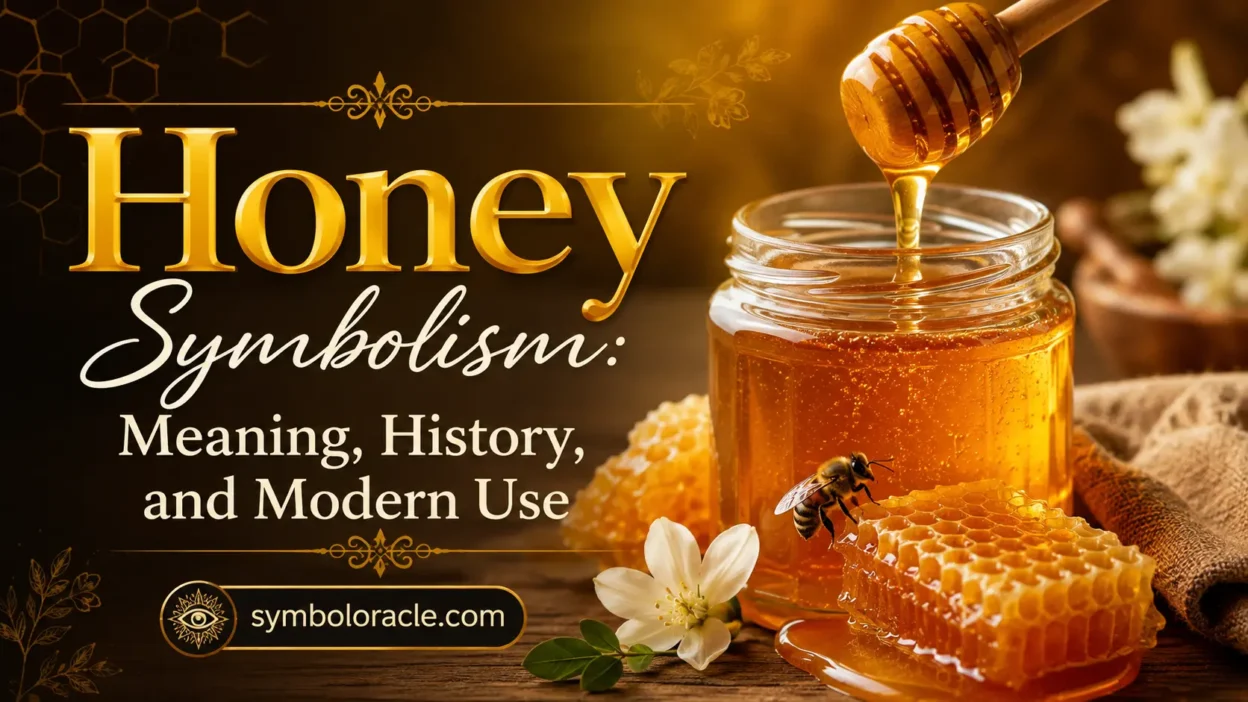
Honey is more than a sweet food. Honey symbolism grows out of its golden color, concentrated sweetness, long shelf life, and connection to bees, flowers, and collective labor — qualities that have made it a natural image of affection, prosperity, wisdom, healing, and reward.
People have harvested honey for thousands of years, long before refined sugar became widely available. Because obtaining it once meant finding wild colonies or carefully managing hives, honey carried a real sense of rarity and value, and ancient societies used it as food, medicine, offering, and an ingredient in fermented drinks. In modern American culture, it shows up in holiday meals, wedding favors, natural-product packaging, tattoos, and affectionate terms like “honey” or “hon.” Its meaning shifts with the setting, but the central idea stays recognizable: something desirable, nourishing, and pleasantly sweet.
Quick Answer
Honey symbolism commonly represents sweetness, abundance, love, healing, and the rewards of patient work in modern American culture. Historically, it has also signified divine blessing, wisdom, prosperity, preservation, and the need to enjoy pleasure in moderation.
At a glance:
- Honey represents sweetness, abundance, affection, and earned reward
- Ancient cultures valued it as food, medicine, offering, and luxury
- Americans associate it with comfort, romance, wellness, and natural living
- Religious traditions connect honey with blessing, wisdom, healing, and moderation
- Negative meanings include excess, temptation, flattery, and attractive deception
Why Honey Naturally Became a Symbol
Symbols usually develop from qualities people can actually observe, and honey offers plenty: it’s sweet, fragrant, golden, nourishing, slow-moving, and difficult to produce, coming from nectar gathered across countless flowers and transformed through a colony’s coordinated work. Those physical qualities feed several symbolic threads at once — sweetness suggests pleasure and kindness, golden color suggests wealth and harvest, bee labor suggests patience and cooperation, long storage life suggests preservation, stickiness suggests attachment or entanglement, and floral origins tie honey to fertility and seasonal abundance.
That range lets honey carry several meanings simultaneously. A jar presented at a wedding can represent a sweet marriage, while honeycomb imagery in a business logo might emphasize industriousness and shared success instead. Honey also varies naturally in color, aroma, and flavor depending on its floral origin — a diversity that lets it symbolize how many separate contributions can become one unified result.
Core Meanings at a Glance
| Context | Common Meaning in the United States | Related Associations | Important Note |
|---|---|---|---|
| Relationships | Love and tenderness | Affection, intimacy, marriage | “Honey” is also a term of endearment |
| Work and achievement | Earned reward | Patience, cooperation, productivity | The sweetness follows sustained labor |
| Religion | Blessing and spiritual nourishment | Wisdom, abundance, healing | Meaning differs among traditions |
| Home and lifestyle | Warmth and natural comfort | Hospitality, harvest, wellness | Often paired with bees and wildflowers |
| Warning or temptation | Pleasure that may become excessive | Flattery, bait, indulgence | Sweetness is not always presented positively |
Sweetness, Pleasure, and a Good Life
The most immediate meaning of honey is simply sweetness. People naturally reach for taste as a metaphor for experience — a “sweet” moment is pleasant, a “sweet” person is kind, a “sweet life” is comfortable or fortunate — and honey strengthens that metaphor because its sweetness is concentrated and lasting rather than fleeting. Unlike a briefly sweet piece of fruit, honey can be stored, shared, or presented as a gift; it represents pleasure that can be saved and passed along to someone else.
That’s why honey turns up so often in messages about enjoying life’s rewards, creating a warm home, speaking gently, celebrating success, or wishing someone happiness. The meaning is generally positive, but it isn’t necessarily extravagant — honey can just as easily symbolize a modest pleasure, like a comforting drink or a family recipe, as luxury in the modern financial sense.
Abundance, Prosperity, and Good Fortune
Honey became associated with prosperity partly because it signaled a productive landscape — a place capable of supporting flowers, healthy colonies, and a surplus of honey appeared fertile and well supplied. Its golden appearance reinforces that meaning: in art and ceremonial decoration, amber honey can resemble liquid gold, suggesting value without the hardness of metal. Honey represents wealth that nourishes rather than wealth that’s merely displayed.
Its prosperity symbolism also comes from multiplication — a small amount of nectar gathered from countless blossoms becomes a substantial stored resource, so honey can represent accumulated blessings or the rewards of many small efforts rather than sudden luck. In contemporary American celebrations, small jars of honey are often given as wedding, baby-shower, or housewarming favors, quietly wishing the recipient sweetness, a plentiful home, and a favorable future.
Work, Cooperation, and Earned Reward
Honey can’t really be separated symbolically from the bees that make it. Bee and honey imagery aren’t identical, but they operate together: bees contribute ideas of community and organized labor, while honey represents the beneficial outcome — a simple sequence where flowers provide possibility, bees perform the work, and honey becomes the reward.
That pattern makes honey a natural fit for representing a completed project, a successful business, or the result of patient craftsmanship, suggesting that worthwhile outcomes usually develop through repeated effort rather than sudden luck. Honeycomb designs reinforce the idea further — their repeating cells communicate order and interdependence, and the honey stored inside adds the sense that well-structured work creates something valuable for the whole group. Still, this symbolism shouldn’t be stretched into romanticizing constant productivity; bees store honey for the colony’s survival, not as an endorsement of overwork, and a balanced reading treats honey as purposeful effort followed by nourishment and rest.
Preservation, Healing, and Renewal
Honey’s resistance to ordinary spoilage has fed its association with preservation. Its low moisture and acidity help it stay stable when properly sealed, though it can still deteriorate if contaminated or exposed to moisture, and symbolically that durability suggests love that survives hardship, knowledge preserved across generations, or hope maintained through difficult periods.
Honey has also long been tied to healing in religious texts and historical medicine — a medieval manuscript illustration, for instance, shows medicine being prepared with honey, reflecting its established place in earlier remedies. Modern symbolic use often stretches that healing association beyond the physical body toward emotional restoration or the return of warmth after grief, though it’s worth keeping these readings symbolic rather than treating them as a promise that honey cures every illness.
Honey in Ancient Egypt and Early History
Human relationships with honey reach far into prehistory. Archaeological evidence and early art show people gathering honey long before managed hives existed, and the effort and danger involved would have raised its perceived value considerably. Ancient Egyptian art offers particularly clear evidence of organized honey production — a scene from the tomb of Rekhmire, dating to Egypt’s 18th Dynasty, depicts honey gathering and processing, with bees raised on estates and honey occupying a real place in food production, ritual life, and elite culture.
Honey placed in tombs has often been read as nourishment or sweetness meant for the afterlife, its long usability making it especially fitting for funerary settings where preservation carried both practical and religious weight. The broader lesson isn’t that every Egyptian understood honey identically — rather, its expense, durability, and ceremonial use let it communicate status, provision, and continuity beyond death.
Honey in Jewish and Christian Traditions
In Jewish scripture, honey frequently appears in images of abundance — the description of a land “flowing with milk and honey” presents a place of agricultural richness and security, though in some biblical contexts the word translated as honey may actually mean concentrated fruit syrup (particularly date syrup) rather than bee honey specifically. Honey also serves as a metaphor for desirable wisdom, with biblical poetry comparing sacred teaching to honey to emphasize that wisdom is satisfying as well as morally valuable.
At Rosh Hashanah, apples dipped in honey express the hope for a sweet new year — one of honey’s most recognizable living ceremonial meanings for many Jewish Americans, tying sweetness to blessing, renewal, and hopeful beginnings. Christian interpretations inherit many of the same biblical associations, with honey representing God’s provision or spiritual nourishment; the story of Samson finding honey in a lion’s remains adds a striking image of sweetness emerging from danger, though it belongs to a larger, morally complicated narrative rather than a simple promise that hardship always yields reward. Biblical literature also gives honey a cautionary edge — Proverbs advises eating only what is sufficient, turning honey into an image of pleasure that turns unpleasant without restraint.
Honey in Islamic Tradition
Honey carries a prominent positive association in Islam. The Quran’s chapter commonly called “The Bee” describes a liquid of varying colors produced by bees and states that it contains healing for people, presenting the bee and its product as signs inviting reflection on order and provision. Within Islamic cultural interpretation, honey can therefore signify blessing, beneficial provision, and the relationship between humble creatures and outcomes that benefit a wider community.
That reference to healing deserves respectful handling — for believers it carries real religious and devotional meaning, and it shouldn’t be reduced to a marketing slogan or stretched into an unsupported claim that any honey treats any medical condition. Honey’s varying colors add a further symbolic layer, too: different flowers and environments produce different honeys through the same general process, which can support themes of diversity within order and varied gifts emerging from different surroundings.
Honey in Maya Culture and the Americas
Long before European colonization, Maya communities practiced sophisticated beekeeping with native stingless bees, using honey in food, ritual, and medicine — traditions that remain culturally important in parts of the Yucatán Peninsula today. In this context honey represented more than sweetness; it linked human communities with flowering plants, seasonal cycles, and sacred responsibilities toward useful animals.
This history matters because broader discussions sometimes present honey traditions as though they belonged only to Egypt, Europe, or the biblical world. The Americas hold their own long-standing, distinct honey cultures that shouldn’t be treated as borrowed versions of European beekeeping — and modern commercial honeybee imagery shouldn’t be projected backward onto every Indigenous tradition, since species, ceremonies, and local meanings differ considerably from community to community.
What Honey Commonly Means in the United States
In the U.S., honey occupies several overlapping cultural spaces at once — an everyday sweetener, a local agricultural product, a traditional home remedy, and a visual sign of natural living, with consumption rising over recent decades and keeping honey visible across supermarkets, farmers’ markets, and wellness-oriented branding. Its most familiar American associations include:
- Comfort — tea, toast, baking, family recipes
- Local identity — regional wildflower, clover, orange blossom, or tupelo varieties
- Natural living — handmade goods, farm stands, botanical packaging
- Affection — calling a loved one “honey”
- Prosperity — golden color, full jars, productive hives
- Environmental awareness — concern for bees, pollination, and habitat
The National Honey Board’s federally supervised promotion and consumer-education role also reflects honey’s established position in American food culture. For most Americans, honey doesn’t carry an explicitly religious meaning unless it appears in a religious setting — a jar in the kitchen usually just communicates warmth, while the same jar at a Rosh Hashanah meal carries a specific ceremonial wish.
Love, Marriage, and Affection
“Honey” is widely used in American English as a term of affection, spoken between romantic partners, family members, or close friends depending on regional and personal habits. The emotional logic is direct — the loved person is compared to something pleasant and sweet — though tone determines everything: a sincere “thank you, honey” communicates tenderness, while the same phrase in an argument can sound dismissive.
Marriage symbolism shows up in the word “honeymoon” too. Its early English sense connected honey with the sweetness of a new marriage, while “moon” referred to a month or changing period — the popular story that the term necessarily came from newlyweds drinking mead for a full lunar month isn’t required to explain how the English word developed. At weddings, honey can express a wish that married life stay generous and affectionate, appearing in favors, desserts, or honeycomb decorations — it works best when it complements the couple’s own story rather than serving as a generic promise that marriage will always be effortless.
Tattoos, Jewelry, Decor, and Personal Style
Honey imagery rarely appears alone in tattoos — it’s commonly paired with bees, honeycomb cells, flowers, jars, or dripping golden liquid, and each added element shifts the emphasis. A honey tattoo can represent enjoying the rewards of hard work, maintaining sweetness despite hardship, romantic affection, healing after a difficult period, or a connection to beekeeping and nature. A broken honeycomb can suggest disrupted community, while a full comb represents security and provision; honey dripping from a flower emphasizes beauty and attraction, and a jar can communicate preservation or something precious being protected.
In jewelry, gold and amber materials naturally reinforce honey’s warm color — honeycomb pendants often communicate order and connection, while bee-and-honey designs may honor motherhood, teamwork, or environmental concern. In home decor, honey tones create warmth: amber glass, wooden honey dippers, and hive patterns fit farmhouse and nature-centered interiors, where honey usually represents hospitality and comfortable abundance rather than wealth or religious devotion.
Emotional and Psychological Meaning
Honey often communicates emotional safety. Its association with familiar food, warm drinks, and caregiving can evoke comfort and reassurance, and it can represent a personality style too — “sweet as honey” suggests kindness or charm, while a “honeyed” voice sounds smooth and pleasing, though it may also imply the speaker is trying too hard to persuade.
Because honey results from gathering and transformation, it can symbolize emotional integration — many separate experiences, pleasant and painful alike, processed into wisdom or creative work. That’s more an interpretation than a fixed traditional doctrine, but it explains why honey shows up so often in art about recovery and personal growth. Its stickiness adds a more complicated layer, too: honey can suggest strong bonds and intimacy, but also difficulty letting go, and in relationship imagery the line between attachment and entrapment depends on whether the sweetness feels freely shared or strategically used.
Excess, Temptation, Flattery, and Deception
Honey is usually positive, but its symbolism has never been entirely innocent — anything intensely pleasurable tends to invite a warning about excess. The biblical advice to eat only enough honey uses physical overindulgence as a broader lesson in self-control; the problem isn’t sweetness itself, but the inability to recognize a healthy limit.
Honey can also represent temptation. Its smell, color, and taste attract attention, so it works naturally as an image of bait — something that looks beneficial while hiding risk or manipulation. Modern language preserves that double meaning directly: a “honeypot” can refer to an attractive person, place, or opportunity, where the sweetness draws people closer but the surrounding context decides whether the attraction is genuinely rewarding or deliberately deceptive. “Honeyed words” can mean gracious speech, but they can also suggest flattery designed to lower someone’s guard — a reminder that charm becomes suspicious once appearance and intention stop matching.
How the Meaning Has Evolved
Honey’s earliest importance was practical: concentrated sweetness that could be stored, traded, used in medicine, and offered in ritual or funerary settings. As refined sugar became widely available, honey lost its exclusive position as a sweetener, and its symbolic identity shifted accordingly — in the modern U.S., people increasingly frame it as traditional, local, artisanal, or more “natural” than heavily processed alternatives.
Language has personalized the symbol further, too. Honey moved from being primarily a valued substance to becoming a name for a beloved person, a pleasant voice, or an especially good example of something. Digital culture has expanded the visual vocabulary even more, with bees, hexagonal patterns, and amber palettes circulating widely in personal branding and environmental campaigns. Despite all these shifts, the central symbolism stays remarkably stable — honey represents something desirable created through relationship, where flowers, bees, landscape, and human care all contribute to the final result.
Common Misunderstandings About Honey as a Symbol
One common misunderstanding is that honey always represents money — its gold color suggests prosperity, but its older meanings tie more closely to nourishment and fertile land than to wealth itself. Another mistake is treating honey and bee symbolism as interchangeable: bees emphasize labor and community, while honey emphasizes the reward or nourishment that results from that activity. Honey also isn’t universally about romantic love — it can just as easily express family affection, hospitality, religious blessing, or moderation.
Historical claims deserve particular care, too. Not every ancient reference translated as “honey” necessarily means bee honey, and not every culture used it in the same rituals — similar symbolic ideas can develop independently simply because people notice the same physical qualities, which doesn’t prove direct cultural borrowing. And finally, “natural” imagery on packaging shouldn’t be mistaken for scientific proof; a honey label can visually suggest purity or wellness without that symbolic design verifying any specific claim about the product.
Frequently Asked Questions
What does honey symbolize spiritually? Honey commonly symbolizes blessing, nourishment, wisdom, healing, and beneficial provision. Its spiritual meaning depends on the tradition — Jewish and Christian texts often connect it with abundance and desirable wisdom, while the Quran presents it as a sign of creation containing healing.
Is honey a symbol of love? Yes. Honey can represent affection, tenderness, and the wish for a sweet relationship, a meaning strengthened by its use as an English term of endearment.
What does honey symbolize in the Bible? Biblical honey can represent fertile abundance, divine provision, and the sweetness of wisdom or sacred teaching. It can also warn against excess, showing that even a good pleasure becomes harmful without restraint.
What does honey mean in a tattoo? A honey tattoo may represent earned success, sweetness after hardship, family cooperation, healing, or a connection to nature. The surrounding imagery — bees, flowers, jars, or damaged honeycomb — usually reveals the intended emphasis.
Why is honey associated with prosperity? Honey comes from productive flowering landscapes and requires extensive gathering and colony labor. Its golden appearance, stored abundance, and historical value made it a fitting symbol of provision and gradually accumulated wealth.
What does honey represent at Rosh Hashanah? Honey expresses the hope for a good and sweet new year. Eaten with apples, it turns an abstract wish for blessing and renewal into a shared sensory experience.
Can honey have a negative meaning? Yes. Honey can symbolize overindulgence, seductive temptation, insincere flattery, or an attractive lure hiding danger — meanings that grow from the same sweetness and attraction behind its positive associations.
Conclusion
Honey brings together pleasure and effort. It’s sweet, but that sweetness depends on flowers, seasons, bees, organized labor, and time — a combination that explains why honey can represent affection, prosperity, wisdom, healing, and a reward that’s been patiently earned.
Honey symbolism carries a useful warning too. Sweetness deserves appreciation, but pleasure without judgment can become excess, and charm without honesty can become manipulation.
Whether it appears in a religious meal, a wedding favor, a tattoo, or an affectionate nickname, honey communicates the value of what nourishes life. Its most grounded message is that sweetness matters most when it’s created carefully, shared generously, and enjoyed with balance.