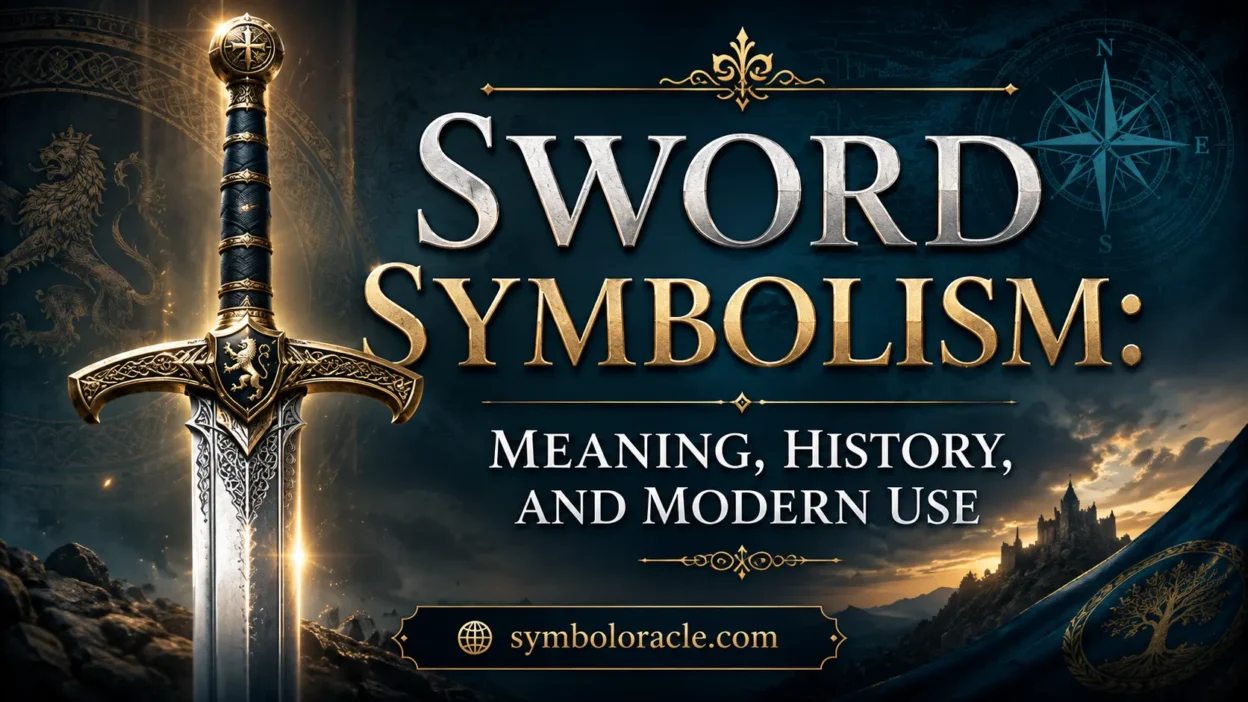
A sword is both a weapon and a carefully constructed visual statement. Its long blade, guarded handle, and sharp point suggest strength, discipline, danger, and decisive action. Sword symbolism matters because the object has represented far more than combat: it has marked rulers, military officers, judges, religious figures, legendary heroes, and people entrusted with protecting others.
In the United States, people encounter swords in court imagery, military ceremonies, tattoos, fantasy stories, video games, jewelry, memorial art, and historical displays. Depending on the setting, the same image can communicate justice, courage, leadership, self-control, conflict, sacrifice, or aggression.
Understanding the context is essential. A raised sword does not convey the same message as a sheathed, broken, crossed, or downward-pointing blade. Religious and cultural traditions also give the object meanings that cannot be reduced to a generic idea of strength.
Quick Answer
Sword symbolism commonly represents courage, justice, authority, and the willingness to defend others in modern American culture. Historically, swords have also signified military rank, noble status, sacred duty, disciplined power, and the authority to judge or rule.
TL;DR
- Swords commonly represent courage, authority, justice, and protection.
- Early blades became signs of rank as well as weapons.
- Americans connect swords with courts, military service, and heroic fiction.
- Religious traditions use swords to represent truth, wisdom, and duty.
- Context determines whether a sword suggests honor, violence, or resistance.
What the Sword Commonly Represents
The sword’s most familiar meanings come from its practical function. It can defend, threaten, divide, punish, or end a confrontation. Symbolically, those actions become courage, protection, judgment, separation, and finality.
A sword may represent honorable strength when held by a protector, but oppressive force when carried by a tyrant. It can symbolize lawful authority in a courtroom, disciplined leadership in a military ceremony, or personal resolve in a tattoo. The bearer’s purpose determines whether the weapon appears noble, dangerous, or morally uncertain.
| Context | Common Meaning in the USA | Typical Associations | Important Note |
|---|---|---|---|
| Courts and law | Justice and enforcement | Judgment, consequences, authority | Often paired with scales |
| Military ceremonies | Leadership and duty | Rank, service, tradition | Usually ceremonial, not functional |
| Tattoos | Courage or protection | Survival, discipline, independence | Meaning varies by design |
| Fantasy stories | Heroism and destiny | Quests, chosen heroes, sacrifice | May also represent corrupted power |
| Memorial art | Loss or completed service | Mourning, honor, remembrance | Position of the blade matters |
| Crossed swords | Conflict or readiness | Battle, rivalry, alliance | Context changes the interpretation |
Why the Sword’s Shape Carries Meaning
A sword is visually direct. The straight blade creates a strong line, the point suggests focus, and the sharpened edges imply the ability to separate one thing from another. This physical design explains why swords frequently symbolize clarity, decision, and uncompromising judgment.
The hilt adds another layer. A sword cannot be used responsibly without control, balance, and training. For that reason, the weapon may suggest disciplined strength rather than uncontrolled anger. The scabbard can be equally meaningful because it represents force being restrained until necessary.
Position also changes the message:
- An upright sword can suggest command, readiness, or justice.
- A raised sword often implies action, defense, or victory.
- A sheathed sword suggests controlled strength or peace maintained through preparedness.
- A broken sword can represent defeat, grief, disarmament, or the end of conflict.
- A downward-pointing sword may communicate mourning, rest, or completed service.
- Two crossed swords commonly suggest confrontation, military identity, or readiness.
These interpretations are conventions rather than universal rules. Surrounding words, figures, colors, and symbols should always be considered.
Ancient Origins and Early Status
The sword developed as metalworking allowed craftspeople to produce blades longer than ordinary knives or daggers. Some of the earliest objects classified as short swords date to the late fourth millennium BCE, although the boundary between a long dagger and an early sword remains debated. More clearly recognizable bronze swords became widespread during the second millennium BCE.
A sword required valuable material, specialist knowledge, and considerable labor. Early examples therefore communicated access to resources as well as fighting ability. Decorated blades and ceremonial weapons could identify a commander, ruler, or member of a warrior elite even when they were not intended for ordinary battlefield use. Archaeological finds show swords placed in graves, preserved as heirlooms, and displayed as markers of authority.
This connection between the blade and social status became one of its most durable meanings. Long after swords stopped being the dominant weapons of war, they remained useful as signs of rank, office, heritage, and public responsibility.
Authority, Rank, and Ceremonial Power
Swords became emblems of authority because they represented the recognized power to command, defend territory, enforce decisions, and punish disobedience. In ancient Near Eastern art, curved swords sometimes appeared in the hands of gods and kings as signs of royal power rather than ordinary combat equipment. Medieval rulers were also shown with sheathed swords indicating political and judicial authority.
A sheathed sword can be especially significant in this context. It communicates that force exists but remains controlled. The ruler, officer, or official possesses power without needing to display immediate violence.
This idea continued in American public imagery. Formal portraits of George Washington used a ceremonial sword to refer to his military experience and position as head of state. The sword identified him as someone who had exercised military power but was now represented within civil government.
Ceremonial swords still appear in military uniforms, leadership transitions, formal salutes, and commemorative events. Their purpose is to communicate continuity, responsibility, and institutional authority rather than preparation for hand-to-hand combat.
Courage, Honor, and the Warrior Ideal
The sword often represents courage because using one historically required close physical engagement. Unlike a distant weapon, it places the fighter near an opponent. In stories and commemorative art, this closeness became associated with bravery, personal risk, and the willingness to face danger directly.
Honor entered the symbolism through warrior codes, military traditions, and later romantic literature. Medieval European swords became connected with knighthood, loyalty, noble service, and ideals of chivalry. These ideals did not always match actual medieval warfare, but they strongly shaped later literature and American popular culture.
Modern audiences often interpret the heroic sword as a test of character. The worthy hero does not merely possess the weapon; the hero must use it responsibly. A sword in this setting represents courage guided by loyalty, restraint, and concern for others.
The opposite is also possible. A dishonorable character may use the same weapon to represent domination, revenge, or abuse of power. This contrast explains why sword-centered stories frequently ask whether strength is controlled by moral judgment.
Justice, Judgment, and Moral Authority
The sword is one of the traditional attributes of Lady Justice, a figure commonly seen in American courthouses and legal imagery. The scales represent the weighing of evidence, while the sword represents the authority to act on a judgment and impose consequences. Its straight form can also suggest decisiveness and the equal application of law.
This legal meaning is not simply “punishment.” The sword represents the enforcement required to make a decision effective. Without authority behind it, justice could remain an abstract ideal rather than a functioning system.
At the same time, the image contains a warning. Judicial power can injure people when used carelessly or unfairly. The sword therefore represents both the necessity and the danger of legal authority. In democratic culture, it works best as a symbol of power restrained by evidence, procedure, impartiality, and accountability.
The blade’s cutting action also supports a metaphorical meaning: separating truth from falsehood, guilt from innocence, or right from wrong.
Religious and Spiritual Meanings
In Christian imagery, the sword can represent spiritual truth, moral conflict, divine judgment, or the active power of sacred teaching. The New Testament describes the “sword of the Spirit” as the word of God, turning a physical weapon into an image of spiritual readiness and truth. This does not make every biblical sword an endorsement of violence; its meaning depends on the passage and theological context.
Another biblical image describes swords being transformed into farming tools. Here the weapon represents warfare being redirected toward peaceful and productive life. The image remains influential in religious art, peace activism, and international public sculpture.
In Buddhist art, the bodhisattva Manjushri carries a sword that cuts through ignorance and delusion. The weapon represents wisdom that separates clear understanding from confusion rather than physical combat.
For initiated Sikhs, the kirpan is an article of faith associated with moral responsibility, compassion, courage, justice, and the duty to protect vulnerable people. Treating it only as a conventional weapon overlooks its religious role and the obligations it represents.
In Islamic history and art, particular swords may carry associations with legitimate leadership, bravery, protection, and religious authority. Zulfiqar, traditionally associated with Ali ibn Abi Talib, became an especially recognizable emblem in parts of the Islamic world. Its meaning should be understood within its specific historical and devotional setting rather than applied to all Muslim communities.
What It Means in the United States
American interpretations draw from European history, biblical language, military tradition, legal imagery, immigration, and popular entertainment. The sword is rarely viewed as an everyday object. Instead, it usually appears as a historical, ceremonial, religious, or fictional emblem.
In courts, it signals justice and enforceable authority. In military settings, it represents rank, leadership, continuity, and service. Marine Corps traditions, for example, retain ceremonial swords as symbols of leadership and use them during formal events that connect present service members with earlier generations.
American political and historical art may use a sheathed sword to show military strength placed under civic control. Revolutionary War surrender scenes can also use the transfer of a sword to represent the transfer of power, the acceptance of defeat, or the formal conclusion of hostilities.
Everyday language extends these meanings. A “double-edged sword” describes something with both benefits and risks. To “cross swords” means to enter a dispute, while “falling on one’s sword” suggests accepting blame or sacrificing one’s position. These expressions preserve the ideas of conflict, consequence, and personal responsibility without referring to literal fighting.
Cross-Cultural Traditions
Sword imagery should not be interpreted as though every culture assigned it the same meaning. Similar objects can represent different social duties, religious ideas, and historical experiences.
In Edo-period Japan, swords functioned as signs of samurai power and authority. Their fittings also became important forms of artistic display and personal expression within a society that regulated status and public appearance. Modern portrayals often reduce the Japanese sword to a vague symbol of “warrior honor,” leaving out its connections to class, government, craftsmanship, and changing military practices.
In Sikh tradition, the kirpan emphasizes an obligation to defend justice and protect others. In Buddhist art, a sword may represent wisdom overcoming ignorance. In some Islamic traditions, a named sword can signify rightful authority, courage, or devotion. African royal and courtly traditions have also used ceremonial swords as emblems of rulership, office, and the authority of particular leaders.
These distinctions matter in tattoos, costumes, branding, and entertainment. Borrowing a culturally specific sword without understanding its context can turn a meaningful religious or historical object into a generic decoration.
Emotional and Psychological Meaning
Psychologically, a sword communicates boundaries. Its edge divides, its point directs attention, and its scabbard controls access to force. People may therefore choose the image when they want to express decisiveness, independence, personal protection, or a refusal to tolerate further harm.
For someone recovering from a difficult experience, the sword may represent regained agency. For another person, it may signal vigilance—the belief that safety requires constant readiness. The same image can therefore express confidence or unresolved fear.
A sheathed blade tends to suggest self-command: “I possess strength, but I choose when to use it.” An exposed blade can feel more confrontational, especially when combined with aggressive wording, blood, flames, or threatening figures.
The emotional message also depends on who carries the sword. In the hands of a guardian, it offers reassurance. In the hands of an executioner or invading force, it creates fear. In the hands of a lone hero, it often signals responsibility and isolation.
Tattoos, Jewelry, Art, and Pop Culture
Sword tattoos commonly represent courage, survival, justice, protection, discipline, or commitment to a personal code. Some people choose them after overcoming hardship, entering military service, accepting a leadership role, or deciding to establish firmer personal boundaries.
Additional elements make the meaning more specific:
- A sword with wings may suggest protection, freedom, or a fallen warrior.
- A sword wrapped in flowers can combine strength with grief, beauty, or renewal.
- A snake around a sword may represent danger, temptation, healing, or transformation.
- A crown above a sword can suggest leadership, victory, or ambition.
- A broken blade may mark loss, surrender, or the decision to end conflict.
- A sword through a heart can represent emotional pain, betrayal, or difficult loyalty.
Jewelry usually presents a quieter version of the same themes. A small sword pendant may communicate confidence, faith, heritage, or determination without the confrontational effect of a large weapon image.
Fantasy novels, superhero stories, anime, films, tabletop games, and video games have made swords symbols of destiny and identity. Named blades often reflect the character of their owners. A bright or inherited sword may represent legitimate leadership, while a corrupted blade can symbolize obsession, temptation, or power gained at an unacceptable cost.
Negative Meanings, Misuse, and Changing Interpretations
A sword can symbolize violence, conquest, intimidation, revenge, or authoritarian control. It should not automatically be described as honorable. Historical swords were used within systems that included warfare, execution, colonization, class privilege, and coercive rule.
Modern designs can also romanticize violence by presenting the weapon without its consequences. Images combining swords with threats, extremist emblems, or dehumanizing language may communicate aggression rather than courage. However, a sword by itself is too widespread to prove a political or ideological affiliation. Interpretation requires the complete design and its context.
Cultural misuse presents another problem. Japanese swords are sometimes treated as interchangeable with all Asian warrior traditions. The Sikh kirpan may be inaccurately described as an ordinary concealed weapon. Religious swords can be removed from their teachings about wisdom, duty, compassion, or justice and reduced to decorations.
The meaning has nevertheless changed as the sword’s practical military role declined. It moved from battlefield equipment to ceremonial object, legal emblem, religious metaphor, collectible artifact, fashion motif, and fictional symbol. Today it usually represents an idea about power rather than power exercised through the blade itself.
Frequently Asked Questions
Is a sword a positive or negative symbol?
It can be either. A sword represents courage, justice, protection, and disciplined leadership in some settings, but it may represent violence, oppression, revenge, or intimidation in others. The bearer, position, and surrounding imagery determine the tone.
What does a sword tattoo symbolize?
A sword tattoo often represents courage, survival, protection, justice, or personal discipline. Flowers, snakes, wings, crowns, hearts, and broken blades can substantially change the message.
What does a sword symbolize in Christianity?
Christian imagery may use the sword for spiritual truth, divine judgment, moral struggle, or the active force of sacred teaching. The “sword of the Spirit” specifically connects it with the word of God rather than physical violence.
Why does Lady Justice carry a sword?
The sword represents the authority to enforce a legal decision and impose consequences. Its straight blade also suggests decisiveness, while the scales beside it represent the careful weighing of evidence.
What does a broken sword mean?
A broken sword can signify defeat, lost authority, grief, disarmament, or the end of a violent period. In personal art, it may also represent refusing to continue a conflict or rebuilding an identity after failure.
What do crossed swords represent?
Crossed swords commonly suggest conflict, battle, military readiness, or rivalry. In insignia and decorative art, they can also represent shared service, an alliance between warriors, or respect between evenly matched opponents.
Conclusion
Sword symbolism centers on directed and accountable power. The blade can defend or injure, establish justice or enforce oppression, and show courage or provoke fear. Its meaning comes from who carries it, why it is displayed, and whether its force appears disciplined or uncontrolled.
In modern American culture, the sword survives as an emblem of justice, service, personal resolve, heroic responsibility, and moral conflict. Its clearest message is not simply strength, but the responsibility that comes with possessing the ability to act.