Starling symbolism commonly centers on communication, cooperation, adaptability, and the complicated relationship between individuality and group identity. These meanings come largely from the bird’s remarkable vocal abilities, its success in human-altered environments, and the coordinated movements of enormous starling flocks.
Starlings are easy to overlook when they forage on lawns, gather around parking lots, or crowd city buildings. Seen closely, however, their dark feathers reflect shades of purple, blue, bronze, and green. In flight, thousands may join a shifting formation known as a murmuration, transforming an ordinary bird into a striking image of collective movement.
For Americans, the starling carries an additional tension. The European starling is admired for its intelligence and shimmering plumage, yet it is also an introduced species associated with agricultural damage and competition with native birds. That contrast gives the bird a more complicated meaning than simple ideas such as freedom or good luck.
Quick Answer
Starling symbolism most commonly represents communication, unity, adaptability, and coordinated action in modern American culture. Historically, the bird has also been connected with messages, imitation, divination, and the consequences of introducing something into a new environment.
TL;DR
- Starlings commonly represent communication, cooperation, and adaptability.
- Murmurations symbolize coordinated movement without centralized control.
- Mimicry connects the bird with voice, learning, and imitation.
- Welsh literature presents a starling as a trusted messenger.
- American interpretations include resilience and ecological controversy.
- Starling imagery can warn against conformity or unchecked expansion.
What a Starling Looks and Sounds Like
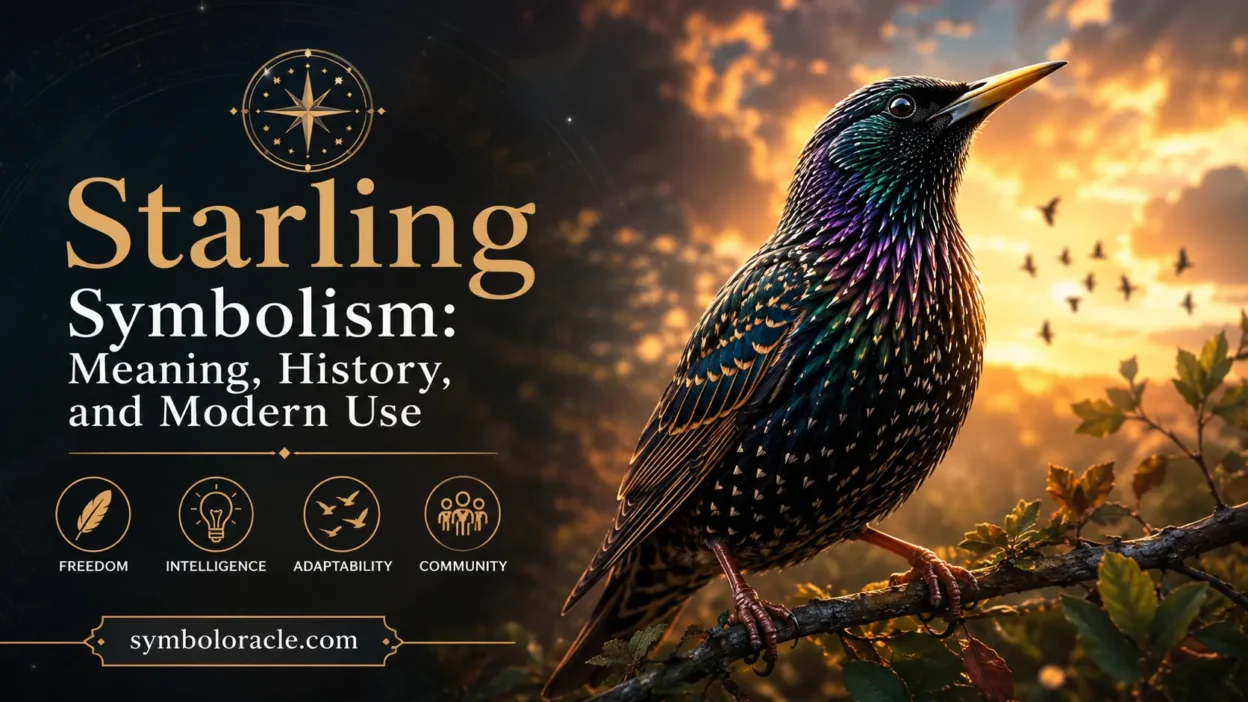
The bird most Americans recognize is the European starling, or Sturnus vulgaris. It is a compact, blackbird-sized bird with a short tail, pointed wings, and a long bill. During parts of the year, its feathers appear dark and speckled; under direct light, the plumage reveals an iridescent mixture of green, violet, blue, and bronze.
This shifting appearance contributes to the starling’s association with hidden complexity. From a distance, it may seem plain or nearly black. A closer look reveals colors that change with the light, making the bird a fitting image for people, situations, or identities that cannot be understood from first impressions.
Starlings are also unusually varied vocalists. Their calls include whistles, clicks, rattles, squeaks, and musical fragments. They can copy other birds and imitate sounds from their surroundings, which is why communication and imitation are among their strongest modern associations.
Core Meanings at a Glance
| Context | Common Meaning in the United States | Basis for the Meaning |
|---|---|---|
| A single starling | Voice, intelligence, adaptability | Vocal mimicry and flexible behavior |
| A pair of starlings | Communication, partnership | Social interaction and shared calling |
| A large flock | Community, belonging, collective strength | Group feeding and communal roosting |
| A murmuration | Coordination, change, responsive leadership | Rapidly synchronized flight |
| An urban starling | Survival, resourcefulness, persistence | Success in human-altered environments |
| An invasive flock | Excess, disruption, unintended consequences | Ecological and agricultural conflict |
These meanings are interpretations rather than a single fixed doctrine. The context matters: a murmuration painted above a conference room may represent teamwork, while the same birds in an environmental illustration may symbolize biological disruption.
Communication, Voice, and the Ability to Be Heard
Communication is one of the clearest meanings attached to the starling. The connection is not based merely on the fact that the bird sings. Starlings listen closely, learn from the sounds around them, and reproduce elements of what they hear.
As a personal symbol, the starling can therefore represent finding one’s voice, delivering a message, or learning how to communicate with different groups. It may suit someone whose work depends on language, music, teaching, public speaking, negotiation, or attentive listening.
The meaning also has a less flattering side. Mimicry can suggest repeating other people’s opinions without understanding them. In that context, a starling may symbolize borrowed language, social performance, gossip, or the pressure to sound like everyone else.
The difference lies in intention. Thoughtful imitation helps people learn, connect, and develop new skills. Empty imitation erases individuality. The starling holds both possibilities.
Unity and Collective Intelligence
Starlings spend much of their lives around other starlings. They feed in groups, gather at communal roosts, and respond quickly to the movements and calls of nearby birds. Their social behavior makes them a natural symbol of community and shared awareness.
This is not unity created by one bird commanding every other bird. Research into starling flocks shows that coordinated patterns emerge through local responses among neighboring birds. Information about a turn can move across the flock rapidly, allowing thousands of individuals to change direction while preserving the group’s overall coherence.
That behavior gives the starling a useful modern meaning: a group can act intelligently without depending on a single dominant leader. Families, neighborhoods, creative communities, and professional teams may all recognize themselves in this image.
At the same time, a healthy flock does not eliminate the individual bird. Each starling remains responsible for responding to its surroundings. Symbolically, this creates a balance between belonging and personal judgment.
What a Murmuration Symbolizes
A murmuration occurs when a large flock of starlings sweeps, turns, contracts, and expands across the sky. The formation may resemble smoke, fabric, waves, or a living cloud. These displays often form around communal roosts and may help the birds respond to predators and share information.
In art and personal symbolism, a murmuration often represents:
- Cooperation without rigid control
- Rapid adaptation to changing conditions
- Safety created through collective awareness
- Order emerging from many small decisions
- The relationship between freedom and responsibility
- A major transition affecting an entire community
A murmuration can also express uncertainty. Its shape never remains fixed for long. For someone experiencing a career change, relocation, shifting family role, or social transition, the flock may represent learning to move with change without becoming lost in it.
The image is especially appropriate for systems in which every participant matters. One bird cannot produce a murmuration, but neither is an individual bird meaningless within it.
Adaptability, Resilience, and Urban Survival
European starlings have adapted successfully to farms, suburbs, city centers, industrial areas, and other human-dominated environments. They eat a varied diet, nest in cavities, and take advantage of structures and food sources created by people.
This flexibility supports symbolic associations with resilience and resourcefulness. A starling does not require an untouched wilderness to survive. It studies the conditions it encounters and uses what is available.
For people, the bird can represent the ability to function in unfamiliar surroundings, rebuild after disruption, or develop practical skills instead of waiting for ideal circumstances. It is particularly relevant to experiences involving immigration, relocation, changing careers, or entering a new social environment.
Resilience should not be confused with endless endurance, however. The starling’s adaptability works because it changes its behavior. Its lesson is not simply to tolerate difficulty but to notice what has changed and respond effectively.
The Emotional Meaning of Belonging
A flock of starlings can evoke comfort because no bird appears entirely alone. This gives the starling emotional associations with companionship, mutual protection, and the human need to belong.
For someone who has felt isolated, the bird may symbolize finding a community that understands a shared language. For someone who has been overwhelmed by group expectations, it may raise a different question: How can a person remain connected without becoming invisible?
That tension makes starling imagery useful for exploring identity. It can represent the relief of joining a group, the anxiety of being judged by that group, or the maturity required to participate without surrendering personal values.
A solitary starling may therefore carry a different emotional message from a flock. Alone, it can suggest an independent voice, observation, or temporary separation. In a group, it emphasizes coordination and social identity.
Ancient Rome and the Interpretation of Bird Movements
In ancient Rome, officials known as augurs observed birds and other natural signs when interpreting whether proposed actions had divine approval. Direction, number, sound, feeding behavior, and patterns of flight could all matter within the formal practice of augury.
Starlings were among the flocking birds associated in later accounts with reading movement in the sky. Their dramatic group formations made them suitable for interpretations concerning agreement, warning, timing, and collective direction.
This does not mean every Roman saw every flock as a supernatural message. Roman augury was a regulated religious and political practice rather than a loose collection of modern “signs from the universe.”
The historical connection nevertheless helps explain why people still treat unusual bird formations as meaningful. Human observers naturally search for patterns, especially when many animals move as if they share one intention.
The Starling as a Messenger in Welsh Literature
One of the most important literary appearances of a starling occurs in the medieval Welsh tale of Branwen, part of the Mabinogi. After Branwen is mistreated in Ireland and prevented from communicating with her family, she trains a starling and sends it across the sea with a message to her brother.
In this story, the bird represents more than communication. It becomes a link between isolation and rescue. Because the starling can be taught and trusted, it also signifies intelligence, loyalty, memory, and the ability of a message to cross political or physical boundaries.
Modern interpretations sometimes expand this episode into broad claims that starlings were universally sacred in Celtic religion. The surviving story supports a clear messenger association, but it does not by itself establish one uniform belief shared by every Celtic-speaking society.
The careful interpretation is more meaningful: in a major Welsh narrative, a starling carries the words of someone whose human channels of communication have been taken away.
Shakespeare, Speech, and the American Introduction Story
A starling appears briefly in Shakespeare’s Henry IV, Part 1. A character proposes teaching the bird to repeat one forbidden name continually. The reference depends on the starling’s well-known capacity for learned speech, connecting it with repetition, protest, provocation, and the refusal to let a message disappear.
The bird later became tied to a famous American origin story. Eugene Schieffelin released European starlings in New York City’s Central Park around 1890, and a population became established after several late-19th-century introductions.
For decades, popular accounts claimed Schieffelin wanted to introduce every bird mentioned by Shakespeare to North America. Recent historical scholarship has challenged that explanation, noting that the Shakespeare motive appears to have been amplified by later retellings rather than firmly documented at the time of the release.
The distinction matters symbolically. The starling is often used as an example of how a compelling story can overshadow a more complicated historical record.
What Starlings Mean in the United States
In the United States, the starling represents both successful adaptation and ecological conflict. European starlings are now widespread across much of North America, although modern estimates indicate that their population has declined substantially from earlier peaks.
Many Americans encounter them in ordinary places: lawns, shopping centers, farms, stadiums, city streets, and utility structures. Their familiarity can symbolize everyday survival rather than remote wilderness.
However, federal wildlife agencies and conservation organizations also describe European starlings as an introduced or invasive species. Large concentrations can damage crops, create sanitation problems, and compete with some native cavity-nesting birds.
This makes the bird symbolically ambivalent. It can represent admirable persistence while also warning that success for one group may create costs for others. Few birds illustrate the difference between individual beauty and population-level impact so clearly.
Positive and Negative Interpretations
The starling’s positive meanings generally arise from its intelligence, social coordination, vocal range, and adaptability.
Positive associations include:
- Effective communication
- Learning through careful observation
- Cooperation and mutual protection
- Social intelligence
- Resilience in changing conditions
- Beauty that becomes visible on closer inspection
- Confidence in one’s voice
Its negative meanings develop from similar traits viewed under different circumstances.
A large, noisy flock can suggest disorder, crowd pressure, gossip, or the loss of individuality. Mimicry can represent insincerity. Rapid population growth can symbolize unchecked expansion, while aggressive competition can signify success achieved at another group’s expense.
The bird is therefore neither entirely positive nor entirely negative. Its meaning depends on whether flexibility becomes exploitation, whether unity becomes conformity, and whether communication becomes mere repetition.
Tattoos and Personal Identity
A starling tattoo often represents voice, community, adaptability, or survival. A person may choose the bird after moving to a new country, leaving a restrictive environment, rebuilding a social life, or learning to speak openly.
A single starling usually emphasizes personal expression, intelligence, or independence. Two birds may represent a communicative partnership. A full murmuration is more likely to symbolize family, social connection, coordinated change, or the idea that individual actions contribute to a larger pattern.
Design choices can alter the message. An iridescent bird highlights complexity and overlooked beauty. A bird carrying a letter recalls the messenger theme. A flock shifting from darkness into open sky may represent transition, release, or recovery.
Because the European starling is ecologically controversial in North America, some tattoos intentionally include that tension. The wearer may identify with being adaptable, misunderstood, displaced, or difficult to categorize.
Jewelry, Decor, Fashion, and Digital Art
Starling imagery appears in pendants, prints, murals, fabric patterns, home decor, and digital illustrations. Murmurations are especially popular because they create flowing designs that work well across large walls, canvases, screens, and textiles.
In a home, a starling flock can communicate movement, sociability, and an active household. In an office, it may represent collaboration or distributed decision-making. In fashion, iridescent colors evoke transformation and visual complexity without requiring a literal bird image.
On social media, murmuration videos are often paired with ideas about teamwork, emergence, trust, or collective change. These comparisons can be useful, but they sometimes oversimplify the birds’ behavior by presenting the flock as perfectly harmonious.
Real starling flocks are responsive systems shaped by risk, spacing, competition, and survival. Their visual beauty does not mean that group life is effortless.
Spiritual Interpretations and Personal Signs
There is no single religious or spiritual meaning accepted by all traditions. Modern readers often interpret an unexpected starling encounter according to the bird’s observable behavior: a calling bird may suggest communication, a flock may suggest community, and a changing formation may suggest flexibility.
Such interpretations are best understood as personal reflection rather than prediction. Seeing a starling does not reliably announce a future event, reveal another person’s thoughts, or guarantee that a decision is correct.
A grounded spiritual reading asks what the encounter brings to mind. Does the bird highlight a conversation being avoided? A need for community? Pressure to conform? A changing situation that requires faster adjustment?
The starling becomes useful when it prompts honest attention, not when broad claims replace judgment.
Common Misunderstandings and Invented Traditions
Online symbolism frequently turns a few genuine facts into sweeping claims. Starlings may be described as universal signs of prosperity, romantic destiny, ancestral guidance, or divine protection, even when no historical tradition supports those specific meanings.
Claims about ancient Indigenous North American starling traditions require particular caution. European starlings were introduced to the continent in the late 19th century, so generalized accounts of ancient tribal beliefs about this species are historically doubtful unless they identify a specific community, time period, and documented source.
It is also misleading to describe the bird as simply “bad” because it is invasive. Ecological terminology describes the effects of populations in particular environments; it is not a moral judgment about an individual animal.
Reliable interpretation separates three things: observed bird behavior, documented cultural history, and personal meaning. Confusing them produces attractive stories but weakens understanding.
How the Meaning Has Changed Over Time
Earlier interpretations often emphasized the starling’s voice and usefulness as a messenger. Roman observers associated flock movement with signs, Welsh literature used the bird to carry urgent information, and Shakespeare drew on its ability to repeat human speech.
Modern interpretations place greater emphasis on murmurations. Photography, documentary film, and social media allow millions of people to watch formations that earlier audiences could experience only in person. As a result, coordination, emergence, and collective intelligence have become central meanings.
American history added another layer. The starling became an example of adaptation, introduced species, disputed historical narratives, and unintended ecological consequences.
Its meaning has therefore expanded rather than followed one straight line. The bird can represent a voice, a community, a living system, a newcomer, a survivor, or a warning about actions whose results spread far beyond their original intention.
Frequently Asked Questions
What does seeing a starling symbolize?
Seeing a starling is commonly interpreted as a reminder to communicate clearly, respond to changing conditions, or consider your relationship with a group. The meaning is reflective rather than predictive and depends on what the bird was doing.
What does a starling tattoo mean?
A starling tattoo often represents adaptability, intelligence, voice, or belonging. A murmuration design usually places more emphasis on family, teamwork, collective movement, or navigating a shared transition.
Are starlings good or bad omens?
Starlings are not universally classified as good or bad omens. Their positive meanings include cooperation and resilience, while negative interpretations may involve conformity, noise, imitation, or uncontrolled expansion.
What does a starling murmuration represent?
A murmuration commonly represents collective intelligence, coordinated change, and the influence of individual actions on a larger group. It can also symbolize uncertainty because the formation remains unified while constantly changing shape.
Do starlings have a biblical meaning?
Starlings do not hold a prominent, clearly defined symbolic role in mainstream biblical interpretation. General biblical themes associated with birds should not automatically be presented as starling-specific teachings.
Do starlings represent communication?
Yes. Their varied calls, ability to imitate sounds, and literary role as messengers make communication one of their best-supported meanings. Depending on context, that communication may be sincere expression or unthinking repetition.
Is starling imagery associated with Celtic tradition?
A starling plays an important messenger role in the medieval Welsh story of Branwen. That documented appearance supports associations with communication and rescue, but broader claims about universal Celtic starling worship should be treated cautiously.
Conclusion
The starling is best understood as a symbol of communication, adaptability, social intelligence, and the difficult balance between belonging and individuality. Its mimicry emphasizes voice and learning, while its flocking behavior shows how coordinated action can emerge from countless small responses.
In the United States, starling symbolism also carries the history of introduction, survival, ecological conflict, and unintended consequences. The bird’s meaning is compelling precisely because admiration and discomfort can exist together.
A starling asks a practical question: how can we respond to those around us without merely copying them, and how can we belong to a larger movement without losing responsibility for our own direction?