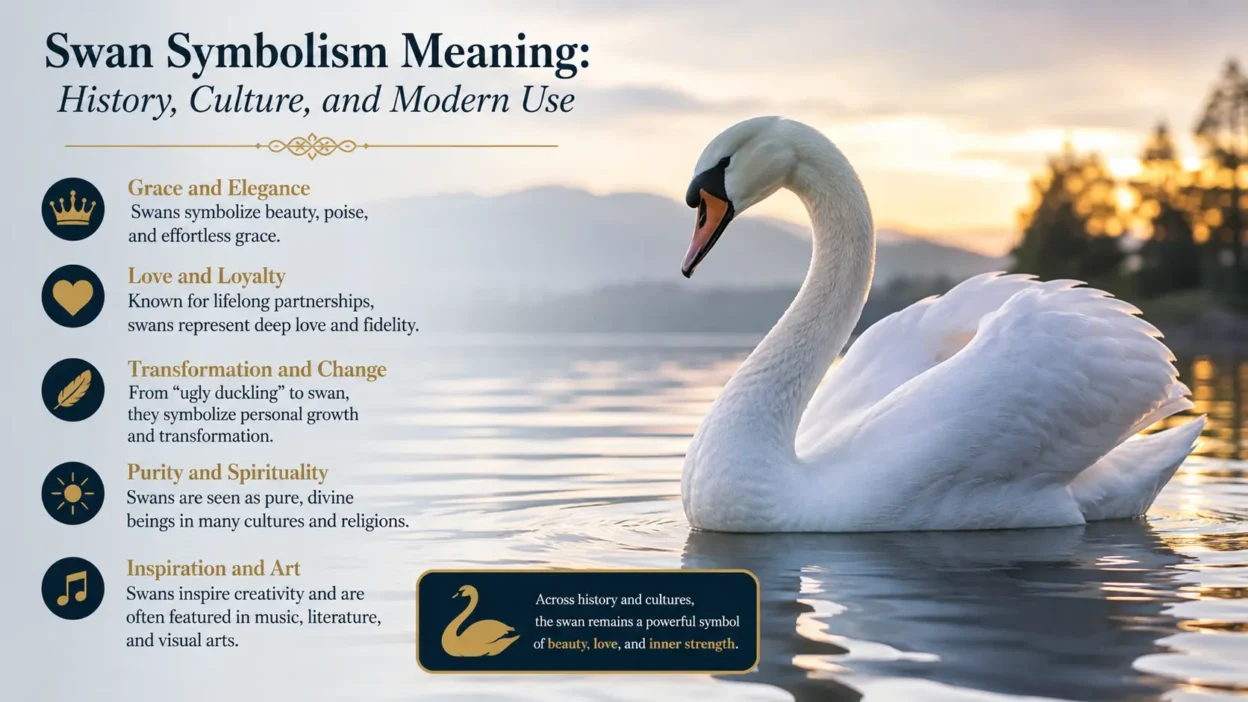
Swans are among the most visually recognizable waterbirds: large bodies, long curved necks, broad wings, and an unusually smooth way of moving across water. Those physical qualities have helped shape swan symbolism around ideas such as love, grace, transformation, beauty, and emotional maturity.
In the United States, people are especially likely to encounter swan imagery in weddings, jewelry, tattoos, ballet, and romantic decorative art. A pair of swans may suggest committed love, while a single white swan often communicates elegance or personal transformation. Yet swan symbolism is older and more complicated than its modern romantic image. Ancient Mediterranean art, Irish legend, Hindu traditions, European literature, ballet, and even modern expressions like “swan song” have all given the bird different layers of meaning.
Quick Answer
Swan symbolism meaning commonly centers on love, devotion, grace, beauty, and personal transformation in modern American culture. Historically, swans have also represented divinity, artistic inspiration, changing identity, sorrow, fidelity, knowledge, and the boundary between outward appearance and inner character.
At a glance:
- Swans commonly symbolize love, grace, devotion, and transformation
- Paired swans often represent romance and lasting partnership
- Ancient myths connect swans with gods, beauty, music, and change
- Irish folklore associates swans with loss, endurance, and family bonds
- Modern art often uses swans to contrast appearance with identity
- Real swan behavior is more complex than romantic symbolism suggests
What Swans Commonly Symbolize in the United States
In contemporary American culture, the strongest swan associations are romantic love, elegance, commitment, and transformation. Love is especially prominent — two swans facing one another can create a heart-like shape with their curved necks, making the birds visually suited to wedding invitations, anniversary gifts, and romantic illustrations.
Grace is another major association. A swan seems to move effortlessly across calm water, so the bird can represent composure and dignity — an interpretation based more on how swans appear to human observers than on their full behavior in nature. Transformation has also become central, helped greatly by literature and ballet, and a swan may symbolize someone growing into confidence or moving beyond an earlier identity. These interpretations often overlap; a swan pendant might represent romance for one person and self-acceptance for another entirely.
The Physical Traits Behind Swan Symbolism
Much of animal symbolism begins with observation. Swans are unusually large waterbirds with elongated necks and striking silhouettes — white species can appear almost luminous against dark water, while their smooth swimming creates an impression of calm control. Those features help explain several symbolic associations directly: white plumage encouraged links with cleanliness and ceremonial beauty, curved necks gave artists an easy visual language for romantic pairing, and movement across water encouraged ideas of calmness and balance.
At the same time, appearance tells only part of the story. Swans can defend nesting territories aggressively and may chase other birds, dogs, or people who come too close. That contrast between graceful appearance and physical strength is worth keeping in mind — a swan doesn’t have to symbolize fragility simply because it looks elegant.
Love, Pair Bonds, and Devotion
Swans became natural symbols of romantic partnership partly because several swan species form strong, long-lasting pair bonds. Tundra swan pairs, for example, can remain together throughout the year once bonded, and mute swans are also predominantly monogamous, commonly establishing lasting breeding partnerships. People translated this behavior into a broader human ideal: two individuals choosing one another and moving through life together.
As a result, paired swans can represent marriage, mutual devotion, and enduring affection — symbolism that works particularly well at weddings because two swans have both a behavioral connection and an immediately readable visual form. That said, saying every swan “mates for life” is too simple. Mate changes occur in some populations, and widowed birds may form new partnerships. The symbolic idea of eternal romance is therefore a cultural interpretation of real pair bonding, not a strict biological rule.
Transformation and Becoming Yourself
Swans frequently represent transformation because popular stories portray them as the final form of something misunderstood or incomplete. The clearest example is Hans Christian Andersen’s The Ugly Duckling, whose central character suffers because it appears different from those around it, only to discover it was never an unattractive duck at all — it was a young swan. That story helped make the adult swan a recognizable image of delayed self-discovery.
In modern use, this symbolism can mean growing into confidence, surviving rejection, or becoming comfortable with difference. Importantly, the message isn’t necessarily that worth comes from becoming physically beautiful — a more useful interpretation is that incorrect judgments made during one stage of life don’t necessarily define who someone actually is. That’s exactly why swan imagery feels so fitting during major transitions like graduation, recovery from a setback, or a new stage of adulthood.
Ancient Greek and Roman Meanings
Swans carried several meanings in the ancient Mediterranean world. In surviving Greek art, Aphrodite was sometimes shown with a swan, and the bird could be connected with grace, music, and divination. Ancient artistic traditions also associated swans with Apollo, including imagery connected with Hyakinthos.
Another famous classical story involves Zeus and Leda, in which Zeus assumes the form of a swan — a myth that has inspired centuries of European paintings and sculpture. Modern audiences should be cautious about turning it into a simple romance symbol, though, since versions of the story involve deception and sexual coercion rather than mutual affection. Ancient swan imagery therefore can’t be reduced to “true love” — depending on the work and tradition, the bird might signal divine presence, desire, artistic inspiration, or supernatural intervention instead. Roman writers continued some of these associations, including imagery of swans connected with Venus, the Roman counterpart of Aphrodite.
Irish Folklore and the Children of Lir
Irish tradition gives the swan a noticeably different emotional tone. One of the best-known legends is the Children of Lir, in which four children are transformed into swans and condemned to remain in that form for hundreds of years. The story combines transformation with separation, endurance, and eventual release, and versions preserved in Irish folklore also contributed to beliefs that swans shouldn’t be harmed, since a swan might carry a human or enchanted identity.
Within this context, the swan becomes less of a decorative romantic emblem and more a symbol of endurance through suffering, displacement, and hope after prolonged hardship. This illustrates why cultural context matters so much — the same white bird that represents a wedding couple in American decor may evoke an entirely different story within Irish folklore.
Hindu Traditions and the Hamsa
South Asian religious art introduces another important layer. The Sanskrit hamsa is translated in English in different contexts as a swan or goose, and because English labels can vary, it’s safer not to assume every historical hamsa image represents exactly the species modern Americans picture when they hear “swan.” Saraswati, the Hindu goddess associated with learning, music, and the arts, is conventionally connected with the hamsa, and historical artwork frequently places the white bird beside her or presents it as her vehicle. Brahma can likewise be shown riding a hamsa.
Because of these religious associations, swan-like imagery in Hindu contexts may suggest learning, disciplined thought, or spiritual discernment. These meanings shouldn’t simply be folded into generic Western “swan spirituality,” though — they belong to specific religious and artistic traditions with their own separate histories.
Swan Lake and the White-Swan/Black-Swan Contrast
Few works have influenced modern swan imagery as strongly as Swan Lake. In the familiar ballet narrative, Princess Odette has been placed under a curse that transforms her into a swan; Prince Siegfried falls in love with her, but deception involving Odile disrupts his promise. The story revolves around transformation, betrayal, and the tension between appearance and truth, and the visual distinction between the white swan and the darker counterpart became especially memorable as a result.
Modern art and fashion sometimes use the two figures symbolically: the white swan for sincerity and idealized beauty, the black swan for seduction and hidden motives. These are artistic conventions rather than universal definitions, though — black swans are real animals, not naturally sinister counterparts to white swans. That distinction matters when interpreting tattoos or artwork, since sometimes the colors simply provide visual contrast rather than any moral message.
White Swans, Black Swans, and Swan Pairs
| Context | Common Meaning in the USA | Associations | Important Note |
|---|---|---|---|
| White swan | Grace and refinement | Calm, beauty, innocence | Often shaped by European art |
| Swan pair | Romantic commitment | Love, union, partnership | Inspired partly by pair bonding |
| Black swan | Rarity or unpredictability | Surprise, individuality, disruption | Not inherently negative |
| Swan in flight | Transition or freedom | Change, independence, movement | Usually a modern interpretation |
| Swan on water | Emotional composure | Serenity, reflection, balance | Based largely on visual appearance |
| Swan transformation | Personal development | Identity, maturity, self-discovery | Strongly reinforced by literature |
The meaning changes substantially depending on whether the image shows a solitary bird, a bonded pair, a particular color, or a transformation scene.
Emotional and Psychological Meaning
Swan imagery often appeals to people who want to express controlled emotion rather than dramatic intensity. A swan on calm water creates an image of composure, and because much of the bird’s movement is hidden beneath the surface, people sometimes interpret it as a metaphor for maintaining outward calm while handling unseen effort underneath. That makes the bird useful as a personal symbol of self-possession.
For someone going through a period of change, a swan may communicate becoming more fully oneself; for someone honoring a relationship, it may represent mutual attachment instead. The psychological interpretation is highly personal this way — unlike a fixed road sign or national emblem, swan imagery has no single authorized meaning, and personal experience, religion, and artistic context all shape what a viewer actually perceives.
Swan Symbolism in Tattoos and Jewelry
Swan tattoos can carry several distinct messages depending on their design. A single white swan often represents grace, independence, or transformation, while two swans usually place more emphasis on partnership or devotion. A swan with spread wings may suggest liberation or entering a new life stage, and a black swan can communicate individuality or refusal to fit expectations. Some designs draw specifically from Swan Lake, using white-and-black imagery to explore duality or inner conflict.
Swan jewelry tends to be less dramatic — necklaces and charms commonly use the curved outline of the bird to communicate elegance or romantic attachment. For personal designs, context matters more than any symbolism dictionary; someone choosing a swan tattoo because of a family memory doesn’t need the image to conform to a traditional interpretation.
Weddings, Decor, Fashion, and Digital Culture
Modern American use has pushed swan symbolism strongly toward romance and refined aesthetics. At weddings, paired swans appear in stationery, cake decorations, and table pieces, their symmetrical necks making them particularly easy to turn into a heart motif. In home decor, swans often appear in spaces designed around soft, vintage, or ballet-inspired styles.
Fashion uses the bird differently, where swan imagery may communicate refinement, theatricality, or deliberate extravagance depending on the garment. Online, swans appear across romantic photography, wedding mood boards, and tattoo portfolios, and digital use has simplified some older meanings along the way — a person posting paired swans today is far more likely communicating romance than referring to ancient Greek divination or Irish folklore.
“Swan Song” and “Black Swan” in Everyday Language
Two expressions have moved swan imagery beyond the bird itself. A “swan song” means someone’s final performance or major act before retirement or departure. The expression comes from an old belief that a swan produces an especially beautiful song shortly before dying — real swan vocal behavior doesn’t support the legend, but the metaphor survived anyway, and “swan song” has been used for a final artistic or public act in English since the nineteenth century.
The “black swan” developed into a different metaphor. Because Europeans once treated black swans as something effectively impossible, the discovery of actual black swans helped turn the bird into a useful image for assumptions being overturned. Modern usage can describe something extraordinarily unexpected, or a rare event that changes how previous expectations are viewed. Today, both expressions function independently of literal swan symbolism.
Common Misunderstandings and Real Swan Behavior
Swan symbolism becomes misleading when poetic interpretation is presented as biological fact. The first misconception is that all swans mate with one individual until death — some species form exceptionally durable pair bonds, but mate changes do occur, and mute swans, for example, may remate after losing a partner. Another misconception is that swans are universally peaceful; breeding swans can be highly territorial, and mute swans may chase people and wildlife while males fight aggressively with rivals.
There’s also an ecological issue worth noting in parts of the United States. Mute swans were introduced from Europe and became established in several regions, and wildlife agencies have raised concerns about their effects on aquatic vegetation and native wildlife. That creates an interesting contrast: culturally, the mute swan may represent perfect natural harmony, while ecologically it can be considered a problematic introduced species in some American habitats. Symbolism and wildlife biology simply aren’t the same thing.
How Swan Meaning Has Changed Over TimeSwan Symbolism Meaning
Swan symbolism didn’t develop along one straight historical path. Ancient Greek art connected the bird with divinities and transformation; Irish tradition developed stories about human beings living in swan form; Hindu imagery connected the hamsa with deities associated with knowledge and creation; European folklore preserved the legendary singing swan. Later literature and ballet emphasized identity, romance, and transformation on top of all that.
Modern American culture inherited pieces of these traditions but simplified many of them. Today, the most visible meanings are usually love (because of paired birds), grace (because of their appearance), transformation (because of famous stories), and individuality (particularly through black-swan imagery). The shift illustrates how symbols evolve generally — a culture doesn’t necessarily discard older meanings, it selects some, forgets others, and creates new interpretations based on current art and social life.
Frequently Asked Questions
What does a swan symbolize spiritually? A swan can represent transformation, discernment, devotion, or movement toward a more mature sense of identity. Spiritual interpretations vary by tradition, so meanings from Hindu religious imagery, European folklore, and modern personal symbolism shouldn’t be treated as interchangeable.
What does a white swan symbolize? A white swan commonly represents grace, beauty, calmness, innocence, and refinement in Western imagery. Its meaning has been shaped by white plumage, classical art, romantic design, and productions of Swan Lake.
What do two swans symbolize? Two swans usually symbolize romantic partnership, commitment, unity, or marriage. Their long-term pair bonds and the heart-like shape sometimes created by their curved necks helped establish this association.
What does a black swan symbolize? A black swan may symbolize rarity, unpredictability, individuality, or an event that challenges expectations. In ballet-inspired artwork, a dark swan can also represent contrast, deception, or another side of a person’s identity.
Is a swan a positive symbol? Usually, yes. Modern American imagery commonly treats swans positively as symbols of love, grace, and transformation, although folklore and art can also use them in stories about grief, betrayal, or loss.
What does a swan tattoo mean? A swan tattoo may represent personal transformation, elegance, independence, committed love, or emotional strength. Paired birds usually emphasize relationships, while a solitary or flying swan may focus more on individual growth.
Do swans really mate for life? Some swan species form extremely long-lasting pair bonds, but “swans always mate for life” is an exaggeration. Mate changes can occur, and birds may establish new partnerships when a previous mate dies.
Conclusion
The swan symbolism most familiar in the United States combines love, grace, commitment, and composed strength. Paired swans naturally became romantic emblems, while literature and ballet turned the bird into an equally recognizable image of changing identity and discovering what lies beneath appearances.
Older traditions broaden that picture considerably. Greek art connected swans with divinity and beauty, Irish legend used them to tell stories of loss and endurance, and Hindu religious imagery placed the hamsa beside deities associated with learning and creation. Modern expressions such as “swan song” and “black swan” have taken the bird into everyday language as well.
The swan remains useful as a symbol precisely because it can hold these contrasts at once: beauty and strength, stillness and effort, partnership and independence, familiar appearance and unexpected change.