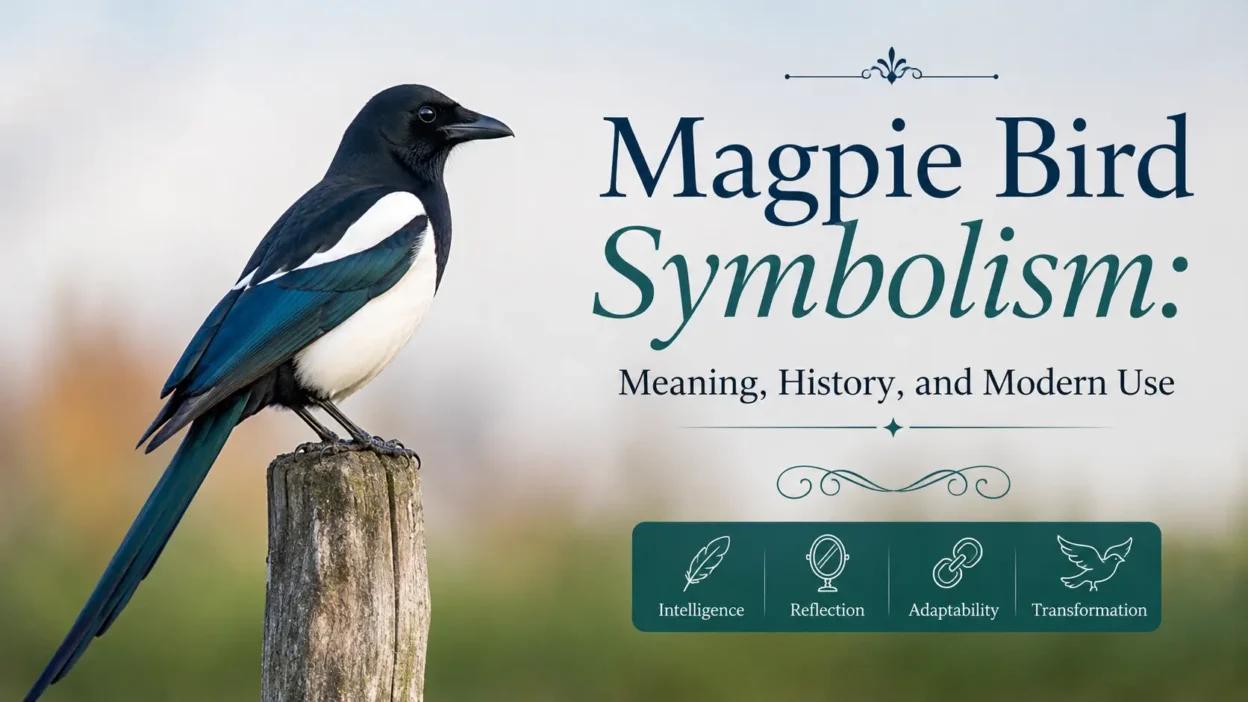
Magpies are difficult birds to ignore. Their sharp black-and-white pattern, iridescent feathers, long tails, noisy calls, and confident behavior have given people plenty of material for stories. Magpie bird symbolism today commonly centers on intelligence, curiosity, communication, adaptability, opportunity, and the coexistence of contrasting qualities.
Those meanings are not universal. British folklore has sometimes treated the magpie as an omen of sorrow or luck depending on how many appear, while Chinese traditions have given the bird an almost opposite reputation as a sign of happiness and favorable news.
For Americans, the picture is more mixed. Actual magpies are familiar birds across much of the western United States, while many superstitions encountered in books, tattoos, and popular culture were inherited from Europe rather than created around North American species.
Quick Answer
Magpie bird symbolism commonly represents intelligence, curiosity, communication, adaptability, and awareness in modern American culture. Historically, magpies have carried contrasting meanings, ranging from sorrow and uncertain fortune in European folklore to happiness, good news, and romantic reunion in Chinese tradition.
TL;DR
- Magpies commonly represent intelligence, curiosity, adaptability, and communication.
- European folklore connects their numbers with fortune and misfortune.
- Chinese tradition often treats magpies as birds of happiness and good news.
- American meanings combine real bird behavior with inherited cultural folklore.
- Modern tattoos often express individuality, cleverness, change, or personal duality.
What a Magpie Looks Like—and Why Appearance Shapes Its Meaning
The magpies most Americans encounter belong to the crow family, Corvidae, which also includes ravens, crows, and jays. The Black-billed Magpie is especially familiar across western North America, where it lives in grasslands, open country, ranching areas, stream corridors, and developed places. California also has the Yellow-billed Magpie, a species with a much more restricted range.
A Black-billed Magpie has a long tail, white belly and shoulder patches, and dark feathers that can flash blue or green when the light catches them. That contrast has made the bird visually memorable in art and symbolic design.
Modern interpretations sometimes read the black-and-white coloring as duality: joy and sorrow, caution and confidence, light and darkness, or two sides of a personality. That interpretation should be understood mainly as contemporary visual symbolism rather than an ancient universal belief.
Its appearance matters for another reason. A magpie can seem black and white from a distance but reveal unexpected color up close. In modern personal symbolism, that makes it a useful image for complexity beneath first impressions.
What Magpies Commonly Mean in the United States
There is no single established American meaning for the magpie. Instead, several themes appear repeatedly because they fit both the bird’s behavior and older folklore that reached the United States through literature and immigration.
| Context | Common U.S. Meaning | Association | Important Note |
|---|---|---|---|
| Everyday symbolism | Intelligence | Observation, problem-solving | Connected with the corvid family’s reputation |
| Personal symbolism | Curiosity | Exploration, alertness | Often viewed positively today |
| Social meaning | Communication | Speech, news, social awareness | Reinforced by the bird’s vocal behavior |
| Tattoo symbolism | Individuality | Cleverness, independence | Meaning depends heavily on the wearer |
| Folklore | Luck or warning | Omens, counting magpies | Largely inherited from European tradition |
| Decorative art | Contrast | Duality, complexity | Usually a modern visual interpretation |
For an American audience, intelligence and curiosity are generally safer interpretations than predicting good or bad luck. The omen tradition is culturally specific folklore, not a rule attached to every magpie encounter.
Intelligence, Curiosity, and Quick Thinking
Magpies belong to a family famous for flexible behavior. Black-billed Magpies forage on many different foods, live comfortably around open natural habitats and human-modified environments, interact socially, and readily take advantage of new feeding opportunities.
That behavior explains why cleverness is one of the bird’s strongest modern meanings.
Symbolically, a magpie can represent someone who watches before acting, notices opportunities other people overlook, or finds an unconventional solution to a problem. Curiosity is part of that image as well, although it should not be confused with the exaggerated stereotype that magpies compulsively collect anything shiny.
In personal art or jewelry, the bird can therefore communicate a fairly specific message: pay attention, learn quickly, and make use of what is available.
Communication, News, and Social Awareness
Magpies are conspicuously vocal birds. Black-billed Magpies regularly call to one another and may gather socially around food or perceived danger. Their noisy presence has helped create human associations with talking, announcements, gossip, and news.
English itself preserves part of this reputation. The word magpie can describe a person who chatters frequently or someone who gathers assorted things.
That gives the bird a double meaning in communication symbolism.
On the positive side, a magpie can represent expression, sociability, alertness, and staying informed. On the negative side, it can suggest gossip, excessive talking, distraction, or spreading information without enough care.
This contrast makes the magpie especially fitting when the intended message is not simply “speak up,” but know when information is useful and when speech becomes noise.
Adaptability and Making the Most of Opportunity
The Black-billed Magpie has adapted successfully to landscapes shaped by people. It can live around agricultural areas, towns, roadsides, ranches, and other developed environments as long as suitable food and nesting habitat remain available.
That ecological flexibility supports a modern symbolic association with resourcefulness.
A magpie image may suit a person going through a career change, relocation, difficult transition, or period that requires improvisation. The message is less about enduring hardship passively and more about reading changing conditions and adjusting intelligently.
This is also why the bird can represent opportunity. Magpies are opportunistic feeders in the biological sense; in symbolism, that trait becomes the ability to recognize useful openings.
Opportunity is not necessarily the same as greed. A more grounded interpretation is using awareness and adaptability instead of waiting for perfect circumstances.
European Folklore and the “One for Sorrow” Tradition
Much of the magpie’s darker reputation in American popular culture comes from Britain and Ireland.
One enduring tradition assigns predictions to the number of magpies a person sees. The rhyme now widely known through versions beginning with “one for sorrow” has changed considerably across regions and generations. Historical versions connected different numbers with sorrow, joy, marriage, birth, death, and other future events.
A lone bird therefore developed an especially uneasy reputation.
Why magpies became omen birds is less certain. Their conspicuous appearance, scavenging behavior, loud calls, and presence around settlements probably made them easy subjects for folk interpretation. Once counting traditions became familiar, random encounters could be fitted into an existing system of luck.
For modern readers, the important distinction is that the rhyme is folklore, not a biological or spiritual law. Seeing one magpie does not predict sorrow, and seeing two does not guarantee good fortune.
Still, the old rhyme has influenced tattoos, poetry, jewelry, music, and popular references. A single magpie can deliberately symbolize solitude or sorrow in art precisely because audiences familiar with the tradition recognize the association.
Why Magpies Symbolize Happiness in Chinese Tradition
The European interpretation is only one side of the bird’s cultural history.
In traditional Chinese art, the magpie has been considered an auspicious bird connected with happiness and welcome news. Museum collections preserve decorative works showing magpies with flowering plants, and pairs of magpies can reinforce ideas of joy and favorable relationships.
The association is strengthened by language: the Chinese name for the bird contains a character associated with happiness.
Magpies also appear in the well-known story connected with the Qixi Festival, in which magpies form a bridge across the Milky Way so the separated Cowherd and Weaver Girl can reunite. The image of the magpie bridge consequently carries associations with love, reunion, devotion, and overcoming separation.
For tattoos or artwork inspired specifically by Chinese culture, then, a pair of magpies may communicate something very different from the lonely bird of British superstition.
Context determines which tradition is being referenced.
Magpies in Indigenous North American Traditions
It is inaccurate to speak of one universal “Native American magpie meaning.” Indigenous nations have distinct histories, languages, and storytelling traditions, so meanings should be tied to particular communities rather than combined into a single generic interpretation.
Magpies do appear in traditions from the Plains and western North America. In one Lakota telling of the Great Race, humans choose several birds to compete on their side against the buffalo. Magpie ultimately plays the decisive role, making the bird part of a story involving courage, endurance, alliance, and the relationship between people and buffalo.
Other Indigenous traditions give corvids and magpies different roles, including helpers, messengers, troublesome figures, or observant participants in events.
Modern symbolism articles often flatten these varied stories into claims such as “the magpie means sacred communication in Native culture.” That wording should be avoided unless a specific nation and tradition support it.
A culturally responsible approach is simpler: recognize that magpies appear in multiple Indigenous traditions, but do not treat those traditions as interchangeable.
Good Luck, Bad Luck, or Both?
Few birds illustrate symbolic contradiction as neatly as the magpie.
In one cultural setting, it may suggest sorrow. In another, happiness. A pair may suggest good fortune in British folk counting traditions, while Chinese imagery can associate paired magpies with happiness and relationship themes.
That does not mean the symbolism is confused. It shows how symbols actually develop.
People interpret animals through local experience, language, stories, religion, art, and inherited customs. The same bird can therefore acquire unrelated—or even opposite—meanings in different places.
For Americans using a magpie symbol today, luck is best treated as a contextual meaning. If a design references the British counting rhyme, the number of birds matters. If it references Chinese art, happiness and favorable news may be more relevant.
Without those cultural cues, intelligence, curiosity, adaptability, and communication are usually clearer modern interpretations.
Emotional and Psychological Meaning
On a personal level, magpies often communicate alertness and mental independence.
Someone drawn to the bird may identify with being observant, talkative, curious, socially aware, unconventional, or difficult to categorize. Because the bird has attracted both admiration and suspicion, it can also suit people who identify with being misunderstood.
Its contrasting plumage offers another useful psychological metaphor. A magpie can represent accepting that personality is rarely one-dimensional: a person can be sociable yet private, playful yet calculating, cautious yet bold.
The bird can also symbolize attention. Not supernatural attention, but the practical skill of noticing small changes in one’s surroundings and adjusting accordingly.
That makes the magpie especially relevant to periods of decision-making, learning, or reinvention.
What Seeing a Magpie Can Mean Personally
A real magpie appearing outside your window or crossing your path has no scientifically established ability to predict future events.
Symbolically, however, an encounter can become meaningful because of what the observer associates with the bird.
Someone familiar with British folklore might immediately think about luck. Someone raised with Chinese cultural imagery may associate the bird with happiness or good news. A birder in Wyoming, Montana, Colorado, or another western state may simply recognize a familiar, intelligent member of the local landscape.
If you choose to interpret the encounter personally, useful questions are more grounded than fortune-telling:
What caught my attention? Am I overlooking useful information? Do I need to communicate more clearly? Am I adapting well to a changing situation?
The meaning comes from reflection and cultural context rather than from assuming the bird delivered a guaranteed prediction.
Magpie Tattoo Meaning
Magpies work particularly well as tattoos because their shape remains recognizable in both detailed and minimalist designs.
A single magpie tattoo may represent independence, intelligence, individuality, observation, or—when intentionally referencing British folklore—sorrow and solitude.
Two magpies can shift the tone toward partnership, joy, balance, friendship, or good fortune. In designs influenced by Chinese tradition, paired birds can also emphasize happiness and romantic connection.
Other elements can narrow the meaning:
- Magpie with flowers: growth, seasonal renewal, beauty, or culturally specific botanical symbolism.
- Magpie in flight: change, freedom, movement, or leaving an old situation.
- Magpie with an object: curiosity, collecting, memory, or personal attachment.
- Black-and-white minimalist magpie: contrast, individuality, or opposing sides of the self.
- Multiple magpies: may intentionally refer to the British counting tradition.
Because the bird carries contradictory cultural meanings, a successful tattoo usually has a more personal explanation than “magpie equals luck.”
Jewelry, Decor, Fashion, and Digital Culture
In jewelry and decorative art, the magpie’s long tail and high-contrast coloring create a distinctive silhouette. Contemporary designs often use the bird to suggest cleverness, individuality, curiosity, or unconventional taste.
Vintage-style illustrations may lean more heavily on European folklore. East Asian-inspired designs may emphasize joy, pairing, blossoms, or favorable news. Modern gothic designs, meanwhile, sometimes place the magpie alongside ravens and crows to create themes of darkness, omens, death, or the uncanny.
On social media, the bird also fits the language of collecting and curation. Calling oneself a “magpie” can mean being drawn to interesting objects, ideas, colors, antiques, art supplies, jewelry, or fragments of inspiration.
That use is often affectionate rather than insulting: a creative collector assembling meaning from many different things.
The Myth of the Magpie Stealing Shiny Objects
Perhaps the most persistent stereotype says that magpies cannot resist jewelry, coins, or glittering objects.
The story has been reinforced by European folklore, literature, and popular entertainment. It became so familiar that magpie itself developed a figurative connection with indiscriminate collecting.
Experimental evidence, however, does not support the idea that Eurasian Magpies possess an automatic attraction to shiny objects. In tests involving shiny and non-shiny items, researchers found no evidence of an unconditional preference; unfamiliar objects could instead produce caution.
That distinction matters symbolically.
A magpie can still represent collecting, curiosity, or attraction to interesting things because the cultural stereotype exists. What should be avoided is presenting the stereotype as established bird behavior.
Folklore can remain meaningful without being mistaken for zoology.
Sorrow, Death, and Darker Interpretations
Magpies sometimes appear in art dealing with mourning, forewarning, or death, especially when a design draws from European traditions.
The connection should not be exaggerated. Magpies are not universally regarded as death symbols, and much of their ominous reputation comes from regional folklore rather than a single ancient belief.
Their relationship with carrion may also have contributed to darker human impressions, as happened with other corvids. Black-billed Magpies do gather at carcasses, but scavenging is simply part of their ecological role.
In contemporary artwork, the bird may therefore express grief, uncertainty, memory, or the presence of change without literally representing death.
A solitary magpie in a stark composition will naturally feel different from two birds perched among flowering branches. Visual context changes the message.
How the Meaning Has Changed Over Time
The magpie’s modern symbolism is a layering of several histories rather than one tradition evolving in a straight line.
European folk beliefs contributed counting rhymes, omens, suspicion, and the image of the noisy thief. Chinese traditions contributed happiness, welcome news, pairing, and reunion. Indigenous North American stories developed within their own cultural settings and should remain attached to the nations that tell them.
In the United States, those inherited meanings now mix with direct experience of western magpies as conspicuous, adaptable, social birds.
Contemporary tattoo culture and digital imagery have added another layer. The magpie can now represent individuality, creative collecting, intelligence, contrasting sides of personality, or the ability to adapt without carrying any deliberate supernatural meaning.
That evolution explains why asking whether a magpie is “positive or negative” rarely produces a useful single answer.
It can be either—or neither—depending on the cultural and personal context.
Frequently Asked Questions
Is a magpie a symbol of good luck?
It can be. Chinese tradition strongly associates magpies with happiness and favorable news, while some European counting traditions treat seeing multiple magpies as fortunate. A single universal rule about magpies bringing luck does not exist.
What does a single magpie symbolize?
In British and Irish folk tradition, a lone magpie became associated with sorrow or misfortune through counting rhymes. In modern personal symbolism, one bird may instead represent independence, observation, solitude, or individuality.
What do two magpies symbolize?
Two magpies are often interpreted positively, especially through the familiar British association between a pair and joy. Paired magpies in Chinese-inspired imagery can also suggest happiness, relationships, favorable news, or reunion.
What does a magpie tattoo mean?
A magpie tattoo commonly represents intelligence, curiosity, adaptability, communication, or individuality. The number of birds and surrounding imagery can add meanings such as sorrow, partnership, change, romance, or good fortune.
Does seeing a magpie have a spiritual meaning?
There is no objective evidence that seeing a magpie predicts a spiritual event or future outcome. People may still use the encounter as a personal symbol of awareness, communication, change, or whatever meaning their own cultural tradition gives the bird.
Do magpies symbolize stealing?
They have long been associated with theft and collecting in European popular culture, particularly through the story that they steal shiny objects. Research has not found evidence that magpies possess an automatic attraction to shiny items, so the “thief” image is better understood as folklore than fact.
Conclusion
Magpie bird symbolism is best understood as a meeting point between real animal behavior and several very different cultural traditions. In modern American use, the clearest themes are intelligence, curiosity, communication, adaptability, alertness, and individuality. Older European folklore adds sorrow and uncertain fortune, while Chinese tradition contributes happiness, good news, love, and reunion.
The contradictions are part of what makes the bird useful as a symbol. A magpie can stand for caution without fear, sociability without conformity, or the ability to notice possibilities other people miss.
Rather than asking whether the magpie is inherently lucky or unlucky, it is more accurate to ask which tradition, behavior, or personal experience gives the bird its meaning in a particular context.