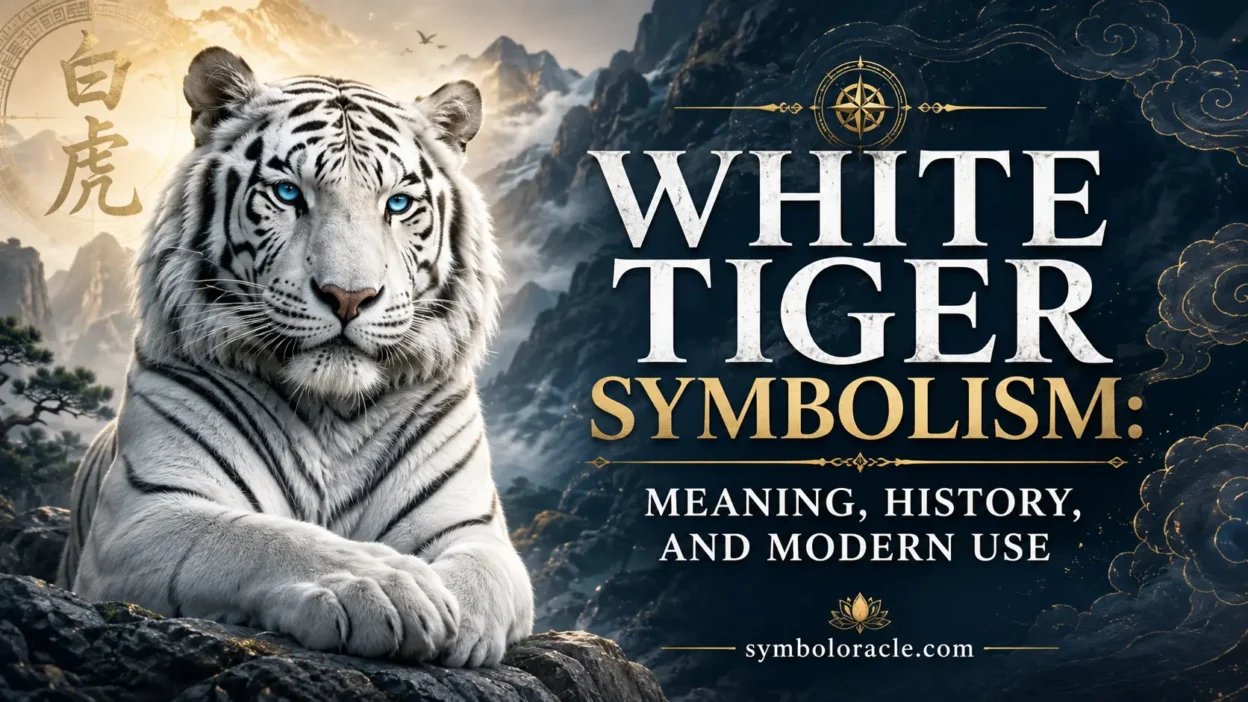
White tiger symbolism brings together the familiar strength of a tiger, the visual associations of the color white, and the animal’s remarkable rarity. These qualities make the white tiger a natural emblem of individuality, courage, protection, and strength that does not need constant display.
The image also carries an older cultural history. In Chinese cosmology, the White Tiger was not merely a pale-colored animal. It was Baihu, a celestial guardian connected with the western sky, autumn, military defense, and the protection of both the living and the dead.
Modern American interpretations often combine these traditions with newer ideas about personal identity, survival, fantasy, luxury, and wildlife conservation. Understanding the symbol therefore requires separating the real animal from the ancient guardian and from the commercial image created by entertainment.
Quick Answer
White tiger symbolism commonly centers on rarity, courage, independence, and protective strength in modern American culture. Historically, the figure also served as Baihu, the western guardian associated with autumn and metal in Chinese cosmology.
TL;DR
- White tigers commonly represent rarity, courage, independence, and protection.
- Baihu guarded the western sky in ancient Chinese cosmology.
- American imagery often emphasizes individuality and disciplined strength.
- Tattoos may signal survival, confidence, or protective identity.
- Captive breeding raises serious animal-welfare and conservation concerns.
What a White Tiger Actually Is
A white tiger is not a separate tiger species or subspecies. It is a pale color form most commonly associated with Bengal tiger ancestry. Its coat is white or cream-colored, while its dark stripes, pink nose, and usually blue eyes remain visible.
The appearance results from an inherited change affecting pigment production. Research has connected the coloration to a recessive variation in the SLC45A2 gene, which reduces the red and yellow pigments responsible for an ordinary tiger’s orange coat without removing its dark stripes. This is why a white tiger should not be described simply as an albino tiger.
This physical combination contributes directly to its symbolic appeal. The animal is immediately recognizable as a tiger, yet visibly different from what people expect. It represents distinction without losing its essential identity.
Core Meanings at a Glance
The white tiger has no single universal definition. Its meaning changes according to whether it appears in American art, East Asian cosmology, a tattoo, a dream, or a wildlife setting.
| Context | Common Meaning in the United States | Main Associations | Important Note |
|---|---|---|---|
| Personal identity | Individuality | Confidence, independence, authenticity | Often chosen by people who value standing apart |
| Protective imagery | Guardianship | Boundaries, vigilance, defense | Influenced partly by East Asian traditions |
| Tattoos | Survival and self-command | Courage, recovery, discipline | Meaning depends on pose and surrounding imagery |
| Art and decor | Rare beauty | Elegance, contrast, prestige | Can become decorative rather than historical |
| Dreams | Unrecognized strength | Fear, instinct, personal change | Interpretations are subjective |
| Wildlife advocacy | Ethical responsibility | Captivity, welfare, conservation | The white coat itself has little conservation value |
The meanings most often overlap rather than compete. A single image may suggest rarity, protection, and personal strength at the same time.
Rarity and Individuality
Rarity is the most immediate modern meaning attached to the white tiger. Its pale coat looks exceptional because it differs sharply from the orange-and-black tiger familiar from nature documentaries, schoolbooks, and wildlife logos.
In personal symbolism, that visual difference becomes a metaphor for being unusual without being weak. The animal does not appear incomplete or faded. It remains muscular, alert, and unmistakably dangerous. As a result, it can represent someone who accepts being different while refusing to be treated as fragile.
This interpretation is common in tattoos, profile images, fantasy artwork, and personal branding. The symbol may communicate:
- Comfort with being noticed
- Independence from group expectations
- Pride in an uncommon background or personality
- A refusal to hide distinctive qualities
The meaning is not necessarily about superiority. In its more thoughtful form, it is about accepting difference without needing to exaggerate it.
Strength, Courage, and Controlled Power
All tigers carry associations with physical strength, territorial confidence, and predatory focus. The white tiger adds an element of restraint. Its pale coloring can make the image appear calmer or more composed, even when the animal is shown with bared teeth or extended claws.
That contrast produces the idea of controlled power. The symbol often appeals to people who value strength but do not identify with constant aggression. It suggests someone capable of defending themselves who does not need to dominate every situation.
A roaring white tiger usually emphasizes open courage, anger, or resistance. A resting tiger may suggest confidence without performance. One walking forward can represent determination, while a tiger watching silently may stand for patience and careful judgment.
Its courage is therefore not limited to combat. It can describe the ability to remain steady during isolation, uncertainty, or public pressure.
Protection and Guardianship
The white tiger is frequently treated as a guardian figure. In modern use, it may symbolize the defense of family, personal values, private space, or emotional boundaries.
This association has a genuine historical foundation. In ancient Chinese cosmology, tiger images representing the western direction appeared on architectural elements and in tomb settings. They were used to protect buildings, guard the living, and defend the deceased in the afterlife.
American users may adopt the image without knowing this history, but the basic idea remains recognizable. A tiger’s alert posture and defensive ability make it an effective emblem of watchfulness.
The symbol is especially appropriate when protection means maintaining clear boundaries rather than attacking others. It represents the guardian who observes first and acts only when necessary.
Ancient Chinese Roots: Baihu, Guardian of the West
One of the most important historical interpretations is Baihu, the White Tiger of Chinese cosmology. Baihu belongs to a group of directional figures commonly known as the Four Symbols.
The system places:
- The Azure Dragon in the east
- The Vermilion Bird in the south
- The White Tiger in the west
- The Black Tortoise or Black Warrior in the north
Within this structure, the White Tiger corresponds to the west, autumn, and the element metal. It was also connected with military protection and the defense of imperial forces. Archaeological evidence shows that directional animal symbolism was already well established in ancient China, including on objects from the first millennium BCE.
Autumn adds complexity to the symbol. It is a season of maturity, harvest, decline, and preparation. Metal suggests firmness, order, sharpness, and resolve. Together, these associations produce a guardian defined not by impulsive violence but by discipline and readiness.
The celestial White Tiger should not be reduced to a decorative version of the biological animal. Baihu is a cosmological figure whose meaning comes from direction, season, astronomy, ritual protection, and the organization of sacred space.
How the Guardian Traveled Across East Asia
The Four Symbols spread beyond China and became part of artistic, religious, and architectural traditions elsewhere in East Asia.
The White Tiger is known as Byakko in Japan, Baekho in Korea, and Bạch Hổ in Vietnam. Although local interpretations differ, the figure generally retains its relationship with the west and its role as a protective guardian.
Korean tomb murals, for example, used the four directional creatures to organize and defend sacred space. Images of the White Tiger could appear on the western side, balancing the dragon placed in the east.
In Japanese visual culture, Byakko appears in temples, fantasy stories, games, animation, and martial imagery. Modern entertainment often simplifies the guardian into an elemental beast or combat figure, but the directional framework remains visible in many adaptations.
Americans encountering these versions through anime, video games, martial arts, or Asian-inspired design may recognize the White Tiger first as a fantasy guardian. Its original cultural setting, however, is far older and more structured than most modern fictional portrayals suggest.
India, Royal Display, and the Captive White Tiger
The biological white tiger is historically associated with the Indian subcontinent, where pale tigers were occasionally documented in the wild. Their extreme rarity made them objects of curiosity, royal interest, and later international exhibition.
Modern captive populations became prominent after white tigers from India were selectively bred and exported during the twentieth century. In the United States, captive lineages were built from a very limited genetic foundation.
This history strengthened associations with exclusivity and prestige. A ruler, zoo, circus, or entertainer who possessed a white tiger could present the animal as an extraordinary attraction unavailable to ordinary people.
That history also exposes a tension in the symbol. Rarity can inspire respect, but it can also encourage possession. The desire to own or display something unusual helped turn a naturally occurring color trait into a commercial product.
Modern interpretation increasingly recognizes that distinction. Admiring the animal’s appearance does not require supporting the practices used to reproduce it.
What It Commonly Means in the United States
In the United States, the white tiger usually represents an uncommon form of strength. It is less closely tied to one fixed religious tradition and more often interpreted through personal identity, entertainment, wildlife imagery, and visual design.
American audiences became especially familiar with white tigers through zoos and large-scale Las Vegas entertainment. Their use in elaborate stage productions linked them with spectacle, luxury, danger, and controlled exoticism. White tigers became part of the visual identity of the modern Las Vegas resort era, where rare animals were presented alongside illusions, elaborate architecture, and theatrical excess.
Today, common American associations include:
- Being different without apologizing
- Quiet confidence
- Protective leadership
- Survival after hardship
- Elegance combined with danger
- Self-control under pressure
These meanings are modern cultural readings rather than strict historical definitions. They emerge from the combination of tiger behavior, pale coloration, rarity, and decades of popular imagery.
Emotional and Psychological Meaning
Emotionally, the white tiger often expresses the experience of being visible and isolated at the same time. Something rare attracts attention, but attention does not always create belonging.
For this reason, the symbol may appeal to people who have felt misunderstood, singled out, or expected to perform because of what makes them different. It can express the desire to turn unwanted attention into self-possession.
The tiger’s solitary behavior also contributes to this reading. The animal suggests independence, careful observation, and trust in one’s own instincts. In personal symbolism, this can represent emotional self-reliance.
Its shadow side is defensiveness. A person who identifies too strongly with the image may use independence as a reason to avoid cooperation or emotional openness. The healthiest interpretation combines confidence with discernment rather than permanent isolation.
Why It Appears in Tattoos
A white tiger tattoo often represents survival, courage, independence, or protection. Its exact meaning depends on the animal’s posture, facial expression, placement, and surrounding symbols.
A calm white tiger may show disciplined confidence. A roaring one can represent resistance or reclaimed anger. A tiger with cubs may emphasize family protection, while one paired with flowers can balance danger with beauty, grief, renewal, or affection.
Common design combinations include:
- Lotus flowers: Growth through difficult circumstances
- Moon imagery: Intuition, solitude, or emotional cycles
- Mountains: Endurance and personal challenge
- Bamboo: Flexibility combined with strength
- Dragons: Balance, conflict, or East Asian directional symbolism
- Crowns: Authority, pride, or personal sovereignty
People using Baihu or other specifically East Asian designs should understand the cultural framework rather than treating the figure as interchangeable with any generic tiger. Respectful use begins with recognizing whether the design represents a real animal, a modern fantasy creature, or a traditional guardian.
Jewelry, Decor, Fashion, and Personal Style
White tiger imagery is visually effective because black stripes create sharp contrast against a pale body. Designers can use the pattern in detailed realism, minimal line art, geometric logos, or luxury-inspired prints.
In jewelry, the animal may appear on pendants, rings, brooches, and protective amulets. The wearer may choose it for confidence, vigilance, or individuality rather than for a formal religious meaning.
In home decor, a white tiger portrait can create an atmosphere of watchfulness and authority. A forward-facing tiger feels confrontational, while a side profile appears calmer and more reflective. Images placed near entrances may function symbolically as guardians, although this modern use should not automatically be described as traditional feng shui.
Fashion often uses the animal to combine elegance with rebellion. The white coat suggests refinement, while the stripes and predatory form prevent the image from appearing delicate. This tension explains why it works in streetwear, performance clothing, fantasy fashion, and dramatic accessories.
Dreams and Personal Spiritual Interpretation
Dream interpretations are subjective, and no white tiger dream has one guaranteed meaning. The animal’s behavior and the dreamer’s emotional response matter more than a fixed dictionary definition.
A calm tiger may reflect confidence that has not yet been fully acknowledged. Being followed by one could represent a responsibility, fear, or personal ability that can no longer be ignored. A protective tiger might reflect a need for stronger boundaries.
An attacking tiger does not automatically predict danger. It may represent anger, pressure, or an instinctive part of the personality that feels suppressed. A caged tiger can suggest restrained confidence or a life situation in which personal ability cannot be expressed.
Spiritual interpretations often describe the animal as a guide or protector. That reading can be personally meaningful, but it should be presented as an individual belief rather than a universal message delivered by the animal.
Pop Culture, Entertainment, and Digital Identity
Fantasy stories frequently cast the white tiger as a guardian, magical companion, rare mount, or high-ranking beast. Its pale appearance allows creators to distinguish it immediately from an ordinary tiger without changing its basic anatomy.
Games and animation often borrow elements from Baihu while adding powers associated with ice, wind, metal, moonlight, or the west. These additions are creative adaptations, not always features of the original tradition.
On social media, white tiger avatars commonly communicate independence, intensity, or emotional distance. The image can make a profile feel watchful and confident without using a human portrait.
The symbol also appears in sports identities, merchandise, digital art, and motivational graphics. In these settings, historical context may disappear almost entirely. What remains is a compact visual message: rare, focused, and difficult to intimidate.
Conservation Ethics and Modern Controversy
The greatest modern controversy concerns captive breeding. Producing white cubs reliably usually requires pairing animals that carry the same rare recessive trait. Historically, limited bloodlines led some breeders to use closely related tigers repeatedly.
The color mutation itself is not proof that an animal is unhealthy. The more serious welfare risks come from intentional inbreeding, which increases the likelihood that harmful recessive traits will also be expressed. Accredited zoological organizations have opposed breeding practices designed primarily to reproduce unusual traits such as white coats when those practices compromise genetic diversity or animal welfare.
White tigers also have little direct conservation value as a separate group because they are not a distinct wild population. Breeding for color does not restore tiger habitat, strengthen genetically managed wild populations, or address poaching.
American public policy has moved away from casual contact with captive big cats. The Big Cat Public Safety Act restricts private possession and breeding and prohibits exhibitors from offering direct public contact with tigers, including cubs, subject to specific legal exceptions.
Modern use of the symbol is therefore most responsible when it encourages respect for tigers rather than promoting cub handling, private ownership, or commercial breeding for appearance.
Common Misunderstandings About the Symbol
Several popular claims mix zoology, mythology, and personal spirituality in misleading ways.
A white tiger is not a separate species. It is a color form of a tiger, most often connected with Bengal tiger ancestry.
It is not a snow tiger. White tigers are not naturally adapted to Arctic environments, and their coat should not be confused with that of a snow leopard.
It is not automatically albino. White tigers retain dark stripes and pigment because their coloration results from a different genetic mechanism.
Baihu is not simply a rare Bengal tiger. The Chinese guardian is a celestial and directional symbol with an independent cosmological history.
Captive breeding is not the same as conservation. Producing more pale cubs does not necessarily help wild tiger populations.
The symbol is not always positive. Depending on context, it may communicate isolation, suppressed anger, excessive pride, or danger as well as courage and protection.
Recognizing these distinctions makes the symbol more meaningful and prevents attractive imagery from replacing accurate history.
Frequently Asked Questions
What does a white tiger symbolize spiritually?
It may symbolize inner strength, protection, sharpened intuition, or the courage to follow an uncommon path. These are modern personal interpretations rather than a universal religious doctrine.
Is a white tiger a positive or negative symbol?
It is usually positive when associated with courage, guardianship, discipline, and individuality. It can become negative when it represents uncontrolled aggression, emotional isolation, pride, or the exploitation of rare animals.
What does a white tiger tattoo mean?
The tattoo commonly represents survival, protective strength, independence, or confidence developed through hardship. Its expression and surrounding images determine whether the design feels peaceful, defensive, mournful, or aggressive.
What does Baihu mean?
Baihu means “White Tiger” and names the guardian of the western direction in Chinese cosmology. It is associated with autumn, metal, military protection, and the defense of sacred or funerary space.
Does the white tiger have a biblical meaning?
The white tiger has no established symbolic role in the Bible. Christian interpretations connecting it with purity, divine protection, or courage are modern readings based largely on general color and animal associations.
Are white tigers endangered?
White tigers are not classified as a separate species or conservation population. Tigers as a species are protected and threatened in the wild, but breeding captive animals specifically for white coats does not by itself support wild tiger recovery.
Conclusion
At its most grounded, white tiger symbolism represents rare individuality joined with courage, self-control, and protection. Its pale coat makes it a natural image of standing apart, while the tiger’s posture and strength prevent difference from being confused with weakness.
Its older history adds a more structured meaning. Baihu was a guardian of the west, autumn, military defense, and the boundary between ordinary and sacred space. Modern American culture has expanded the image through tattoos, fantasy, fashion, entertainment, and personal identity.
The symbol is most meaningful when admiration remains connected to understanding. A white tiger can represent strength without aggression and rarity without possession—qualities that honor both the image and the living animal behind it.