
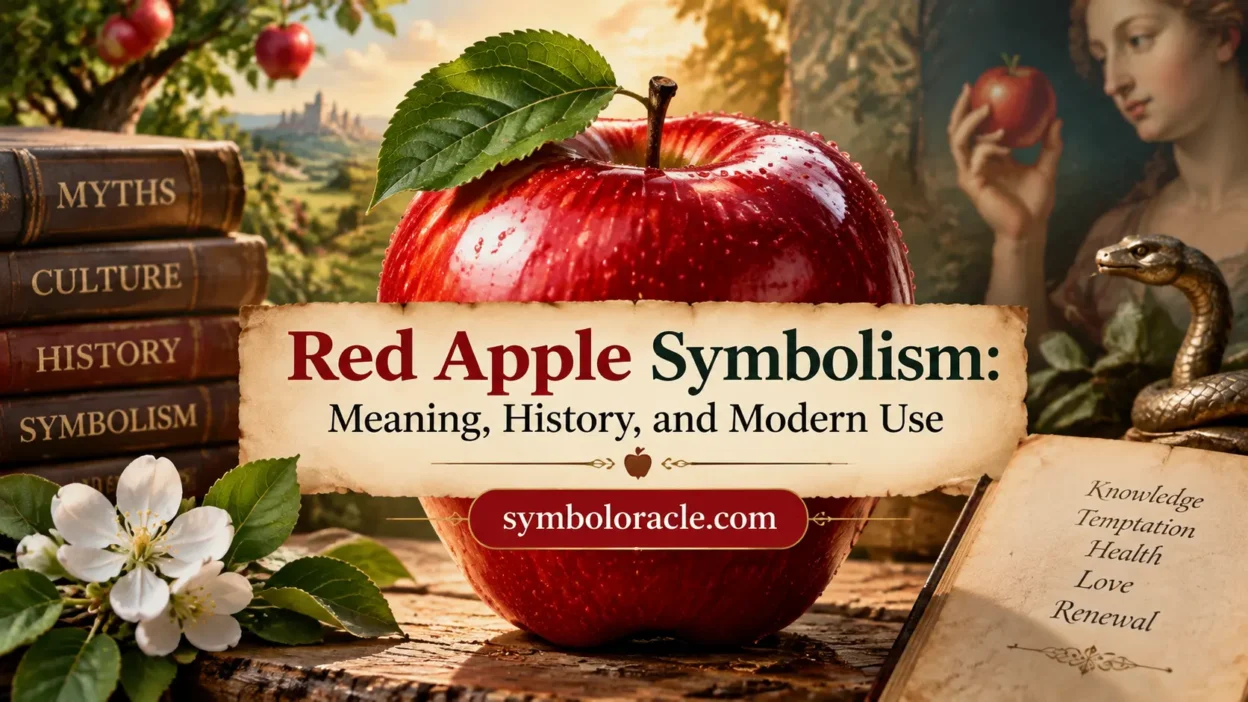
A red apple is one of the most recognizable symbols in American culture, often connected with knowledge, health, temptation, care, and everyday kindness. Red apple symbolism appears in classrooms, holiday traditions, artwork, stories, advertising, and personal expressions because the fruit carries meanings that developed across religion, folklore, and social customs.
The image of a bright red apple can represent something simple, such as a healthy choice or a thoughtful gift, but it can also carry more complex ideas about learning, desire, morality, and human choices. Its meaning depends greatly on the cultural setting where it appears.
In the United States, the red apple is especially associated with teachers, education, and appreciation, but its history reaches far beyond schools. Religious stories, ancient myths, and artistic traditions have shaped how people understand this familiar fruit today.
Quick Answer
Red apple symbolism commonly represents knowledge, health, kindness, and appreciation in modern American culture, especially through education and gift-giving traditions. Historically, it has also been associated with temptation, wisdom, love, and moral choices in religious and cultural stories.
TL;DR
- Red apples symbolize knowledge and education.
- Teachers often receive apples as appreciation gifts.
- Ancient stories linked apples with temptation.
- The fruit represents health and natural abundance.
- Modern designs use apples for warmth and trust.
- Apple symbolism varies across cultures.
What a Red Apple Represents in Everyday Life
A red apple is a familiar fruit with a strong visual identity: smooth red skin, rounded shape, and a connection to nature and nourishment. Because apples are common in homes, markets, schools, and celebrations, people often attach meanings to them beyond their physical appearance.
In daily American life, the red apple frequently suggests something positive. It may represent generosity when given as a gift, responsibility when associated with healthy habits, or learning when placed in an educational setting.
The meaning usually comes from context. A red apple sitting on a teacher’s desk sends a different message than an apple appearing in a painting about temptation or a story about personal choices.
What It Commonly Means in the United States
In the United States, the red apple has several widely recognized meanings. The strongest association is education. The connection between apples and teachers became especially popular through American school culture, where students traditionally gave apples to educators as signs of respect and gratitude.
The symbol also represents:
- Learning and curiosity
- Health and wellness
- Appreciation and generosity
- Simplicity and everyday comfort
- Growth and personal improvement
The apple’s connection with education is partly practical as well as symbolic. Apples were inexpensive, widely available farm products, making them a natural gift for students to bring to teachers in earlier rural communities.
Today, the symbol continues in classrooms, school decorations, teacher appreciation events, and educational branding.
| Context | Meaning in the USA | Common Associations | Notes |
|---|---|---|---|
| Schools | Knowledge and respect | Teachers, learning, students | One of the strongest modern meanings |
| Health | Wellness and nutrition | Healthy choices, natural foods | Linked to the phrase “an apple a day” |
| Gifts | Appreciation and kindness | Gratitude, generosity | Often used for teachers and mentors |
| Stories | Choice and morality | Temptation, wisdom | Influenced by religious and literary traditions |
| Design | Warmth and familiarity | Home, comfort, tradition | Common in decor and branding |
Ancient Roots and Early Symbolism of Apples
The symbolic history of apples developed over thousands of years, although not every culture viewed the fruit in the same way. Apples appeared in mythology, religious traditions, and artistic representations because they were valuable foods and were often connected with ideas of fertility, abundance, and human experience.
In ancient Mediterranean cultures, apples were associated with beauty, love, and prosperity. Greek mythology included stories involving golden apples, such as the apples connected with the Garden of the Hesperides and the conflict surrounding the Apple of Discord. These stories helped connect apples with desire, competition, and important choices.
The fruit also became connected with ideas of immortality and knowledge. Because apples could be stored and preserved, they sometimes represented continuity and the cycles of nature.
Over time, artists and storytellers used apples as symbols because the fruit could express both positive and challenging human experiences.
Religious Symbolism and the Idea of Temptation
One of the most famous symbolic associations of the apple comes from Western Christian art. Although the biblical Book of Genesis does not specifically identify the forbidden fruit as an apple, European artists and writers gradually popularized the apple as the traditional representation of the fruit involved in the story of Adam and Eve.
This association developed partly because of language connections in Latin and artistic traditions. The Latin words for “apple” and “evil” are similar, which influenced how the fruit was interpreted in some medieval European contexts.
Because of this tradition, the apple became linked with:
- Temptation
- Human choice
- Knowledge
- Moral responsibility
However, this meaning is specific to certain cultural interpretations. Many religious traditions and modern readers do not automatically view apples negatively.
In contemporary American culture, the apple often carries positive meanings, while the temptation association appears more commonly in literature, religious art, and discussions of symbolism.
How the Red Color Changes the Meaning of the Apple
The color red adds another layer to the symbolism of the apple. Across many cultures, red is visually associated with strong emotions and important human experiences.
Red can represent:
- Love and affection
- Passion and desire
- Energy and vitality
- Attention and importance
- Warning or danger
When combined with the apple, the red color can strengthen both positive and complex interpretations. A red apple may appear warm and inviting because of its connection with freshness and health, but it may also suggest temptation because red naturally draws attention.
In American design and advertising, red apples often create feelings of familiarity, trust, and friendliness. The color helps the symbol stand out while maintaining a connection to nature and tradition.
How the Apple Became Connected With American Education
The connection between apples and education is one of the strongest examples of how a common object can gain cultural meaning. In the United States, the image of a student giving an apple to a teacher became popular through a combination of agricultural life, school traditions, and public imagination.
During the 18th and 19th centuries, many American communities were rural, and apples were widely grown on farms. Bringing a simple farm product as a gift to a teacher was a practical way for families and students to show appreciation.
Over time, the apple became a visual shortcut for the relationship between teachers and students. School illustrations, children’s books, advertisements, and classroom decorations reinforced the connection.
Today, a red apple near a chalkboard or classroom image immediately suggests:
- Learning
- Guidance
- Respect for educators
- Academic achievement
- Childhood memories
Although teachers do not commonly receive apples as payment or routine gifts today, the symbol remains strong. Teacher appreciation events, educational logos, and school materials continue using the apple because people instantly understand its meaning.
Emotional and Psychological Meaning of the Red Apple
Symbols work because people connect visual objects with emotions and memories. The red apple often creates feelings of comfort, familiarity, and trust because it is connected with everyday experiences.
From a psychological perspective, the apple can communicate several emotional ideas.
A red apple may represent:
Care and nurturing:
Because apples are associated with food and health, they can suggest someone’s desire to support another person’s well-being.
Curiosity and growth:
The connection with education makes the apple a symbol of learning, improvement, and personal development.
Simplicity and tradition:
Apples are ordinary objects found in homes and communities, which gives them a sense of reliability.
Achievement:
In academic settings, the apple can represent progress, effort, and accomplishment.
The symbol is effective because it combines everyday familiarity with broader human experiences. People do not need a detailed explanation to understand why an apple might represent kindness or knowledge.
Red Apple Symbolism in American Holidays and Traditions
The red apple appears in several American traditions because it connects naturally with seasonal changes, food culture, and community celebrations.
During autumn, apples are strongly associated with harvest traditions. Apple picking, cider festivals, and fall decorations often use red apples as symbols of abundance and seasonal comfort.
In homes, red apples may appear in:
- Thanksgiving decorations
- Fall centerpieces
- Kitchen designs
- Farmhouse-style decor
- Harvest displays
The apple’s connection with harvest reflects older agricultural meanings. A successful apple crop represented preparation, nourishment, and the rewards of careful work.
Unlike some holiday symbols that are tied to one specific celebration, apples remain flexible. They can represent family, home, nature, and gratitude throughout the year.
Cross-Cultural Meanings of the Apple
Although this article focuses on American interpretations, apples have carried different meanings around the world.
In Greek mythology, apples were connected with beauty, competition, and divine gifts. Stories involving golden apples often explored themes of desire, conflict, and achievement.
In European folklore, apples sometimes represented fertility, love, and transformation. They appeared in stories where food choices influenced the direction of a character’s life.
In some Asian traditions, apples have positive associations. In Chinese culture, apples can symbolize peace and safety because the word for apple sounds similar to the word for peace in Mandarin. Apples are sometimes exchanged during celebrations as symbols of goodwill.
In Celtic traditions and European folklore, apples were often connected with knowledge, mystery, and the relationship between humans and nature.
These meanings show that the apple is not limited to one interpretation. Different societies have used the fruit to express ideas about life, relationships, wisdom, and human choices.
The Red Apple in Literature and Popular Culture
Writers and artists often use apples because the fruit can communicate multiple ideas at once. A single apple in a story can suggest innocence, temptation, knowledge, or change depending on the context.
One of the most recognizable examples comes from stories influenced by the tale of Snow White. The poisoned apple represents deception and hidden danger beneath an attractive appearance.
In literature, apples may symbolize:
- Forbidden choices
- Hidden consequences
- Discovery
- Transformation
- Human weakness
Modern entertainment continues using apple imagery because audiences already understand these associations. A red apple can quickly create a feeling of childhood, danger, mystery, or familiarity without requiring explanation.
The meaning depends on how the symbol is presented. A classroom apple feels encouraging, while a poisoned apple in a fantasy story creates a completely different emotional response.
Red Apple Symbolism in Tattoos and Personal Expression
Apple tattoos are less common than some traditional symbols, but they can carry personal meanings for people who choose them. The interpretation usually depends on the design and the person’s connection to the image.
A red apple tattoo may represent:
- Love of learning
- A connection to teaching or education
- Childhood memories
- Family traditions
- Personal growth
- Curiosity and creativity
Some people choose apple tattoos because they appreciate the contrast between innocence and complexity. A simple apple can represent positive qualities while also acknowledging life’s difficult choices.
Additional elements change the meaning:
- An apple with books may emphasize knowledge.
- An apple with flowers may suggest beauty and growth.
- A bitten apple may reference curiosity or technology.
- A dark or damaged apple may represent struggle or transformation.
Like many personal symbols, the meaning comes from the individual rather than a universal rule.
Modern Uses of the Red Apple in Design and Branding
The red apple remains popular in modern visual communication because it creates immediate recognition. Businesses, schools, and organizations use apple imagery when they want to communicate ideas such as trust, learning, or natural quality.
Common modern uses include:
- Educational materials
- Teacher appreciation products
- Food packaging
- Kitchen decorations
- Farm-inspired designs
- Social media graphics
The symbol works well because it combines several positive associations. It feels approachable rather than distant, making it useful for organizations that want to appear friendly and reliable.
In digital culture, apple imagery can also represent nostalgia. Many people associate apples with childhood classrooms, school supplies, and early learning experiences.
Positive and Negative Interpretations of the Red Apple
The red apple is generally considered a positive symbol, but its history includes both encouraging and challenging meanings.
Positive interpretations include:
- Knowledge
- Health
- Generosity
- Love
- Growth
- Appreciation
Negative or cautionary interpretations include:
- Temptation
- Deception
- Forbidden desires
- Risky choices
These different meanings do not contradict each other. Symbols often reflect the complexity of human experiences. An apple can represent learning and temptation because both ideas are connected with knowledge and choice.
Understanding the context prevents oversimplification. A teacher’s apple and a villain’s poisoned apple may look similar, but they communicate completely different messages.
Common Misunderstandings About Apple Symbolism
One common misunderstanding is that every apple symbol has the same meaning. In reality, symbolism changes based on culture, time period, and situation.
Another misconception is that the apple was always the forbidden fruit in religious stories. The Bible does not name the fruit, and the apple connection developed later through European artistic traditions.
Some people also assume that apple symbolism is only positive because of its association with education and health. However, historical traditions show that the fruit has also represented difficult choices and moral questions.
The best way to understand the symbol is to consider where and how it appears.
How Red Apple Meaning Has Changed Over Time
The meaning of the red apple has shifted as societies changed. Early traditions often emphasized fertility, abundance, and mythological ideas. Later European traditions added connections with temptation and moral choices.
In America, the apple gained a particularly strong educational identity. Rural communities, schools, and popular culture transformed it into a symbol of teachers, learning, and appreciation.
Today, the red apple combines many layers of meaning:
- A classroom symbol of knowledge
- A food symbol of health
- A seasonal symbol of harvest
- A cultural symbol of tradition
- A storytelling symbol of choices
Its continued popularity comes from its ability to represent both ordinary experiences and larger human themes.
Frequently Asked Questions
What does a red apple symbolize in American culture?
A red apple commonly symbolizes education, knowledge, health, and appreciation in American culture. Its strongest modern association is with teachers and learning, although it also appears in food, home design, and seasonal traditions.
Why is an apple associated with teachers?
The apple became connected with teachers because students historically brought locally available apples as gifts of appreciation. American schools and popular culture later strengthened this association.
Does the red apple symbolize temptation?
Yes, in some Western traditions the apple represents temptation because European art connected it with the forbidden fruit story of Adam and Eve. However, this is only one interpretation and not the meaning used in every context.
What does a red apple tattoo mean?
A red apple tattoo can represent knowledge, education, personal growth, childhood memories, or curiosity. The meaning depends on the person’s design choices and personal experiences.
Is the apple a religious symbol?
The apple can have religious associations, especially in Western Christian art, where it became linked with temptation and human choice. The original biblical text does not specifically identify the forbidden fruit as an apple.
What does an apple symbolize in modern design?
In modern design, an apple often represents friendliness, learning, health, simplicity, and trust. Schools, food brands, and home decor frequently use apple imagery because these meanings are widely recognized.
Conclusion
The red apple has become one of the most familiar symbols in American culture because it connects everyday life with larger ideas about knowledge, health, kindness, and personal choices. From classrooms and harvest traditions to literature and design, the fruit carries meanings shaped by centuries of cultural development.
Red apple symbolism reflects both positive and complex human experiences. It can represent learning and generosity while also reminding people of temptation, decisions, and responsibility.
Whether used as a classroom image, a seasonal decoration, or a personal design choice, the red apple remains a symbol people recognize because it connects simple experiences with broader ideas about growth, curiosity, and human connection.


