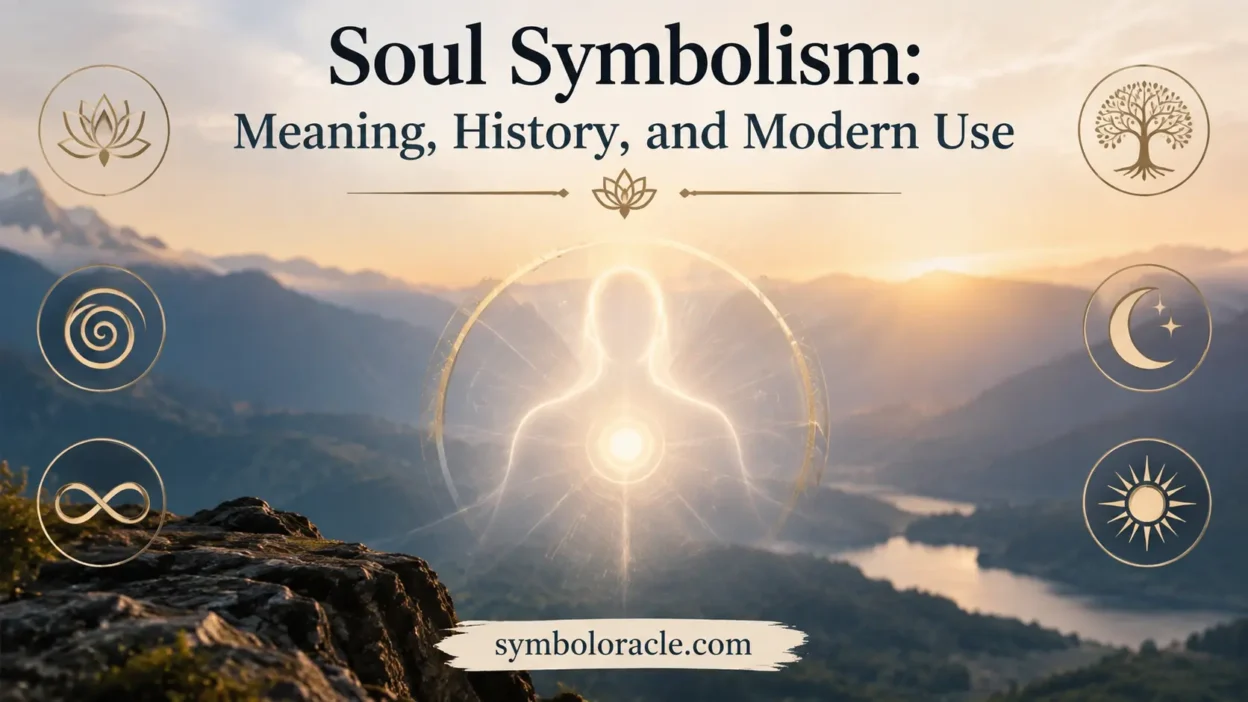
Soul symbolism connects the invisible part of human life with ideas such as identity, conscience, love, spirituality, and existence. In modern American culture, people often use the idea of the soul to describe a person’s deepest character or the part of them that feels separate from outward appearance.
The subject matters because the soul appears in religion, literature, music, art, tattoos, memorials, jewelry, and everyday speech. Someone may say a song “feeds the soul,” describe a loved one as having a “beautiful soul,” or choose a butterfly tattoo to represent personal transformation.
There is no single object that represents the soul in every culture. Instead, different traditions have used birds, butterflies, hearts, flames, light, breath, and other images to express ideas about life, identity, death, and spiritual existence.
Quick Answer
Soul symbolism commonly represents the inner self, spiritual identity, conscience, life essence, and the part of a person believed to continue beyond the physical body. Historically, different cultures connected the soul with life, breath, moral character, death, rebirth, and the possibility of existence beyond the body.
TL;DR
- The soul often symbolizes inner identity, character, and spiritual life.
- Birds and butterflies have represented the soul in several historical traditions.
- American culture commonly links the soul with authenticity and personal identity.
- Religious traditions differ widely on what happens to the soul after death.
- Tattoos often use soul imagery to express transformation, memory, or individuality.
- Modern soul symbolism can be spiritual, emotional, artistic, or secular.
What the Soul Represents in Modern American Culture
In the United States, the soul is often used as a way to talk about the person beneath the surface. It can refer to character, values, emotional depth, or spiritual identity without requiring a specific religious belief.
For example, calling someone a “good soul” usually describes their kindness and character. Saying that a person has “lost their soul” can suggest that they have abandoned their values or humanity.
American music also uses the word frequently. Expressions such as “soul music,” “soulful voice,” and “music for the soul” connect the concept with emotional honesty and personal expression.
The modern meaning therefore extends beyond religion. A person can use soul imagery to express faith, grief, love, creativity, independence, or a search for personal meaning.
Why There Is No Single Symbol for the Soul
Unlike a national flag or a traffic sign, the soul does not have one universally recognized visual form.
The reason is simple: different societies have understood the soul in different ways. Some traditions describe it as a spiritual part of a person. Others connect it with life itself, consciousness, breath, moral identity, or a person’s relationship with the divine.
As a result, artists often choose physical things that suggest movement from one state to another. A bird can leave the ground and fly into the sky. A butterfly changes from one form into another. A flame can represent life because it burns while it remains alive and disappears when extinguished.
These visual qualities make such objects useful metaphors for an invisible human reality.
Ancient Egyptian Ideas About the Soul
Ancient Egyptian beliefs provide one of the clearest examples of a culture using several symbols for different aspects of human existence.
Egyptian religious thought did not reduce the person to one simple concept called “the soul.” Different parts had different roles. The ka was associated with life force, while the ba was a nonphysical aspect of the person that could move beyond the tomb. The ba was commonly represented as a bird with a human head.
This bird imagery is especially important because it gave a visible form to something that could not be seen. The ba could leave the tomb and return, linking the living person, death, and continued existence.
Egyptian funerary practices also focused on preserving and reuniting different aspects of the deceased. This shows why soul-related imagery appeared alongside tombs, coffins, amulets, and funerary texts.
The ancient Egyptian example also demonstrates why it is misleading to assume that every culture has always used the word “soul” in exactly the modern American sense.
Greek Philosophy and the Meaning of Psyche
Ancient Greek thought gave the idea of the soul another important direction. The Greek word psychē developed into a broad concept connected with life, personality, thought, emotion, and moral qualities.
In early Greek literature, the soul could be understood as something that departs at death. Later thinkers expanded the concept. Plato discussed the soul in relation to immortality, morality, and the structure of human life, while Aristotle developed a different theory in which the soul served as the principle of life in living organisms.
This history matters because modern Western ideas about the soul did not come from one source. Religious beliefs, philosophy, literature, and everyday language all contributed to the concept.
The Greek tradition also helped establish a long-lasting connection between the soul and questions such as:
- What makes a person truly alive?
- What makes someone who they are?
- Does personal existence continue after death?
- How are thought and character related to the body?
Those questions still appear in modern discussions of spirituality and identity.
Birds as Symbols of the Soul
Birds are among the most common images associated with the soul because they naturally suggest movement between earth and sky.
A bird can leave the ground, travel through the air, and disappear into the distance. That physical behavior makes it an effective image for ideas about freedom, transcendence, departure, and spiritual movement.
Ancient Egyptian art used the human-headed ba bird specifically in connection with the nonphysical aspect of a deceased person.
In Christian art, the dove developed a different religious meaning. It commonly represents the Holy Spirit rather than the human soul. This distinction is important because modern decorative imagery can sometimes combine several spiritual symbols without preserving their original religious meanings.
Today, an American choosing a bird tattoo may interpret it as freedom, remembrance, spiritual growth, or leaving the past behind. The exact meaning usually comes from the person rather than from one fixed rule.
Butterfly Symbolism and Spiritual Transformation
The butterfly is another popular soul-related image, particularly in modern tattoos and memorial art.
Its appeal comes from transformation. A butterfly begins life as a caterpillar, enters a chrysalis, and emerges in a very different form. Because of this visible change, people often connect butterflies with personal growth, rebirth, change, and the idea that identity can continue through major transitions.
The butterfly has also appeared in older traditions connected with the soul. The Greek word psychē could refer to both soul and butterfly, creating a linguistic and symbolic association between the two.
Modern Americans often use butterfly imagery after major life changes. It can mark recovery, adulthood, freedom, grief, or a new beginning without necessarily expressing a specific religious belief.
The Heart, Flame, and Light
Several familiar images can represent aspects of the soul, although they do not all have the same historical meaning.
The heart often represents love, compassion, desire, sincerity, and moral character. In religious and artistic traditions, the heart has sometimes served as a symbolic location for inner life.
The flame commonly suggests life, spirit, devotion, or an inner fire. A candle flame at a memorial, for example, can express remembrance and continuing love.
Light often represents knowledge, divine presence, goodness, hope, or spiritual awareness. Christian art frequently uses light to communicate a connection between the earthly and heavenly realms.
These meanings overlap, but they should not be treated as interchangeable. A heart is more strongly associated with emotion, while light often points toward guidance or divine presence.
Soul Symbolism in Christianity
Christian interpretations of the soul vary among denominations and theological traditions, but the soul is generally discussed in relation to human life, moral responsibility, God, salvation, death, and eternal life.
Christian art uses many symbols connected with spiritual existence. The dove represents the Holy Spirit, flames can recall Pentecost, and light can communicate divine presence or revelation.
The cross is primarily a symbol of Christ’s crucifixion and resurrection rather than a generic “soul symbol.” However, it can represent salvation, faith, sacrifice, and hope for eternal life.
For American Christians, soul-related imagery may therefore appear in church art, gravesites, jewelry, memorial objects, tattoos, and personal devotional items. The meaning depends strongly on the specific symbol and religious context.
Soul Concepts in Other Religious Traditions
The idea of a soul is not identical across religions.
In Hindu traditions, ātman is associated with the self and is treated within different philosophical schools in relation to ultimate reality. The concept has no perfect one-word equivalent in every English context.
Buddhist traditions provide an important contrast because many forms of Buddhism reject the idea of a permanent, unchanging self through the teaching commonly called anattā or anātman. Therefore, calling a Buddhist symbol a “soul symbol” can sometimes impose a Western concept where it does not fit.
Jewish and Islamic traditions also contain their own vocabulary and theological discussions concerning life, personhood, spirit, and what happens after death.
These differences are important. “Soul” is a useful English word, but it should not be assumed that every religion defines human spiritual identity in the same way.
What Soul Imagery Means Emotionally
Soul-related symbols often communicate feelings that are difficult to express directly.
They may represent:
- Identity: “This represents who I really am.”
- Memory: “A part of this person remains with me.”
- Love: “This relationship matters beyond appearances.”
- Transformation: “I became a different person after this experience.”
- Freedom: “I am no longer limited by my former life.”
- Faith: “My existence has a spiritual dimension.”
- Mourning: “Someone’s presence continues in memory.”
- Authenticity: “I want to live according to my real values.”
This emotional flexibility explains why soul imagery works in both religious and secular settings. A person does not need to share one specific theology to find meaning in a butterfly, bird, flame, or heart.
Soul Symbolism in Mourning and Memorials
Death is one of the strongest contexts in which people use soul-related imagery.
American memorial traditions may include candles, angels, birds, butterflies, crosses, hearts, photographs, flowers, and personalized jewelry. These objects can express grief while also communicating continued connection.
A butterfly may suggest transformation or a loved one’s continued presence in memory. A bird may represent freedom or departure. A candle may symbolize remembrance and a life that still matters to those left behind.
These interpretations are personal rather than universal. Two people may choose the same image for completely different reasons.
Soul Imagery in Tattoos and Jewelry
Soul-related designs are especially common in personal body art because tattoos allow people to attach a permanent meaning to an image.
Popular choices include:
- Butterfly tattoos for transformation
- Bird tattoos for freedom or remembrance
- Heart designs for love and character
- Angel wings for protection or spiritual belief
- Flames for passion or inner strength
- Trees for growth, family, and connection
- Religious symbols for faith and salvation
Jewelry serves a similar purpose. Pendants, rings, lockets, and bracelets can carry a symbol connected with a loved one, religious belief, personal change, or private identity.
The meaning of a tattoo should therefore be read from the person’s story rather than assumed from the image alone.
Soul Symbolism in Art, Literature, and Music
Artists have long used the soul as a way to explore identity, mortality, morality, and inner conflict.
In literature, the soul can represent a person’s conscience or essential character. A character who “sells their soul” may be giving up moral integrity for personal gain. A character who “finds their soul” may be discovering an authentic identity.
Music uses the concept even more broadly. “Soulful” can describe a performance that sounds emotionally honest, expressive, or deeply personal.
In American popular culture, the word has therefore developed a meaning that extends beyond theology. It can describe emotional truth itself.
Soul Symbolism in Modern Digital Culture
Social media has made symbolic identity more visual and personal.
People use birds, butterflies, celestial imagery, hearts, flames, halos, wings, and other designs in profile pictures, artwork, tattoos, digital illustrations, and memorial posts.
The interpretation can also shift quickly. A symbol that once carried a specific religious meaning may now appear in fashion or digital art simply because people associate it with beauty, freedom, or individuality.
This does not erase the original meaning. It simply adds another layer of interpretation.
Common Misunderstandings About Soul Symbols
One common mistake is assuming that every spiritual-looking image represents the soul.
For example, an angel, dove, butterfly, cross, and bird may all appear in spiritual artwork, but they do not have identical meanings. Their histories and religious associations differ.
Another mistake is treating a modern tattoo interpretation as an ancient universal tradition. Many popular websites assign fixed meanings to symbols even when the historical evidence is limited.
It is also important not to confuse symbolism with scientific evidence. A symbol can communicate belief, memory, identity, or emotion without proving that a soul exists or that a particular supernatural event has occurred.
The safest interpretation considers the historical tradition, cultural setting, and personal meaning together.
Positive and Negative Meanings of Soul Imagery
Soul symbolism is usually positive, but the concept can also express fear, moral failure, loss, or spiritual conflict.
A “dark soul” can describe cruelty or a troubled character. A “soulless” person may be portrayed as lacking compassion. In stories, a damaged or divided soul can represent guilt or internal conflict.
The same image can also change meaning depending on context. A flame can represent spiritual life in one setting and destruction in another. A bird can represent freedom but also departure or death.
Meaning comes from context rather than from the object alone.
How Soul Symbolism Has Changed Over Time
The concept has moved from ancient explanations of life and death into a much broader modern vocabulary.
Ancient Egyptian traditions developed detailed ideas about different aspects of a person’s existence. Greek philosophers examined the relationship between soul, life, thought, and morality. Religious traditions later developed their own teachings about spiritual identity, salvation, death, and eternal existence.
Modern American culture adds another layer. The soul can now mean spiritual identity, emotional authenticity, creativity, moral character, or the memory of someone who has died.
That change does not mean older meanings disappeared. Instead, several meanings now exist side by side.
Soul Symbols Compared in the United States
| Symbol | Meaning in the USA | Common Associations | Notes |
|---|---|---|---|
| Butterfly | Transformation and new beginnings | Change, growth, renewal | Often used in tattoos and memorials |
| Bird | Freedom, departure, spiritual movement | Flight, remembrance, release | Historical meanings vary by culture |
| Heart | Love and inner character | Compassion, devotion, emotion | Often emotional rather than specifically spiritual |
| Flame | Life, passion, remembrance | Hope, devotion, memorials | Meaning depends strongly on context |
| Light | Guidance and spiritual awareness | Hope, faith, goodness | Common in religious and artistic imagery |
| Tree | Growth, connection, and continuity | Family, roots, life | Often used as a symbol of lasting identity |
Why People Still Use Soul Symbols Today
People continue to use soul-related imagery because some parts of human experience are difficult to describe with ordinary language.
A photograph can show someone’s face, but it may not express what that person meant to a family. A written biography can describe someone’s achievements, but it may not communicate their character. A symbol can condense an emotional idea into one recognizable image.
That is especially useful during major life events such as marriage, loss, personal transformation, religious commitment, or a new beginning.
For many Americans, soul imagery is therefore less about one fixed definition and more about expressing what feels essential about a person or experience.
Frequently Asked Questions
What does a soul symbolize?
A soul commonly symbolizes a person’s inner identity, life essence, conscience, or spiritual self. Depending on the tradition, it can also represent existence after death or a relationship with the divine.
What symbol represents the soul?
There is no universal soul symbol. Birds, butterflies, hearts, flames, light, and trees are frequently used because they can represent life, transformation, love, freedom, or spiritual continuity.
What does a soul tattoo mean?
A soul tattoo can represent personal identity, spiritual belief, transformation, remembrance, or emotional connection. Its exact meaning depends on the image and the person’s reason for choosing it.
What does a butterfly mean spiritually?
A butterfly is often associated with transformation, renewal, and the transition from one stage of life to another. In some historical traditions, its association with the soul is strengthened by the relationship between the Greek words psychē for soul and butterfly.
What does the soul mean in Christianity?
Christian teachings commonly discuss the soul in connection with human identity, sin, salvation, death, and eternal life. Specific beliefs vary among Christian traditions, so there is no single interpretation shared by every denomination.
Is a bird a symbol of the soul?
A bird can symbolize the soul because flight suggests freedom and movement beyond the physical world. Ancient Egyptian art provides a particularly clear example through representations of the ba as a human-headed bird.
Is soul symbolism always religious?
No. Modern soul imagery can be religious, spiritual, emotional, artistic, or completely secular. Someone may use a butterfly or bird to represent personal growth or memory without making a religious statement.
Conclusion
Soul symbolism represents the part of human existence people associate with inner identity, character, spirituality, memory, and life beyond outward appearance. Its visual language varies because different cultures have developed different ideas about what a soul is and how it relates to the body.
In the United States, these meanings now appear across religion, art, music, tattoos, jewelry, memorials, literature, and digital culture. A bird may represent freedom, a butterfly may mark transformation, and a flame may preserve the idea of remembrance.
The most accurate interpretation always depends on context. A symbol becomes meaningful when its history, cultural setting, and personal story are considered together.


