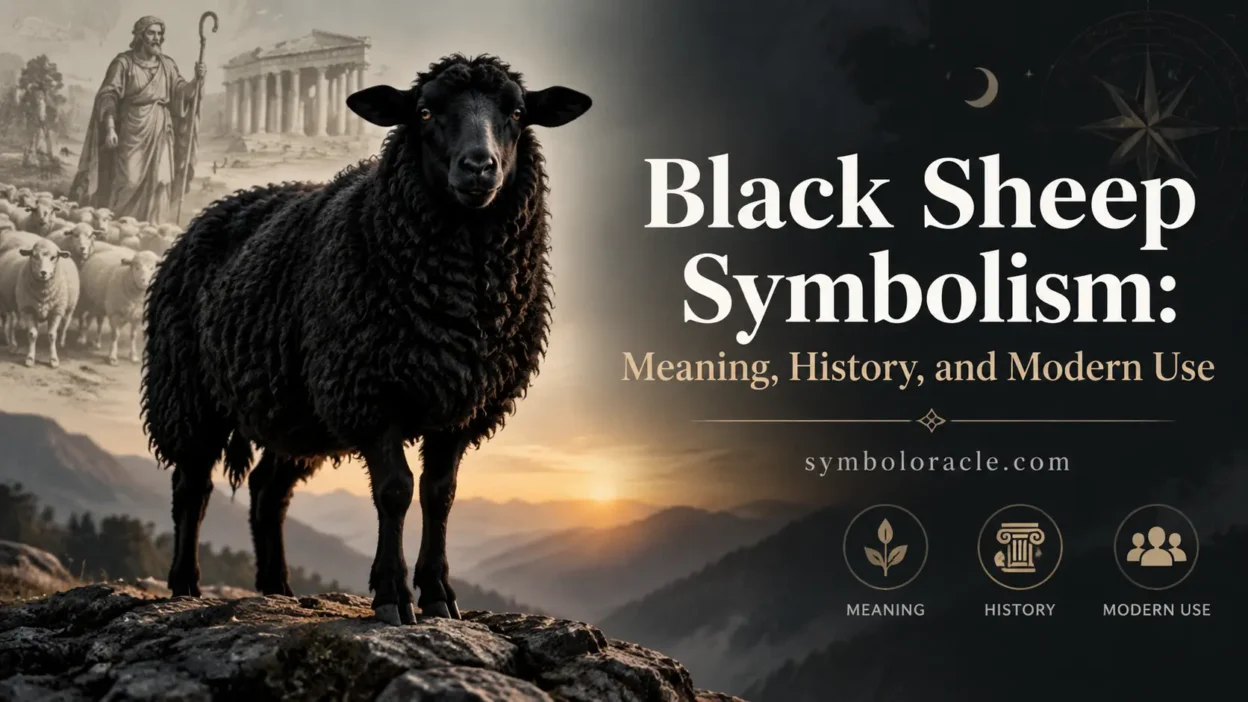
A black sheep is often used to describe someone who stands apart from a group, family, or community. Black sheep symbolism commonly represents individuality, difference, independence, and the experience of not fitting into expected roles. While the phrase has often carried negative associations with being an outsider, modern interpretations increasingly view the black sheep as a symbol of originality, self-expression, and personal identity.
The image comes from a simple natural difference: a sheep with dark wool among a flock of mostly white sheep. Over time, that visual contrast became a way for people to describe social differences, family dynamics, and personal choices. In American culture, the black sheep can represent both the challenges of being misunderstood and the strength that comes from embracing uniqueness.
Today, people encounter this symbol in many places, including tattoos, clothing, artwork, literature, and conversations about identity. Its meaning depends greatly on context. For some, it represents rejection or isolation. For others, it represents courage, creativity, and the freedom to follow a different path.
Quick Answer
Black sheep symbolism commonly represents individuality, independence, and being different from the group in modern American culture. Historically, it was associated with being an outsider or less valued member of a community, but today it is often embraced as a symbol of uniqueness and self-acceptance.
TL;DR
- Black sheep represents individuality and difference.
- The symbol originated from unusual dark-colored sheep.
- American culture often links it with independence.
- Families use the phrase for outsiders or nonconformists.
- Modern tattoos celebrate uniqueness and identity.
- The meaning can be negative or empowering.
What Does a Black Sheep Look Like and Why Did It Become a Symbol?
A black sheep is a sheep with naturally dark wool caused by genetic variation. Unlike the more common white or cream-colored sheep found in many farming communities, black sheep have darker coats that immediately stand out within a flock.
This visible contrast is the foundation of the symbol. Humans naturally notice things that are different from the majority, and the unusual appearance of a dark sheep among lighter-colored animals became an easy metaphor for someone who does not follow the crowd.
In farming communities, wool color also had practical importance. White wool was traditionally preferred because it could be dyed into many colors. Dark wool was harder to change, which sometimes made black sheep less commercially valuable. This practical difference contributed to the idea that something unusual might be viewed as less desirable.
However, the same difference that once created separation is now often seen as a sign of uniqueness. The black sheep stands out not because it is weaker, but because it is visibly different.
The Core Meaning of Black Sheep Symbolism
The meaning of the black sheep has changed over time. Older interpretations focused on exclusion, while modern views often highlight personal strength.
The most common meanings include:
Individuality
A black sheep represents someone who has their own identity rather than simply following social expectations. This interpretation connects with people who choose unusual careers, lifestyles, beliefs, or creative paths.
In American culture, individuality is often considered a positive quality. The idea of creating your own path is strongly connected with personal freedom and self-expression.
Nonconformity
The black sheep is frequently associated with someone who challenges traditions or refuses to follow common rules. This does not necessarily mean rebellion in a negative sense. It can also describe innovation, independent thinking, and originality.
Many artists, entrepreneurs, and creators identify with this idea because their success often comes from doing something different.
Feeling Like an Outsider
The symbol can also express loneliness or the feeling of not belonging. Someone may be called the black sheep of a family because their choices differ from relatives or social expectations.
This meaning reflects the emotional side of the symbol: being different can bring freedom, but it can also create distance.
Self-Acceptance
Modern interpretations often transform the black sheep from a symbol of rejection into a symbol of confidence. Instead of hiding differences, people may embrace them as part of their identity.
Ancient Roots and Early Cultural Associations
The idea behind the black sheep existed before the modern phrase became common. Sheep have held symbolic importance in many societies because they were connected with agriculture, survival, wealth, and community life.
In ancient communities, sheep were valuable animals. They provided wool, milk, meat, and economic resources. Because flocks represented security and prosperity, anything unusual within the flock naturally attracted attention.
The contrast between a single dark sheep and a larger group of lighter sheep became a simple image for difference. Early agricultural societies often valued uniformity because a consistent flock was easier to manage and commercially useful.
Over time, the unusual sheep became connected with ideas about belonging and separation. The symbol developed from a physical observation into a social metaphor.
How the Phrase “Black Sheep” Developed
The phrase “black sheep” eventually entered everyday language as a description of someone who differs from their group.
Historically, being called a black sheep was usually not a compliment. It suggested that a person was unusual, troublesome, or did not represent the values of their family or community.
For example, someone might have been described as the black sheep of a respected family because they rejected traditional expectations or made choices considered unconventional.
The phrase became especially common in English-speaking cultures because the image was easy to understand. Everyone could imagine a flock of similar animals with one noticeable exception.
However, language changes with society. Today, many people use the term with pride, recognizing that being different does not automatically mean being wrong.
Black Sheep Symbolism in the United States
In the United States, the black sheep has a complicated but increasingly positive meaning. American culture often values independence, personal choice, and the ability to create a unique identity.
Because of this, many Americans interpret the black sheep as someone who refuses to be limited by expectations.
The symbol appears in discussions about:
- Family differences
- Career choices
- Creative identity
- Alternative lifestyles
- Personal growth
- Social independence
A person may describe themselves as the black sheep of their family because they chose a different profession, moved away, questioned traditions, or developed interests that others did not share.
In many cases, the phrase is no longer about failure. Instead, it can describe someone who became successful because they followed a different direction.
For example, an artist in a family of business professionals may see themselves as the black sheep because their creative career does not match family traditions. Rather than viewing this difference as a weakness, they may see it as proof of their originality.
Positive and Negative Meanings of the Black Sheep Symbol
The black sheep carries both challenging and empowering meanings.
| Context | Meaning in the USA | Common Associations | Notes |
|---|---|---|---|
| Family identity | Different member of a family | Unusual choices, independence | Can be positive or negative |
| Personal growth | Self-acceptance | Confidence, authenticity | Often embraced today |
| Social situations | Outsider role | Feeling misunderstood | Depends on acceptance |
| Art and tattoos | Individual expression | Creativity, uniqueness | Popular modern use |
| Traditional usage | Someone who breaks expectations | Disapproval, separation | Older interpretation |
The meaning depends on whether the difference is viewed as a problem or a strength.
A person who feels excluded may connect with the symbol because it represents their struggles. Someone who celebrates independence may use the same symbol to represent confidence and freedom.
Black Sheep Meaning in Family Relationships
One of the most common uses of the black sheep symbol involves family relationships.
Families often develop shared traditions, expectations, and values. When one person follows a noticeably different path, they may become known as the black sheep.
This difference can involve:
- Choosing a different career
- Rejecting family traditions
- Having different beliefs
- Moving to a different lifestyle
- Expressing a unique personality
The black sheep role can create tension, especially when families expect everyone to follow similar patterns. However, it can also introduce new ideas and perspectives.
Many families eventually recognize that the person who seemed different may bring valuable change. The black sheep can become the member who encourages growth rather than simply maintaining old habits.
Emotional and Psychological Meaning of the Black Sheep Symbol
The black sheep often represents a complex emotional experience: the desire to belong while also wanting to remain authentic. Many people who identify with this symbol understand what it feels like to be different from those around them.
From a psychological perspective, being the “different one” can create both challenges and strengths.
On one side, feeling like a black sheep may involve:
- Feeling misunderstood
- Experiencing social pressure
- Struggling with acceptance
- Feeling separated from a group
On the other side, the same experience can encourage:
- Self-awareness
- Independence
- Creativity
- Confidence
- Emotional resilience
Many people discover their identity by recognizing that their differences are not weaknesses. A person who does not fit into a traditional role may develop stronger personal values because they have had to make independent choices.
The black sheep symbol often appeals to people who have learned to accept themselves without needing complete approval from others.
Why People Relate to the Black Sheep Identity
People connect with the black sheep because many life experiences involve moments of feeling different.
A teenager may feel like the black sheep because their interests are different from their classmates. An adult may feel this way because their career, personality, or beliefs do not match their family’s expectations.
The symbol gives language to a common human experience: being part of a group while still feeling separate.
In modern American culture, this idea is often connected with authenticity. Many people value being genuine rather than changing themselves simply to fit social expectations.
The black sheep represents the decision to say, “I may be different, but that difference is part of who I am.”
Black Sheep Symbolism in Tattoos and Personal Style
The black sheep has become a popular tattoo design because it communicates identity in a simple but recognizable way.
People choose black sheep tattoos for many reasons, including:
- Celebrating individuality
- Representing personal struggles
- Honoring independence
- Showing pride in being different
- Remembering a time of personal transformation
A black sheep tattoo does not always mean someone feels rejected. For many people, it represents overcoming rejection and becoming comfortable with their own identity.
Design choices can also change the meaning.
A realistic black sheep may represent connection to nature, family history, or personal experience.
A cartoon-style black sheep may express humor and confidence.
A black sheep surrounded by flowers may combine ideas of uniqueness and growth.
A black sheep with a flock may represent someone who belongs while still maintaining individuality.
In American tattoo culture, symbols often become personal stories rather than having one fixed definition.
Black Sheep Symbolism in Fashion and Design
The black sheep appears in fashion and visual design because it immediately communicates contrast.
Designers often use the image to represent:
- Alternative thinking
- Creativity
- Youth culture
- Independent identity
- Breaking traditional patterns
The phrase “black sheep” has also appeared in clothing designs, logos, and artwork. Brands sometimes use it to appeal to people who see themselves as unconventional or different from mainstream culture.
The appeal comes from the balance between separation and confidence. The symbol suggests someone who does not disappear into the crowd.
In interior design, sheep imagery can represent comfort, simplicity, and rural traditions. A black sheep decoration may add a playful reminder that uniqueness has value.
Religious and Spiritual Interpretations of the Black Sheep
Sheep hold important symbolism in several religious traditions, but the specific meaning of a black sheep depends on cultural context.
In Christianity, sheep are often associated with themes such as guidance, care, community, and spiritual belonging. The image of a lost sheep appears in biblical teachings as a symbol of someone who needs guidance or restoration.
A black sheep may sometimes be interpreted as someone who feels separated from a community, although it is not a central religious symbol in Christianity itself.
In broader spiritual discussions, people may use the black sheep as a metaphor for personal transformation. The idea focuses less on being “bad” and more on finding purpose while following a unique path.
It is important to separate traditional religious meanings from modern personal interpretations. The black sheep is mainly a social and cultural symbol rather than a formal religious emblem.
Black Sheep Symbolism in Folklore and Storytelling
Stories often use the black sheep character to explore themes of difference and belonging.
In folklore and literature, the unusual member of a group frequently becomes the person who discovers new possibilities. The character who does not follow the normal path may bring change, solve problems, or reveal hidden truths.
This storytelling pattern appears because societies often need both stability and innovation.
The “ordinary” members of a group preserve traditions, while the outsider questions them. The black sheep character represents the tension between maintaining the familiar and creating something new.
Modern movies, books, and television shows often use similar characters. The outsider may initially appear misunderstood but later becomes valued because of their unique perspective.
Cross-Cultural Meanings of the Black Sheep
Although the phrase “black sheep” is especially common in English-speaking countries, the idea of an unusual member of a group appears in many cultures.
In some agricultural societies, unusual animals were viewed with curiosity or concern because they did not match the expected appearance of the group.
The specific phrase may not exist everywhere, but many cultures have similar ideas about:
- Outsiders
- Nonconformists
- Family differences
- People who challenge traditions
In some societies, standing apart can be viewed negatively because community harmony is highly valued. In others, individual difference may be celebrated as a sign of creativity or leadership.
The interpretation depends on cultural values. Some communities emphasize fitting in, while others emphasize personal independence.
Black Sheep Symbolism and Color Meaning
The color black plays an important role in how people interpret this symbol.
Black has different meanings depending on context. It can represent:
- Mystery
- Strength
- Formality
- Independence
- Grief
- Protection
- Rebellion
When combined with the sheep, black creates a contrast between softness and difference.
Sheep are often associated with gentleness, cooperation, and community. The black color introduces ideas of separation and individuality.
This combination makes the symbol interesting because it contains two opposing ideas:
- Belonging and separation
- Gentleness and strength
- Tradition and independence
That contrast explains why the black sheep remains meaningful in modern culture.
Black Sheep Symbolism in Modern Digital Culture
Social media has changed how people use the black sheep symbol.
Online, many people use the phrase to describe themselves, their communities, or their personal stories. It often appears in discussions about identity, creativity, and rejecting social pressure.
The symbol is especially common among people who share:
- Personal growth stories
- Alternative lifestyles
- Creative projects
- Mental health journeys
- Family experiences
Digital culture has helped shift the meaning from “the unwanted one” toward “the person who chooses a different path.”
However, online discussions can also oversimplify the symbol. Not everyone who feels different has a positive experience. Some people genuinely struggle with isolation or rejection.
The symbol works best when it recognizes both sides: the difficulty of being different and the possibility of finding strength in that difference.
Common Misunderstandings About Black Sheep Symbolism
Because the phrase has been used negatively for a long time, several misunderstandings exist.
Misunderstanding 1: A black sheep is always a bad person
This is one of the oldest interpretations, but it is not always accurate.
Being different does not automatically mean being harmful or irresponsible. A person can be the black sheep because they are creative, independent, or simply follow a different lifestyle.
Misunderstanding 2: The symbol only represents rejection
Although rejection is part of the symbol’s history, modern meanings often focus on acceptance and individuality.
Many people proudly identify as black sheep because they value originality.
Misunderstanding 3: All cultures interpret it the same way
Symbol meanings change between societies. Some cultures may emphasize community differences, while others may focus on personal freedom.
The meaning depends on historical background and social values.
The Evolution of Black Sheep Meaning Over Time
The black sheep has experienced a major shift in meaning.
Earlier interpretations focused on being unusual, unwanted, or separate from the group. This reflected societies where conformity and shared traditions were often important for survival.
Modern interpretations are more balanced. Many people now see the black sheep as someone who has the courage to be different.
This change reflects broader cultural changes in the United States, where individuality and self-expression have become highly valued.
The symbol has moved from representing exclusion to representing identity.
It does not completely lose its older meaning, but it now carries a wider range of interpretations.
How the Black Sheep Symbol Is Used Today
Today, people encounter black sheep imagery in many areas of life.
Personal Identity
People use it to describe their role within families, friendships, or communities.
Art and Creativity
Artists use the image to represent originality and unconventional thinking.
Tattoos
The design often represents personal stories and life experiences.
Clothing and Merchandise
The symbol appears on products aimed at people who value independence.
Literature and Media
Writers use the black sheep character to explore belonging and personal growth.
Conversation
The phrase remains common when discussing family roles and social differences.
The continued popularity of the symbol comes from its flexibility. Different people can see different parts of themselves in it.
Black Sheep Symbolism Comparison Table
| Area | Traditional Meaning | Modern Interpretation |
|---|---|---|
| Family | The unusual or different member | Independent thinker |
| Society | Outsider or nonconformist | Individual with unique identity |
| Personal growth | Separation from others | Self-acceptance |
| Art and tattoos | Struggle or difference | Creativity and confidence |
| Culture | Breaking expectations | Celebrating originality |
Frequently Asked Questions About Black Sheep Symbolism
What does a black sheep symbolize?
A black sheep symbolizes individuality, difference, and independence. In modern American culture, it often represents someone who embraces being unique rather than following the crowd.
Is being called a black sheep negative?
It depends on the context. Historically, the phrase often suggested disapproval, but today many people use it positively to describe someone who is original or independent.
What does a black sheep tattoo mean?
A black sheep tattoo often represents personal identity, overcoming challenges, and pride in being different. The meaning depends on the person’s own experience and design choices.
Does the black sheep have religious meaning?
The black sheep is not a major religious symbol, but sheep imagery appears in several religious traditions. Modern spiritual interpretations often connect it with personal growth and finding one’s own path.
Why do people call someone the black sheep of the family?
People use this phrase when someone has different beliefs, choices, personality traits, or lifestyle decisions compared with their relatives.
Is the black sheep a symbol of rebellion?
Sometimes, but not always. It can represent rebellion against unfair expectations, but it can also simply represent individuality and personal freedom.
Conclusion
The black sheep has developed from a symbol of difference into a broader representation of identity, independence, and self-acceptance. While older meanings focused on separation and being outside the group, modern interpretations often celebrate the courage to remain authentic.
Black sheep symbolism continues to matter because many people understand the experience of feeling different. The symbol reminds us that standing apart does not always mean losing belonging; sometimes it means creating a more honest version of yourself.
A black sheep may look different from the flock, but that difference is exactly what makes it memorable.