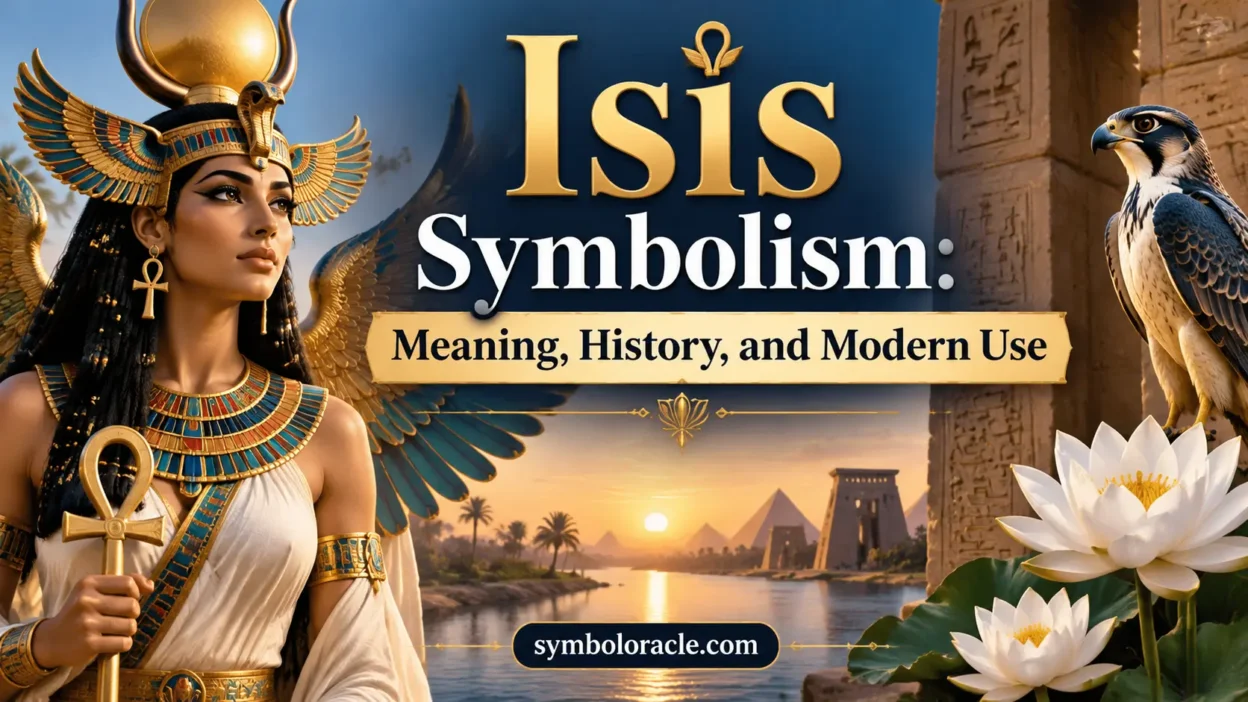
Isis symbolism represents ideas of motherhood, protection, healing, wisdom, and renewal, based on the ancient Egyptian goddess Isis and her role in Egyptian mythology. As one of the most important deities of ancient Egypt, Isis became associated with family devotion, magical knowledge, compassion, and the restoration of life.
People continue to study Isis today because her image appears in historical art, museum collections, religious discussions, literature, jewelry, and modern spiritual movements. Her symbolism reflects how ancient societies used stories and images to express human experiences such as love, loss, survival, and transformation.
Although Isis originated in ancient Egypt, her meaning changed as her worship spread beyond Egypt into the Greco-Roman world. In modern America, she is usually understood as a historical and mythological figure rather than a commonly practiced religious symbol, though some groups still draw inspiration from her traditional associations.
Quick Answer
Isis symbolism commonly represents motherhood, protection, healing, and feminine wisdom in modern American interpretations. Historically, the Egyptian goddess Isis was also associated with magic, resurrection, devotion, and the restoration of balance.
TL;DR
- Isis represents motherhood, healing, and protection.
- Ancient Egyptians honored Isis as a life-giving goddess.
- Her myths influenced later Mediterranean cultures.
- Americans often view Isis as a historical symbol.
- Modern uses appear in art, jewelry, and spirituality.
Who Was Isis in Ancient Egyptian Culture?
Isis was one of the most significant goddesses in ancient Egyptian religion. Her Egyptian name was Aset, and she was connected with the themes of family, fertility, protection, and divine knowledge.
According to Egyptian mythology, Isis was the wife of Osiris and the mother of Horus. One of the most famous myths describes Osiris being killed by his brother Set. Isis searched for and restored Osiris’s body, using her knowledge and devotion to bring order after tragedy.
This story made Isis a symbol of loyalty, endurance, and the ability to overcome loss. Ancient Egyptians viewed her not simply as a mother figure but as a powerful goddess who could protect people during life and guide them through death.
Temples dedicated to Isis existed across Egypt, and her worship eventually spread throughout the Mediterranean world.
The Core Meanings Behind Isis Symbolism
The symbolism of Isis developed from her myths, religious roles, and visual representations. Different cultures emphasized different aspects of her identity, but several meanings remained consistent.
Motherhood and Nurturing Care
One of the strongest associations of Isis is motherhood. Her relationship with Horus represented protection, sacrifice, and the responsibility of caring for the next generation.
In ancient Egyptian art, Isis was often shown holding or nursing Horus. This image emphasized the protective bond between mother and child.
Modern viewers often connect Isis with:
- maternal love
- family protection
- emotional support
- caregiving
- compassion
Because of these associations, Isis is sometimes compared with other ancient mother figures who represented fertility and family devotion.
Protection and Spiritual Guardianship
Isis was believed to protect both individuals and communities. Ancient Egyptians called upon her for safety, healing, and guidance during difficult moments.
Her protective symbolism came partly from her role in defending Horus and restoring Osiris. She represented a force that preserved life against disorder.
Today, people who study Egyptian symbolism often interpret Isis as representing:
- personal strength during hardship
- protection of loved ones
- resilience after challenges
- emotional security
Her protective meaning remains one of the reasons her image appears in historical-inspired artwork and decorative objects.
Healing, Restoration, and Renewal
The story of Isis restoring Osiris made her closely connected with healing and renewal.
Ancient Egyptian beliefs often focused on maintaining balance between life, death, and rebirth. Isis became a figure who represented recovery after destruction.
This symbolism can be understood in modern terms as:
- rebuilding after loss
- emotional healing
- personal growth
- starting again after difficulties
Unlike symbols that focus only on strength or power, Isis often represents a gentler form of endurance based on patience and care.
Ancient Roots of Isis Worship
The worship of Isis developed during ancient Egyptian history and became especially important during later periods of Egyptian religion.
Her influence expanded beyond Egypt when Egyptian religious ideas interacted with Greek and Roman cultures. Temples honoring Isis appeared in places such as Greece, Italy, and other parts of the Roman Empire.
During this period, Isis gained additional associations. Some communities viewed her as a universal mother figure connected with nature, fertility, and protection.
However, interpretations varied by region. Different societies adapted Isis according to their own religious traditions and cultural needs.
Symbols Associated With the Goddess Isis
Ancient Egyptian artists represented Isis through several important symbols. These symbols helped communicate her identity and role.
| Symbol | Meaning Associated With Isis | Historical Context | Modern Interpretation |
|---|---|---|---|
| Throne-shaped crown | Royal authority and divine status | Connected with her Egyptian name and imagery | Leadership and dignity |
| Wings | Protection and guardianship | Often shown sheltering others | Safety and care |
| Ankh | Life and vitality | Common Egyptian symbol of life | Renewal and existence |
| Knot of Isis (Tyet) | Protection and blood symbolism | Used in Egyptian religious practices | Feminine strength and protection |
| Moon imagery | Cycles and renewal | Linked with later interpretations | Change and transformation |
Isis Symbolism in Ancient Egyptian Art
Artists portrayed Isis in many forms depending on the period and purpose of the artwork.
Common images include:
- Isis wearing a throne-shaped crown
- Isis holding the ankh symbol
- Isis protecting Osiris or Horus
- Isis with outstretched wings
- Isis as a royal or maternal figure
These images were not decorative alone. Egyptian art often carried religious meaning, and visual symbols helped communicate beliefs about protection, life, and the relationship between humans and gods.
The winged Isis image became especially recognizable because it visually expressed her role as a guardian.
How Americans Interpret Isis Symbolism Today
In the United States, Isis is mainly recognized through history, mythology, museums, books, films, and academic discussions.
Most Americans encounter Isis through:
- ancient Egyptian exhibitions
- mythology studies
- fantasy literature
- historical documentaries
- decorative art
- spiritual symbolism communities
Modern American interpretations often focus on her positive themes, including motherhood, healing, and resilience.
However, her meaning is usually separated from ancient Egyptian religious practice. For many people, Isis represents a cultural and historical symbol rather than an active religious figure.
Isis Symbolism in Modern Spiritual Practices
Some modern spiritual communities use Isis as an inspirational figure connected with feminine wisdom, nature, healing, and personal transformation.
These interpretations often draw from ancient Egyptian traditions but may also include newer ideas developed through modern spiritual movements.
Common themes include:
- connection with feminine identity
- inner strength
- compassion
- emotional restoration
- personal transformation
These modern interpretations are diverse and do not represent a single shared belief system.
Isis Symbolism in Tattoos and Personal Identity
Tattoos featuring Isis often reflect personal connections with themes such as protection, resilience, motherhood, and transformation. People who choose Isis imagery usually focus on her mythological role rather than ancient Egyptian worship alone.
Common tattoo designs include:
- Isis with spread wings
- Isis holding the ankh
- Egyptian-inspired portraits of Isis
- Isis combined with lotus flowers, scarabs, or other Egyptian motifs
For some people, a winged Isis tattoo represents protection or the desire to support others. For others, it may symbolize recovery after a difficult period, especially because the myth of Isis centers on rebuilding life after loss.
The meaning of an Isis tattoo depends heavily on the individual. A design connected to family, personal growth, or cultural interest may have a very different meaning from one chosen mainly for its visual connection to ancient Egypt.
Religious Interpretations of Isis Across Cultures
The meaning of Isis changed as her worship moved beyond ancient Egypt. In Egypt, she was part of a religious system involving many gods and concepts such as balance, order, and the relationship between life and death.
When Isis worship spread into the Greco-Roman world, some communities emphasized different parts of her identity. She became associated with ideas of universal motherhood, protection at sea, and guidance through life’s challenges.
Some later interpretations compared Isis with other mother and fertility figures from Mediterranean traditions. These comparisons show cultural exchange, but they do not mean that all goddesses shared identical meanings.
Today, religious interpretations of Isis vary:
| Context | Meaning of Isis | Common Associations | Notes |
|---|---|---|---|
| Ancient Egypt | Divine protector and mother | Horus, Osiris, healing | Original religious context |
| Greco-Roman world | Universal goddess figure | Nature, protection, guidance | Adapted across regions |
| Modern spirituality | Personal inspiration | Feminine wisdom, renewal | Diverse interpretations |
| Historical study | Mythological figure | Egyptian culture and art | Academic perspective |
Isis Symbolism and Feminine Identity
Isis is often connected with feminine identity because ancient stories portray her as a devoted mother, healer, and protector. Her symbolism does not focus only on traditional motherhood but also on intelligence, independence, and problem-solving.
In Egyptian mythology, Isis was not portrayed as a passive figure. She used knowledge and determination to overcome challenges.
This has influenced modern interpretations where Isis may represent:
- confidence
- emotional intelligence
- creativity
- caregiving strength
- perseverance
For some people, Isis provides an example of feminine power expressed through wisdom and compassion rather than physical force.
Emotional and Psychological Meaning of Isis
Symbols often become meaningful because people connect them with personal experiences. Isis can represent several emotional ideas that remain understandable today.
Her story involves grief, searching, healing, and restoration. Because of this, many people interpret her symbolism through the lens of overcoming hardship.
Psychological associations may include:
- recovering after change
- finding hope after loss
- protecting important relationships
- accepting life transitions
The story of Isis and Osiris is especially connected with the human experience of facing difficult circumstances and trying to rebuild what has been damaged.
Isis Symbolism in Jewelry, Fashion, and Decor
Ancient Egyptian imagery has remained popular in jewelry and decorative design. Isis-inspired pieces often use traditional Egyptian elements such as wings, crowns, hieroglyphic patterns, and the ankh.
Modern uses include:
- necklaces
- pendants
- wall art
- historical replicas
- fantasy-inspired designs
- museum-inspired decorations
People may choose Isis designs because they appreciate Egyptian history, enjoy ancient art styles, or connect with the symbolic themes associated with the goddess.
However, decorative use does not always reflect a complete understanding of ancient Egyptian beliefs. A design may be appreciated for its appearance while carrying a different meaning for another person.
Isis Symbolism in Popular Culture
Isis appears in books, movies, games, and fictional stories that draw inspiration from ancient mythology.
Modern entertainment often adapts Egyptian gods by emphasizing themes such as:
- supernatural abilities
- ancient mysteries
- heroic journeys
- conflicts between gods
These portrayals can introduce audiences to Egyptian mythology, but fictional versions may simplify or change traditional stories for entertainment purposes.
People interested in accurate symbolism often look beyond fictional portrayals and explore the original myths and historical context.
Common Misunderstandings About Isis Symbolism
Because Isis has been interpreted across many centuries, misunderstandings can occur.
One common mistake is viewing Isis only as a “goddess of magic.” While Egyptian stories connect her with magical knowledge, her symbolism includes much broader themes such as family, healing, protection, and restoration.
Another misunderstanding is assuming that every modern use of Isis imagery represents the same belief system. Today, people may use Isis symbols for historical interest, artistic reasons, personal identity, or spiritual reflection.
The meaning depends on the context in which the symbol appears.
Isis Symbolism and Modern Misuse
The name “Isis” has also become associated with a modern extremist organization that used the acronym ISIS. This association is unrelated to the ancient Egyptian goddess.
Because of this, some people may encounter confusion when seeing the word “Isis” outside historical contexts. When discussing the goddess Isis, the subject is ancient Egyptian mythology and cultural history, not the modern political organization.
Separating these meanings is important because they come from completely different origins.
How Isis Symbolism Has Changed Over Time
The meaning of Isis has evolved significantly over thousands of years.
In ancient Egypt, she was a major goddess connected with religious life, family protection, and restoration. Later Mediterranean cultures expanded her image and emphasized different qualities.
In modern times, Isis is often viewed through historical, artistic, and symbolic perspectives rather than as a central religious figure.
Her changing meaning demonstrates how symbols develop as societies reinterpret old stories according to new cultural settings.
Why Isis Remains Relevant Today
Isis remains relevant because the themes connected with her story continue to appear in human experiences.
People still understand ideas such as:
- caring for family
- surviving loss
- rebuilding after challenges
- seeking knowledge
- protecting others
These themes explain why ancient symbols continue to appear in modern art, storytelling, and personal expression.
The lasting interest in Isis does not come from one single meaning. It comes from the many human experiences represented through her mythology.
Frequently Asked Questions About Isis Symbolism
What does Isis symbolize?
Isis commonly symbolizes motherhood, protection, healing, and restoration. In ancient Egyptian religion, she was also connected with magic, wisdom, and the preservation of life.
What does an Isis tattoo mean?
An Isis tattoo often represents protection, resilience, transformation, or connection with ancient Egyptian culture. The personal meaning depends on the person wearing the design.
Is Isis a positive or negative symbol?
Historically, Isis was primarily viewed as a protective and nurturing goddess. Some modern confusion comes from the unrelated use of the acronym ISIS by a violent extremist organization, which has no connection to the Egyptian goddess.
Why was Isis important in ancient Egypt?
Isis was important because Egyptian myths portrayed her as a devoted wife, mother, healer, and protector. Her stories represented themes of family loyalty, survival, and restoring balance.
What does the winged Isis symbol mean?
The winged Isis image represents protection and guardianship. Ancient artists often showed her wings as a sign of her ability to shelter and defend others.
Do people still worship Isis today?
Some modern spiritual groups include Isis in their practices, while many others study her as a historical and mythological figure. Modern interpretations vary widely.
How is Isis viewed in American culture?
In the United States, Isis is mainly recognized as an ancient Egyptian goddess associated with mythology, art, history, and symbolic meanings such as protection and renewal.
Conclusion
Isis symbolism reflects ideas of protection, motherhood, healing, wisdom, and renewal that developed from one of ancient Egypt’s most influential goddesses. Her myths show a figure connected with devotion, restoration, and the ability to overcome hardship.
Today, Isis is understood in many ways across American culture, including historical study, art, tattoos, jewelry, and spiritual reflection. While interpretations have changed over time, the central themes connected with Isis continue to focus on care, resilience, and rebuilding after loss.
The meaning of Isis symbolism depends on context, but its connection to protection and renewal remains one of the clearest reasons this ancient figure continues to be remembered.