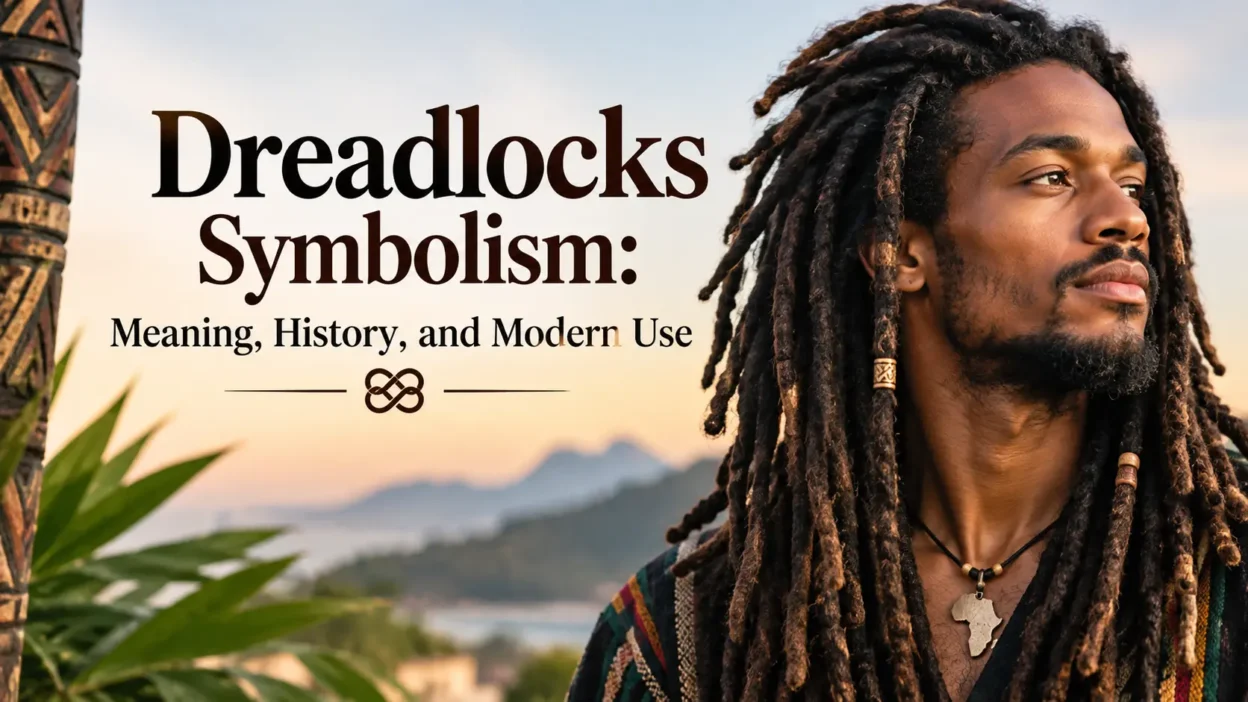
Dreadlocks symbolism is closely connected to identity, spirituality, cultural pride, resistance, and natural self-expression. In the United States, locs can carry different meanings depending on the wearer, from personal freedom and Black cultural identity to religious devotion and individual style.
The hairstyle itself consists of sections of hair that naturally or intentionally coil, twist, or mat together into rope-like strands. Although many Americans associate locs with Jamaica and Rastafari, similar forms of matted hair have existed in several cultures and religious traditions.
Today, the meaning of locs is especially important because hair can communicate identity without words. For some people, growing locs is a spiritual commitment. For others, it is a way to embrace natural hair, reject restrictive beauty standards, honor family or cultural heritage, or simply choose a hairstyle that feels authentic.
Quick Answer
Dreadlocks commonly symbolize cultural identity, self-acceptance, spirituality, and resistance to imposed beauty standards in modern American culture. Historically, matted hair has also been associated with religious devotion, asceticism, African and Afro-Caribbean identity, and Rastafari beliefs.
TL;DR
- Locs can symbolize identity, cultural pride, spirituality, and personal freedom.
- Rastafari gave dreadlocks major religious and cultural meaning in Jamaica.
- Hindu ascetics have long used matted hair as a sign of renunciation.
- In America, locs became linked with Black pride and natural-hair movements.
- Some wearers choose “locs” instead of “dreadlocks” because of the word’s history.
- Modern locs can represent culture, fashion, individuality, or several meanings at once.
What Dreadlocks Look Like and Why They Carry Meaning
Locs are formed when sections of hair become tightly intertwined rather than being regularly separated with a comb. They may develop naturally, or a person may intentionally create them through methods such as twisting, interlocking, palm rolling, or other techniques.
Their physical appearance matters symbolically because the style often shows a long-term relationship with natural hair. Unlike a haircut that changes quickly, locs can take years to grow and mature.
That visible passage of time can become part of their personal meaning.
A person’s locs may represent patience, commitment, self-acceptance, or a decision to stop altering their hair to fit someone else’s expectations. In other cases, they are simply a preferred hairstyle.
This distinction is important. Not every person with locs is making a cultural, political, or religious statement. The same hairstyle can have very different meanings for different people.
What Locs Commonly Mean in the United States
In the United States, locs are strongly associated with Black identity and the history of natural-hair acceptance.
The connection developed through several overlapping cultural movements. Rastafari brought a distinctive spiritual and political meaning to the hairstyle, while the Black Power and natural-hair movements helped establish natural Black hairstyles as visible expressions of racial pride and cultural self-definition.
For many African Americans, wearing locs can therefore communicate a rejection of the idea that straightened or Eurocentric hair is the standard for professional or personal appearance.
The meaning can also be much more personal. Someone may grow locs because they want to accept their natural texture, mark a new stage of life, honor their heritage, or create a hairstyle that feels uniquely theirs.
The National Museum of African American History and Culture notes that African Americans today embrace many natural hairstyles, including locs, braids, and Afros, reflecting changing attitudes toward Black hair and beauty.
Ancient and Early Traditions of Matted Hair
It would be misleading to say that one culture “invented” locs.
Matted and locked hair has appeared in different parts of the world at different periods. The exact hairstyle, method, and symbolism have not always been the same.
Ancient Egyptian evidence, for example, includes braids, locks, hair extensions, and wigs. Archaeological objects from Egypt show that carefully arranged locks and braided hair were part of established grooming practices thousands of years ago.
India provides another important historical tradition. Hindu ascetics have used jata, or matted hair, as part of an ascetic lifestyle. In Hindu art, Shiva is frequently portrayed with matted hair, making the hairstyle closely associated with asceticism, spiritual discipline, and religious imagery.
These examples demonstrate why modern locs should not be treated as having one universal origin or one universal meaning.
Rastafari and the Spiritual Meaning of Dreadlocks
The most important historical connection for the modern word “dreadlocks” is Rastafari.
Rastafari developed in Jamaica during the 1930s in a social environment shaped by colonialism, African identity, Christianity, and the ideas associated with Jamaican political organizer Marcus Garvey. The coronation of Haile Selassie I of Ethiopia in 1930 became particularly important to the emerging movement.
Within Rastafari, uncut or locked hair became part of a broader way of life and a visible declaration of African identity.
The hair was not simply a fashion choice. It could communicate religious commitment, separation from oppressive social structures, and identification with African heritage.
Rastafari communities were also historically marginalized and sometimes persecuted by authorities and wider Jamaican society. Wearing dreadlocks therefore carried social meaning as well as religious meaning.
This history explains why reducing Rastafari dreadlocks to a “reggae hairstyle” misses an important part of their cultural significance.
Dreadlocks and the Symbolism of Spiritual Devotion
Hair can become a religious symbol when a tradition connects physical appearance with discipline or devotion.
In Rastafari, allowing hair to grow and form locks has been connected with religious identity and a rejection of imposed standards. In Hindu traditions, matted hair can signify the ascetic’s separation from ordinary worldly concerns.
These traditions are different and should not be merged into one generic idea of “spiritual hair.”
The similarity is more basic: hair becomes a visible reminder of a person’s chosen way of life.
For someone who regards their locs as religious, cutting the hair may therefore have significance beyond changing a hairstyle. It can represent a change in religious practice, identity, or personal commitment.
At the same time, many people with locs have no religious connection to them. Spiritual symbolism belongs to particular traditions and individuals rather than automatically applying to everyone who wears the style.
Locs, Black Identity, and Cultural Pride
In American culture, locs can symbolize Black identity and cultural pride.
This meaning became especially visible during the 1960s and 1970s, when Black Power encouraged greater pride in African heritage, natural hairstyles, clothing, and cultural expression. Locs became one of several natural hairstyles used to challenge narrow standards of beauty.
The hairstyle could communicate an important message without requiring a political slogan:
My natural appearance does not need to be changed to become acceptable.
For some wearers, that idea remains central today.
Locs can also connect individuals with family and community. A person may grow them because parents, grandparents, friends, or cultural figures wore similar hairstyles. In this sense, the symbolism can involve continuity rather than protest.
Why Locs Can Symbolize Resistance
Resistance is one of the strongest modern interpretations of locs, but it needs context.
Black hair in America has often been judged according to standards that favored straight hair and treated natural Black textures as less professional or less attractive. Locs, Afros, braids, and other natural styles consequently became part of larger conversations about racial identity and social acceptance.
In this setting, choosing to wear locs can represent resistance to pressure to conform.
The symbolism becomes particularly clear when someone has previously experienced criticism, school restrictions, workplace rules, or social pressure because of their hair.
Hair discrimination has also been documented in American schools and workplaces, which helped fuel legal and cultural movements addressing discrimination based on natural Black hairstyles.
Resistance, however, is not the only possible meaning. Calling every person’s locs a political statement would be just as limiting as ignoring the historical politics altogether.
What Dreadlocks Can Symbolize Emotionally
On a personal level, locs can represent several emotional ideas:
| Context | Meaning in the USA | Common Associations | Notes |
|---|---|---|---|
| Natural hair | Self-acceptance | Confidence, authenticity | Often connected to embracing natural texture |
| Cultural identity | Heritage and pride | Black identity, African diaspora | Meaning varies by individual |
| Spiritual practice | Devotion | Faith, discipline, commitment | Especially relevant in specific religious traditions |
| Resistance | Independence | Nonconformity, social change | Often connected to hair-discrimination history |
| Personal style | Individuality | Creativity, fashion | May have no religious or political meaning |
| Life journey | Growth and patience | Time, change, maturity | Long-term hair growth can mark personal milestones |
The emotional symbolism often comes from the story behind the hairstyle.
Someone who grows locs after a major life transition may see them as a marker of renewal. Another person may associate them with childhood, family, faith, or cultural belonging.
That is why there is no single emotional definition.
Dreadlocks in Other Religious and Cultural Traditions
Rastafari is not the only tradition associated with matted hair.
In Hinduism, jata refers to matted hair associated particularly with ascetics and representations of Shiva. Religious artwork shows Shiva with piled or flowing matted locks, making the hair an important part of his visual identity.
The symbolism includes ascetic discipline and a life oriented away from ordinary material concerns. In representations of Shiva, the locks also appear in stories concerning the Ganges, whose descent to Earth is controlled by Shiva’s hair.
Other African and Afro-diasporic traditions have their own histories of natural and locked hairstyles.
These traditions should not be treated as interchangeable. A Rastafari’s locks, a Hindu ascetic’s jata, and a contemporary American person’s locs may look related while carrying entirely different religious or personal meanings.
How Bob Marley Changed the American Image of Locs
Bob Marley played an enormous role in making the visual connection between locs, Jamaica, reggae, and Rastafari recognizable to audiences around the world.
As reggae spread internationally during the 1970s, Marley’s appearance became closely associated with the music and with Rastafari culture. The hairstyle consequently became much more recognizable to Americans who had little direct knowledge of Jamaican religious history.
This created both visibility and simplification.
Some people came to associate locs mainly with reggae, peace, or a relaxed lifestyle. Those associations are part of popular culture, but they do not capture the broader religious, historical, and racial meanings that developed around the hairstyle.
Marley’s global influence helped move locs from a relatively specific cultural context into international fashion and popular culture.
Why Some People Prefer the Term “Locs”
The language surrounding the hairstyle matters.
“Dreadlocks” remains a standard English term and is widely understood in the United States. Dictionaries continue to define it as a hairstyle consisting of long, twisted or matted sections of hair.
However, some wearers prefer locs because they feel that the word “dread” carries negative associations.
The history of the word itself is debated. One explanation connects “dread” with the reverence or fear of God associated with Rastafari, while another popular account connects the term with outsiders describing African or Afro-textured hair negatively. The historical evidence does not justify presenting one disputed explanation as unquestionable fact.
For this reason, using “locs” can be a matter of cultural preference and respect.
The safest approach is simple: if someone identifies their hairstyle as locs, using that term respects their stated preference.
Locs in Modern American Fashion and Media
Today, locs appear across American fashion, entertainment, sports, music, art, and everyday life.
They can be worn short, long, thick, thin, loose, tied back, colored, decorated, or incorporated into elaborate styles. This variety has expanded the hairstyle beyond the visual image established by early reggae culture.
Modern wearers may choose locs for practical reasons, personal style, cultural expression, or some combination of these.
Social media has also changed how loc culture is represented. People share maintenance routines, styling techniques, growth journeys, salon work, and personal stories. This makes locs not only a hairstyle but also a subject of community knowledge and creative expression.
The growing visibility of natural hairstyles has helped make locs more familiar to Americans who may previously have encountered them mainly through reggae or Rastafari imagery.
Dreadlocks, Tattoos, and Personal Symbolism
When locs appear in tattoos or artwork, the meaning often becomes more explicit.
A tattoo showing a person with locs may symbolize Black pride, African heritage, Rastafari spirituality, rebellion against social expectations, or admiration for a particular musician or cultural figure.
However, visual symbolism should be interpreted carefully.
A tattoo of Bob Marley, for example, may represent reggae music to one person and Rastafari or Jamaican identity to another. A portrait showing locs does not automatically communicate the religious beliefs of the person depicted.
The surrounding symbols matter. African colors, religious imagery, musical instruments, national symbols, or specific words can change the interpretation considerably.
Common Misunderstandings About Dreadlocks
One common misunderstanding is that everyone with locs is Rastafari.
That is not true. Rastafari gave locs a major religious and cultural significance, but millions of people who wear locs do not belong to the Rastafari movement.
Another misunderstanding is that locs are inherently unclean.
The hairstyle itself does not determine cleanliness. Locs require appropriate hair and scalp care, just as other hairstyles do. Problems can arise from poor maintenance, excessive tension, or unsuitable practices, but these are not unique symbolic characteristics of locs.
A third misunderstanding is that locs always represent rebellion.
For some people, they do. For others, locs simply express beauty, convenience, identity, family tradition, spirituality, or personal taste.
Symbolism depends on context and the person wearing the hairstyle.
Controversies and Cultural Misuse
Locs can become controversial when people remove them from their historical context.
One example is treating Rastafari imagery as a costume while ignoring the religious and cultural beliefs behind it. Another is using locs as a stereotype for laziness, poor hygiene, criminality, or unprofessional behavior.
Such stereotypes have had real consequences.
American schools and workplaces have historically imposed appearance rules that disproportionately affected Black hairstyles. Research on school dress codes has documented stigmatization and negative treatment involving students who wear dreadlocks.
At the same time, cultural borrowing is not automatically the same thing as disrespect. A person outside the culture may wear locs for personal reasons without intending harm. The important questions involve context, representation, stereotypes, and whether a sacred or culturally specific practice is being reduced to a costume or novelty.
How the Meaning of Locs Has Changed
The symbolism of locs has never been completely fixed.
In different settings, matted hair has represented ascetic devotion, religious identity, cultural belonging, resistance, social difference, or personal style.
In Jamaica, Rastafari transformed locs into a highly recognizable sign of African identity and spiritual commitment. Reggae then carried that visual language across international borders.
In the United States, the hairstyle became connected with Black pride, natural-hair movements, resistance to discriminatory beauty standards, and eventually mainstream fashion.
Today, those meanings coexist.
A person may wear locs because of religion, heritage, family, fashion, personal freedom, or no symbolic reason at all. Modern American culture therefore treats locs as both a recognizable cultural symbol and an ordinary form of personal expression.
Frequently Asked Questions
What do dreadlocks symbolize spiritually?
They can symbolize spiritual devotion, discipline, renunciation, or a visible commitment to a religious way of life. The exact meaning depends on the tradition, with particularly important examples found in Rastafari and Hindu ascetic traditions.
What do locs symbolize in Black culture?
Locs can symbolize natural beauty, cultural pride, identity, self-acceptance, and resistance to Eurocentric beauty standards. Their meaning varies among individuals and communities rather than representing one universal Black experience.
Do dreadlocks always mean someone is Rastafari?
No. Rastafari has an important historical and religious connection with dreadlocks, but many people with locs do not practice Rastafari. In modern America, locs are also worn as a cultural, personal, and fashion choice.
Why do some people call them locs instead of dreadlocks?
Some people prefer “locs” because they consider “dreadlocks” to carry negative historical or cultural associations. Others continue to use “dreadlocks,” so terminology is often a matter of individual or community preference.
What do dreadlocks symbolize in Hinduism?
Matted hair, or jata, has a long association with Hindu ascetics and with Shiva. It can represent renunciation, ascetic discipline, and spiritual practice within particular Hindu traditions.
Are dreadlocks a symbol of rebellion?
They can be, particularly when worn as a rejection of restrictive beauty standards or discriminatory hair rules. But locs do not automatically signify rebellion; many people wear them primarily for cultural, religious, practical, or aesthetic reasons.
What do dreadlocks symbolize in modern America?
Modern meanings include cultural identity, natural-hair pride, individuality, spirituality, resistance, and fashion. The symbolism is highly personal, so the hairstyle alone cannot establish what a particular wearer believes.
Conclusion
Dreadlocks symbolism reflects a long and varied history involving religion, cultural identity, natural hair, personal expression, and social change. Rastafari gave the hairstyle a particularly important spiritual and cultural meaning, while American Black communities connected locs with natural-hair pride and resistance to restrictive standards of appearance.
Today, locs can communicate heritage, faith, individuality, or simply personal style. Their meaning is best understood by looking at the person, tradition, and context behind the hairstyle rather than assuming that one interpretation applies to everyone.