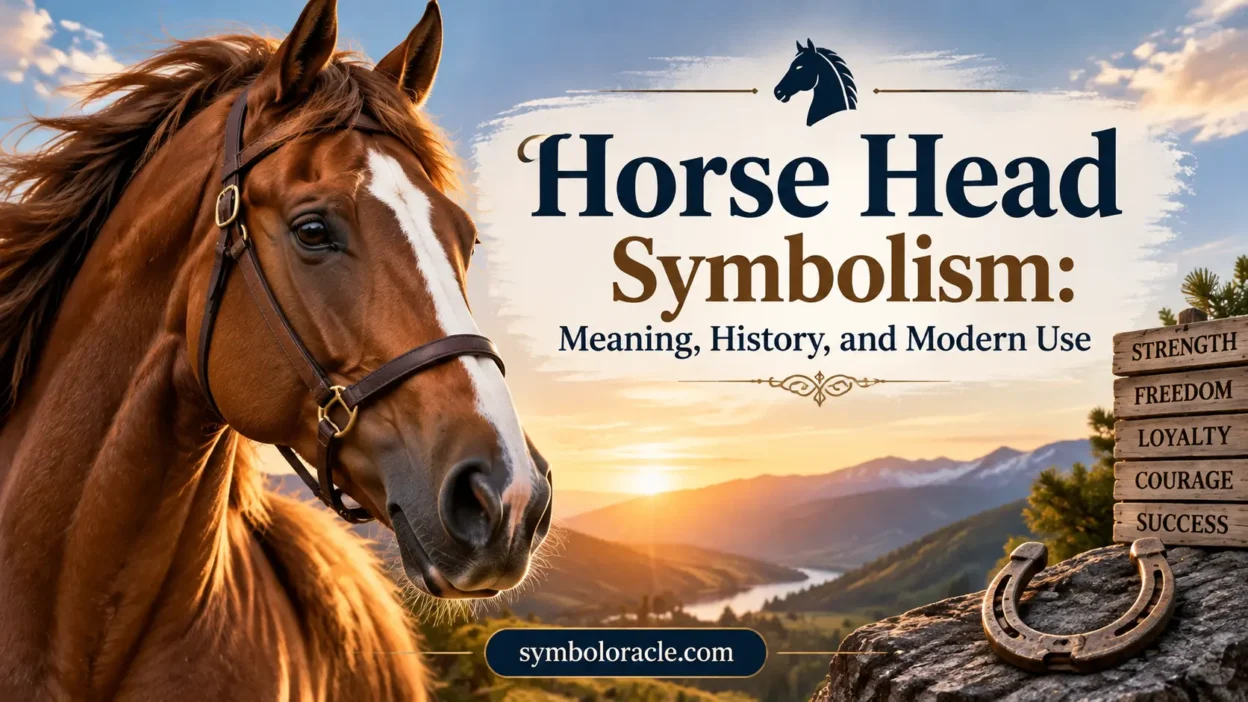
A horse’s head is one of the most recognizable animal images in art and design. With alert ears, a long face, expressive eyes, and a flowing mane, it can suggest motion even when the rest of the animal is absent. Horse head symbolism most often centers on freedom, strength, courage, intelligence, and the close relationship between people and horses.
The image also carries meanings shaped by history. Horses once provided transportation, farm labor, military mobility, hunting advantages, and companionship. In the American West, they became closely associated with ranch life and open landscapes. Horses also became culturally and spiritually important within a number of Native nations, although those traditions are distinct and should not be reduced to a single universal “Native American” meaning.
Today, a horse head can appear on a ranch sign, necklace, tattoo, sports emblem, painting, sculpture, or home decoration. The exact message changes with its pose, artistic style, surrounding imagery, and the person using it.
Quick Answer
Horse head symbolism commonly represents freedom, strength, courage, intelligence, and independence in modern American culture. Historically, horse imagery has also been associated with travel, warfare, labor, prestige, companionship, and the close partnership between humans and horses.
TL;DR
- Horse heads commonly represent freedom, strength, courage, and independence.
- American imagery often connects horses with the West and ranch culture.
- Historical meanings include transportation, labor, warfare, wealth, and prestige.
- Some Native traditions give horses important cultural and spiritual roles.
- Tattoos may express resilience, individuality, movement, or equestrian identity.
- Pose, color, and surrounding imagery can significantly change the meaning.
What a Horse Head Symbol Looks Like
A horse head symbol usually shows the animal from the neck upward. Some versions are realistic, while others use a silhouette or only a few flowing lines.
Artists tend to emphasize recognizable features such as the upright ears, elongated muzzle, large eyes, muscular neck, and mane. A mane flowing backward can create an impression of speed and freedom. A still, upright head can communicate alertness, dignity, or control.
Context changes the interpretation. A horse head enclosed in a horseshoe may suggest equestrian life or good fortune. A horse head beside mountains can emphasize wilderness and freedom. A crowned horse can communicate prestige, while a skeletal horse head creates a much darker impression.
Unlike a full horse shown running across a landscape, a close-up of the head naturally draws attention to personality and expression. This is one reason the design works particularly well for portraits, logos, tattoos, jewelry, and memorial art.
What Horse Heads Commonly Symbolize
Several meanings appear repeatedly in modern horse imagery:
| Context | Common Meaning in the USA | Typical Associations | Notes |
|---|---|---|---|
| Horse head portrait | Strength and dignity | Confidence, intelligence, character | Expression affects interpretation |
| Flowing mane | Freedom | Movement, wilderness, independence | Common in art and tattoos |
| Ranch imagery | Western identity | Cowboys, horses, open country | Strong U.S. cultural association |
| Equestrian design | Partnership | Riding, training, trust | Often personal rather than spiritual |
| Memorial image | Loyalty and remembrance | Companionship, loss, gratitude | May represent a specific horse |
| Dark or skeletal design | Mortality or danger | Death, change, unease | Depends heavily on context |
These interpretations are not fixed definitions. Symbols work through context, and two people may choose the same horse design for very different reasons.
A rider might use it to represent a lifelong relationship with horses. Someone else might choose the same image because it represents an independent personality.
Freedom and Independence
Freedom is probably the most familiar modern American association with horse imagery.
Much of this connection comes from the visual language of horses running across large landscapes. Western movies, paintings, advertisements, photography, and popular culture have repeatedly placed horses against open plains, mountains, and deserts.
A horse therefore became an effective visual shorthand for life without confinement.
A horse head with a loose or windswept mane can strengthen this interpretation. The image suggests an animal moving according to its own direction rather than one controlled by a harness.
For people, the same imagery may communicate independence, self-direction, travel, or the desire to live with fewer restrictions.
There is an important distinction, however. The symbolism of freedom is a cultural interpretation of the image; it does not mean every historical use of horses represented freedom. Horses have also been controlled, traded, worked, ridden into warfare, and used as markers of wealth.
That contrast is part of what makes horse imagery complex.
Strength Without Brute Force
Horse imagery communicates strength differently from symbols such as a bear, bull, or lion.
A horse combines muscular power with responsiveness and coordination. Humans historically depended on horses because they could carry riders, pull loads, travel long distances, and perform demanding work.
As a result, a horse head can symbolize capable strength rather than aggression.
The animal’s posture matters. A raised head with forward-facing ears can appear confident and alert. A dramatically arched neck may suggest physical power and controlled energy.
This interpretation helps explain why horse heads appear in sports logos, ranch branding, automotive imagery, and other designs intended to communicate speed, performance, or endurance.
Intelligence, Awareness, and Sensitivity
The horse head places particular emphasis on the animal’s eyes and ears, making awareness another natural interpretation.
Horses continuously respond to their surroundings. Their ears, head position, eyes, and body posture contribute to communication with other horses and with people.
In symbolic art, those visible characteristics can suggest attentiveness, sensitivity, perception, and instinct.
A calm horse portrait may therefore communicate something different from a charging stallion. Instead of raw speed, the portrait can emphasize patience, trust, intelligence, or emotional connection.
This meaning is especially relevant in equestrian portraits and memorial artwork, where artists often try to capture the recognizable personality of an individual animal.
Courage, Endurance, and Forward Movement
For centuries, horses carried people through difficult terrain, dangerous journeys, hunts, military campaigns, and demanding work. Those historical roles contributed to associations with endurance and courage.
In modern personal symbolism, the horse can become a metaphor for continuing forward despite hardship.
A horse head facing ahead may suggest determination. A rearing or energetic horse can emphasize resistance and courage, while a calm horse may represent endurance through steadiness rather than confrontation.
Because of this flexibility, horse imagery can work as a personal symbol for recovery, a major life transition, or persistence toward a goal.
The meaning usually comes from the person’s story rather than from an established universal code.
Horses in Early Human Culture
The symbolic history of horses is much older than the modern American West.
Humans depicted horses in prehistoric art long before written historical records. Later societies used domesticated horses for transportation, agriculture, warfare, communication, hunting, ceremony, and status.
These practical roles helped shape symbolic ones.
A mounted warrior could move faster than a person on foot. A ruler with valuable horses could display wealth and military capacity. A traveler depended on the animal to cover distances that would otherwise require far more time.
Consequently, horse imagery became associated in different societies with mobility, prestige, military power, nobility, travel, and vitality.
The horse head also developed into a recognizable decorative motif. It appears in sculpture, metalwork, architectural ornament, heraldic imagery, and later commercial design.
Yet there is no single ancient meaning shared by every society. Horse symbolism developed differently according to local religion, economy, mythology, and relationships with the animal.
Horse Symbolism in Mythology
Mythology expanded the horse beyond its everyday role.
One famous example is Pegasus, the winged horse of Greek mythology. Modern culture often connects Pegasus with imagination and inspiration, although ancient stories surrounding the figure are more specific and complicated than modern inspirational interpretations suggest.
Other traditions contain supernatural horses connected with gods, heroes, journeys, warfare, the sky, water, or passage between worlds.
Norse mythology includes Sleipnir, the extraordinary eight-legged horse associated with Odin. Hindu traditions include important horse imagery as well, including Hayagriva, a horse-headed form associated in Hindu religious traditions with Vishnu and knowledge.
These examples should not be merged into one universal definition. A sacred horse in one religious tradition may have little in common with a horse figure from another.
What they demonstrate is how useful the horse became as a metaphor. Its real abilities—speed, travel, strength, and the capacity to carry people—could be extended into stories about supernatural journeys, divine power, or heroic movement.
Horse Imagery in Native American Cultures
Horse imagery has an especially important place in discussions of American history, but broad generalizations require caution.
Different Native nations have distinct histories, languages, beliefs, and artistic traditions. There is no single Native American definition of the horse.
Horses were reintroduced to the Americas through European colonization and spread through trade, capture, breeding, and exchange. By the eighteenth and nineteenth centuries, horses had transformed life for numerous Indigenous peoples, particularly across the Great Plains.
They could expand mobility, make certain forms of hunting more effective, influence warfare, support trade, and become measures of wealth or prestige.
The relationship was not merely practical.
Within particular Plains traditions, horses also became part of ceremonies, stories, artistic practices, and spiritual relationships. Historical horse effigies and dance sticks could commemorate significant horses and the achievements or experiences associated with them.
Modern Native artists continue to use horse imagery, sometimes drawing from community traditions and sometimes addressing contemporary identity, history, or colonial change.
Because these meanings belong to living cultures, a generic horse-head graphic decorated with random feathers or invented “tribal” markings should not automatically be described as authentic Native symbolism.
The Horse Head in American Western Culture
Few settings have shaped modern American horse imagery as strongly as the West.
During the nineteenth century, horses were essential to ranching, transportation, military activity, communication, and many forms of work. Cowboys depended on horses for managing cattle and traveling across large areas.
Later, paintings, dime novels, rodeos, Wild West entertainment, photography, movies, television, and advertising transformed the horse into an enduring image of the frontier.
The resulting symbol combines several ideas:
freedom, open land, hard work, independence, risk, skill, and nostalgia for rural life.
A horse head on a ranch gate or Western-style sign may therefore communicate regional or occupational identity more than spirituality.
Today, the image remains common in rodeo culture, equestrian businesses, ranch branding, Western clothing, country decor, and organizations connected with horses.
Why the Horse Head Can Represent Human-Animal Partnership
Not every horse symbol is about independence.
For riders, trainers, ranchers, and horse owners, the image can represent partnership.
Working successfully with a horse requires communication. Riders learn to notice posture, movement, tension, and other behavioral signals, while horses respond to cues from people.
That relationship makes trust an important modern interpretation.
A horse-head pendant received after years of riding, for example, may symbolize an individual’s equestrian identity. A portrait tattoo might commemorate one particular horse rather than symbolize horses in general.
Memorial pieces make this especially clear. A name, date, halter, flowers, or realistic portrait can transform a general animal emblem into a symbol of grief, gratitude, and companionship.
In those cases, personal history matters more than traditional symbolism.
Emotional and Psychological Meaning
Horse-head imagery often communicates a combination of autonomy and connection.
That combination may seem contradictory, but it reflects how people perceive horses. A horse is physically powerful and capable of independent movement, yet it can also develop close working relationships with people.
Psychologically, someone may therefore identify with a horse because they value independence without wanting isolation.
Common personal associations include:
- confidence without aggression
- emotional sensitivity
- resilience under pressure
- desire for freedom
- self-reliance
- loyalty to trusted companions
- movement toward a new stage of life
These are symbolic interpretations rather than psychological diagnoses. Seeing a horse repeatedly in dreams or choosing horse artwork does not establish a particular personality type.
The meaning comes from the person’s associations, experiences, and context.
Horse Head Tattoo Meaning
Horse head tattoos allow people to personalize the symbol extensively.
A realistic horse portrait often represents a beloved animal or an important connection with equestrian life. A minimalist outline may emphasize freedom or simplicity. A wild mane can suggest independence, while flowers can soften the composition and introduce themes such as remembrance, growth, affection, or beauty.
Other design choices change the message further.
A horse head with mountains may represent travel or attachment to the outdoors. A Western design can express ranch or cowboy identity. A horse and rider may emphasize partnership. A memorial tattoo containing a horse’s name or dates clearly shifts the focus toward remembrance.
Black horses can create a dramatic or elegant visual tone, while white horses are often used artistically to suggest purity, lightness, or idealized freedom. These color associations are contextual rather than universal rules.
Anyone using culturally specific Indigenous designs should determine whether the imagery has a documented meaning and whether using it outside its community is appropriate.
Horse Heads in Jewelry, Decor, and Fashion
Horse-head jewelry has a long appeal because the animal’s profile translates easily into small decorative forms.
Necklaces, rings, bracelets, earrings, belt buckles, and brooches may signal a love of horses or participation in equestrian culture. For some wearers, the image has no formal symbolic meaning beyond that connection.
Home decor uses the motif differently.
A sculpted horse head can suggest traditional elegance, while rustic versions fit Western or ranch-inspired interiors. Minimalist metal silhouettes often emphasize motion and contemporary design.
Fashion brands and sporting organizations can use similar imagery to communicate speed, refinement, athleticism, or prestige.
This illustrates an important feature of modern symbolism: sometimes an image operates as an identity marker rather than a spiritual symbol.
What a Horse Head Symbol Means in Different Contexts
A symbol cannot be interpreted reliably without looking at its setting.
A horse head on a riding-club jacket probably identifies an equestrian organization. The same image carved on a memorial may represent an animal that died. On a Western restaurant sign, it may simply establish a ranch-inspired theme.
Even posture changes interpretation.
An upright head can suggest alertness or dignity. A lowered head may communicate calmness, rest, or sadness depending on the composition. A horse with bared teeth or extreme movement creates tension that a peaceful portrait does not.
Surrounding objects matter as well. Wings, crowns, flowers, skull imagery, horseshoes, landscapes, bridles, and religious motifs can introduce meanings that do not belong to the horse head by itself.
Interpret the complete design rather than isolating one element.
Horse Skull Versus Living Horse Head Symbolism
A living horse head and a horse skull should not automatically receive the same interpretation.
A living horse commonly emphasizes vitality, freedom, strength, personality, or companionship.
A skull introduces mortality.
In Western and Southwestern-inspired art, horse skulls may evoke harsh landscapes, death, survival, abandoned places, or the passage of time. In contemporary tattoos, they can represent mortality, transformation, endurance after loss, or simply a preference for Gothic or macabre imagery.
A skull is therefore not automatically an evil symbol.
Likewise, a black horse or dark-colored horse head does not inherently represent death. Visual mood and cultural context determine whether the design carries a negative, neutral, or positive meaning.
Common Misunderstandings About Horse Head Symbolism
One mistake is assuming that every horse image has a secret spiritual definition.
Many horse-head designs are decorative, occupational, commemorative, or commercial. A ranch logo may simply indicate a horse business.
Another problem is treating all Indigenous horse imagery as one system. Native nations have different traditions, and culturally specific symbols should be identified through the community they belong to rather than assigned generic meanings.
Popular online interpretations can also overstate color symbolism. A white horse does not always mean purity, and a black horse does not automatically mean death. Those interpretations depend on the artistic, religious, or narrative setting.
Finally, a severed or isolated horse head should not automatically be interpreted as violent simply because the rest of the body is absent. Graphic design routinely uses animal heads because they remain recognizable at small sizes.
The form alone does not establish the message.
How the Meaning Changed Over Time
Horse imagery changed as people’s relationship with actual horses changed.
In societies where horses were essential for transportation or warfare, they could represent tangible wealth, mobility, and military capability. Their symbolism emerged partly from what they enabled people to accomplish.
Industrialization altered that relationship.
Cars, trucks, tractors, trains, and other machines replaced many practical uses of horses in the United States. Yet horse imagery did not disappear. Instead, much of its meaning shifted toward recreation, sport, heritage, personal identity, nostalgia, and ideas of freedom.
Modern Americans are more likely to encounter a horse head on a necklace, tattoo, ranch logo, painting, racing emblem, or social-media profile than as an emblem of military transportation.
The physical animal stayed the same. Human circumstances changed, and the symbolism changed with them.
FAQs
What does a horse head symbolize?
A horse head commonly symbolizes freedom, strength, intelligence, courage, and independence. It can also represent equestrian identity, companionship, endurance, or Western heritage depending on the design.
What does a horse head tattoo mean?
A horse head tattoo can represent personal freedom, resilience, movement, or a strong connection with horses. Realistic portrait tattoos are also frequently used to honor a specific horse or preserve the memory of an animal companion.
Is a horse head a symbol of good luck?
Not universally. Horses and related images can carry fortunate associations in some traditions and personal belief systems, but a horse head does not have one established worldwide meaning of good luck.
What does a horse head mean in Native American culture?
There is no single Native American meaning because Indigenous nations have distinct cultural traditions. Among several Plains peoples, horses became important to mobility, hunting, wealth, warfare, ceremony, artistic expression, and spiritual life after horses spread widely through their communities.
What does a black horse head symbolize?
A black horse head may suggest elegance, strength, independence, mystery, or dramatic intensity in modern artwork. Black does not automatically make the horse a symbol of death or misfortune; context determines the interpretation.
What does a white horse head symbolize?
White horse imagery is often associated in modern Western art with purity, freedom, peace, nobility, or an idealized spiritual quality. These meanings are cultural associations rather than fixed rules shared by every historical tradition.
What is the difference between a horse head and horse skull symbol?
A living horse head generally emphasizes vitality, personality, freedom, or strength. A horse skull shifts attention toward mortality, loss, survival, transformation, or the harshness of nature, particularly in Western, Gothic, and tattoo imagery.
Conclusion
The horse head remains effective as a symbol because it can communicate both physical strength and individual character. Its meaning grew from thousands of years of human interaction with horses—as transportation, working partners, animals of war, measures of status, companions, and subjects of art.
In the United States, horse head symbolism most commonly points toward freedom, strength, courage, independence, Western heritage, or a personal bond with horses. Native traditions, mythology, memorial art, ranch culture, and modern tattoo design add other meanings, but each requires its own historical and cultural context.
Rather than assigning every horse head one fixed definition, look at its posture, setting, surrounding imagery, cultural origin, and intended use. Those details usually reveal far more than the horse image alone.


