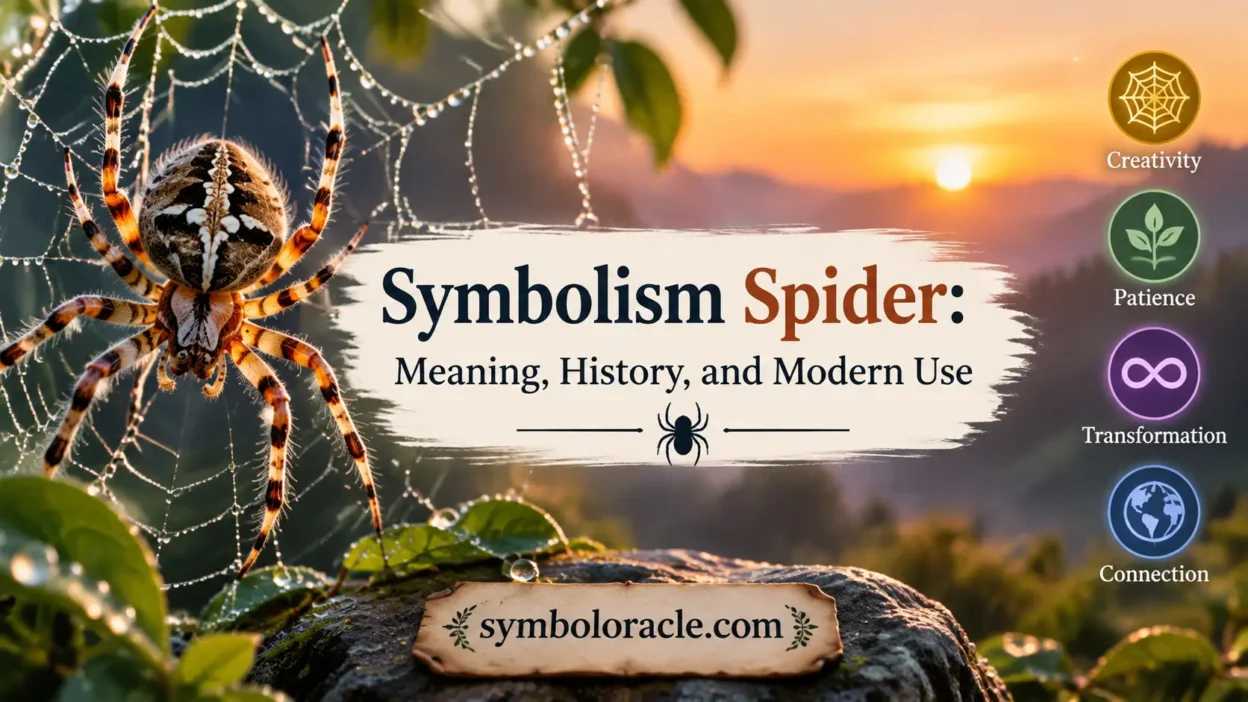
Spiders are among the most recognizable creatures in nature, appearing in homes, gardens, stories, art, and popular culture. Symbolism Spider often represents creativity, patience, independence, and transformation, but its meaning changes depending on cultural background and personal experience. Some people see spiders as signs of skill and resilience, while others associate them with fear or mystery.
The spider’s ability to create intricate webs has made it a symbol connected with creation, planning, and connection. In the United States, spiders appear in Halloween traditions, tattoos, literature, movies, and personal artwork, where they can represent many different ideas beyond simple fear.
Understanding spider symbolism requires looking at history, mythology, psychology, and modern American culture. The meaning of this small creature has developed through centuries of human observation and storytelling.
Quick Answer
Spider symbolism commonly represents creativity, patience, independence, and the ability to build one’s own path in modern American culture. Historically, spiders have also been connected with creation stories, feminine wisdom, fate, protection, and transformation in different traditions.
TL;DR
- Spiders often symbolize creativity through their web-building skills.
- Ancient cultures connected spiders with creation and destiny.
- Americans view spiders through nature, Halloween, and personal expression.
- Spider tattoos often represent strength, patience, or transformation.
- Fear of spiders influences some negative interpretations.
- Modern meanings depend on personal and cultural context.
What Does a Spider Symbolize in the United States?
In the United States, spiders usually carry a mixture of positive and negative meanings. Many people admire spiders because they create complex webs, survive in challenging environments, and play an important role in ecosystems. These qualities have led to associations with creativity, persistence, and adaptation.
At the same time, spiders are one of the most common animals connected with fear. Many Americans grow up hearing stories about dangerous spiders or seeing spiders portrayed as frightening creatures in movies and Halloween decorations.
Because of this contrast, spiders have a unique place in American symbolism. They can represent both careful creation and hidden danger depending on the situation.
| Context | Meaning in the USA | Common Associations | Notes |
|---|---|---|---|
| Nature | Balance and survival | Webs, ecosystems, patience | Often linked with environmental awareness |
| Tattoos | Personal strength or change | Creativity, independence | Meaning varies by individual |
| Halloween | Mystery and fear | Darkness, suspense, horror themes | Mostly cultural entertainment |
| Art and Design | Creativity and craftsmanship | Patterns, imagination | Inspired by spider webs |
| Personal Growth | Transformation | Adaptation, rebuilding | Connected to overcoming challenges |
The Physical Traits Behind Spider Symbolism
The symbolic meanings of spiders often come from their natural behavior. Unlike many animals that rely on speed or strength, spiders depend on patience, planning, and precision.
A spider’s web is one of the most important reasons people associate spiders with creativity. Each web requires careful construction, balance, and attention. The spider creates something functional from simple materials, which has made it a symbol of making, designing, and building.
Spiders also represent independence because many species live alone and rely on their own abilities to survive. Their quiet movement and ability to adapt to different environments have contributed to ideas of self-reliance.
Their ability to regenerate after damage and continue building has also influenced interpretations related to recovery and personal change.
Ancient Roots and Early Spider Symbolism
Human connections with spiders go back thousands of years. Ancient communities observed spiders closely because they appeared in everyday environments and displayed unusual behaviors.
In several traditions, spiders became connected with creation because of their ability to produce webs. The web was sometimes viewed as a model of the universe, showing how different parts of life are connected.
Ancient stories often used spiders to explain ideas about intelligence, patience, and destiny. Rather than being seen only as insects or pests, spiders sometimes became characters representing wisdom and cleverness.
However, meanings were never identical across cultures. Some groups respected spiders, while others viewed them with caution because of their hidden movements and venomous species.
Spider Symbolism in Mythology and Folklore
Spiders appear in many myths and folk traditions around the world. These stories often focus on intelligence, creativity, and survival.
In West African folklore, the spider figure Anansi is one of the most famous examples. Anansi is often portrayed as a clever storyteller who uses intelligence to solve problems. The character helped connect spiders with communication, wisdom, and creativity.
In some Native American traditions, spider figures appear in stories about creation, teaching, and protection. Different communities have their own interpretations, and these meanings should be understood within their specific cultural contexts.
European folklore sometimes presented spiders as signs of mystery or hidden knowledge. In some stories, spiders were associated with fate because their webs resembled patterns or connections that could not easily be changed.
Spider Symbolism and Creation Stories Symbolism Spider
The spider’s ability to weave has made it a frequent symbol of creation. A spider begins with a small amount of material and turns it into a complex structure, which mirrors the human process of building ideas, relationships, and communities.
This connection appears in many symbolic interpretations:
- A spider weaving a web may represent creating a future.
- A web may represent connections between people.
- The spider may represent the creator behind a larger design.
Modern interpretations often use this idea in personal development. Someone may view the spider as a reminder that small actions can eventually create something meaningful.
The Connection Between Spiders and Creativity
Creativity is one of the most common positive meanings associated with spiders. The web is often compared to artistic work because both require imagination, structure, and patience.
Artists and designers sometimes use spider imagery because webs contain natural patterns that inspire visual creativity. The geometric shapes of webs appear in jewelry, architecture, clothing designs, and artwork.
For writers and storytellers, spiders can represent the act of creating narratives. The phrase “weaving a story” reflects this connection between threads, patterns, and imagination.
The spider does not create randomly. It follows a process, making it a symbol of thoughtful creation rather than simple inspiration.
Spider Symbolism in American Holidays and Popular Culture
In the United States, spiders are strongly connected with Halloween. During October, spider decorations appear in homes, stores, costumes, and entertainment because they represent mystery and fear.
Artificial spider webs are commonly used as decorations because they create an atmosphere associated with abandoned places, haunted houses, and suspense.
Popular culture has also shaped spider meanings. Movies, comics, and books have used spiders as symbols of danger, intelligence, transformation, or supernatural abilities.
For example, spider characters may represent villains because of their association with traps and hidden threats. Other stories present spider-like qualities as strengths, such as patience, strategy, and adaptability.
Spider Symbolism in Religion and Spiritual Traditions
Spiders appear in religious and spiritual stories across different cultures, although their meanings vary widely. In some traditions, spiders are connected with creation, wisdom, and protection. In others, they represent caution, illusion, or the challenges people face in life.
In some Hindu traditions, spider imagery is connected with ideas of creation and the relationship between the creator and the universe. The spider weaving a web can represent how existence is created and connected.
In Islamic storytelling and cultural traditions, spiders are sometimes associated with protection because of stories about a spider web providing concealment. Interpretations vary, and the meaning depends on the specific story and cultural context rather than the animal itself.
In some Christian interpretations, spiders may symbolize patience and careful work because of their ability to build webs. However, spiders also appear in religious art and literature as symbols of traps, temptation, or hidden dangers.
These different interpretations show that spider meanings are shaped by beliefs, stories, and local traditions rather than having one universal definition.
Emotional and Psychological Meaning of Spiders
The emotional meaning of spiders often depends on a person’s experiences and feelings toward them. For some people, spiders represent creativity and calm observation. For others, they create feelings of fear or discomfort.
Psychologically, spiders can represent several human experiences:
- Patience: A spider waits carefully instead of rushing.
- Control: Web-building reflects planning and structure.
- Adaptation: Spiders survive in many environments.
- Independence: Many spider species function alone.
- Hidden fears: Fear of spiders can represent reactions to uncertainty or unfamiliar situations.
The strong emotional response many people have toward spiders makes them powerful symbols in stories and artwork. A spider can represent something fascinating and something frightening at the same time.
Why Spider Tattoos Have Different Meanings
Spider tattoos are popular because the symbol can communicate many personal ideas. Unlike symbols with a single widely accepted meaning, spider tattoos often reflect the wearer’s own experiences.
Common interpretations include:
- Creativity: The spider’s web represents building something unique.
- Strength: Surviving difficult situations can be represented by the spider.
- Transformation: A spider may symbolize personal growth or change.
- Independence: The image can represent self-reliance.
- Connection: A web can represent relationships and life experiences.
Some people choose spider tattoos because they appreciate the animal’s appearance, while others connect with its symbolic meanings.
A spider tattoo does not automatically represent a specific belief or identity. Its meaning depends on the person wearing it, the design style, and the cultural setting.
Spider Symbolism in Jewelry, Fashion, and Home Decor
Spider imagery appears in jewelry, clothing, artwork, and interior design because of its detailed visual qualities.
Spider web patterns are often used in decorative designs because they create interesting geometric shapes. Jewelry featuring spiders may represent creativity, mystery, or appreciation for nature.
In home decor, spider designs are especially common during Halloween. Outside of seasonal decoration, spider and web patterns may appear in artistic spaces where they represent craftsmanship or natural beauty.
Fashion designers sometimes use spider imagery because it creates a balance between elegance and unusual visual appeal. The symbol can appear dark, artistic, delicate, or dramatic depending on the design.
Spider Symbolism in Literature, Movies, and Digital Culture
Stories have used spiders for centuries because they naturally create tension and curiosity. Their ability to hide, wait, and build traps makes them effective symbols in fiction.
In literature, spiders may represent:
- intelligence and strategy
- danger and mystery
- creativity and storytelling
- patience and planning
Modern entertainment continues to use spider imagery in different ways. Some fictional spiders are frightening creatures, while others represent heroes, transformation, or special abilities.
Digital culture has also changed how people view spiders. Online communities often share spider photography, educational content, and conservation discussions. These spaces have helped some people move from fear toward curiosity by showing spiders as important parts of nature.
Spider Symbolism Compared With Other Web-Building Creatures
Spiders are often compared with other creatures that create structures, but their symbolism is unique because the spider creates its own material and design.
| Symbol | Main Meaning | Why It Is Associated |
|---|---|---|
| Spider | Creativity and patience | Builds detailed webs independently |
| Bee | Cooperation and productivity | Creates colonies and honey structures |
| Bird | Freedom and movement | Builds nests but represents travel |
| Ant | Organization and teamwork | Creates complex societies |
| Beaver | Construction and preparation | Builds dams through physical effort |
The spider’s symbolism focuses more on individual creation and careful design, while many other building animals are associated with teamwork or community.
Common Misunderstandings About Spider Symbolism
Because spiders often create strong emotional reactions, their symbolism is sometimes misunderstood.
One common misunderstanding is that spiders always represent something negative. While spiders are used in horror themes, many cultures also connect them with creativity, wisdom, and survival.
Another misunderstanding is assuming every spider image has a hidden meaning. Sometimes people use spider designs simply because they like the appearance or because they find spiders interesting.
Some online discussions also exaggerate spider symbolism by presenting one interpretation as the only meaning. In reality, symbols change depending on history, culture, personal beliefs, and context.
The Difference Between Real Spiders and Symbolic Spiders
The meaning people give spiders often differs from the reality of the animal itself.
Real spiders play an important ecological role by controlling insect populations. Their behavior shows adaptation, patience, and efficiency.
Symbolic spiders, however, represent human ideas. A spider in a story, tattoo, or artwork may represent creativity, fear, intelligence, or transformation depending on the creator’s intention.
Separating the real animal from symbolic interpretations helps create a more balanced understanding.
How Spider Symbolism Has Changed Over Time
Spider meanings have shifted as societies changed. Earlier traditions often focused on mythology, survival, and creation stories. Later interpretations developed through literature, art, religion, and popular entertainment.
In modern America, spiders exist between nature and imagination. They appear in science education, Halloween traditions, personal artwork, and entertainment.
The symbol has become more flexible. A spider can represent fear in one setting and creativity in another. A web can suggest a trap or a carefully built connection.
This changing meaning is what makes spider symbolism interesting. It reflects both the characteristics of the animal and the ideas humans attach to it.
Frequently Asked Questions About Spider Symbolism
What does spider symbolism usually mean?
Spider symbolism commonly represents creativity, patience, independence, and the ability to create something meaningful. In different cultures, spiders may also represent wisdom, destiny, protection, or caution.
What does a spider tattoo symbolize?
A spider tattoo can symbolize creativity, personal growth, resilience, or independence. The meaning depends on the design, the person’s experience, and the cultural context.
Are spiders considered a positive symbol?
Spiders can have positive or negative meanings. Many traditions connect them with creation and intelligence, while others associate them with fear, danger, or hidden threats.
What do spiders symbolize in American culture?
In the United States, spiders are commonly linked with Halloween, mystery, nature, and creativity. Their meaning often depends on whether they appear in entertainment, art, decoration, or personal expression.
What does a spider web symbolize?
A spider web often represents connection, creation, planning, and relationships. In some contexts, it can also represent traps or complicated situations.
Are spiders connected to spiritual meanings?
Yes, spiders appear in many spiritual traditions with different interpretations. Some view them as symbols of creation and wisdom, while others focus on caution or transformation.
Why are spiders associated with fear?
Spiders are associated with fear because of their appearance, movement, and the presence of some venomous species. Stories, movies, and cultural traditions have also strengthened this association.
Conclusion
Spiders represent a wide range of human ideas, from creativity and patience to fear and uncertainty. Their ability to build detailed webs has made them a symbol of creation, while their survival skills have connected them with adaptation and independence.
In modern America, spider symbolism continues to appear in tattoos, art, Halloween traditions, stories, and personal expression. Its meaning depends on the situation, the culture, and the person interpreting it.
Rather than having one fixed definition, the spider remains a flexible symbol that reflects how humans understand creativity, challenges, and the connections we build.


