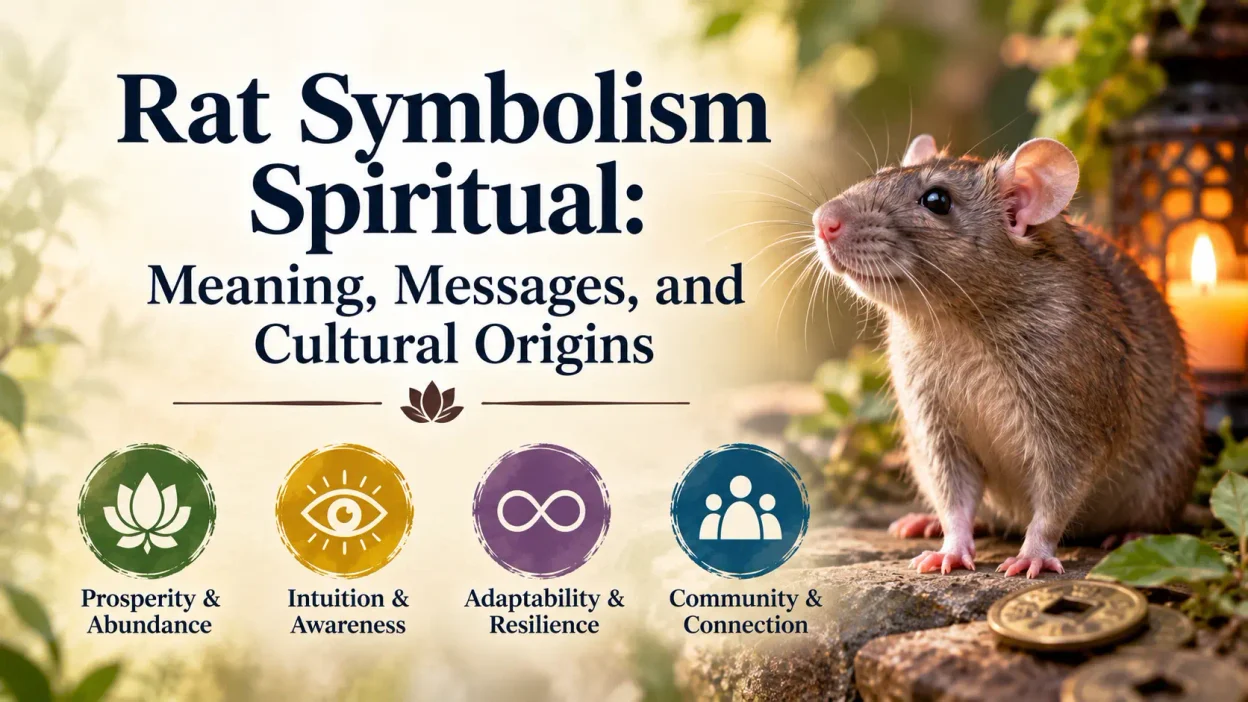
Rat symbolism spiritual interpretations often connect rats with survival, resourcefulness, adaptability, and the ability to find opportunities in difficult circumstances. In modern American culture, rats can also represent fear, distrust, disease, or unwanted change because people commonly associate them with urban environments, garbage, and infestations. These contrasting meanings make the rat an interesting symbol of how people respond to challenging situations.
Rats are intelligent, socially complex mammals that can survive in many environments. They find food in crowded cities, navigate narrow spaces, and adjust to changing conditions. Those characteristics have helped people interpret rats as symbols of persistence and practical intelligence, even when their presence causes discomfort.
A rat appearing in a dream, artwork, story, or spiritual reflection may therefore prompt questions about trust, personal boundaries, overlooked opportunities, or resilience. However, no universal spiritual rule assigns one meaning to every rat encounter. Personal experiences, cultural traditions, and the circumstances surrounding the encounter all influence its interpretation.
Understanding rat symbolism requires looking beyond the animal’s negative reputation. Its history includes associations with prosperity, cleverness, survival, destruction, and renewal. Examining these different perspectives can help explain why a rat may represent either a warning or a reminder of one’s ability to adapt.
Quick Answer
Rat symbolism spiritual meanings commonly include survival, resourcefulness, adaptability, and awareness of hidden problems, while rats can also represent fear, distrust, and unwanted change. Historically, different cultures have associated rats with prosperity, cleverness, destruction, or renewal, so their spiritual meaning depends on cultural context and personal experience.
TL;DR
- Rats commonly symbolize adaptability, survival, and resourcefulness.
- Negative associations include secrecy, betrayal, contamination, and neglected problems.
- Chinese zodiac traditions connect the Rat with intelligence and opportunity.
- Dreams about rats often reflect personal concerns rather than predictions.
- A rat encounter can prompt reflection without proving a supernatural message.
- Modern interpretations depend on culture, environment, and individual experience.
1. What Rats Symbolize in Spiritual Interpretations
Rats often represent the ability to survive in difficult circumstances. They find shelter, locate food, and adjust to environments that other animals might struggle to navigate. In symbolic interpretations, these behaviors can represent practical intelligence, persistence, and the determination to keep moving when circumstances become uncomfortable.
A rat may also symbolize awareness of what other people overlook. Rats frequently inhabit spaces hidden from ordinary view, including walls, basements, tunnels, and drains. This association can inspire interpretations about concealed information, neglected responsibilities, or problems developing outside public attention.
The same animal carries a less favorable meaning in many settings. Because rats can damage property and spread certain diseases, people may associate them with contamination, disorder, or broken trust.
These interpretations are not mutually exclusive. A rat can represent resourcefulness while also reminding someone to examine a difficult situation honestly. Its symbolism becomes more useful when it encourages practical reflection rather than fear.
2. Why Rats Have Such Contrasting Symbolic Meanings
Rats live close to human communities, which has shaped their reputation. Their ability to exploit food supplies and shelter can make them seem clever and persistent, but the same behavior can create serious problems for households and businesses.
This close relationship explains why rats appear in both favorable and unfavorable stories. People may admire an animal’s ability to survive while resenting its presence in their homes. Symbolism often grows from this mixture of respect, inconvenience, fear, and familiarity.
Rats also tend to remain out of sight. When people discover signs of an infestation, they may feel that something has been happening without their knowledge. Symbolically, that experience can suggest hidden concerns, unspoken tensions, or a situation that requires attention.
Still, a rat’s ordinary behavior does not establish a supernatural message. Its symbolic meaning comes from the interpretations people build around their experiences and cultural beliefs.
3. Ancient Origins of Rat Symbolism
Rats and mice have lived alongside human communities for thousands of years, especially as agriculture and food storage created new opportunities for rodents. Grain stores attracted them, and their ability to thrive near settlements made them familiar animals in daily life.
This relationship produced mixed interpretations. Rodents could threaten food supplies and household security, but their presence also reflected the abundance of resources available in a particular environment. Their association with stored grain helped connect them with both material concerns and the vulnerability of prosperity.
Ancient stories and religious traditions did not assign rats one consistent meaning. Some cultures portrayed them as troublesome animals, while others incorporated them into stories about deities, fortune, or the natural world.
It is important to distinguish documented cultural traditions from modern spiritual interpretations. Ideas about rats representing personal transformation or hidden opportunities may be meaningful today, but they should not automatically be described as beliefs shared by all ancient societies.
4. Rat Symbolism in Chinese Culture and the Zodiac
<AsyncImage query=”Chinese zodiac Rat traditional Chinese ink painting gold red decorative art” aspectRatio=”16:9″ width=”100%”/>
One of the clearest positive examples of rat symbolism comes from Chinese zodiac traditions. The Rat occupies the first position in the traditional twelve-animal zodiac cycle, and its place is explained through a well-known folk story about a race among the zodiac animals.
In a popular version of the story, the Rat uses intelligence and strategy to reach the finish line ahead of the other animals. Depending on the telling, it rides on the Ox and jumps forward at the final moment. The story emphasizes cleverness and planning, although versions differ across communities.
People born in Rat years are traditionally associated with qualities such as quick thinking, adaptability, charm, and resourcefulness. Some popular interpretations also connect the Rat with prosperity and the ability to recognize opportunities.
These associations belong to a specific cultural system. Chinese zodiac traditions have their own historical development, regional variations, and connections with calendrical practices. They should not be treated as evidence that everyone in Chinese culture interprets rats identically.
For readers exploring spiritual symbolism, this tradition offers an important reminder: an animal considered unpleasant in one setting can represent intelligence and good fortune in another.
5. Rat Symbolism in Hindu Traditions
<AsyncImage query=”Hindu Lord Ganesha with mouse Mushika traditional Indian devotional painting” aspectRatio=”16:9″ width=”100%”/>
In Hindu traditions, the mouse or rat is closely associated with Ganesha, the deity widely revered as a remover of obstacles and a patron of wisdom, learning, and new beginnings. His vehicle, known as Mushika, is commonly depicted as a small rodent.
The relationship between Ganesha and Mushika has inspired several interpretations. The small animal can represent the ability to enter narrow spaces, reach hidden places, and move through obstacles. Its presence beside a large deity also creates a contrast between physical size and spiritual significance.
Some interpretations understand the rodent as a representation of restless desires or the mind’s tendency to pursue countless distractions. In this reading, Ganesha’s control over his vehicle suggests the importance of guiding impulses through wisdom and discipline.
These explanations vary by tradition and interpretation. The mouse is not simply a symbol of greed or negative behavior, nor should its meaning be separated from the religious story in which it appears.
For modern readers, this association shows how an animal’s ordinary characteristics can become part of a larger religious teaching about judgment, humility, and overcoming obstacles.
6. What a Rat Can Symbolize in Dreams
Dreams involving rats can feel unsettling, particularly for people who fear rodents or associate them with unclean environments. Others may dream about rats without experiencing fear at all. The emotions and circumstances within the dream matter more than the animal alone.
A rat hiding in a room might remind someone of an unresolved concern. A rat escaping could bring to mind an issue the dreamer has struggled to control. A calm or friendly rat might represent curiosity, adaptability, or a willingness to reconsider something previously disliked.
These are possible reflective interpretations, not established universal meanings. There is no reliable evidence that dreaming about a rat predicts betrayal, financial loss, illness, or an approaching event.
Psychologically, dreams can draw on memories, daily experiences, worries, and familiar images. Someone who recently saw a rat in a subway station may dream about one without any broader symbolic significance.
If a rat dream feels meaningful, consider three questions: What emotion did it produce? What was happening in your life at the time? What personal associations do you have with rats? Those questions offer a grounded way to explore the experience without treating it as a prophecy.
7. Rat Symbolism as a Sign of Survival and Resilience
Rats are adaptable animals. They can learn routes, remember locations, and adjust their behavior when conditions change. Their survival depends partly on recognizing resources and responding to risks.
These traits make the rat a useful metaphor for resilience. A person facing a difficult period might identify with the animal’s ability to find a way forward without ideal conditions or obvious support.
Unlike symbols associated with strength or dominance, the rat suggests a more practical form of persistence. It does not need to be the largest animal in its environment to survive. It benefits from awareness, flexibility, and an ability to use available resources.
This interpretation can be especially relevant during career changes, financial uncertainty, or periods of personal adjustment. A rat may serve as a reminder to assess the situation carefully, conserve resources, and look for realistic alternatives.
Resilience does not mean accepting every difficult circumstance. Sometimes adaptation involves leaving an unhealthy environment, asking for help, or establishing better boundaries. The useful lesson is not to endure everything, but to respond intelligently to changing conditions.
8. Rats as Symbols of Hidden Problems and Betrayal
In many English-speaking contexts, rats have a strongly negative reputation. Expressions such as calling someone a rat can suggest betrayal, informing on others, or behaving disloyally. These expressions influence how people interpret rats in dreams, stories, and personal symbolism.
The association with hidden problems also comes from everyday experience. Rats can live inside walls or beneath floors, leaving signs of their presence before anyone sees the animals themselves. This can create a metaphor for concerns that have remained unnoticed.
In a spiritual or reflective interpretation, a rat might prompt someone to reconsider whether a situation feels trustworthy. Perhaps a friendship has become one-sided, a workplace has developed unhealthy habits, or an important responsibility has been neglected.
However, the animal’s appearance cannot establish that another person is dishonest. It would be unfair to treat a dream or an unexpected sighting as evidence of betrayal.
A more constructive interpretation is to examine observable facts. If trust has become a concern, look at behavior, communication, and boundaries rather than assuming the rat has revealed a hidden truth.
9. Rat Symbolism in Modern American Culture
In the United States, rats have a complicated place in popular imagination. In cities such as New York, they are familiar urban animals associated with subway systems, alleys, restaurants, and older buildings. Their presence can evoke frustration, disgust, humor, or admiration for their ability to survive.
Popular culture often portrays rats as pests, sneaky characters, or symbols of urban disorder. At the same time, animated films, children’s stories, and animal-focused media sometimes present them as clever, misunderstood, or unexpectedly lovable.
This contrast shapes contemporary spiritual interpretations. Someone who sees rats mainly as pests may associate them with the need to clean up a problem or protect personal boundaries. Someone who admires their intelligence may see them as symbols of ingenuity and perseverance.
Rats also appear in public health discussions because some rodents can transmit diseases and contaminate food. These are practical concerns, not spiritual judgments about the animal.
The American interpretation therefore reflects a mixture of urban experience, language, entertainment, and personal attitudes. There is no single national belief about what a rat means spiritually.
10. Emotional and Psychological Meaning of Rats
A rat can produce strong emotional reactions because it challenges ideas about cleanliness, safety, and control. Discovering one in a home may create anxiety about damage or contamination. Seeing one in a park may provoke curiosity rather than alarm.
These reactions affect the symbolism people attach to the animal. Someone who has experienced betrayal may associate rats with distrust, while someone who values persistence may admire their resourcefulness.
The same contrast can appear in personal reflection. An unpleasant encounter might bring attention to fears that deserve examination, while a calm observation might encourage greater appreciation for animals that people often dismiss.
Color, setting, and behavior can influence the impression as well. A rat in a dark basement may feel threatening to one observer, while a rat in a nature documentary may appear intelligent and socially complex.
These responses do not mean the animal possesses a fixed emotional message. They show how people use familiar creatures to think about their own experiences, values, and concerns.
11. Rat Symbolism in Other Cultural Traditions
Rat symbolism varies widely across cultural settings, and not every tradition gives the animal a formal spiritual role.
In some European folklore, rats appear in stories about hunger, plague, shipwrecks, or the breakdown of ordinary life. Their association with food stores and crowded settlements helped connect them with hardship and danger. Such stories reflect historical living conditions as well as cultural beliefs.
In parts of South and East Asia, rats can carry more favorable associations, including cleverness, prosperity, and religious significance. The Chinese zodiac and the Hindu tradition surrounding Ganesha provide distinct examples, but their meanings should not be merged into one universal interpretation.
In modern Western storytelling, rats may represent corruption, betrayal, survival, or cleverness. Their meaning changes according to the character they represent and the role they play in the plot.
Cultural respect requires avoiding broad claims such as “Eastern cultures see rats as lucky” or “Western cultures see rats as evil.” Beliefs vary within regions, religions, and communities, and modern interpretations continue to evolve.
12. What It Means to See a Rat in Real Life
Seeing a rat unexpectedly can feel significant, especially when someone is already thinking about change, uncertainty, or a difficult relationship. A spiritual interpretation may offer a way to reflect on the experience, but it does not establish that the encounter was arranged to deliver a message.
One possible approach is to consider the animal’s qualities as prompts for reflection. Its adaptability might inspire you to reconsider your options. Its association with hidden spaces might encourage you to address a neglected responsibility. Its negative reputation might prompt you to examine concerns about trust or personal boundaries.
The setting matters, too. A rat seen outdoors may simply be moving between shelter and food sources. A rat repeatedly entering a home may indicate an actual pest problem that needs attention.
If you prefer a spiritual perspective, you can hold it alongside a practical explanation. Personal meaning does not require rejecting ordinary causes or assuming that every unusual event predicts the future.
13. Rat Tattoos, Art, and Personal Identity
Rat imagery appears in tattoos, illustrations, clothing, and alternative art. People who choose a rat tattoo may be expressing resilience, intelligence, unconventional identity, or an appreciation for animals that society often misunderstands.
For some, the rat represents survival under difficult circumstances. Its ability to thrive in overlooked spaces can suggest independence and determination. For others, the animal’s association with urban life connects it to a particular city, subculture, or personal history.
A rat image can also be deliberately provocative. Someone may choose it because it challenges conventional ideas of beauty or because it represents a refusal to seek social approval.
The design changes the impression. A realistic rat may emphasize the animal itself, while a cartoon rat can communicate humor or nostalgia. A rat paired with a key, a moon, or a plant may reflect meanings specific to the artist or wearer.
There is no universal spiritual interpretation of a rat tattoo. Its most reliable meaning comes from the person’s own reasons for choosing it.
14. Common Misunderstandings About Rat Spirituality
One common misconception is that seeing a rat always signals betrayal or bad luck. Such claims often come from cultural stereotypes and modern spiritual interpretations rather than a shared, established belief across traditions.
Another misunderstanding is that every rat dream predicts a future event. Dreams can feel vivid and emotionally significant, but they do not reliably forecast illness, financial trouble, relationship problems, or other outcomes.
It is also misleading to describe rats as universally negative symbols. Their role in the Chinese zodiac and their association with Ganesha show that rodents can carry favorable or sacred meanings in specific traditions.
Finally, spiritual symbolism should not replace practical judgment. If rats appear in a home, address possible entry points, food sources, and sanitation concerns. If an encounter raises questions about a relationship, examine the actual behavior involved.
A balanced interpretation leaves room for personal reflection while respecting cultural differences and real-world evidence.
Frequently Asked Questions
What does a rat mean spiritually?
A rat may symbolize adaptability, survival, resourcefulness, hidden concerns, or distrust, depending on the context. Its meaning is not universal, so personal associations and cultural traditions matter.
Is seeing a rat a good sign or a bad sign?
Neither interpretation is automatically correct. Some traditions associate rats with intelligence or prosperity, while other cultural associations emphasize danger and disorder.
What does a rat symbolize in a dream?
A rat in a dream may prompt reflection on anxiety, trust, change, or practical challenges. Dreams do not provide reliable predictions, so consider your feelings and recent experiences before assigning meaning.
What does a rat symbolize in Chinese culture?
In Chinese zodiac traditions, the Rat is associated with qualities such as intelligence, adaptability, and resourcefulness. It holds the first position in the twelve-animal zodiac cycle, with its place explained through traditional stories.
What is the spiritual meaning of a rat in Hinduism?
The mouse or rat associated with Ganesha is known as Mushika and serves as the deity’s vehicle. Interpretations may connect it with overcoming obstacles, managing desires, and navigating difficult situations.
Does a rat symbolize betrayal?
In some English-speaking cultures, calling someone a rat suggests disloyalty or informing on others. However, this is a cultural association rather than evidence that seeing a rat reveals another person’s intentions.
What does a rat tattoo mean spiritually?
A rat tattoo may express survival, cleverness, independence, or identification with an overlooked animal. The wearer’s intentions, design choices, and cultural background provide the clearest guide to its meaning.
Conclusion
Rat symbolism spiritual interpretations bring together seemingly opposite ideas: resilience and vulnerability, intelligence and distrust, opportunity and disorder. These contrasts reflect the rat’s long relationship with human communities, where its adaptability has inspired admiration even as its presence can create practical problems.
Chinese zodiac traditions, Hindu religious imagery, European folklore, and modern American culture demonstrate that the rat does not carry one fixed spiritual meaning. Its interpretation depends on the tradition, the situation, and the person considering it.
If a rat encounter feels meaningful, use it as an opportunity to reflect on adaptability, neglected concerns, or personal boundaries without assuming it predicts the future. Sometimes the most useful lesson is simply to look carefully at the circumstances, recognize what needs attention, and choose a practical next step.