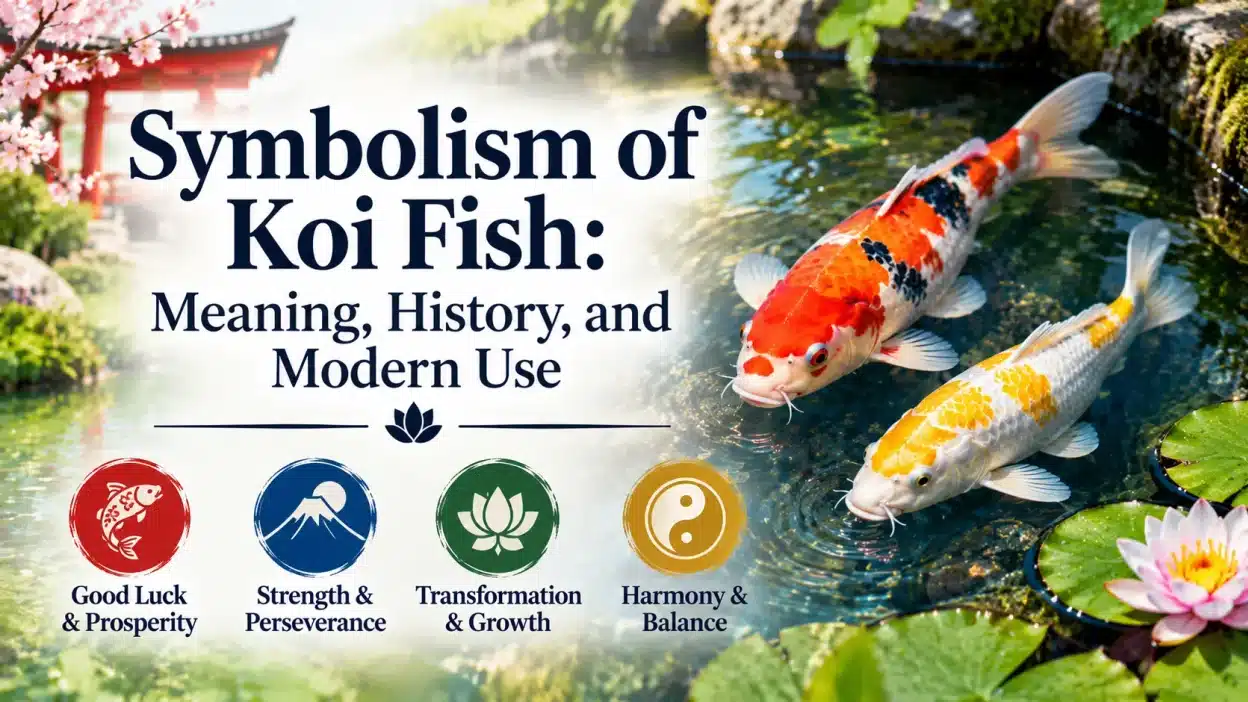
Koi fish are commonly associated with perseverance, good fortune, transformation, and the ability to overcome obstacles. The symbolism of koi fish draws much of its meaning from East Asian cultural traditions, especially Japanese koi keeping and Chinese stories about a carp that becomes a dragon. Today, these colorful fish appear in American tattoos, home decor, water gardens, and artwork as reminders of personal growth and determination.
A koi is a domesticated ornamental variety of common carp, known for its striking patterns of red, white, black, yellow, and orange. Unlike ordinary images of fish used simply to represent aquatic life, koi designs often carry cultural associations that extend beyond their appearance. Their movement through water, longevity under suitable conditions, and place in traditional stories have helped make them recognizable symbols of endurance and prosperity.
For American readers, koi symbolism offers a connection between personal expression and cultural history. Someone may choose a koi tattoo to mark a difficult chapter in life, while another person may keep koi in a garden pond to create a sense of calm and continuity. Understanding the symbol means looking at its Asian roots as well as the different meanings people attach to it today.
Quick Answer
The symbolism of koi fish most commonly represents perseverance, strength, good fortune, prosperity, and personal transformation in modern American culture. In Japanese and Chinese traditions, koi and related carp imagery are also associated with courage, achievement, and the ability to overcome difficult challenges.
TL;DR
- Koi commonly symbolize perseverance, strength, prosperity, and personal growth.
- Chinese carp legends connect swimming upstream with achievement and transformation.
- Japanese koi culture developed distinctive meanings through ornamental breeding and traditional art.
- Koi tattoos often represent resilience, ambition, and important life changes.
- Different koi colors can carry different meanings, but interpretations are not universal.
- Respectful use recognizes koi symbolism’s East Asian cultural roots.
What Koi Fish Look Like and Why They Matter
Koi are ornamental carp bred for their colors, patterns, and body shapes. Their scales may form bright patches, dark markings, or contrasting bands across white, red, orange, yellow, and black bodies. Some varieties have metallic-looking scales, while others are prized for clean patterns and balanced coloration.
People commonly encounter koi in Japanese-style gardens, ornamental ponds, paintings, traditional tattoos, and decorative objects. Their slow, graceful movement can create a sense of calm, while their size and vivid markings make them visually distinctive.
Koi are also recognizable because they thrive in managed ponds and can live for many years with proper care. Their longevity contributes to associations with endurance and continuity, although a koi’s lifespan depends on water quality, genetics, nutrition, and other conditions.
The fish’s appearance does not carry one automatic meaning. A red-and-white koi in a painting may suggest different things from a pair of koi in a wedding design or a black koi in a personal tattoo. The surrounding imagery and the artist’s cultural tradition help determine the interpretation.
The Core Meaning of Koi Fish Symbolism
The most familiar meanings associated with koi are perseverance, courage, prosperity, good fortune, and transformation. These ideas developed through a combination of East Asian stories, artistic traditions, ornamental fish culture, and later personal interpretations.
Perseverance is one of the strongest associations. Koi are frequently depicted swimming against currents or moving through turbulent water. This imagery makes them natural symbols for people facing demanding circumstances or working toward a long-term goal.
Transformation comes partly from a well-known Chinese legend about carp that overcome a difficult river passage and become dragons. The story turns a physical struggle into an image of achievement and change.
Prosperity and good fortune are connected to the fish’s place in East Asian cultural symbolism and the use of carp imagery in celebrations and decorative art. In modern settings, koi may appear in homes, businesses, and gardens as expressions of hopes for success and abundance.
These meanings overlap, but they are not interchangeable. A person may choose a koi because it represents persistence rather than money, while another may focus on prosperity or family well-being.
Chinese Origins: The Carp That Becomes a Dragon
One of the best-known stories connected with koi symbolism is the Chinese legend of carp crossing the Dragon Gate. In popular versions, carp swim upstream against a strong current toward a waterfall or difficult passage. Those that successfully leap over the Dragon Gate are transformed into dragons.
The story is associated with the Yellow River and the idea that extraordinary achievement requires sustained effort. The carp’s journey represents a demanding test, while the dragon represents the elevated status or ability gained by completing it.
This legend has influenced interpretations of carp imagery across East Asia. It is often connected with educational achievement, career advancement, ambition, and the determination to rise beyond one’s starting circumstances. In Chinese cultural contexts, related carp imagery may appear in art and decorative objects associated with success and good fortune.
The story is particularly meaningful because transformation follows action. The carp does not become a dragon simply by wishing for a different life. It must face a difficult challenge and reach the other side.
Modern koi tattoos and illustrations sometimes borrow this narrative to represent a personal milestone, such as completing an education, recovering from a major setback, or building a new life. However, the dragon transformation belongs to a traditional legend, not to the biology of koi fish.
How Koi Fish Became Important in Japanese Culture
Koi hold a particularly visible place in Japanese ornamental fish culture. The Japanese word koi means carp, and nishikigoi refers to the colorful ornamental varieties admired for their patterns. Although carp have a much longer history in East Asia, selective breeding in Japan helped establish the distinctive koi varieties recognized today.
During the nineteenth century, fish keepers in the Niigata region developed and refined colorful carp varieties. Their work gradually turned koi keeping into a respected hobby, and the fish became prized for their appearance, rarity, and carefully developed patterns.
Koi later became familiar features of Japanese gardens, ponds, paintings, and decorative designs. Their movement through water offered artists a way to depict life, persistence, and natural beauty. Their association with perseverance also made them suitable subjects for artwork celebrating determination and achievement.
Japanese koi symbolism is not identical to Chinese carp symbolism, even though the traditions overlap. Chinese legends provide important stories about transformation and success, while Japanese koi culture developed its own artistic conventions and associations.
Koi Fish and the Meaning of Perseverance
A koi swimming against a current is one of the clearest visual expressions of perseverance. The image suggests a person continuing toward a goal despite resistance, uncertainty, or difficult circumstances.
This meaning is especially common in modern American tattoos. Someone who has recovered from an illness, completed a demanding education, left an unhealthy situation, or rebuilt a career may choose koi imagery to represent the effort involved in that change.
The symbolism does not mean that every struggle ends in success. Rather, it emphasizes the decision to keep moving when progress is difficult. That distinction makes the koi a useful symbol for people who value persistence even when the outcome remains uncertain.
A koi swimming upstream often communicates resistance and ambition. A fish moving through calmer water may instead suggest steadiness, patience, or the ability to adapt. The direction of movement and the surrounding water can influence the message.
What Koi Fish Symbolize in the United States
In the United States, koi symbolism appears most often in personal art, tattoos, landscape design, and wellness-oriented spaces. Its popularity reflects both interest in East Asian artistic traditions and the appeal of a symbol that can express several personal values at once.
For some Americans, koi represent overcoming adversity. Others associate them with financial success, good luck, balance, or the willingness to pursue a difficult goal. A koi image may also express an interest in Japanese gardens, traditional tattoo art, or Asian-inspired design.
The meaning changes with the setting. A koi pond outside a home may contribute to a peaceful garden atmosphere, while a koi tattoo may communicate a personal story of survival or achievement. In a business setting, koi imagery may suggest prosperity and forward movement.
American interpretations often combine traditional cultural meanings with individual experiences. This flexibility can make the symbol personally meaningful, but it is important to remember that koi are not simply a generic symbol of motivation. Their history in Chinese and Japanese culture gives them associations that deserve recognition.
Koi Fish Color Meanings and Their Interpretations
Different koi colors are often assigned particular meanings in contemporary symbolism guides, tattoos, and decorative art. Some associations draw on East Asian cultural traditions, while others reflect modern design choices or personal interpretations.
| Koi color or pattern | Common symbolic association | Interpretive context |
|---|---|---|
| Red or red-orange | Love, passion, courage, and vitality | Often used to express strong emotion or determination |
| White | Purity, renewal, and new beginnings | Meaning depends on the accompanying colors and cultural setting |
| Black | Overcoming adversity, strength, and change | Frequently used in modern tattoos to mark difficult experiences |
| Gold or yellow | Prosperity, success, and abundance | Often selected for wealth-related or celebratory imagery |
| Blue | Calm, stability, and masculinity in some modern designs | Meanings vary and are not universal |
| Red and white | Relationships, balance, or achievement | Often interpreted through the design and the person’s intended meaning |
These associations are useful starting points rather than universal rules. A particular color may have different meanings across regions, artistic traditions, and individual experiences.
Black koi, for example, are often described in modern tattoo culture as symbols of surviving hardship. That interpretation can be personally compelling, but it should not be presented as the only traditional meaning of black koi in every Japanese or Chinese context.
Similarly, gold-colored koi may suggest prosperity because of the color’s familiar association with wealth. The meaning may come as much from modern visual conventions as from a specific historical tradition.
When choosing a koi design, consider the overall composition instead of relying on color alone.
Two Koi Fish and the Symbolism of Balance
Two koi swimming together often represent harmony, partnership, balance, or the relationship between contrasting forces. The design is particularly popular in tattoos, paintings, and garden decorations.
When two fish swim in opposing directions, their arrangement may suggest movement between different aspects of life. Some modern interpretations connect the design with the balance of yin and yang, the Chinese philosophical concept of complementary forces that interact to form a whole.
This association requires care. A pair of koi is not automatically a direct representation of the yin-yang symbol, and the two designs have distinct histories. An artist may intentionally combine them, but the interpretation depends on the composition.
In personal art, two koi can represent a marriage, a close friendship, or a partnership that depends on mutual support. They may also symbolize the effort to balance work and family, independence and connection, or ambition and rest.
The image’s appeal lies in the relationship between the fish. Rather than presenting strength as an individual achievement, paired koi can emphasize the value of cooperation and complementary qualities.
Koi Fish, Good Fortune, and Prosperity
Koi are commonly associated with good fortune and prosperity, particularly in decorative contexts influenced by East Asian traditions. Their bright appearance, cultural history, and connections to successful achievement have helped establish this interpretation.
In some Chinese cultural settings, fish imagery is associated with abundance and surplus. This connection is reinforced by the Chinese word for fish, yú, which sounds like the word for surplus or abundance. That linguistic association helps explain why fish appear in some festive images and New Year decorations.
Koi imagery also appears in modern American homes, offices, gardens, and businesses where people want to express hopes for growth and success. A koi painting might be selected for a home office, while a pond can serve as a focal point in a landscape designed around continuity and renewal.
However, koi should not be treated as a guaranteed source of wealth or luck. Their symbolic value comes from cultural associations and personal meaning, not evidence that owning a fish or displaying its image changes financial outcomes.
The distinction allows people to appreciate koi as expressions of hope without confusing cultural symbolism with a promise of material success.
Spiritual and Religious Interpretations of Koi
Koi are sometimes associated with spiritual growth, patience, and the movement through life’s difficulties. In modern spiritual artwork, the fish may represent the idea that a person can develop wisdom through experience rather than avoid every challenge.
Koi also appear in Japanese Buddhist art and temple-related settings, although their significance varies by image and tradition. Buddhist interpretations may connect fish with freedom, vitality, or the ability to move through the world without being trapped by its difficulties. Not every koi image, however, has a specifically Buddhist meaning.
In some modern spiritual practices, koi imagery is used to represent personal transformation or the search for balance. These interpretations may combine traditional Asian imagery with contemporary ideas about mindfulness and self-development.
It is important not to assume that koi are sacred in exactly the same way across all Asian religions. Japanese Buddhism, Shinto practices, Chinese folk traditions, and secular decorative art have different histories and purposes.
A koi pond in a Japanese garden may be designed primarily for beauty and contemplation rather than religious worship. Understanding the setting prevents a general appreciation of Asian art from turning into an inaccurate claim about spiritual belief.
Koi Fish in Tattoos, Jewelry, and Personal Style
Koi tattoos are popular because their shape lends itself to movement, color, and detailed composition. Artists can arrange the fish around an arm, shoulder, back, or leg, using water, waves, flowers, and other elements to create a larger visual story.
For many people, a koi tattoo represents perseverance or a major life transition. The design might commemorate recovery, personal independence, the completion of a long-term goal, or a decision to continue after a difficult experience.
Direction matters in some tattoo traditions. A koi depicted swimming upstream is often interpreted in modern designs as confronting a challenge or working toward achievement. A fish moving downstream may suggest that a struggle has been overcome or that the person is moving with the circumstances of life. These meanings vary by artist and tradition, so they should not be treated as fixed rules.
Koi also appear on necklaces, bracelets, pendants, clothing, and small decorative objects. These items allow people to carry the symbol without committing to a large tattoo.
When choosing koi imagery, consider the design’s cultural influences, the intended meaning, and the quality of the artwork. A design that reflects the fish’s historical and artistic context will usually communicate more than one selected solely because its colors look attractive.
Koi Fish in Gardens, Home Decor, and Modern Design
A koi pond can transform a garden into a place for observation and quiet recreation. The fish move through the water, respond to their environment, and create changing patterns that encourage people to slow down and pay attention.
In Japanese-inspired landscape design, koi ponds may work alongside rocks, bridges, carefully placed plants, and flowing water. The complete setting matters more than the fish alone. It creates a relationship between living creatures and a designed environment.
American homeowners may use koi imagery in wall art, ceramic pieces, fountains, textiles, and outdoor landscaping. Some choose the fish because of its association with prosperity, while others appreciate its visual connection to nature and traditional Japanese aesthetics.
There is also a practical distinction between symbolic display and animal care. Keeping live koi requires appropriate pond size, filtration, water quality, feeding, and protection from predators. The symbol of calm should not obscure the work needed to maintain a healthy environment.
For people who want the visual meaning without the responsibility of live fish, paintings and decorative sculptures offer alternatives. The chosen form can express the same interest in persistence, balance, or natural beauty.
Emotional and Psychological Meaning of Koi
Koi symbolism can help people give a visual form to experiences that are difficult to explain. A person who has endured a long period of uncertainty may find the image of a fish moving against a current more meaningful than a generic statement about staying strong.
The fish can also serve as a reminder of progress. When connected to a personal milestone, a koi tattoo or painting may help its owner recall a decision, relationship, or challenge that changed their life.
Its meaning can be positive without suggesting that suffering is necessary for growth. People sometimes face obstacles they did not choose, and not every difficult experience leads to a satisfying outcome. Koi symbolism is most useful when it recognizes persistence without blaming people who need help or time to recover.
The image may also communicate patience. A koi does not need to be interpreted as constantly fighting. In a calm pond, its steady movement can suggest the value of continuing at a sustainable pace.
This broader interpretation makes the koi relevant to people who value determination but also recognize the importance of rest, support, and adaptation.
Misunderstandings and Cultural Appropriation
Koi imagery is widely shared across global art and popular culture, but its popularity can lead to oversimplification. One common mistake is treating every koi design as a Japanese symbol when its imagery may draw on Chinese legends, modern tattoo conventions, or several traditions at once.
Another mistake is claiming that every color has a fixed traditional meaning. Color associations vary, and contemporary tattoo guides sometimes present personal or modern interpretations as if they were universal historical rules.
Cultural appropriation is also worth considering, particularly when koi designs are combined with other elements from Japanese tattoo traditions. Using an image from another culture is not automatically disrespectful, but context matters. A design can become reductive when it strips a tradition of its history, uses sacred imagery as a meaningless decoration, or relies on stereotypes.
A respectful approach begins with understanding the source of the design. Learn whether its elements come from Japanese tattoo art, Chinese mythology, Buddhist imagery, or contemporary illustration. If working with a tattoo artist, ask about the meaning of the composition rather than assuming that every traditional-looking element has the same significance.
Appreciating koi symbolism does not require claiming ownership of its cultural history. It requires recognizing that the image developed within traditions that continue to matter to the people who maintain them.
How Koi Symbolism Has Changed Over Time
Koi symbolism has developed through several overlapping stages. Carp imagery existed in East Asia long before the colorful ornamental varieties now associated with koi ponds became widely admired. Traditional stories established associations with perseverance and achievement, while artistic and decorative practices gave fish imagery a place in celebrations and everyday life.
The development of ornamental koi in Japan added another dimension. Breeders selected fish for distinctive patterns and colors, turning koi keeping into a specialized cultural practice. The fish became admired not only for their symbolic associations but also for their beauty and rarity.
In the modern era, international travel, art, popular media, and tattoo culture introduced koi imagery to broader audiences. American interpretations often emphasize personal resilience, self-improvement, balance, and prosperity. These meanings overlap with older associations, but some are modern adaptations rather than direct continuations of a single historical belief.
Digital culture has expanded the symbol further. Koi appear in online artwork, profile graphics, illustrations, and personal storytelling. A person can now use the fish as a compact visual statement about identity, ambition, or a period of change.
The result is a symbol with several layers: historical stories, regional artistic traditions, ornamental beauty, and individual meaning. Understanding those layers makes koi symbolism more informative than a list of color definitions alone.
Frequently Asked Questions
What is the main meaning of koi fish symbolism?
Koi fish most commonly symbolize perseverance, strength, transformation, and good fortune. Their association with overcoming challenges is especially connected to East Asian traditions and the story of carp that reach the Dragon Gate and become dragons.
What does a koi fish tattoo mean?
A koi tattoo often represents resilience, ambition, personal growth, or overcoming a difficult period. Its meaning can change with the fish’s direction, color, and surrounding imagery, as well as the owner’s personal experience.
What does a black koi fish symbolize?
In modern tattoo culture, a black koi is often associated with adversity, strength, and surviving difficult experiences. This is a common contemporary interpretation rather than a universal rule across all Japanese and Chinese traditions.
Are koi fish symbols of good luck?
Yes, koi are commonly associated with good fortune and prosperity in many decorative and cultural contexts influenced by East Asian traditions. This association expresses hope and cultural meaning rather than a guarantee of financial success.
What does it mean when two koi fish swim together?
Two koi often symbolize harmony, partnership, balance, or complementary qualities. The image may represent a romantic relationship, a close friendship, or the effort to balance different parts of life.
What is the difference between Japanese and Chinese koi symbolism?
Chinese carp legends, particularly the Dragon Gate story, emphasize perseverance, achievement, and transformation. Japanese koi culture developed distinctive ornamental varieties and artistic traditions that also connect the fish with courage, endurance, and good fortune.
Are koi fish connected to Buddhism?
Koi and other fish appear in some Buddhist artistic and cultural contexts, where fish imagery may suggest freedom or vitality. However, koi are not exclusively Buddhist symbols, and their meaning depends on the specific tradition and setting.
Conclusion
The symbolism of koi fish brings together perseverance, transformation, prosperity, and the determination to move through difficult circumstances. Its roots in Chinese carp legends and Japanese ornamental fish culture explain why koi appear so often in traditional art, tattoos, gardens, and modern personal designs.
For Americans today, the koi can represent a hard-earned achievement, a new beginning, a valued relationship, or a hope for future success. Its meaning depends on the design, cultural context, and story the person associates with it.
The koi’s most useful lesson is not that every struggle leads to triumph. It is that progress can require patience, adaptation, and sustained effort, even when the way forward is difficult to see.