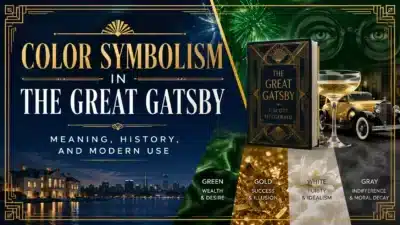

Color symbolism in The Great Gatsby Chapter 1 helps establish the novel’s atmosphere and introduces several themes that become more important as the story develops. F. Scott Fitzgerald uses descriptions of clothing, rooms, landscapes, and objects to distinguish between wealth, social appearance, personal ambition, and emotional uncertainty. The colors in the opening chapter are not simply decorative details; they help readers understand the world Nick Carraway enters when he moves to West Egg.
Published in 1925, The Great Gatsby examines American wealth, class divisions, romantic longing, and the pursuit of an idealized future. Chapter 1 introduces Nick, his wealthy neighbors Tom and Daisy Buchanan, and the mysterious Jay Gatsby, whom Nick sees standing alone outside his mansion. Fitzgerald’s descriptions create an immediate contrast between comfortable luxury and the dissatisfaction hidden beneath it.
Green, white, yellow, and other visual details provide useful starting points for understanding these characters. However, not every color has a fixed meaning, and some familiar interpretations become clearer only in later chapters. Looking closely at Chapter 1 allows readers to separate the symbolism established in the opening from meanings that develop throughout the novel.
Quick Answer
Color symbolism in The Great Gatsby Chapter 1 commonly suggests wealth, social status, hope, innocence, and the contrast between appearance and reality. Fitzgerald uses colors such as green and white, along with descriptions of luxurious surroundings, to introduce the social divisions and personal desires that shape the novel.
TL;DR
- Green introduces Gatsby’s longing and the possibility of an ideal future.
- White reflects elegance, privilege, and the appearance of innocence.
- Yellow and gold connect the novel’s world with wealth and luxury.
- Gray suggests emotional emptiness and social hardship in the wider story.
- Color descriptions help establish the differences between East Egg and West Egg.
- Fitzgerald uses visual details to question the American Dream.
1. Why Fitzgerald Uses Color in Chapter 1
Fitzgerald’s use of color helps readers picture the characters and their surroundings while introducing ideas that extend beyond physical appearance. Instead of explaining every character’s personality directly, he allows descriptive details to influence how readers understand the setting.
Chapter 1 moves between Nick’s modest background, the wealthy Buchanan home, and Gatsby’s mansion across the water. Each location contributes to a different impression of American society. The comfortable elegance of East Egg contrasts with the newer wealth of West Egg, while the distance between the two properties suggests a social divide that money alone cannot easily remove.
Color contributes to this contrast by giving the settings recognizable visual qualities. White clothing, green landscapes, and descriptions of expensive surroundings help create an atmosphere of privilege and possibility.
These details also encourage readers to question what lies beneath the attractive surface. The Buchanans possess wealth and social standing, but their comfortable home does not guarantee happiness or honesty. Fitzgerald introduces this tension before readers fully understand the characters’ private lives.
2. Green Symbolism: Gatsby’s Hope and Desire
Green is one of the most recognizable colors in The Great Gatsby. At the end of Chapter 1, Nick notices Gatsby standing outside his mansion, stretching his arms toward a green light across the water.
The light comes from the direction of Daisy Buchanan’s home, although Nick does not yet know the full importance of their relationship. Gatsby’s gesture creates an image of someone reaching for something distant and emotionally significant.
Green commonly represents growth, renewal, possibility, and hope in American culture. These associations make it a suitable color for Gatsby’s longing. He appears to believe that the future can provide what the past has denied him.
The green light also introduces a difference between wanting something and actually possessing it. Gatsby can see the light, but the water separates him from it. That physical distance reflects the emotional and social barriers between his dream and reality.
Although Chapter 1 gives only a brief glimpse of the green light, the image prepares readers for one of the novel’s central concerns: the human tendency to pursue an ideal that may never match real life.
3. White Symbolism: Elegance and Social Appearance
White is especially noticeable in the descriptions of Daisy and Jordan Baker. When Nick visits the Buchanan home, he sees the two women dressed in white, surrounded by an elegant interior and a light, airy atmosphere.
In American culture, white often represents purity, innocence, cleanliness, and refinement. It is commonly associated with weddings, formal clothing, and celebrations. Fitzgerald uses this familiar visual language to create an impression of comfort and sophistication around the Buchanan women.
However, white also introduces ambiguity. Daisy and Jordan appear graceful and relaxed, but their surroundings do not reveal the full complexity of their personalities. Their elegant appearance can encourage readers to associate them with innocence, even though the novel gradually challenges that impression.
White therefore works on two levels. It creates an attractive picture of upper-class life while inviting questions about whether appearances accurately reflect character.
Daisy’s white clothing is particularly interesting because her social position gives her a polished public image. Yet her conversations and personal circumstances suggest uncertainty, dissatisfaction, and emotional limitations. Fitzgerald uses the contrast between appearance and behavior to complicate the meaning of elegance.
4. Yellow and Gold: Wealth, Luxury, and Status
Yellow and gold are often associated with money, prestige, celebration, and material success in American culture. These associations are relevant to the world Fitzgerald introduces in Chapter 1, where expensive homes, fashionable clothing, and privileged lifestyles establish social identity.
The Buchanan residence communicates financial comfort through its scale, location, furnishings, and overall presentation. Its beauty is not simply personal decoration; it also reflects the family’s established position in society.
Yellow and gold become more recognizable symbolic colors as the novel progresses. Gold is frequently connected with luxury and the display of wealth, while yellow can suggest both brightness and artificial glamour. Readers should be careful not to assign every later meaning directly to Chapter 1.
The important point is that Fitzgerald introduces a society in which material possessions help determine how people are perceived. Wealth creates access to attractive surroundings, but it does not necessarily produce emotional security or moral responsibility.
5. Blue and the Atmosphere of Distance
Blue is often connected with calmness, sadness, imagination, and emotional distance in modern American color associations. In literary interpretation, it can also contribute to a dreamlike or reflective atmosphere.
The opening chapter introduces a world in which characters appear comfortable but are not necessarily emotionally fulfilled. Nick’s observations create a degree of distance between the reader and the wealthy people he visits. He notices their behavior without immediately understanding everything that motivates them.
Blue can be used as an interpretive lens for this atmosphere, particularly when discussing the contrast between outward comfort and private dissatisfaction. However, readers should distinguish between an actual color detail in Fitzgerald’s writing and a broader color association applied during analysis.
The novel’s strongest blue imagery becomes more apparent in later descriptions, so Chapter 1 should not be treated as though it establishes blue as a central recurring symbol.
6. Gray: Social Hardship and Emotional Emptiness
Gray is commonly associated with dullness, uncertainty, aging, and a lack of vitality. These meanings become particularly relevant to the Valley of Ashes, a setting introduced in a later chapter rather than the opening chapter.
It is important to maintain that distinction when analyzing Chapter 1. The Buchanan home and the Valley of Ashes represent very different environments, and Fitzgerald develops their contrast as the narrative progresses.
Chapter 1 establishes the wealthy world that will later be contrasted with places marked by economic hardship and environmental decay. This early introduction makes the novel’s larger class divisions easier to recognize when the setting changes.
Gray therefore belongs in a discussion of the novel’s overall color system, but its major social significance should not be incorrectly attributed to the first chapter alone.
7. The Buchanan Mansion and the Colors of Privilege
The Buchanan mansion is one of the most important settings in Chapter 1. Nick describes a large, attractive home with an expansive lawn, gardens, and an interior designed to communicate wealth and comfort.
The house represents more than financial success. It shows how inherited wealth can create an environment in which people have access to beauty, leisure, and social influence.
The setting also shapes the reader’s first impression of Tom and Daisy. Their home appears organized around comfort and entertainment, yet their conversations reveal tension and dissatisfaction.
The contrast between the mansion’s attractive appearance and the problems within it introduces a recurring idea: a luxurious environment cannot guarantee a stable personal life.
Color descriptions strengthen this contrast by making the setting visually appealing while allowing readers to question the values behind that appearance.
8. East Egg and West Egg: Color, Wealth, and Social Division
Chapter 1 introduces East Egg and West Egg, two wealthy communities on Long Island. Although both contain expensive homes, they represent different forms of social status.
East Egg is associated with inherited wealth and established family connections. West Egg represents newer wealth, including fortunes built by people who want entry into the upper class.
| Color or visual detail | Common interpretation | Connection to Chapter 1 |
|---|---|---|
| Green light | Hope and longing | Gatsby reaches toward Daisy’s distant home |
| White clothing | Elegance and apparent innocence | Daisy and Jordan’s introduction |
| Yellow and gold | Wealth and material display | The novel’s broader world of luxury |
| Blue atmosphere | Distance and reflection | A possible interpretive lens for the novel |
| Gray imagery | Hardship and emptiness | Developed more clearly in later chapters |
The geographical separation between the two communities also represents a social division. Gatsby may possess considerable money, but his position is not identical to that of families with established social connections.
This distinction helps explain why wealth alone cannot fulfill Gatsby’s ambitions. He wants more than a luxurious home. He wants acceptance into a world that values family background and inherited status.
9. Color Symbolism and Daisy Buchanan’s Character
Daisy’s introduction is one of the most carefully constructed moments in Chapter 1. Her white clothing, elegant home, and relaxed manner create an image of beauty and social comfort.
Yet Nick’s conversation with her reveals a more complicated personality. Daisy makes playful comments, expresses dissatisfaction, and speaks about the difficulties of life in a way that suggests emotional uncertainty.
Her appearance and behavior do not always seem to match. White can therefore be interpreted as a symbol of social presentation rather than proof of genuine innocence.
Daisy occupies a privileged position, but she is also shaped by the expectations of her society. Her wealth provides security, while her marriage and social environment limit the choices she appears willing to make.
Through Daisy, Fitzgerald introduces the difference between being admired and being understood. Her outward elegance does not explain everything about her character.
10. Gatsby’s First Appearance and the Green Light
Gatsby does not speak to Nick during their first encounter in Chapter 1. Instead, Nick sees him standing outside his mansion, looking across the water and reaching toward a distant green light.
This brief moment is important because it presents Gatsby as a man defined by longing before readers know his personal history.
The mansion suggests wealth, while his solitary position suggests emotional separation. He has the possessions associated with success, yet he appears focused on something he cannot reach.
The green light becomes a visual representation of that distance. It connects Gatsby’s private desire with the larger themes of ambition and the American Dream.
The scene also creates curiosity about Gatsby’s identity. Nick initially knows little about him, and the reader is left to consider why a wealthy man would stand alone in the darkness, reaching toward another person’s home.
11. Historical Meaning of Color in the 1920s
The 1920s were marked by changing fashion, commercial advertising, expanding entertainment industries, and new approaches to interior design. Color played an important role in these developments.
White clothing could communicate elegance and leisure, while brighter colors attracted attention in fashion, theater, and advertising. Gold and yellow were also used to suggest prosperity and decorative luxury.
Green had long-standing associations with nature and growth, while its use in the novel’s green light gives it a specific connection to Gatsby’s personal ambition.
These cultural associations provide useful historical context, but they do not establish that every color in the chapter carries a deliberate historical message. Fitzgerald’s descriptions should remain the foundation of interpretation.
The novel reflects a period in which consumer culture and social ambition were increasingly visible. Its colors help readers understand the attractive surface of that world and the inequalities beneath it.
12. What Color Symbolism Reveals About the American Dream
The American Dream is one of the novel’s central concerns. It traditionally involves the possibility of improving one’s circumstances through opportunity, effort, and ambition.
Gatsby appears to embody this ideal. He acquires wealth, builds an impressive home, and creates a new identity. Yet his ambitions are not limited to financial success. He wants to recreate a relationship and enter a social world that continues to treat him as an outsider.
Green provides the clearest color connection to this pursuit. The distant light represents something desirable but difficult to reach.
White and gold offer a contrasting perspective. They help create the appearance of privilege, refinement, and material success, but these qualities do not necessarily lead to happiness or genuine fulfillment.
Through these visual contrasts, Fitzgerald questions whether the American Dream remains achievable when society places so much value on wealth, reputation, and social background.
13. How Modern American Readers Interpret These Colors
Modern American readers often approach Fitzgerald’s colors through familiar cultural associations. Green may suggest hope or new opportunities, white may suggest innocence or elegance, and gold may suggest financial success.
These associations can make the novel easier to discuss in classrooms, book clubs, and literary essays. They also help readers connect the story to contemporary questions about wealth, identity, relationships, and social mobility.
However, modern interpretations should not replace the historical setting. The novel reflects the social values and inequalities of the 1920s, even though its themes remain relevant to American life today.
A strong interpretation combines three elements: the actual description in the chapter, the character or setting involved, and the larger theme that the detail helps develop.
This method prevents readers from turning color symbolism into a list of disconnected definitions.
14. Common Mistakes When Analyzing Chapter 1 Color Symbolism
One common mistake is assuming that every color has an equally important role in the opening chapter. Green and white have particularly useful connections to its scenes, while the major meanings of gray and yellow become clearer in later parts of the novel.
Another mistake is treating white as proof that Daisy and Jordan are morally innocent. Their clothing creates an impression, but Fitzgerald gradually complicates that impression through their actions and conversations.
Readers should also avoid claiming that Gatsby’s green light represents every possible form of hope. In the opening chapter, its immediate importance is connected to Gatsby’s distant gesture and the home across the water. Its wider meaning develops throughout the novel.
Finally, color analysis should be supported by textual details. A good literary argument explains why a particular description matters instead of simply assigning a symbolic definition to it.
Frequently Asked Questions Color Symbolism in The Great Gatsby Chapter 1
What does green symbolize in Chapter 1 of The Great Gatsby?
Green represents Gatsby’s hope, longing, and desire for a future connected to Daisy. The distant light also introduces the separation between his dream and the reality of his circumstances.
What does white symbolize in The Great Gatsby Chapter 1?
White suggests elegance, social refinement, and apparent innocence through the descriptions of Daisy and Jordan. However, their behavior gradually challenges the idea that an attractive appearance reflects a person’s true character.
Why is color symbolism important in Chapter 1?
Color helps establish the atmosphere, introduce characters, and develop themes without lengthy explanations. It also prepares readers for the novel’s larger discussions of wealth, class, ambition, and the American Dream.
What does the green light mean in Chapter 1?
The green light represents something Gatsby desires but cannot immediately reach. Its position across the water connects his personal longing to the novel’s wider exploration of hope and ambition.
Does yellow symbolize wealth in The Great Gatsby?
Yellow and gold are commonly interpreted as signs of money, luxury, and social status in the novel. Their associations become more developed in later chapters, where material display is increasingly connected to moral uncertainty.
What is the difference between East Egg and West Egg?
East Egg represents established, inherited wealth, while West Egg represents newer money and people seeking acceptance into elite society. Their geographical separation reflects the social barriers that remain even when individuals acquire considerable wealth.
How does Fitzgerald use color to criticize the American Dream?
Fitzgerald contrasts the attractive appearance of wealth with the emotional and moral problems experienced by privileged characters. Green represents the pursuit of an ideal, while the novel’s luxurious settings reveal that financial success does not guarantee happiness or social acceptance.
Conclusion
Color symbolism in The Great Gatsby Chapter 1 introduces important ideas about hope, wealth, innocence, and social position. Green connects Gatsby to his distant dream, while white helps establish the elegant appearance of Daisy and Jordan’s privileged world. Other colors contribute to the novel’s wider visual language as its story develops.
Fitzgerald uses these descriptions to show that appearances can be misleading. A beautiful home does not guarantee happiness, expensive possessions do not ensure acceptance, and an attractive public image does not always reflect a person’s character.
By examining the colors alongside the characters and settings, readers can better understand how the opening chapter prepares them for the novel’s larger criticism of wealth, class divisions, and the American Dream.