Willow flower symbolism connects the willow tree’s delicate spring blossoms and flowing branches with renewal, flexibility, grief, and emotional healing. In the United States, willows often appear in gardens, poetry, memorial landscapes, and artwork, where their graceful shape can suggest both sorrow and the ability to keep going after hardship. Although people frequently discuss the willow as a symbol, its flowers have a more specific botanical meaning worth understanding.
Unlike roses or sunflowers, willows do not produce large, colorful blossoms. Most willow species develop small flowers in clusters called catkins, which often appear before or alongside the leaves. Their understated appearance, early-season growth, and association with water have helped shape the ways people interpret these trees.
The willow’s meaning also varies across cultures and historical periods. In some settings, it represents mourning and separation; in others, it suggests fertility, adaptability, or new life. Understanding these differences helps explain why a willow can feel appropriate for a memorial, a wedding illustration, a nature-inspired tattoo, or a quiet corner of a garden.
Quick Answer
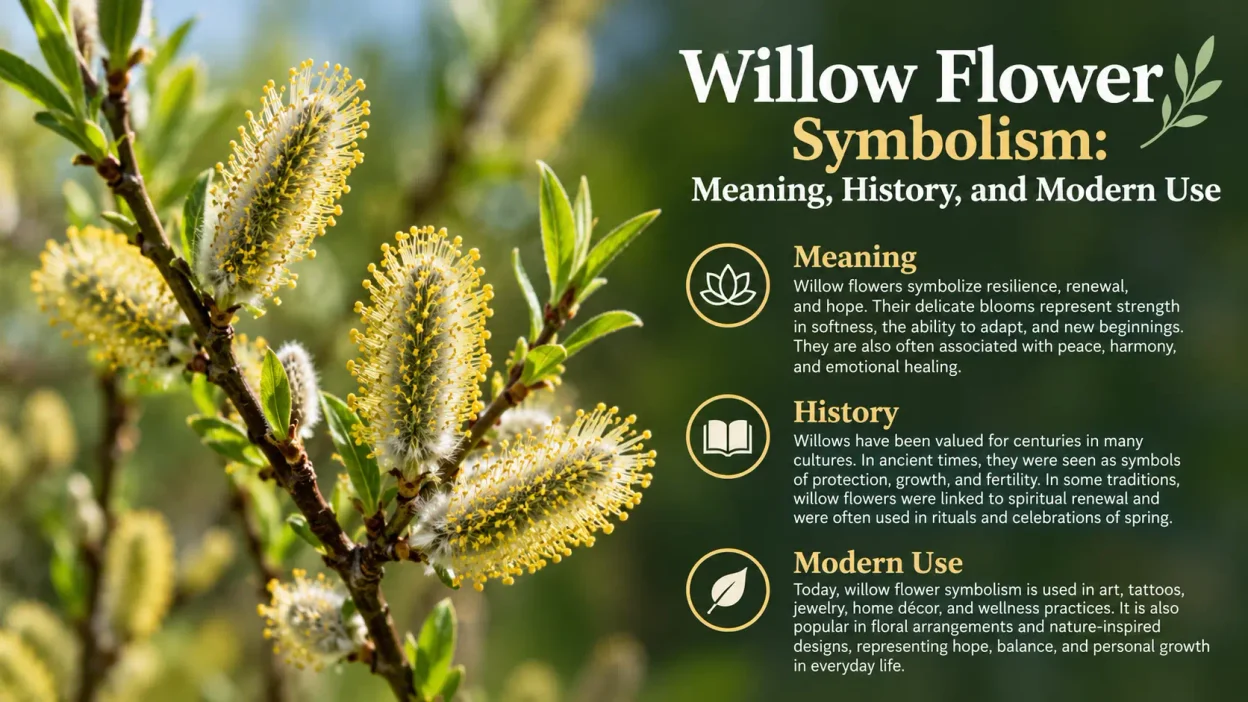
Willow flower symbolism commonly represents resilience, emotional healing, renewal, and the ability to adapt without losing one’s essential character. Historically, willow branches and catkins have also been associated with mourning, fertility, protection, and seasonal change, although specific meanings differ across cultures and traditions.
TL;DR
- Willow flowers can symbolize renewal, resilience, and emotional recovery.
- Drooping branches often suggest grief, reflection, and remembrance.
- Early spring catkins connect willows with seasonal change and new growth.
- Different cultures associate willows with fertility, protection, mourning, or adaptability.
- In American gardens and memorials, willows often evoke peace and reflection.
- Willow tattoos and artwork can express survival, personal growth, or remembrance.
What Willow Flowers Look Like and Why They Matter
Willow flowers are small, clustered blossoms that grow on structures known as catkins. Depending on the species, these clusters may appear silvery, gray, yellow, or greenish. Many people recognize them as soft, fuzzy buds that emerge in late winter or early spring, sometimes before the tree develops its leaves.
Willows belong to the genus Salix, which includes hundreds of species and varieties. Pussy willow, for example, is known for its soft, silvery catkins, while other willows produce more noticeable yellow flowers as pollen develops. Most willows have separate male and female flowers, commonly borne on different trees.
These flowers matter symbolically partly because they arrive at a transitional moment in the year. When much of the landscape still looks dormant, willow catkins provide visible evidence of approaching spring. Their appearance can suggest that growth has begun even when the wider environment has not yet changed much.
The willow’s recognizable form also contributes to its symbolism. Long, flexible branches may hang toward the ground or sweep over a riverbank, creating a visual impression of softness, movement, and contemplation.
The Core Meaning of Willow Flower Symbolism
The willow’s main symbolic associations come from its appearance, growth habits, and place in cultural traditions. Its flowers suggest seasonal renewal, while its flexible branches provide a natural image of endurance and adaptation.
Four meanings are particularly useful for understanding the symbol.
- Resilience: Willow branches bend in strong winds, offering an image of responding to pressure rather than resisting every force.
- Renewal: Early catkins signal the return of growth after winter.
- Grief and remembrance: The drooping shape of many willows resembles a posture of sorrow or quiet reflection.
- Emotional healing: The tree’s association with water, shade, and peaceful landscapes can suggest a place for processing difficult feelings.
These meanings can overlap. Someone who plants a willow in memory of a loved one might see it as both a symbol of grief and a reminder that life continues. A person recovering from a difficult experience might focus on its flexibility and capacity to grow.
No single interpretation applies to every willow or every person. The intended meaning depends on the setting, the cultural background, and the reason someone chooses the tree or its flowers as a symbol.
How Willows Became Symbols of Mourning
The association between willows and sorrow has roots in the tree’s physical appearance and its role in poetry, art, and burial landscapes. A weeping willow’s long branches hang downward, creating a shape that resembles bowed heads or a posture of mourning. Its quiet presence beside water can reinforce the impression of solitude.
In European art and garden design, weeping willows became recognizable images of grief and remembrance. During the eighteenth and nineteenth centuries, sentimental landscapes and cemetery monuments often used natural forms to communicate emotions that words could not fully express. The willow suited this purpose because its branches appeared to bend under an invisible weight.
The association also became familiar in American cemeteries and memorial imagery. A willow beside a grave could suggest sorrow while offering a sense of shelter and continuity. The tree remained alive and growing even when the person remembered was gone.
However, this mourning symbolism is more closely associated with the willow tree and its branches than with the flowers alone. Catkins can add a different dimension by introducing the possibility of renewal into an image otherwise associated with loss.
This contrast makes the willow especially suitable for memorial art: it can acknowledge grief without suggesting that grief is the only part of a person’s story.
Willow Flowers and the Meaning of Renewal
Willow catkins often appear near the end of winter, making them natural signs of seasonal transition. Their emergence reminds observers that biological activity can resume before a landscape looks fully green.
In symbolic terms, this timing connects willow flowers with fresh starts, recovery, and the gradual return of hope. Renewal does not necessarily mean that a difficult period has disappeared. It can mean that a person has begun taking small steps forward while still carrying memories of what happened.
The willow’s growth habits reinforce this interpretation. Many willow species grow quickly under suitable conditions, particularly where water is available. Some can regenerate from cuttings, which makes them familiar examples of how plants can establish new growth from existing material.
This botanical ability should not be confused with a guarantee that every damaged willow will recover. Growth depends on species, climate, soil, water, and other conditions. Yet the tree offers a concrete natural image of persistence.
In American spring gardens, pussy willow branches are often brought indoors as seasonal decorations. Their soft catkins can represent the transition from winter’s stillness to spring’s activity, making them fitting symbols for a new home, a personal milestone, or the beginning of a new chapter.
<WritingBlock id=”64182″ variant=”document”>## Willow Symbolism in American Culture
In the United States, willows are familiar features of parks, residential gardens, lakeshores, and older cemeteries. Their symbolic meanings are shaped by both their appearance and their presence in places where people go to relax, remember, or reflect.
The weeping willow is particularly recognizable. Its arching branches create a sheltered space beneath the canopy, while its association with water makes it a common choice for landscapes designed to feel calm and natural. In a memorial setting, the same shape can suggest sorrow, dignity, and remembrance.
Pussy willow branches have a different cultural role. Their soft catkins are often used in spring arrangements, where they represent the approaching growing season. Unlike the weeping willow’s traditional connection to mourning, pussy willow imagery can feel lighthearted, hopeful, and connected to the return of warmer weather.
Americans may also encounter willow motifs in home decor, landscape photography, greeting cards, and garden illustrations. These uses do not follow one official symbolic tradition. Instead, people draw on familiar associations with nature, emotional recovery, and the passage of time.
Willow Flowers in Chinese Culture
Willows have a long history of cultural significance in China, where they appear in poetry, folklore, seasonal customs, and visual art. Their meanings include vitality, feminine grace, separation, longing, and the ability to begin again.
One notable association involves parting. Willow branches have been connected with farewell customs and poems about friends or loved ones leaving home. The tree’s image can therefore express affection for someone who is absent, particularly when a departure creates uncertainty about when the people involved will meet again.
Willows also symbolize spring and renewal. Their fresh growth makes them suitable images of vitality, while their flexible branches contribute to associations with adaptability and graceful movement.
These meanings can coexist. A willow branch in a poem might express sadness about separation while also suggesting that the relationship continues despite physical distance.
It is important to distinguish these broader tree traditions from a specific symbolism assigned exclusively to willow flowers. Chinese cultural meanings have developed through particular customs, literary works, and historical contexts, not through one universal interpretation of every part of the tree.
Willow Flowers in European Folklore and Christian Tradition
European folklore contains several different interpretations of the willow. In some traditions, the tree was associated with protection, fertility, seasonal celebrations, or supernatural practices. In others, it became a recognizable emblem of grief and disappointed love.
Christian history contributed to the mourning association through the biblical image of people weeping beside the rivers of Babylon and hanging their instruments on willow trees. The passage connects the tree with exile, homesickness, and the sorrow of a displaced community. The trees described in ancient texts may not have been the same species as the familiar modern weeping willow, so the historical connection should not be treated as a precise botanical identification.
Willow branches also acquired a place in some Christian seasonal customs. In areas where palm branches were unavailable, willow could be used in Palm Sunday observances. In this setting, the branches serve a celebratory religious purpose rather than representing grief.
The contrast demonstrates how a single plant can carry different meanings within the same broad religious tradition. The setting and the practice determine whether the willow suggests sorrow, remembrance, or seasonal celebration.
Willow Flowers and Emotional Healing
Willow symbolism often appeals to people who are trying to understand difficult emotions without defining themselves entirely by those experiences. The tree offers a visual metaphor for remaining responsive to change while continuing to grow.
Its flexible branches are central to this interpretation. They move with wind rather than remaining rigid, which makes them a familiar image of adaptability. In personal symbolism, this can represent learning to adjust to circumstances without abandoning one’s values.
The willow’s relationship with water adds another layer. Rivers and lakes often appear in literature and art as places of reflection, transition, or emotional release. A willow growing beside water can reinforce those associations, creating an image of quiet recovery.
These are symbolic interpretations, not psychological guarantees. Looking at a willow does not automatically reduce stress or resolve grief, and people respond to natural settings in different ways. Still, choosing a plant as a personal reminder can help someone express an intention, such as allowing time for recovery or accepting a change that cannot be reversed.
For someone rebuilding life after a loss, a willow may represent the possibility of moving forward without forgetting what mattered.
Willow Flowers as Symbols of Fertility and Protection
Willows can also represent fertility and protection in certain historical traditions. Their ability to establish new growth, their preference for moist environments, and the abundance of their seasonal catkins have contributed to associations with vitality and reproduction.
In some European folk practices, willow branches were placed near entrances or incorporated into seasonal customs with the hope of protecting a household or encouraging good fortune. Such practices belong to particular regional traditions and should not be presented as beliefs shared by all European communities.
Protection symbolism also appears in accounts of willow’s traditional practical uses. People valued the tree for its flexible wood, which could be woven into baskets, fencing, and other useful objects. Its bark was used in traditional remedies, and willow contains salicin, a compound that contributed to the historical development of aspirin.
These practical qualities may help explain why the willow became associated with care and survival. However, medicinal history and symbolic belief are different matters. The fact that willow bark has a history of use in pain relief does not establish that willow flowers possess special healing powers.
In modern personal symbolism, protection can be understood more simply as a reminder of safety, boundaries, and the importance of caring for oneself and others.
What Willow Flowers Mean in Tattoos and Personal Style
Willow tattoos appeal to people who want a nature-based image that can express both vulnerability and endurance. The meaning depends on the design, but several interpretations are common.
A weeping willow with long, curved branches may represent grief, remembrance, or a connection to someone who has died. A willow with new catkins or fresh leaves may emphasize renewal, recovery, or the beginning of a different stage of life.
Some people choose a willow because it reminds them of a childhood home, a favorite landscape, or time spent near a river. In these cases, the image functions as a personal memory rather than a universal cultural symbol.
A tattoo combining a willow with water might emphasize emotional reflection or the passage of time. Adding birds can suggest freedom or movement, while including a date or name can make the design a memorial. These additional meanings come from the combined imagery and the wearer’s intention.
Willow motifs also work in jewelry, embroidery, clothing, and illustrated accessories. Fine branches can create delicate designs, while the tree’s silhouette remains recognizable without large areas of color.
If you are choosing a willow design, consider whether you want it to emphasize grief, growth, remembrance, or flexibility. A specific intention will make the design more personal than relying on a generic list of symbolic meanings.
Willow Flowers in Gardens, Weddings, and Home Decor
Willows offer several decorative possibilities because their appearance changes with the season. Pussy willow stems are often used in spring arrangements, while weeping willows provide shade and a distinctive shape in suitable landscapes.
In home decor, willow branches can create a natural, understated look. A vase of pussy willow stems may suggest the arrival of spring, while a willow illustration can bring a sense of calm or reflection to a room.
For weddings, willow imagery can represent a relationship that adapts and continues to grow through changing circumstances. It may appear in invitations, botanical illustrations, table decorations, or outdoor ceremony settings. However, willow is not a standard wedding symbol across the United States, and its meaning depends on the couple’s preferences and cultural background.
At memorial gatherings, the tree’s established connection to grief and remembrance may be more appropriate. A willow planted in someone’s memory can continue growing after the ceremony, offering a living reminder of the person being honored.
Gardeners should also consider practical needs before planting one. Many willow species require substantial moisture and space, and some have vigorous roots that can create problems near pipes, drains, or foundations. Symbolic meaning is most useful when the plant also suits its location.
Willow Symbolism Compared Across Different Contexts
The willow does not communicate one fixed message. Its meaning changes according to the part of the plant, the cultural tradition, and the reason it appears.
| Context | Common symbolic meaning | Why the association fits |
|---|---|---|
| Spring catkins | Renewal and new beginnings | They emerge around the transition from winter to spring |
| Weeping willow | Grief and remembrance | Its drooping branches resemble a bowed or sorrowful posture |
| Flexible branches | Resilience and adaptability | They bend in wind and can establish new growth |
| Chinese poetry and customs | Parting, longing, and vitality | Willow imagery appears in farewell traditions and spring literature |
| Memorial gardens | Memory and continuity | A living tree can remain as a lasting tribute |
| Personal tattoos | Recovery, identity, or remembrance | The wearer can connect the image with a specific life experience |
These comparisons are starting points rather than strict rules. A weeping willow can represent peace instead of sadness, and a spring branch can symbolize a new relationship rather than a new season. Personal context often matters as much as traditional association.
Common Misunderstandings About Willow Flower Symbolism
One common misconception is that willow flowers always symbolize sadness. The association between weeping willows and mourning is well established in some artistic and cultural traditions, but other willow meanings include vitality, renewal, protection, and seasonal celebration.
Another mistake is treating willow flowers and the whole willow tree as interchangeable symbols in every context. Many historical meanings developed around the tree’s branches, shape, wood, or presence near water rather than around its catkins. A claim about willow symbolism should specify which feature is being interpreted when that distinction matters.
It is also misleading to assume that all cultures share the same willow traditions. Chinese farewell customs, European mourning imagery, and American memorial landscapes developed in different contexts. Similar meanings may emerge independently, but that does not make the traditions identical.
Finally, willow symbolism should not be confused with botanical facts or medical advice. The tree’s ability to regenerate helps explain its association with resilience, but it does not mean every willow survives damage. Likewise, traditional uses of willow bark do not make willow flowers a proven treatment for emotional or physical illness.
Understanding these distinctions makes the symbolism more useful. It allows people to appreciate the tree’s cultural history without assigning it meanings that the available context cannot support.
Frequently Asked Questions
What do willow flowers symbolize spiritually?
Willow flowers may symbolize renewal, adaptability, emotional recovery, and the continuation of life after hardship. Spiritual interpretations vary by tradition, and there is no single religious meaning shared by everyone.
Are willow flowers a symbol of love?
They can represent affection, longing, or the desire to remain connected to someone who is absent. In some Chinese literary and cultural traditions, willow imagery is associated with farewell and separation rather than exclusively with romantic love.
Why is the weeping willow associated with sadness?
Its long, drooping branches resemble a bowed posture, making the tree a natural image of sorrow. European religious imagery, poetry, and cemetery art helped strengthen the association between willows and mourning.
Do willow flowers symbolize new beginnings?
Yes, they can represent new beginnings because catkins often emerge near the end of winter, signaling the return of seasonal growth. This makes them suitable symbols for personal recovery, fresh starts, and changes that develop gradually.
What does a willow tattoo mean?
A willow tattoo can represent resilience, grief, remembrance, adaptability, or a connection to a meaningful place. The design’s details and the wearer’s personal story determine its most accurate interpretation.
Are willow flowers considered lucky?
Some regional folk traditions associate willow branches with protection or good fortune, but this is not a universal belief. In modern American culture, willow imagery is more commonly interpreted through nature, renewal, reflection, and remembrance.
What is the difference between willow flower symbolism and weeping willow symbolism?
Willow flower symbolism often emphasizes seasonal renewal and new growth, while the weeping willow is more strongly associated with mourning because of its drooping form. Both can represent resilience, but the precise meaning depends on the species, setting, and cultural context.
Conclusion
Willow flower symbolism brings together renewal, resilience, emotional healing, and remembrance. The catkins suggest the return of growth, while the tree’s flexible branches and graceful form offer images of adaptation and reflection. Historical traditions add other meanings, including mourning, fertility, protection, and longing.
In the United States, the willow can serve as a springtime decoration, a memorial tree, a garden feature, or a personal emblem of recovery. Its meaning changes with the setting and the person who chooses it, so no single interpretation needs to define every willow.
The willow’s most useful lesson is not that hardship disappears, but that growth can continue alongside memory, change, and loss.