When people look into the night sky, some star patterns feel familiar even without knowing their names. Cassiopeia symbolism comes from one of the most recognizable constellations, known for its distinctive W or M shape and its connection to stories, navigation, identity, and imagination. In modern American culture, Cassiopeia is often viewed as a symbol of confidence, individuality, curiosity, and a connection between human stories and the universe.
Cassiopeia has been observed for thousands of years and appears in ancient mythology, astronomy, art, and personal expression. Unlike many symbols that come from objects people create, Cassiopeia comes from a natural feature of the sky that humans have interpreted across different cultures.
Today, people encounter Cassiopeia in astronomy education, star maps, tattoos, jewelry, artwork, and discussions about personal meaning. Its symbolism continues to change as people connect ancient stories with modern ideas about identity and exploration.
Quick Answer
Cassiopeia symbolism commonly represents confidence, individuality, curiosity, and the search for identity in modern American culture. Historically, the constellation has been linked to Greek mythology, royal imagery, storytelling, and humanity’s long relationship with the stars.
TL;DR
- Cassiopeia represents confidence and individuality today.
- The constellation comes from ancient Greek mythology.
- Americans often connect it with exploration and curiosity.
- Its W-shaped stars make it easily recognizable.
- Tattoos use Cassiopeia for personal identity.
- The symbol blends science, art, and storytelling.
What Is Cassiopeia and Why Is It Recognized?
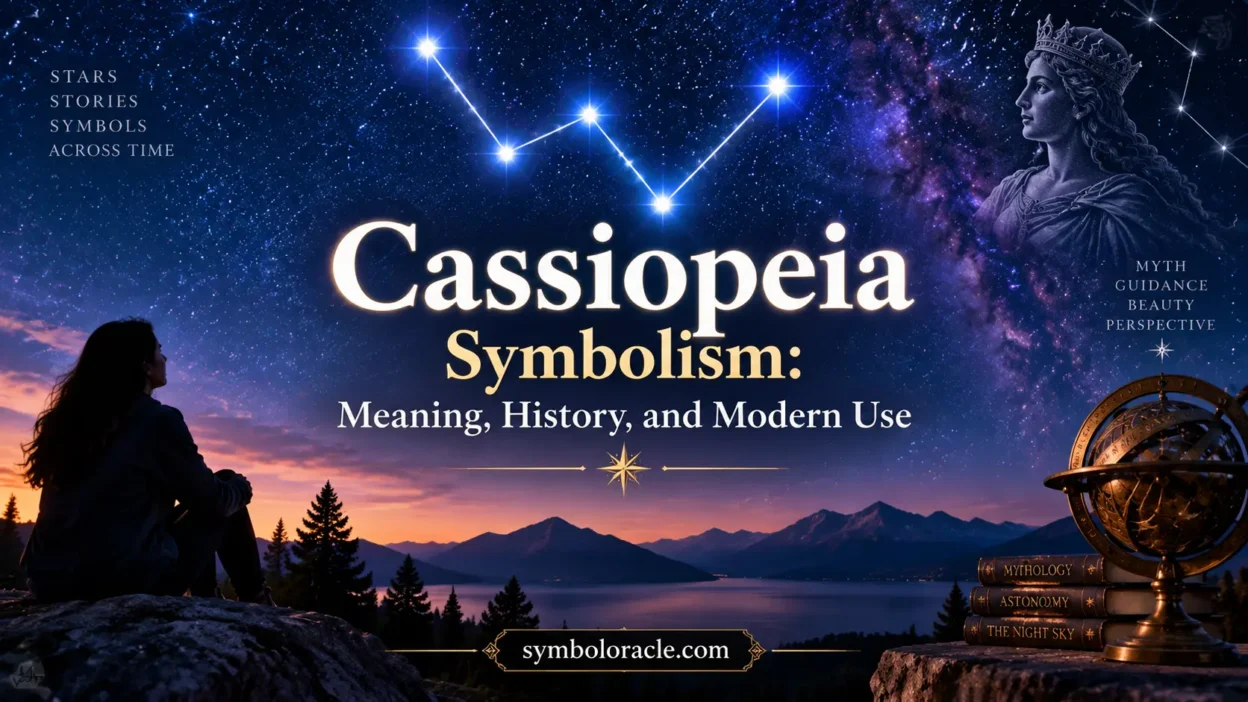
Cassiopeia is a constellation located in the northern sky. Its five brightest stars create a shape that looks like a “W” or, depending on the season and viewing angle, an “M.” Because of this unusual pattern, it is one of the easiest constellations for many northern hemisphere observers to identify.
The constellation is named after Cassiopeia, a queen from Greek mythology. Ancient storytellers connected the stars with a royal figure whose actions became part of a larger myth involving pride, family, and consequences.
For modern viewers, Cassiopeia is more than a group of stars. It represents the human habit of finding meaning in the sky and using celestial patterns to tell stories about personality, ambition, and life experiences.
What Cassiopeia Commonly Means in the United States
In the United States, Cassiopeia is usually interpreted through a combination of astronomy, mythology, and personal symbolism. Many people associate it with qualities connected to looking upward, discovering new possibilities, and understanding one’s place in the world.
Common meanings include:
- Individuality: The constellation’s unique shape makes it stand out among thousands of stars.
- Confidence: Its connection with a queen figure creates associations with presence and self-expression.
- Curiosity: Cassiopeia encourages interest in astronomy and learning.
- Exploration: Stars often represent journeys, discovery, and unknown possibilities.
- Personal identity: People may choose Cassiopeia because its story feels connected to their own experiences.
Unlike symbols with one fixed meaning, Cassiopeia allows individuals to create their own interpretation.
Ancient Roots and Greek Mythology Behind Cassiopeia
The earliest famous stories about Cassiopeia come from ancient Greek mythology. Cassiopeia was described as the queen of Ethiopia and the wife of King Cepheus. In myth, she was known for her beauty and pride.
One version of the story says Cassiopeia claimed that she or her daughter Andromeda was more beautiful than sea nymphs called the Nereids. This angered the sea god Poseidon, leading to challenges that affected her family.
The myth connects Cassiopeia with themes of:
- pride and self-image
- leadership and royalty
- human mistakes
- consequences of excessive confidence
The constellation does not simply represent vanity. Modern interpretations often focus more on self-awareness, resilience, and the complexity of human character.
How Cassiopeia Became a Symbol Through Astronomy
Ancient civilizations used the stars for practical and cultural reasons. Constellations helped people track seasons, navigate oceans, and organize stories about the natural world.
Cassiopeia became especially important because it is a circumpolar constellation in many northern locations, meaning it appears visible throughout the year and does not disappear below the horizon in many areas.
For sailors and travelers, recognizable stars provided guidance before modern navigation systems existed. This gave Cassiopeia associations with direction, discovery, and movement.
In modern astronomy, Cassiopeia represents scientific curiosity. The constellation contains important astronomical objects, including star clusters and areas studied by researchers exploring how stars form and change.
Cassiopeia Symbolism in American Culture
American interpretations of Cassiopeia often combine scientific interest with personal expression. Many people encounter the constellation through school astronomy lessons, planetariums, camping trips, and outdoor activities.
In U.S. culture, Cassiopeia may symbolize:
| Context | Meaning in the USA | Common Associations | Notes |
|---|---|---|---|
| Astronomy | Discovery and learning | Space, science, exploration | Used in education and stargazing |
| Tattoos | Personal identity | Individuality, life stories | Often chosen for emotional connections |
| Art and Decor | Wonder and imagination | Night sky, beauty | Popular in modern designs |
| Jewelry | Personal expression | Memories, uniqueness | Often worn as a meaningful symbol |
| Mythology | Human character | Pride, growth, lessons | Based on ancient storytelling |
Cassiopeia does not have one official American meaning. Its importance depends on how individuals connect it with their own experiences.
The Emotional and Psychological Meaning of Cassiopeia
People often use sky symbols because they represent ideas larger than everyday life. Cassiopeia can create feelings of perspective, reminding people that human experiences exist within a much larger universe.
Psychologically, star symbols are often connected with:
- hope during difficult periods
- imagination and creativity
- personal goals
- reflection and self-discovery
Cassiopeia’s connection with a queen figure may also appeal to people who value confidence and independence. At the same time, its myth includes a warning about pride, creating a more balanced interpretation.
The constellation can represent both strength and the importance of humility.
Cassiopeia in Tattoos and Personal Style
Cassiopeia has become a popular choice in tattoo culture because it combines visual simplicity with personal meaning. The constellation’s five-star pattern can be designed in many styles, from minimal line art to detailed galaxy-inspired artwork.
Common reasons people choose Cassiopeia tattoos include:
- a love of astronomy
- connection to mythology
- memories connected with someone special
- interest in the night sky
- representation of personal growth
Some people pair Cassiopeia with moons, planets, flowers, names, or dates to create a customized design.
Unlike traditional symbols with established meanings, constellation tattoos often become personal symbols shaped by individual stories.
Cassiopeia in Art, Fashion, and Modern Design
The visual appeal of Cassiopeia makes it popular in creative fields. Designers often use star patterns because they suggest imagination, elegance, and exploration.
Modern uses include:
- astronomy-themed home decor
- clothing designs
- stationery
- digital illustrations
- fantasy artwork
- educational materials
The constellation’s simple shape works well in both minimalist and detailed designs. Its connection with the night sky also fits modern interests in space exploration and science-inspired creativity.
Cassiopeia Meaning Across Other Cultures
Although the Greek myth is one of the best-known stories, different cultures have interpreted star patterns in their own ways.
Many societies created their own names and stories for groups of stars based on local traditions, animals, heroes, and natural events. The idea of connecting stars with human experiences appears worldwide.
Cassiopeia’s broader cultural meaning often reflects common human themes:
- storytelling
- navigation
- seasonal awareness
- connection with nature
- curiosity about the universe
The exact story changes between cultures, but the practice of finding meaning in the stars remains widespread.
Religious and Spiritual Interpretations of Cassiopeia
Cassiopeia does not have a major universal religious meaning in most traditions. However, some people view stars generally as symbols of guidance, creation, and reflection.
In personal spiritual practices, Cassiopeia may represent:
- seeking direction
- understanding one’s journey
- connection with something greater than daily life
These interpretations are personal rather than part of a single established belief system. Different individuals may attach different spiritual meanings to the constellation.
Common Misunderstandings About Cassiopeia Symbolism
Because star symbols often appear in spiritual and creative spaces, Cassiopeia can sometimes be given meanings that are not connected to its historical background.
Common misunderstandings include:
- believing it has one fixed spiritual meaning
- assuming all cultures interpret it the same way
- treating mythology as historical fact
- connecting it with supernatural claims without evidence
The original stories about Cassiopeia come from mythology, while modern interpretations are usually personal, artistic, or cultural.
Understanding the difference between mythology and astronomy helps preserve both the scientific and cultural value of the constellation.
How Cassiopeia’s Meaning Has Changed Over Time
Cassiopeia’s meaning has evolved from ancient storytelling into a modern symbol of curiosity and self-expression.
In ancient times, it was connected mainly with mythology and navigation. Later, astronomers studied it as part of a scientific system for understanding the universe.
Today, Cassiopeia exists at the meeting point of:
- science
- mythology
- personal identity
- creative expression
This evolution shows how symbols change as societies develop new ways of understanding the world.
Why People Still Connect With Cassiopeia Today
Modern interest in Cassiopeia comes from its ability to connect old stories with current experiences. A person looking at the constellation today may think about astronomy, family memories, personal goals, or a fascination with the unknown.
For some, it represents confidence. For others, it represents curiosity or a reminder to keep exploring.
Its lasting appeal comes from the fact that the same stars can inspire scientific questions and personal reflection at the same time.
Frequently Asked Questions
What does Cassiopeia symbolize?
Cassiopeia commonly symbolizes individuality, confidence, curiosity, and exploration. Its meaning comes from both its distinctive star pattern and its connection to Greek mythology.
Is Cassiopeia a positive symbol?
Cassiopeia is generally viewed positively today, especially as a symbol of uniqueness and discovery. However, its mythological story also includes lessons about pride and self-awareness.
What does a Cassiopeia tattoo mean?
A Cassiopeia tattoo often represents a personal connection with astronomy, mythology, identity, or important life experiences. The meaning usually depends on the person wearing it.
Does Cassiopeia have a religious meaning?
Cassiopeia does not have a widely recognized religious meaning across major faith traditions. Some individuals may personally view stars as symbols of guidance or creation.
Why is Cassiopeia shaped like a W?
Cassiopeia appears as a W because of the arrangement of its five brightest stars. The shape changes between a W and an M depending on the viewer’s position and the season.
Is Cassiopeia visible in the United States?
Yes, Cassiopeia is visible throughout much of the United States, especially in northern regions where it remains above the horizon for much of the year.
Conclusion
Cassiopeia represents the relationship between human imagination and the night sky. From ancient mythology to modern astronomy, the constellation has carried meanings connected with identity, exploration, confidence, and reflection.
Today, cassiopeia symbolism continues to inspire people through tattoos, art, education, and personal storytelling. Its meaning is not limited to one interpretation; instead, it reflects how people use symbols to connect history, science, and their own experiences.
The stars remain the same, but the stories people create around them continue to evolve.