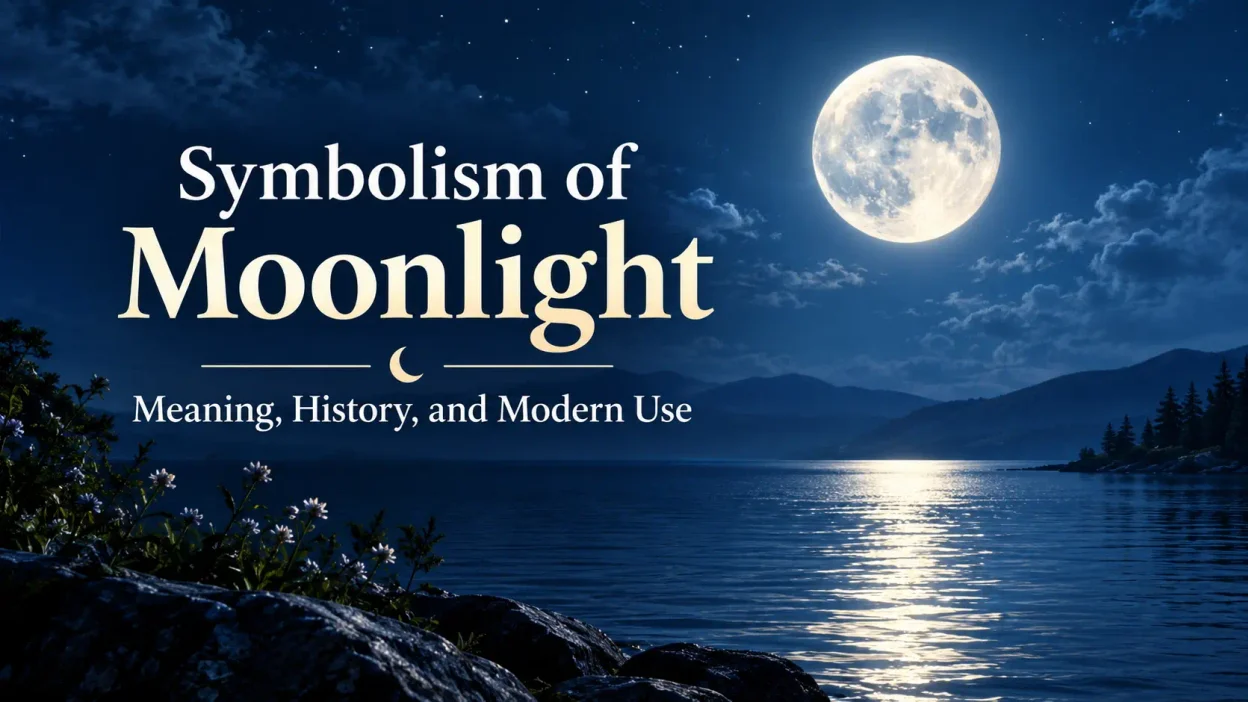
Moonlight has long been associated with mystery, romance, intuition, and quiet reflection. The symbolism of moonlight comes partly from its unusual appearance: it illuminates the night without the brightness or warmth of the sun, creating a world where familiar places look different and shadows seem more pronounced. In literature, art, religion, and everyday life, this soft light often represents feelings or experiences that are difficult to express directly.
In the United States, moonlight appears in romantic imagery, nighttime photography, poetry, music, films, and spiritual artwork. A moonlit landscape might suggest peace and solitude, while moonlight falling across an empty street can create suspense or uncertainty. Its meaning depends on the scene and the feelings associated with it rather than on one universal interpretation.
Moonlight also has a physical explanation that adds to its symbolic appeal. The Moon does not produce its own visible light; it reflects sunlight toward Earth. This combination of borrowed light, darkness, and changing lunar phases has encouraged people across different periods and cultures to connect moonlight with cycles, hidden knowledge, transformation, and the relationship between what is visible and what remains unseen.
Quick Answer
The symbolism of moonlight commonly represents mystery, romance, intuition, peace, and reflection in modern American culture. Historically, moonlight has also been associated with lunar deities, sacred calendars, seasonal cycles, spiritual renewal, and the boundary between the familiar world and the unknown.
TL;DR
- Moonlight often symbolizes mystery, romance, intuition, and quiet reflection.
- Ancient lunar traditions connected the Moon with time, fertility, and renewal.
- American art and entertainment use moonlight to create intimacy or suspense.
- Its changing appearance encourages associations with transition and personal growth.
- Religious and cultural meanings vary across traditions and communities.
- Modern tattoos, decor, and photography use moonlight to express mood and identity.
1. What Moonlight Looks Like and Why It Feels Different
Moonlight is sunlight reflected from the Moon’s surface. It is much dimmer than direct sunlight, so nighttime scenes illuminated by the Moon have softer contrasts, reduced color visibility, and long or indistinct shadows.
These physical qualities help explain why moonlight carries such varied meanings. A familiar garden under daylight appears open and easy to navigate. Under moonlight, the same garden may feel private, peaceful, romantic, or slightly unsettling.
Human vision also changes in dim conditions. Colors become harder to distinguish, and details that seem obvious during the day can disappear into shadow. This creates a natural contrast between what people can see and what they must imagine.
Artists use this effect deliberately. Moonlight can reveal a character’s face while leaving the surrounding landscape obscure, or it can illuminate a path without showing where that path leads. The resulting image encourages curiosity and uncertainty without requiring an explicitly supernatural explanation.
2. The Core Symbolic Meanings of Moonlight
Moonlight does not have one fixed symbolic meaning. Its most common interpretations arise from the relationship between illumination and darkness, the Moon’s changing phases, and the emotional atmosphere of nighttime.
Several meanings appear frequently in contemporary American culture:
- Mystery: Dim light leaves details hidden and invites interpretation.
- Romance: Moonlit settings often suggest intimacy, attraction, and shared privacy.
- Peace: A quiet nighttime landscape can represent rest and freedom from daily demands.
- Intuition: Moonlight can suggest awareness that comes through reflection rather than direct observation.
- Transformation: The changing Moon provides an image of transition, growth, and renewal.
- Loneliness: An empty landscape under moonlight may emphasize distance, grief, or isolation.
These meanings can overlap. A moonlit beach may feel peaceful to one person and lonely to another. A scene in a romantic film may use the same light to suggest closeness, while a thriller may use it to create tension.
Context determines which interpretation is most convincing.
3. Ancient Roots of Moonlight Symbolism
Long before electric lighting, moonlight helped people navigate nighttime environments, observe seasonal patterns, and organize time. Its changing brightness and predictable cycle made the Moon important in many early systems of timekeeping and cultural belief.
Different societies developed their own explanations for lunar phenomena. Some associated the Moon with particular deities, while others connected its phases with agricultural rhythms, fertility, or the passage of time. These traditions were not identical, and they should not be treated as a single universal lunar religion.
Moonlight also occupied an unusual position in human experience. It provided enough illumination to reveal parts of the nighttime world without eliminating darkness. That partial visibility could be useful for travel and observation, but it could also make unfamiliar places feel uncertain.
Stories about night spirits, supernatural encounters, and extraordinary transformations often developed within this broader setting. Moonlight became a natural backdrop for events believed to occur beyond ordinary experience.
Its symbolic history therefore grew from several sources: practical dependence on lunar cycles, religious explanations of the heavens, and the emotional effects of moving through a world that was only partly visible.
4. Moonlight in Greek and Roman Mythology
In ancient Greek mythology, the Moon was associated with Selene, a goddess often depicted traveling across the night sky. Artemis was also associated with the Moon in later religious and literary traditions, while the Roman goddess Luna personified the Moon.
These figures had distinct identities and histories. Selene was closely connected with the Moon itself, whereas Artemis had broader associations with wilderness, hunting, and protection. Roman traditions adapted and combined Greek influences in their own ways.
Moonlight in mythological art and literature could suggest divine presence, beauty, distance, or a connection between the human world and the heavens. The night sky offered a setting for encounters between mortals and divine figures, making lunar light an effective visual element in stories about desire and destiny.
Modern artists sometimes draw on these associations when depicting a moonlit goddess, a silver-lit forest, or a solitary figure beneath the Moon. Such imagery can evoke classical mythology without reproducing the religious beliefs of ancient communities.
The important distinction is that moonlight itself does not carry exactly the same meaning in every myth. Its interpretation depends on the deity, narrative, and cultural setting in which it appears.
5. Moonlight in Other Cultural and Religious Traditions
Moonlight has meanings across many cultures, but those meanings differ according to religious practice, folklore, geography, and history.
In Hindu traditions, the Moon is associated with Chandra, a deity connected with the lunar sphere and important themes in Hindu cosmology and astrology. Moon imagery may appear in devotional art, poetry, and discussions of time and cosmic order.
In Islamic practice, lunar observation has an important calendrical role. The beginning of Ramadan and the determination of major dates in the Islamic calendar are associated with lunar months. Moonlight may also appear in poetry and visual art, but it should not be treated as a universal religious symbol with one prescribed meaning.
In Chinese cultural traditions, the Moon is closely associated with the Mid-Autumn Festival, family reunion, and seasonal celebration. The full Moon can represent completeness and togetherness in this setting, particularly through customs involving mooncakes and family gatherings.
In some Buddhist contexts, the Moon appears in imagery and teachings that explore clarity, change, and the nature of experience. Interpretations vary by tradition, text, and artistic context.
These examples show why cultural care matters. Moonlight can participate in religious symbolism, but it does not mean the same thing everywhere, and one community’s interpretation should not be presented as universal.
6. Why Moonlight Symbolizes Mystery and the Unknown
One of the most recognizable meanings of moonlight is mystery. Its limited illumination reveals enough to create interest but not always enough to provide certainty. A figure at the edge of a moonlit field may be recognizable without being fully understood, leaving room for imagination.
This quality makes moonlight especially effective in Gothic literature, ghost stories, suspense films, and supernatural fiction. Writers can establish uncertainty through the setting itself rather than explaining that a character feels afraid.
The connection between moonlight and mystery does not mean the Moon is inherently frightening. The same shadows that make a forest seem threatening can make a quiet garden feel secluded and inviting. The emotional effect depends on what the observer expects and what happens in the scene.
In everyday American culture, moonlit imagery often appears in Halloween decorations, haunted-house designs, and horror movie posters. It helps communicate that the ordinary world has become unfamiliar, at least temporarily.
Moonlight can therefore symbolize the limits of human knowledge. It represents situations in which people have enough information to form an impression but not enough to see the whole picture.
7. Moonlight as a Symbol of Romance and Intimacy
Moonlight has a familiar place in romantic imagery because nighttime can offer privacy, quiet, and distance from everyday responsibilities. A moonlit walk or dinner outdoors creates an atmosphere that feels separate from the demands of work, schedules, and public attention.
American films, love songs, novels, and wedding photography frequently use moonlit settings to suggest attraction or emotional closeness. The setting does not create love by itself; instead, it provides a visual environment that encourages audiences to associate a moment with intimacy.
Moonlight also differs from bright daylight in how it presents people and places. Soft illumination can reduce visual detail and make a scene feel less exposed. In romantic storytelling, this can reflect a character’s desire to escape judgment or share a private moment.
However, moonlight can also accompany unrequited love, separation, or longing. A character looking at the Moon alone may be thinking about someone far away. In such a scene, the same light that symbolizes romance can emphasize emotional distance.
This dual meaning explains why moonlight works so well in love poetry. It can suggest both the comfort of being close to someone and the ache of wanting a connection that remains out of reach.
8. Moonlight, Intuition, and Spiritual Reflection
Moonlight often represents intuition because it illuminates indirectly. Unlike the Sun’s bright daylight, it allows only a partial view of the surrounding world. As a metaphor, this can suggest understanding that develops gradually through observation, memory, and reflection.
In modern American spiritual writing, moonlight sometimes appears alongside meditation, journaling, mindfulness, and personal reflection. A person may choose to sit outdoors beneath the Moon as a way to pause, examine emotions, or mark a personal transition.
Some contemporary spiritual practices also associate lunar phases with setting intentions, releasing old habits, or beginning new routines. These practices draw on the visible changes of the Moon as a framework for reflection. They are personal or tradition-specific interpretations, not scientifically established effects of moonlight on intuition or emotional development.
Religious and spiritual interpretations should also be distinguished from claims about supernatural powers. Moonlight can serve as a meaningful image in prayer, contemplation, or ritual without requiring a belief that lunar light directly changes a person’s fate.
Its symbolic value lies in the opportunity it offers for reflection. The quiet of night can help people step away from immediate distractions and consider experiences that seem less clear during a busy day.
9. The Psychological Meaning of Moonlight
The emotional response to moonlight often combines environmental conditions with personal associations. Quiet surroundings, reduced visibility, nighttime memories, and cultural images can all influence whether a moonlit scene feels comforting or unsettling.
For some people, moonlight suggests solitude without loneliness. Sitting near a window beneath a full Moon may create a sense of calm because the environment is quiet and familiar. For others, the same scene may remind them of grief, distance, or a difficult period in their lives.
Moonlight can also represent emotional ambiguity. A person may feel hopeful about a relationship while remaining uncertain about its future. A dimly lit setting can serve as a visual metaphor for this mixture of understanding and doubt.
It is important not to turn these associations into universal psychological rules. There is no single emotional response that every person must experience when seeing the Moon. Personal memories, cultural background, circumstances, and individual preferences all influence interpretation.
In literature and visual art, this flexibility makes moonlight an effective way to communicate a character’s inner state without explaining every feeling directly.
10. Moonlight and the Symbolism of Change
The Moon changes appearance through its phases, from the thin crescent to the full Moon and back again. This repeating pattern has made lunar imagery a natural symbol of cycles, transition, and renewal.
Moonlight can represent a period when change is underway but not yet complete. A crescent Moon may suggest beginnings or possibilities, while a waning Moon can be used in contemporary symbolic art to represent release, reflection, or the closing of a chapter.
These meanings are interpretive conventions rather than universal rules. Historically, lunar calendars have served practical purposes, while religious and cultural traditions have assigned different meanings to specific phases.
In American personal symbolism, the changing Moon frequently appears in tattoos, jewelry, planners, and artwork connected with life transitions. Someone marking a new career, recovery from a difficult period, or a change in identity might choose a lunar image to express the idea that life moves through stages.
The Moon’s cycle offers a particularly useful distinction between change and failure. A dark phase does not mean the cycle has ended; another phase will follow. For people who use lunar imagery as a personal reminder, this pattern can represent patience and the possibility of beginning again.
11. Moonlight in American Holidays and Popular Culture
Moonlight appears in several American celebrations and entertainment traditions, although its role varies by occasion.
<box gap={3}> <row align=start gap={3}> <AsyncImage query=”romantic moonlit night sky Valentine’s Day red roses photography” aspectRatio=”3:4″ maxWidth=”112px”/> <box flex=”1″ gap={1}> **Valentine’s Day and romance**
  Moonlit scenes complement the holiday's familiar themes of love and intimacy. Cards, restaurant advertising, and romantic photography often combine nighttime skies with flowers, couples, or reflective water.
</box>
</row> <divider color=”subtle”/> <row align=start gap={3}> <AsyncImage query=”full moon over spooky haunted house Halloween night illustration” aspectRatio=”3:4″ maxWidth=”112px”/> <box flex=”1″ gap={1}> **Halloween**
  Moonlight helps create the atmosphere of haunted houses, supernatural stories, and nighttime adventures. A bright Moon above a dark landscape can suggest that familiar places have become strange or threatening.
</box>
</row> <divider color=”subtle”/> <row align=start gap={3}> <AsyncImage query=”American outdoor summer concert moonlit night crowd stage lights” aspectRatio=”3:4″ maxWidth=”112px”/> <box flex=”1″ gap={1}> **Summer nights and outdoor events**
  Moonlit skies often appear in concert photography, camping imagery, outdoor cinema promotions, and vacation advertising. Here, the Moon can suggest freedom, shared experiences, and escape from routine.
</box>
</row> <divider color=”subtle”/> <row align=start gap={3}> <AsyncImage query=”classic cinematic moonlit ocean silver reflections romantic film still aesthetic” aspectRatio=”3:4″ maxWidth=”112px”/> <box flex=”1″ gap={1}> **Film and music**
  Moonlight is a familiar visual and lyrical device for expressing longing, suspense, nostalgia, or emotional closeness. Its meaning depends on the story rather than the setting alone.
</box>
</row> </box>
American popular culture often combines these associations. A moonlit scene can feel romantic in one film and frightening in another, even when both use similar imagery.
This flexibility makes moonlight a lasting visual shorthand for atmosphere. Audiences recognize the setting quickly, allowing filmmakers, musicians, and designers to establish an emotional tone without lengthy explanation.
12. Moonlight in Tattoos, Jewelry, and Home Decor
Moonlight-inspired designs allow people to express personal meanings through an image that remains recognizable but open to interpretation.
<box gap={3}> <row align=start gap={3}> <AsyncImage query=”minimal crescent moonlight fine line tattoo on forearm black ink” aspectRatio=”3:4″ maxWidth=”112px”/> <box flex=”1″ gap={1}> **Tattoos**
  Moonlight tattoos may represent personal change, intuition, solitude, remembrance, or a connection with nighttime. Some designs combine a crescent Moon with stars, waves, flowers, or a landscape to express a more specific personal story.
</box>
</row> <divider color=”subtle”/> <row align=start gap={3}> <AsyncImage query=”silver crescent moon pendant necklace minimalist jewelry on neutral background” aspectRatio=”3:4″ maxWidth=”112px”/> <box flex=”1″ gap={1}> **Jewelry**
  Silver-colored pendants, crescent earrings, and lunar charms can communicate an interest in astronomy, nature, or celestial imagery. Their significance may be spiritual, decorative, sentimental, or simply aesthetic.
</box>
</row> <divider color=”subtle”/> <row align=start gap={3}> <AsyncImage query=”serene moonlight bedroom decor silver blue tones moon wall art warm neutral interior” aspectRatio=”3:4″ maxWidth=”112px”/> <box flex=”1″ gap={1}> **Home decor**
  Moon prints, lunar lamps, and moonlit landscape paintings can create a calm or contemplative atmosphere. Blue, silver, and muted gray palettes often reinforce the association with quiet nighttime settings.
</box>
</row> </box>
These objects do not have standardized meanings. A crescent pendant may reflect a religious identity for one wearer, an interest in astronomy for another, and a personal memory for someone else.
The best interpretation begins with the person’s stated intention. It is better to ask what a lunar tattoo means to its wearer than to assume that the image automatically communicates spirituality, femininity, or a particular belief.
13. Moonlight in Art, Photography, and Literature
Artists use moonlight to control what viewers notice and what they must imagine. A landscape painted in daylight often emphasizes color and detail, while a moonlit scene can place greater emphasis on silhouette, atmosphere, contrast, and empty space.
In photography, moonlight offers a different challenge because it provides relatively little illumination. Long exposures, careful composition, and artificial lighting may be used to create a recognizable nighttime image. Some photographs depict the Moon itself, while others use reflected light on water, buildings, or distant hills to establish a sense of place.
Literature uses moonlight in a similarly flexible way. A writer may use it to establish a romantic meeting, create an atmosphere of uncertainty, or show a character experiencing solitude. The light can also establish contrast between what a character believes and what the reader gradually learns.
In American literary traditions, moonlit landscapes appear across genres, from romance and nature writing to Gothic fiction and contemporary fantasy. The setting is not inherently romantic or supernatural; the surrounding language and events determine its role.
A useful reading question is: What does the moonlight reveal, and what does it leave hidden? The answer often explains more about the scene than a simple list of symbolic meanings.
14. Common Misunderstandings About Moonlight Symbolism
Several assumptions can make moonlight symbolism less accurate than it first appears.
Moonlight does not always symbolize romance. It can also suggest isolation, uncertainty, danger, memory, or ordinary nighttime beauty. The surrounding scene determines which association fits best.
The Moon does not have one universal spiritual meaning. Religious traditions differ in their stories, rituals, and interpretations of lunar imagery. Similar images can carry different meanings across communities.
Lunar phases do not scientifically determine personality or destiny. Astrology and contemporary spiritual practices may assign meanings to the Moon’s phases, but those beliefs should not be confused with established scientific findings.
Moonlight is not the same as moon symbolism. The Moon itself may represent cycles, femininity, time, or a deity, while moonlight emphasizes illumination, atmosphere, visibility, and the experience of nighttime. The concepts overlap but are not identical.
Darkness is not automatically negative. Nighttime can provide rest, privacy, beauty, and opportunities for observation. Moonlight often represents the coexistence of uncertainty and comfort rather than a simple battle between good and evil.
Understanding these distinctions helps readers approach the subject with cultural awareness and interpretive care.
Frequently Asked Questions
What does moonlight symbolize spiritually?
Moonlight can represent reflection, intuition, renewal, and awareness of what is not immediately visible. These meanings vary among spiritual traditions, so its significance depends on the person’s beliefs and the context in which the image appears.
Is moonlight a symbol of love?
Yes, moonlight commonly suggests romance and intimacy in American films, poetry, and popular imagery. It can also represent longing or separation when a character experiences the nighttime scene alone.
What does moonlight mean in a dream?
A person might interpret moonlight in a dream as an image of uncertainty, reflection, hope, or emotional change. Dream symbols have no universally validated meaning, so personal associations and the details of the dream matter more than a fixed interpretation.
Why is moonlight associated with mystery?
Moonlight illuminates the world only partially, leaving some details concealed in shadow. Writers and filmmakers use this visual effect to create uncertainty, suspense, or a sense that something remains unknown.
What does a moonlight tattoo symbolize?
A moonlight tattoo may represent personal growth, intuition, peace, solitude, or an interest in celestial imagery. Its meaning often depends on accompanying elements, such as stars, water, flowers, or a particular lunar phase.
Does moonlight have a different meaning from sunlight?
Moonlight often suggests reflection, mystery, and indirect understanding, while sunlight is commonly associated with clarity, visibility, vitality, and openness. These are cultural and artistic associations rather than universal meanings, and a particular work may use either light source differently.
Is moonlight considered a positive or negative symbol?
Moonlight can carry either positive or negative associations, depending on its context. A peaceful landscape may suggest comfort and renewal, while a shadowy setting in a suspense story may create fear or uncertainty.
Conclusion
The symbolism of moonlight brings together mystery, romance, reflection, and change. Its distinctive combination of illumination and darkness makes it useful in religious imagery, mythology, literature, art, and everyday American culture. From romantic films to personal tattoos, moonlight allows people to express emotions that do not fit neatly into a single definition.
Its meaning is never entirely separate from context. Cultural traditions, personal memories, artistic choices, and the surrounding scene all influence what moonlight communicates. Understanding these differences helps distinguish established historical traditions from modern interpretations and unsupported supernatural claims.
Moonlight reminds us that seeing part of a situation is not the same as understanding all of it. Sometimes, the most meaningful details emerge when we take the time to look more carefully.