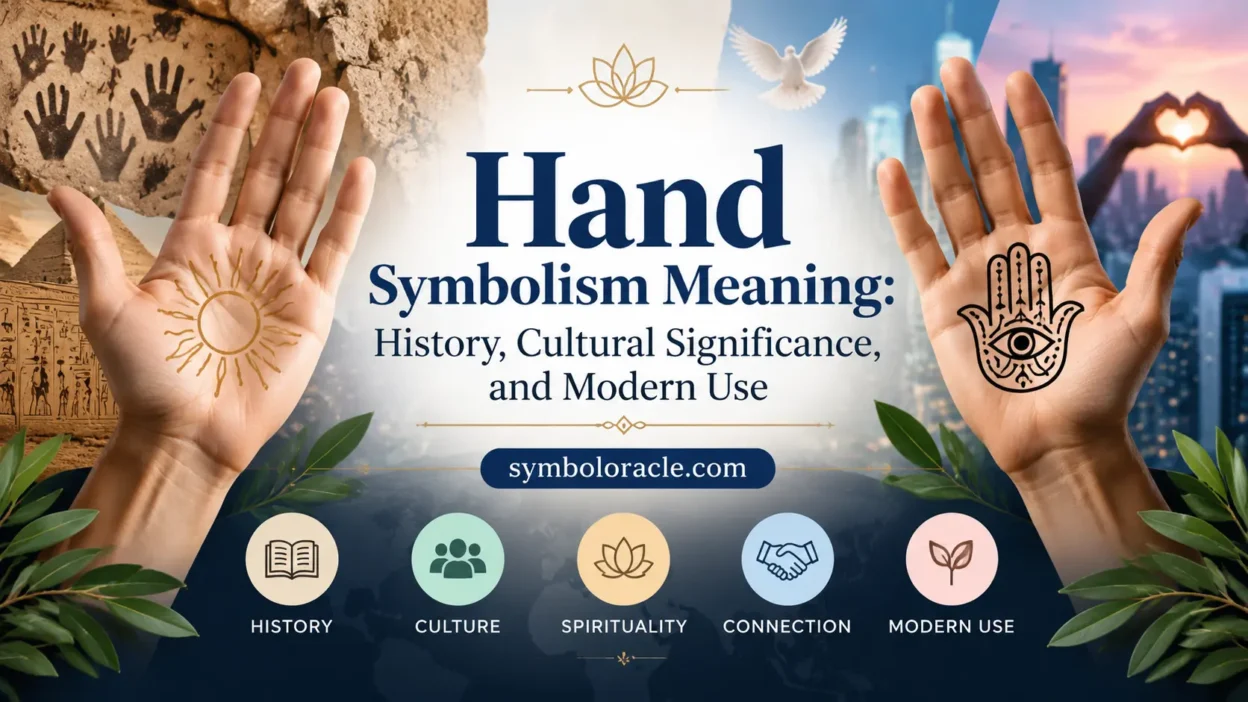
The hand symbolism meaning people recognize today often comes from a simple idea: hands show what people do, feel, communicate, and believe. A raised palm can signal peace or protection, clasped hands can suggest prayer or connection, and an open hand can represent welcome, generosity, or honesty.
Hands matter because they are closely connected to human action. We use them to build, greet, comfort, create, work, write, point, promise, and communicate without words. Artists have therefore used hands for thousands of years to express ideas that facial expressions or objects alone cannot convey.
In the United States, hand symbolism appears in religious art, memorials, tattoos, jewelry, advertising, fashion, photography, sports, and everyday gestures. At the same time, a hand gesture does not have one universal meaning. Its position, cultural setting, accompanying symbols, and historical context can completely change what it communicates.
Quick Answer
Hand symbolism meaning commonly centers on communication, action, connection, protection, help, and human identity in modern American culture. Historically, hands have also represented prayer, blessing, authority, creation, mourning, service, and spiritual beliefs across different cultures.
TL;DR
- Hands commonly symbolize communication, action, connection, and human effort.
- Raised palms can represent protection, peace, openness, or reassurance.
- Clasped hands often appear in prayer, mourning, marriage, and memorial traditions.
- Religious traditions developed specific meanings for hand positions and gestures.
- American culture uses hand symbols in art, tattoos, fashion, and digital communication.
- A gesture’s meaning depends heavily on its cultural and social context.
What the Hand Represents in Symbolic Language
The hand is one of the clearest symbols of human agency because it allows people to physically change their surroundings. A hand can create something, destroy something, offer assistance, or communicate an intention.
This connection explains several common symbolic meanings:
- Action: Hands represent doing rather than simply thinking.
- Communication: Gestures can communicate without spoken language.
- Connection: Holding hands can symbolize friendship, love, family, or partnership.
- Protection: An open or raised palm can signal defense or reassurance.
- Creation: Hands are associated with art, craftsmanship, work, and invention.
- Service: Helping hands commonly represent generosity and care.
- Authority: A hand raised, extended, or positioned formally can communicate command or blessing.
- Identity: Hand gestures can reveal membership, personality, culture, or social affiliation.
The hand also carries a personal quality that makes it especially effective in symbolism. Unlike a generic geometric shape, a hand belongs to an individual. A handprint can therefore suggest presence: someone was here, touched this object, made this work, or left a mark.
Ancient Roots of Hand Symbolism
Hand imagery reaches back into prehistoric art. Hand stencils appear in some of the world’s oldest known rock-art traditions. Archaeologists cannot always determine exactly what these ancient artists intended, so modern interpretations must remain cautious.
A handprint could have recorded physical presence, participated in a ritual, marked a particular place, or served another purpose that is now impossible to recover. What matters is that people were deliberately placing the human hand into symbolic and artistic environments thousands of years ago.
The hand also became important in early written and visual traditions because it was naturally associated with human activity. A hand could point, hold an object, raise a weapon, offer food, or perform a ritual action.
Over time, artists learned that changing the position of a hand could change the meaning of an entire figure.
Hand Gestures in Religious ArtHand Symbolism Meaning
Religious art provides some of the most structured examples of hand symbolism.
In Hindu, Buddhist, and Jain traditions, specific hand positions known as mudras can communicate particular ideas. A raised palm may represent reassurance or protection, while other positions can represent teaching, meditation, giving, or significant religious events.
Buddhist images provide especially clear examples. The Buddha’s hands may be positioned to represent meditation, teaching, reassurance, or the moment of enlightenment. The gesture is not simply decorative; it helps viewers understand the scene and the figure’s spiritual role.
Christian art also uses hand positions extensively. Christ and saints may raise a hand in blessing, point toward something significant, hold objects associated with their roles, or extend a hand in a gesture of teaching.
These traditions show why it is risky to treat every hand symbol as having one universal definition. A particular position may carry a very specific meaning inside one religious tradition.
What Hand Symbols Mean in the United States
American interpretations often combine older religious traditions with contemporary social meanings.
An open hand commonly suggests friendliness, welcome, honesty, or assistance. A raised hand may mean “stop,” request attention, or represent a greeting depending on the situation.
Holding hands has a different emotional vocabulary. Couples may use it to express affection and commitment, while friends and family members may use it to show support or solidarity.
Hands also appear frequently in American public symbolism. Memorials, monuments, charitable campaigns, and community projects often use hands to communicate cooperation and service.
The meaning becomes especially clear when the hand appears with another symbol. Two hands around a heart can emphasize care or compassion. Hands holding a globe can suggest stewardship or international cooperation. Helping hands can communicate charity and community support.
Open Hands, Raised Hands, and Helping Hands
The position of the hand strongly affects its symbolic meaning.
| Hand Position or Image | Meaning in the USA | Common Associations | Notes |
|---|---|---|---|
| Open palm | Welcome, honesty, peace, openness | Greeting, reassurance | Meaning changes with context |
| Raised hand | Stop, attention, greeting, protection | Communication, boundaries | Common in everyday life |
| Clasped hands | Prayer, partnership, farewell | Faith, marriage, mourning | Common in religious and memorial art |
| Helping hand | Support and generosity | Charity, community, care | Often used by organizations |
| Pointing hand | Direction, instruction, attention | Guidance, authority | Can feel commanding in some settings |
These meanings are not fixed rules. For example, a raised hand during a classroom discussion has a completely different meaning from a raised palm used to tell someone to stop.
Hands in Christian Symbolism
Hands have a particularly visible role in Christian visual traditions.
A raised hand can represent blessing or teaching. Hands joined in prayer can communicate devotion and humility. Hands placed on another person may represent healing, blessing, support, or the transfer of responsibility depending on the specific tradition.
Christian memorial art also uses hands to communicate relationships between the living and the dead. Historic American gravestones sometimes show clasped hands, pointing hands, or praying hands. Their meanings can include farewell, eternal life, religious devotion, marriage, friendship, or hope.
Because Christian imagery developed over many centuries and across different communities, individual symbols should be interpreted alongside inscriptions, biblical references, surrounding figures, and the period in which the artwork was produced.
Hands in Hindu and Buddhist Symbolism
South Asian religious art demonstrates how precisely hand gestures can function as a visual language.
In Buddhist imagery, different mudras can identify particular teachings or moments. The hand touching the earth, for example, is associated with the Buddha’s enlightenment and the calling of the earth to witness that event.
Other Buddhist gestures communicate meditation, teaching, reassurance, or the transmission of religious law.
Hindu imagery similarly uses hand positions as part of a broader visual system. Deities may hold particular objects while their hands form gestures associated with blessing, protection, giving, or other qualities.
For viewers unfamiliar with these traditions, the important point is that a hand gesture should not be interpreted only through modern American body language. Religious iconography often has its own established vocabulary.
Hand Symbolism in Native North American Traditions
Hands and gestures also have important histories among Indigenous peoples of North America, although these traditions are extremely diverse and should not be reduced to a single “Native American” meaning.
Historical Plains sign languages allowed people speaking different languages to communicate through hand and body signs. Hand signs could express concepts involving people, numbers, emotions, time, nature, and everyday activities.
This history demonstrates that hand communication is not merely a modern substitute for speech. For some communities, gesture became part of sophisticated communication systems shaped by specific cultural and historical circumstances.
Modern interpretations should therefore distinguish between documented Indigenous traditions and generalized imagery created later by popular culture.
Hands, Emotion, and Human Connection
Hands carry emotional meaning because physical touch is closely associated with relationships.
A parent holding a child’s hand can communicate protection and trust. Friends holding hands can express solidarity. A handshake can signal agreement or introduction. A comforting hand placed on someone’s shoulder can communicate support without requiring words.
This makes the hand especially useful in visual storytelling.
Photographers, filmmakers, painters, and advertisers often focus on hands when they want to suggest an emotional relationship without showing faces. Two hands reaching toward one another can imply connection. An empty hand may suggest loss or absence. A working hand can represent labor, skill, or perseverance.
The meaning comes partly from the action shown rather than from the hand itself.
Hand Symbolism in Mourning and Memorials
Hands appear frequently in American mourning traditions.
Historic gravestones may show hands clasped together, hands pointing upward, or hands engaged in prayer. A pointing hand can refer symbolically to heaven or eternal life, while clasped hands can represent farewell, marriage, devotion, or the continuing bond between people.
Modern memorial imagery sometimes uses hands differently. A photograph of someone holding another person’s hand may emphasize personal memory rather than formal religious belief.
The hand can also symbolize absence. A memorial showing an empty space where a hand might have been can suggest loss, while an old photograph of intertwined hands can preserve the memory of a relationship.
Hand Symbolism in Tattoos and Personal Style
Hand imagery is popular in tattoo culture because it can carry both personal and cultural meanings.
A pair of hands may represent family, friendship, partnership, or spiritual connection. Praying hands often communicate faith or personal devotion. Helping hands can represent service or gratitude. A hand holding a flower can combine human action with themes of growth, beauty, remembrance, or care.
The meaning of a hand tattoo depends heavily on the surrounding design.
For example:
- Hand + heart: love, compassion, or emotional connection
- Hand + flower: care, growth, beauty, or remembrance
- Hand + eye: awareness, observation, or spiritual imagery
- Skeleton hand: mortality, death, or gothic aesthetics
- Helping hands: service, support, and community
- Praying hands: faith, prayer, remembrance, or devotion
Personal tattoos should not automatically be assigned a historical meaning. Many people choose hand imagery because it represents an individual experience rather than a traditional symbol.
Hands in American Fashion, Art, and Design
Hand imagery appears across American visual culture because it is immediately recognizable.
Graphic designers use hands to direct attention, demonstrate action, or create an emotional focal point. Posters may use an extended hand to represent invitation or assistance. Advertising frequently shows hands using products because the action makes the product’s function easy to understand.
Artists may use distorted, oversized, fragmented, or repeated hands to explore identity, labor, technology, relationships, or vulnerability.
Jewelry also incorporates hand motifs. A hand-shaped pendant or ring can carry meanings related to protection, friendship, faith, or personal identity depending on its design.
The hand works particularly well in visual design because viewers understand its basic physical function before they interpret its symbolic meaning.
Hand Signs, Social Media, and Digital Culture
Digital culture has expanded the number of hand symbols people encounter every day.
Emoji such as thumbs-up, waving hands, raised hands, folded hands, and pointing fingers have become part of online communication. Their meanings are usually understood through context rather than through a universal symbolic dictionary.
A thumbs-up may indicate agreement or approval in one conversation but may feel dismissive in another. Folded hands can represent prayer, gratitude, pleading, or thanks depending on the person using them.
This illustrates an important principle: symbols evolve when communication environments change.
Digital platforms have not eliminated traditional hand symbolism. Instead, they have compressed familiar gestures into small visual characters that people use alongside written language.
When Hand Symbols Are Misunderstood
Hand symbolism can create misunderstandings when people assume that a gesture has the same meaning everywhere.
Some gestures carry different meanings across countries and communities. A sign considered friendly in one place may be rude, offensive, or ambiguous elsewhere.
The same problem occurs when historical religious gestures are removed from their original context. A person may recognize a hand position but misunderstand its cultural or theological meaning.
Popular culture can also simplify complicated symbols. A gesture may acquire a new association through entertainment, politics, advertising, or internet culture without completely replacing its older meanings.
For this reason, interpretation should begin with context: Who is making the gesture? Where? When? Alongside what symbols? And for what purpose?
How Hand Symbolism Has Changed Over Time
The basic connection between hands and human action has remained remarkably stable, but individual meanings have changed.
Ancient hand images may have recorded presence or participated in ritual practices. Religious artists later developed highly structured hand gestures that communicated theological ideas. American memorial artists used hands to represent relationships, devotion, farewell, and hope.
Modern designers use hands to represent inclusion, cooperation, technology, communication, and social identity. Digital culture has turned familiar gestures into emojis that can function almost like punctuation.
The symbol therefore has both continuity and change. The hand remains connected to human action, but societies continually create new ways to express that idea.
Why Hands Remain Such a Strong Symbol
The hand works as a symbol because it connects thought with action.
People can have an intention, but the hand often turns that intention into something visible. We write a message, build a home, offer assistance, create art, shake hands, raise a hand to speak, or reach toward another person.
That physical connection gives hand imagery unusual flexibility.
A hand can represent work without showing the worker, affection without showing the couple, faith without depicting an entire religious story, and communication without using words.
This flexibility explains why hands continue to appear across very different forms of American culture.
FAQs About Hand Symbolism
What does a hand symbolize spiritually?
A hand can symbolize blessing, protection, prayer, service, healing, or divine action depending on the religious tradition. Its exact meaning comes from the gesture, surrounding imagery, and specific belief system.
What does a hand tattoo usually symbolize?
A hand tattoo can represent many things, including faith, family, love, protection, creativity, mortality, or personal identity. The surrounding tattoo design usually provides more information than the hand image alone.
What do clasped hands symbolize?
Clasped hands commonly represent prayer, devotion, partnership, farewell, or a continuing bond between people. In historic American memorial art, their meaning can depend on whether the hands appear to belong to one person or two people.
What does an open hand symbolize?
An open hand often communicates openness, welcome, honesty, peace, assistance, or reassurance. In everyday American communication, however, an open palm can also mean “stop” when used in a particular situation.
Are hand gestures universal symbols?
No. Some gestures have broadly recognizable meanings, but many differ between cultures, religions, and social settings. A gesture should be interpreted within its specific cultural context.
What do hands symbolize in dreams?
Dream interpretations are personal rather than scientifically fixed. Hands in a dream may relate to work, relationships, control, communication, creativity, or helping someone, depending on the dreamer’s circumstances and the action performed by the hands.
Why are hands important in religious art?
Hands allow artists to communicate actions and beliefs visually. Specific gestures can identify blessing, teaching, meditation, protection, prayer, giving, or important religious events without requiring written explanations.
Conclusion
The hand symbolism meaning centers on a simple human reality: hands allow people to act, communicate, create, connect, and care for others. That practical role has made the hand a flexible symbol in religious art, memorial traditions, Indigenous communication systems, American design, tattoos, fashion, and digital culture.
There is no single meaning that applies to every hand image. A raised palm, clasped hands, helping hands, and a pointing finger can communicate very different ideas. The most reliable interpretation comes from examining the gesture, surrounding symbols, historical setting, and cultural context.
Hands remain recognizable because their symbolic language begins with something familiar: human beings using their hands to make meaning visible.