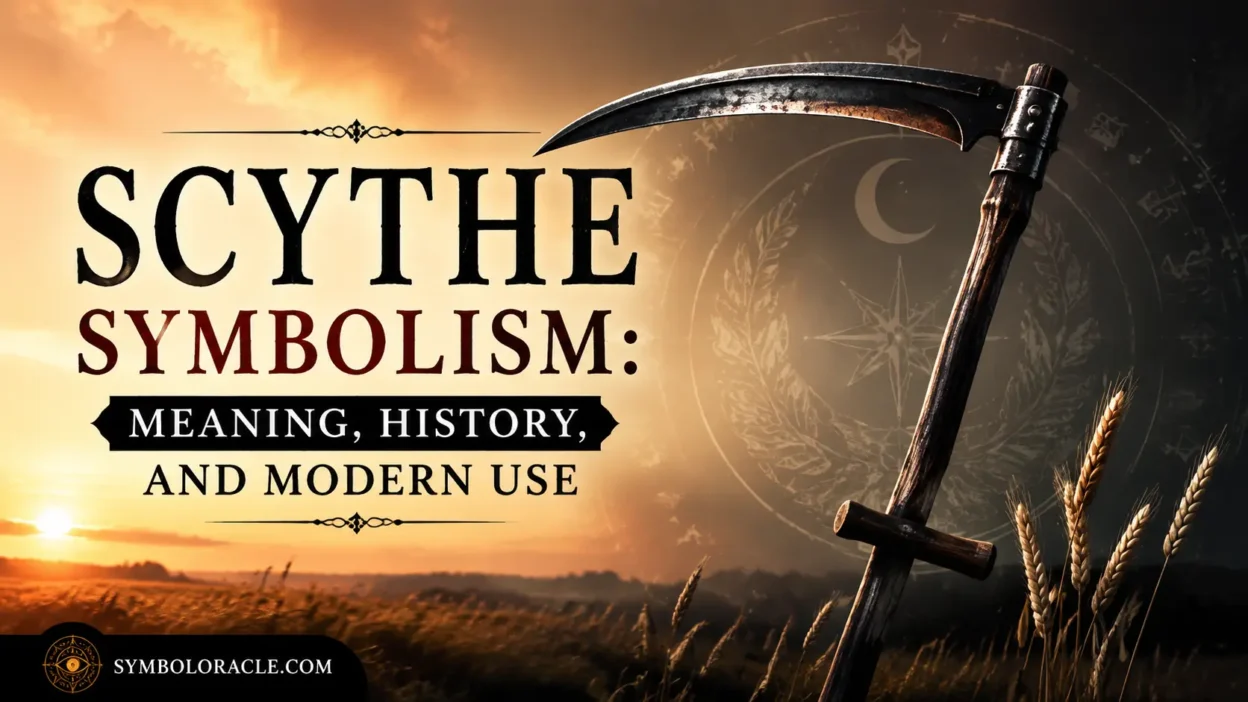
A scythe is a curved blade attached to a long handle, traditionally used for cutting grass, grain, and other plants. Beyond its practical purpose in farming, scythe symbolism has become connected with ideas of harvest, mortality, change, labor, and the passage of time.
For many people in the United States, the image of a scythe immediately brings to mind the figure of the Grim Reaper, autumn traditions, or old agricultural landscapes. However, the symbol has a much broader history. It has represented both the cycle of life and the ending of life, depending on the cultural setting and the message being expressed.
Understanding the scythe requires looking beyond its association with death. It is also a symbol of human work, seasonal renewal, nature’s cycles, and the relationship between people and the land. Its meaning has changed as societies moved from agricultural communities into modern urban cultures.
Today, the scythe appears in tattoos, artwork, fantasy media, Halloween decorations, historical imagery, and personal designs. Some people use it to represent transformation or acceptance of change, while others associate it with darker themes such as mortality and endings.
Quick Answer
Scythe symbolism commonly represents death, the cycle of life, harvest, and change in modern American culture. Historically, it was connected to farming, seasonal renewal, and later became associated with mortality through images like the Grim Reaper.
TL;DR
- Scythes symbolize harvest, endings, and life cycles.
- Ancient farming shaped the tool’s original meaning.
- Americans often connect scythes with death imagery.
- Grim Reaper traditions influenced modern interpretations.
- Tattoos use scythes for transformation themes.
- The symbol carries both positive and dark meanings.
What a Scythe Represents and Why It Became Symbolic
A scythe is one of humanity’s oldest agricultural tools. Its long wooden handle and curved metal blade allowed farmers to cut large amounts of grass or grain efficiently. Before modern machinery, the scythe represented essential survival because harvesting crops determined whether communities had enough food.
The physical design of the tool contributed to its symbolism. The curved blade resembles a crescent shape, which has often been associated with cycles, seasons, and natural rhythms. The act of cutting also created symbolic associations with separation, endings, and transitions.
Unlike many objects that gained symbolic meanings after becoming decorative items, the scythe first carried meaning because of its everyday importance. It represented the relationship between human effort and the natural world.
Over time, societies began using the image of the scythe to express ideas that extended beyond farming. The act of harvesting became a metaphor for collecting, completing, or ending something.
The Ancient Agricultural Roots of Scythe Symbolism
The earliest meaning of the scythe came from agriculture. Farming societies depended on harvest tools to gather crops, making the scythe a symbol of productivity, survival, and preparation.
In European agricultural traditions, harvest time was often connected with community celebrations and seasonal festivals. The scythe represented the final stage of growth when crops were ready to be collected. In this context, the tool was not a symbol of destruction but one of achievement and abundance.
The connection between harvesting and time also influenced the symbol’s later meanings. A harvest marks the end of one process and prepares the way for another. Seeds are planted, crops grow, and eventually they are cut down so new growth can begin.
This natural cycle helped transform the scythe into a symbol of transition. It represented endings that were necessary for continuation.
How the Scythe Became Associated With Death
The strongest modern association with the scythe comes from European images of death, especially the figure known as the Grim Reaper. This figure is usually shown as a hooded skeleton carrying a scythe.
The connection developed because harvesting crops and human mortality shared similar metaphors. Just as a farmer cuts down plants at the end of their growth cycle, death was imagined as collecting human lives when their time had arrived.
During the Middle Ages, especially after widespread experiences with disease and social hardship, artists increasingly used symbolic images to represent mortality. The scythe became a visual reminder that life has a natural ending.
However, the symbol was not originally created as a representation of evil. In many historical contexts, it reflected acceptance of life’s limits rather than fear alone.
Scythe Symbolism in the United States
In the United States, the scythe has several overlapping meanings depending on where it appears. Many Americans recognize it primarily through Halloween imagery and popular culture. The Grim Reaper’s scythe is one of the most recognizable symbols connected with death.
At the same time, the agricultural meaning remains important. In rural communities and historical settings, a scythe can represent farming heritage, self-reliance, and traditional craftsmanship.
The symbol also appears in discussions about seasonal change. Autumn imagery often includes harvest themes, pumpkins, fallen leaves, and farming tools. In these settings, the scythe represents gathering the results of effort rather than simply an ending.
| Context | Meaning in the USA | Common Associations | Notes |
|---|---|---|---|
| Halloween | Death and mortality | Grim Reaper, fear, mystery | Most common modern association |
| Farming history | Labor and harvest | Crops, rural life, tradition | Connected to agricultural heritage |
| Tattoos | Transformation and change | Personal growth, endings | Meaning depends on design |
| Fantasy art | Power or dark themes | Warriors, supernatural figures | Often influenced by fiction |
| Decor | Seasonal symbolism | Autumn, harvest | Can be positive or neutral |
The Scythe as a Symbol of Harvest and Renewal
Although many people associate scythes with death, their original agricultural meaning was connected with growth and abundance.
Harvest is not simply about taking something away. It is the moment when months of preparation produce a result. The scythe represents the reward of patience, work, and cooperation with nature.
In this sense, the symbol can represent completion. A project, personal journey, or period of life may reach a point where something must be gathered, evaluated, or released before moving forward.
Modern interpretations often use this idea of harvest metaphorically. Someone may view the scythe as a reminder to recognize achievements, accept change, and make room for new experiences.
Emotional and Psychological Meanings of the Scythe
The emotional meaning of a scythe depends heavily on personal interpretation. Some people see it as unsettling because of its connection with death imagery, while others see it as a symbol of acceptance and transformation.
Psychologically, the scythe can represent the idea that endings are part of development. Relationships, careers, identities, and personal beliefs often change over time. The symbol can express the willingness to let go of what no longer serves a person.
For others, the scythe represents control over one’s own life story. It can suggest strength, independence, and the ability to move through difficult transitions.
Because the symbol carries both positive and negative associations, its meaning is usually shaped by surrounding images, colors, and personal experiences.
Scythe Symbolism in Mythology, Folklore, and Religion
The scythe appears in several mythological and religious traditions, usually connected with time, harvest, and the natural order of life. Its meaning often depends on whether the focus is on growth and renewal or endings and mortality.
In ancient Greek traditions, agricultural imagery was connected with deities associated with farming and harvest. The Roman figure Saturn was sometimes depicted carrying a harvesting tool, linking the blade with farming cycles and the passage of time.
The scythe also became associated with the idea of time itself. In European artistic traditions, figures representing time were sometimes shown holding an hourglass and a scythe. Together, these objects communicated that time moves forward and cannot be stopped.
Religious interpretations vary. In some Christian-influenced artwork, harvest imagery was used as a metaphor for judgment, where gathering crops represented separating or collecting souls. These interpretations helped strengthen the connection between harvesting and spiritual themes.
However, the scythe is not universally a symbol of fear or punishment. In many traditions, it represents the natural order of existence: growth, maturity, completion, and renewal.
The Scythe and the Grim Reaper in American Culture
The Grim Reaper is the most recognizable modern image connected with the scythe in the United States. Usually shown as a cloaked skeleton carrying a large curved blade, this figure appears frequently during Halloween, in horror films, video games, and fantasy artwork.
American culture often uses the Grim Reaper symbol to explore ideas about mortality in a dramatic or fictional way. A Halloween decoration featuring a scythe is generally intended to create a spooky atmosphere rather than express a serious belief about death.
Popular entertainment has also shaped how Americans understand the symbol. Movies, comics, and video games often portray scythe-wielding characters as mysterious, powerful, or supernatural figures. These portrayals sometimes move the symbol away from traditional death imagery and toward themes of strength, rebellion, or transformation.
Because of this, younger audiences may recognize the scythe more through fantasy culture than through its original agricultural purpose.
Scythe Meaning in Tattoos and Personal Expression
Scythe tattoos have become a popular way for people to express personal ideas about change, mortality, and resilience. The meaning depends greatly on the design elements surrounding the blade.
A scythe combined with flowers may represent the relationship between life and death, showing that growth and endings exist together. A skull and scythe design usually emphasizes mortality, acceptance of death, or an interest in darker artistic styles.
Some people choose scythe imagery after experiencing major life changes. In these cases, the symbol may represent leaving behind an old identity and creating a new one.
Common tattoo interpretations include:
- Acceptance of life’s temporary nature
- Personal transformation
- Strength during difficult periods
- Connection with nature and seasons
- Interest in mythology or fantasy
The meaning is not fixed. A scythe tattoo does not automatically represent negativity or danger. Like many symbols, its message depends on the person wearing it and the surrounding artwork.
Scythe Symbolism in Art, Design, and Popular Media
Artists have used the scythe for centuries because its shape immediately communicates movement and meaning. The curved blade creates a strong visual image that can suggest both elegance and danger.
In modern design, the scythe appears in several styles:
- Gothic artwork
- Fantasy illustrations
- Horror themes
- Historical paintings
- Video game character designs
- Seasonal decorations
In fantasy settings, the scythe is often transformed from a farming tool into a weapon. This creative change has created new associations with power, mystery, and supernatural abilities.
Digital culture has also influenced the symbol’s popularity. Online communities focused on gaming, fantasy art, and alternative fashion frequently use scythe imagery because it creates a recognizable visual identity.
Despite these newer uses, the original connection to harvesting remains visible. The same curved blade that once represented gathering crops now often represents gathering ideas, memories, or personal experiences.
Positive and Negative Interpretations of the Scythe
The scythe has one of the widest symbolic ranges because it can represent opposite ideas.
Positive interpretations include:
- Completion after hard work
- Natural cycles
- Preparation for a new beginning
- Connection to agriculture
- Acceptance of change
Negative interpretations include:
- Fear of death
- Loss
- Destruction
- The unknown
- Final endings
Neither interpretation is automatically correct. Context determines meaning.
For example, a scythe displayed with wheat and autumn colors usually suggests harvest and abundance. A black-cloaked figure holding a scythe creates a very different message associated with death and horror.
Understanding the surrounding symbols is essential when interpreting the scythe.
Common Misunderstandings About the Scythe Symbol
Because of its connection with the Grim Reaper, the scythe is sometimes misunderstood as only a symbol of death. This interpretation ignores thousands of years of agricultural meaning.
The tool was originally associated with life because it helped communities gather food. Farmers used scythes to support survival, not to represent destruction.
Another misunderstanding is that the scythe always carries a negative message. In many modern contexts, it represents acceptance of change rather than fear. A person choosing a scythe symbol may be expressing maturity, reflection, or personal growth.
The symbol has also been misused in certain fictional or ideological contexts where it is given meanings unrelated to its historical background. These modern associations should be separated from its broader cultural history.
How the Meaning of the Scythe Has Changed Over Time
The meaning of the scythe has evolved alongside human societies.
During agricultural periods, it was mainly associated with work, harvest, and seasonal cycles. As societies became less dependent on farming, the everyday connection weakened, and symbolic interpretations became stronger.
Medieval and early modern artwork expanded its connection with mortality. Later, literature, theater, movies, and television reinforced the image of the scythe as an object connected with death.
In the modern United States, the symbol exists in multiple forms at once. It can represent Halloween, farming heritage, fantasy culture, personal transformation, or philosophical ideas about life’s temporary nature.
This evolution shows how symbols are not fixed. Their meanings change as communities create new associations while preserving older ones.
Scythe Symbolism in Modern American Life
Today, Americans encounter scythe imagery in many unexpected places. It appears in Halloween decorations, historical museums, clothing designs, tattoos, video games, and artwork.
For some people, it represents a connection to rural traditions and older ways of living. For others, it reflects an interest in gothic aesthetics, mythology, or fantasy storytelling.
The symbol also appears in discussions about sustainability and traditional farming. As interest grows in older agricultural methods and handmade tools, the scythe has gained renewed attention as a representation of simpler relationships with land and labor.
Its continued use shows that the symbol remains flexible. It can communicate fear, respect for nature, acceptance of change, or appreciation for history.
Frequently Asked Questions About Scythe Symbolism
What does a scythe symbolize spiritually?
A scythe can symbolize cycles of life, transformation, and the acceptance of change. In some spiritual traditions, it represents the idea that endings are a natural part of existence rather than something separate from life.
Is a scythe a symbol of death?
A scythe is commonly associated with death because of the Grim Reaper image, especially in American Halloween culture. However, its original meaning was connected with farming, harvest, and survival.
What does a scythe tattoo mean?
A scythe tattoo may represent personal transformation, acceptance of mortality, overcoming challenges, or an interest in gothic and fantasy imagery. The meaning depends on the design and the person’s personal story.
Why does the Grim Reaper carry a scythe?
The Grim Reaper carries a scythe because harvesting became a metaphor for collecting lives. The image connects the cutting of crops with the end of a human lifespan.
Is the scythe symbol positive or negative?
The scythe can have both positive and negative meanings. It may represent harvest, growth, and renewal, or it may represent death, endings, and loss depending on the context.
What does a scythe represent in American culture?
In American culture, the scythe is often connected with Halloween and death imagery, but it also represents farming history, seasonal change, and traditional craftsmanship.
Conclusion
The meaning of a scythe depends on the story surrounding it. While many Americans recognize it through the Grim Reaper and ideas of mortality, its older symbolism comes from farming, harvest, and the natural rhythm of growth and renewal.
Scythe symbolism represents the connection between endings and beginnings. It reminds people that change, completion, and transformation are parts of human experience.
Whether seen in artwork, tattoos, seasonal decorations, or historical settings, the scythe remains a symbol that carries both practical origins and evolving cultural meanings. Its message is shaped not only by the blade itself, but by the ideas people choose to associate with it.


