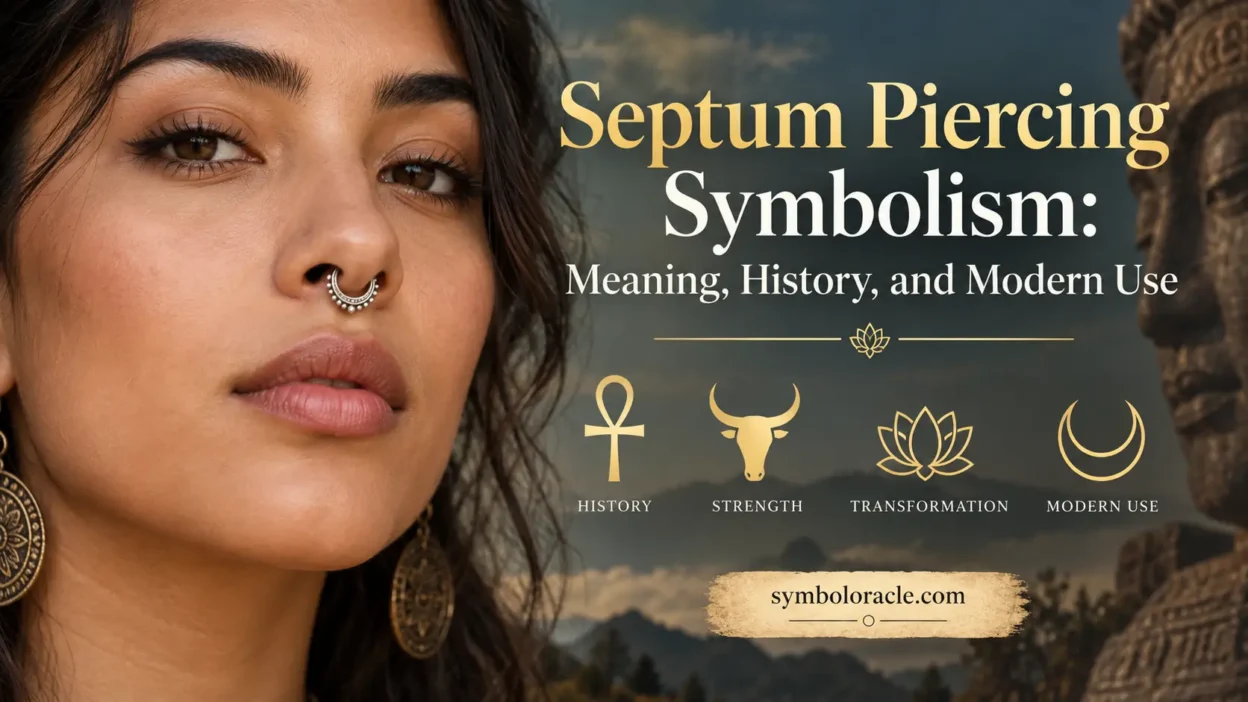
Septum piercing symbolism can represent individuality, self-expression, confidence, cultural identity, or a willingness to challenge social expectations. In the United States, many people now choose a septum ring simply because they like its appearance, while others connect it with personal identity, alternative fashion, or a meaningful change in their lives.
The piercing itself passes through the tissue beneath the nasal cartilage that separates the nostrils. Jewelry may include a circular ring, horseshoe-shaped barbell, clicker, retainer, or another small ornament. Because the piercing sits in the center of the face, it is easy to notice and can become an intentional part of a person’s appearance.
However, its story is much older than today’s fashion trends. Nose and septum ornaments have appeared in Indigenous communities and other societies around the world. Their meanings have included adulthood, status, ceremony, beauty, identity, and social belonging. Those meanings were not identical from one culture to another.
Today, an American wearing a septum ring does not automatically communicate one fixed message. Personal style, jewelry choice, workplace expectations, cultural background, and individual experience all influence how the piercing is understood.
Quick Answer
Septum piercing symbolism commonly represents individuality, self-expression, confidence, and alternative personal style in modern American culture. Historically, septum ornaments have also marked social status, adulthood, ceremonial identity, beauty, and community belonging in different cultures.
TL;DR
- Septum rings often symbolize individuality and personal expression in the United States.
- Indigenous cultures used septum ornaments for status, ceremonies, beauty, and life transitions.
- Modern American wearers do not share one universal symbolic meaning.
- Jewelry style can change the visual message of a septum piercing.
- Some people choose septum piercings to mark confidence or personal change.
- Cultural history matters when discussing traditional forms of nose piercing.
What a Septum Piercing Actually Represents
A septum piercing is placed through the tissue at the lower portion of the nasal septum, the structure separating the two nostrils. The jewelry hangs beneath the nose, which makes it visually different from a standard nostril piercing.
Symbolically, its central position can make it feel more deliberate than less visible forms of body jewelry. The wearer is placing an ornament directly in the middle of the face rather than at the edge of the ear or nose.
Still, the physical location does not create a universal meaning. A person may wear a septum ring because they enjoy alternative fashion, want a visible form of self-expression, like facial jewelry, or simply prefer the look.
The symbolism therefore comes from a combination of body placement, cultural history, personal intention, and social interpretation.
What It Commonly Means in the United States
In modern American culture, the most common associations are individuality and self-expression.
For some people, a septum ring communicates that they are comfortable making unconventional style choices. It can also be associated with alternative fashion, punk, goth, metal, indie, streetwear, and other creative subcultures.
That does not mean every person with a septum piercing belongs to one of those groups. Facial piercings have become much more common across mainstream fashion, especially among younger adults.
A septum piercing can also symbolize personal freedom. Someone may choose it after leaving behind an old style, reaching adulthood, changing careers, recovering from a difficult period, or simply deciding to make their appearance more personal.
The important point is that Americans generally cannot determine someone’s personality from the piercing alone.
Individuality and Self-Expression
One of the clearest modern meanings is individuality.
Unlike a hidden tattoo or a piece of jewelry that can easily disappear beneath clothing, a septum ring can become part of someone’s recognizable appearance. The wearer decides how visible, decorative, or subtle it should be.
Different jewelry styles allow people to communicate different aesthetics. A small gold ring may look understated, while a large decorative piece can create a much stronger visual statement.
For some wearers, this makes the piercing a form of personal branding. It becomes part of how they present themselves to friends, online audiences, coworkers, or creative communities.
The symbolism is therefore less about rebellion itself and more about having control over one’s appearance.
Rebellion and Alternative Identity
Septum piercings are sometimes associated with rebellion because facial piercings were once considered unconventional in many parts of American society.
That association has roots in alternative youth culture, including punk and other underground scenes. Body modification could challenge expectations about what a respectable or conventional appearance should look like.
However, the meaning has changed as piercings have entered mainstream fashion.
A septum ring in 2026 does not necessarily mean rebellion. A teacher, artist, office worker, parent, student, or business owner may wear one without identifying with any rebellious subculture.
The older rebellious association still exists, but it is now only one possible interpretation.
Ancient Roots and Early Cultural Meanings
Septum piercing does not have one single geographic origin. Archaeological and ethnographic evidence shows that nose piercing and septum ornamentation developed in multiple parts of the world.
In several Indigenous societies, nose ornaments were connected with social customs rather than modern ideas of fashion. The materials themselves could also communicate information about the wearer.
Bone, shell, wood, feathers, animal materials, beads, and valuable metals were used in different places. A particular material could reflect local resources, craftsmanship, social position, or ceremonial importance.
Some traditions used septum piercing during important life transitions. In certain communities, it could be associated with initiation or adulthood. In others, it formed part of ceremonial dress or expressed identity within the community.
This variety is important because there is no historically accurate definition such as “septum piercing always meant strength.” Its meaning depended on the people, period, ritual, and social setting.
Septum Piercing in Indigenous Traditions
Septum piercing has a documented history among several Indigenous peoples in different regions.
For example, historical records and museum collections document nose ornaments among some Indigenous communities of North America. In Alutiiq communities, nose ornaments could include wooden pins, shell, ivory, beads, and other materials. Archaeological evidence indicates that such ornaments have a long history in the region.
Historical ethnographic records from Australia also describe septum piercing connected with initiation and ceremonial practices among particular Aboriginal groups.
In other parts of the Americas and the Pacific, nose ornaments could be associated with adulthood, social position, ceremony, beauty, or warrior identity.
These traditions should not be combined into one “tribal meaning.” Each community has its own history and cultural framework.
Status, Adulthood, and Social Identity
In some traditional societies, body modification helped communicate where a person stood within the community.
A piercing could mark a transition from childhood into adulthood. It might also appear during a ceremony or be connected with marriage, social responsibility, or community membership.
Jewelry could further communicate status. Precious or difficult-to-obtain materials were sometimes more significant than ordinary materials because they required greater resources or skill.
This helps explain why body jewelry historically could carry much more information than simple decoration.
For modern Americans, the same visual object may communicate something entirely different. A septum ring might signal a person’s aesthetic preferences rather than age, rank, or social position.
Spiritual and Ceremonial Associations
Some cultures have incorporated nose piercing into ceremonies or spiritual practices. However, there is no single worldwide spiritual meaning attached to the septum.
Claims that every septum piercing represents spiritual awakening, energy balance, fertility, protection, or a particular religious belief are too broad.
Traditional spiritual meanings must be connected to specific communities and practices.
For example, some Indigenous initiation traditions gave body modification a ceremonial role. In such cases, the piercing could be part of a larger social and spiritual event rather than an isolated fashion choice.
Modern wearers sometimes give their own septum piercing a spiritual meaning. Someone may view the experience as a personal rite of passage, a reminder of resilience, or a marker of transformation. That interpretation can be meaningful to the individual without being an ancient universal tradition.
Beauty, Jewelry, and the Meaning of Materials
The jewelry itself can influence the symbolism.
Gold often creates a traditional or luxurious appearance. Silver-colored metals may create a clean and understated look. Decorative pieces can make the piercing feel more artistic, while simple rings may emphasize minimalism.
Historically, material could carry social meaning because some resources were scarce or difficult to obtain.
Today, the relationship is more connected to fashion and personal taste. A person choosing a delicate ring may want the piercing to blend into their appearance. Someone choosing a large ornament may want it to become a focal point.
This makes septum jewelry similar to other forms of personal adornment: the object can communicate taste even when it carries no formal cultural message.
Septum Piercing as a Rite of Personal Change
Some people attach meaning to the moment they receive a piercing.
A new piercing can mark a birthday, graduation, breakup, move, recovery from a difficult period, or another personal transition. The piercing becomes a physical reminder of a particular point in life.
This is a modern form of symbolic behavior that does not require an ancient tradition.
People have long used clothing, jewelry, tattoos, hairstyles, and other forms of appearance to mark changes in identity. A septum piercing can serve the same purpose.
For one person, it may represent independence. For another, confidence. For someone else, it may simply represent finally doing something they had wanted for years.
Emotional and Psychological Symbolism
The emotional meaning of a septum piercing often centers on agency.
Choosing a visible body modification can give someone a sense of ownership over their appearance. The decision is personal, and the result remains visible as a reminder that the wearer made the choice for themselves.
It can also become a confidence marker. A person who once felt uncomfortable standing out may eventually become comfortable with a distinctive appearance.
At the same time, not every piercing has a psychological story. Some people get pierced because they like the jewelry. That simple explanation is just as valid.
Symbolic interpretation should therefore leave room for ordinary personal preference.
Septum Piercing in Modern American Fashion
Septum rings have moved far beyond their earlier association with underground scenes.
They now appear in everyday fashion, social media, music, photography, beauty culture, and entertainment. Jewelry designers offer pieces ranging from inexpensive minimalist rings to elaborate decorative ornaments.
The piercing can fit many different styles:
| Context | Meaning in the USA | Common Associations | Notes |
|---|---|---|---|
| Everyday fashion | Individuality | Personal style, confidence | Often has no deeper symbolism |
| Alternative fashion | Nonconformity | Punk, goth, indie | Historical association remains visible |
| Personal milestone | Change | Growth, independence | Meaning comes from the wearer |
| Decorative jewelry | Beauty | Creativity, fashion | Material and design influence appearance |
| Cultural tradition | Community identity | Ceremony, adulthood, status | Meaning varies by specific culture |
Its growing popularity has also reduced the idea that facial piercings automatically indicate a particular personality.
Why Some People Hide or Flip Their Septum Ring
A distinctive feature of septum jewelry is that some designs can be flipped upward into the nose.
This has practical and symbolic implications.
Someone may hide the jewelry at work, during formal events, around family members, or in settings with appearance rules. The ability to change its visibility gives the wearer control over when the piercing becomes part of their public appearance.
In the United States, this can reflect the tension between personal expression and social expectations.
The same person can present a conventional appearance in one setting and a more expressive style in another. The piercing therefore does not have to represent permanent rebellion.
Common Misunderstandings About Septum Symbolism
One common misconception is that every septum piercing has a secret meaning.
It does not.
Another misconception is that everyone who wears one is rebellious or belongs to a particular subculture. Modern American fashion is much broader than that.
There is also a tendency online to assign one spiritual meaning to septum piercing and present it as universal. Historical evidence does not support such a simple interpretation.
Finally, people sometimes treat Indigenous traditions as though they were one shared practice. They were not. Different communities developed different forms, materials, rituals, and meanings.
A responsible interpretation recognizes cultural differences rather than turning many traditions into one symbolic story.
Cultural Appropriation and Respectful Interpretation
The history of septum piercing raises questions about cultural borrowing because modern Western body-modification communities became interested in practices that already existed in Indigenous societies.
The issue is complicated because there is no single Indigenous position covering every septum piercing or every community.
The safest approach is to avoid claiming that a modern fashion choice reproduces a specific sacred tradition unless there is a genuine connection to that tradition. It is also important not to use inaccurate labels such as “tribal” as though Indigenous cultures were interchangeable.
Respect begins with recognizing that traditional body modification belongs to particular communities with their own histories.
A modern American can appreciate the long history of septum piercing while still understanding that today’s fashion use is not automatically equivalent to traditional ceremonial practice.
How the Meaning Has Changed Over Time
The symbolism has shifted considerably.
In some traditional societies, a nose ornament could communicate information about age, social position, ceremony, or community membership. Later, Western alternative cultures helped associate facial piercings with nonconformity and subcultural identity.
Today, the meaning is much more individualized.
A septum ring may represent fashion, confidence, creativity, independence, gender expression, personal transformation, or nothing beyond aesthetic preference.
This evolution reflects a larger change in American culture. Body modification has moved from the margins toward mainstream personal style, making it harder to assign one social message to any single piercing.
Positive and Negative Interpretations
Most modern interpretations are neutral or positive, but reactions can vary.
Positive interpretations may include:
- individuality
- confidence
- creativity
- independence
- self-expression
- authenticity
- artistic style
Negative interpretations usually come from social expectations rather than an inherent meaning in the piercing. Some people may associate visible facial jewelry with rebellion, unprofessionalism, or nonconformity.
Those judgments depend heavily on age, workplace culture, community, and personal taste.
The piercing itself does not determine whether a person is responsible, professional, confident, or rebellious.
What a Septum Piercing Can Say About Personal Identity
A septum piercing can become a visible part of identity because it changes the face rather than simply adding an accessory.
For some people, that visibility is the point. It can communicate comfort with individuality and a willingness to make personal choices without relying entirely on conventional beauty standards.
For others, the meaning is more private. The jewelry may remind them of a personal decision, a difficult period they overcame, or a moment when they started making choices for themselves.
The same ring can therefore carry different meanings for different people.
That is one reason symbolism should be treated as interpretation rather than a fixed code.
Septum Piercing Symbolism in Tattoos, Art, and Digital Culture
Septum imagery also appears outside actual body piercing.
Artists may use a septum ring in portraits to suggest alternative fashion, youth culture, independence, or a distinctive personality. Digital avatars and illustrations sometimes use facial piercings as quick visual signals of a character’s style.
In tattoo culture, a septum piercing may appear alongside other body-modification imagery. The combination can suggest individuality or a broader interest in alternative aesthetics.
Social media has further changed how people interpret piercings. Photos and short videos allow styles to spread rapidly across communities, reducing the connection between a piercing and any single geographic or cultural group.
FAQ About Septum Piercing Symbolism
What does a septum piercing symbolize?
A septum piercing commonly symbolizes individuality, self-expression, confidence, and personal style in modern American culture. Its meaning can also be connected to personal change, alternative fashion, or identity depending on the wearer.
Does a septum piercing have a spiritual meaning?
It can have spiritual meaning for an individual, but there is no universal spiritual interpretation. Some cultures have used septum piercing in ceremonial or spiritual contexts, and those meanings differ from modern personal interpretations.
What does a septum piercing mean for a woman?
There is no single meaning for women who wear septum piercings. In contemporary American culture, it may represent fashion, independence, creativity, confidence, or simple personal preference.
Does a septum piercing symbolize rebellion?
It can symbolize rebellion because facial piercings were historically associated with alternative and punk subcultures. Today, however, septum piercings are mainstream enough that the wearer may have no rebellious intention at all.
Is a septum piercing connected to Indigenous traditions?
Yes, septum and other nose-piercing traditions have existed among multiple Indigenous peoples around the world. However, each community has its own cultural meaning, so it is inaccurate to describe all Indigenous septum piercings as having one symbolism.
What does a septum ring symbolize in modern American culture?
It often signals personal style and individuality rather than a specific social status. The design, setting, and wearer’s reason for choosing it can change how other people interpret the ring.
Can a septum piercing symbolize personal transformation?
Yes. Some people use body modification to mark a major life change, such as becoming more independent or moving into a new stage of life. That symbolism is personal rather than a universal historical rule.
Conclusion
Septum piercing symbolism has no single definition. In the modern United States, it most often points toward individuality, self-expression, confidence, and personal style, while older traditions show that septum ornaments have also been connected with adulthood, ceremony, status, beauty, and community identity.
The most accurate interpretation depends on context. A septum ring worn as everyday fashion should not automatically be treated as a religious symbol, a sign of rebellion, or a representation of one Indigenous tradition.
Ultimately, the meaning belongs partly to the wearer. The jewelry may be fashionable, meaningful, cultural, personal, or simply attractive—and understanding that range makes the history of septum piercing more accurate and respectful.


