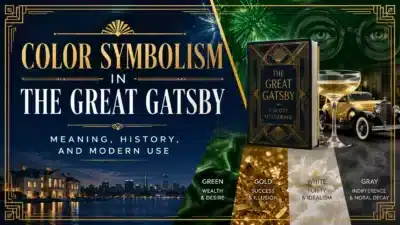
In The Great Gatsby, red symbolism helps readers understand the tension beneath the glamour of the Jazz Age. Although F. Scott Fitzgerald uses color throughout the novel, red can suggest anger, passion, danger, violence, and emotional intensity. These associations are especially relevant to a story filled with romantic obsession, reckless behavior, social competition, and tragic consequences.
Published in 1925, The Great Gatsby follows Jay Gatsby, a wealthy man who builds his life around the hope of reuniting with Daisy Buchanan. His lavish parties and expensive possessions appear to promise success, but the novel gradually exposes the insecurity and moral carelessness behind that appearance. color can help readers explore these contrasts, although Fitzgerald’s symbolism should not be reduced to a simple code in which every color has one fixed meaning.
Understanding red symbolism in The Great Gatsby requires attention to context. Red is not the novel’s only important color, and its significance depends on the scene, the characters, and the ideas surrounding it. Reading red alongside the novel’s more prominent associations with green, white, yellow, and gold reveals how Fitzgerald connects desire and social ambition with the destructive consequences of pursuing an ideal at any cost.
Quick Answer
Red symbolism in The Great Gatsby can suggest passion, danger, anger, violence, and the emotional intensity surrounding the characters’ relationships. In the broader historical and cultural context of the 1920s, red also carried associations with love, vitality, political conflict, and warning, making it a useful lens for examining the novel’s unstable world.
TL;DR
- Red can represent passion, aggression, danger, and emotional conflict.
- The novel’s central tragedy grows from obsession, deception, and reckless privilege.
- Fitzgerald’s Jazz Age setting connects glamour with moral uncertainty.
- Green, white, yellow, and gold have more prominent recurring symbolic roles.
- Red’s meaning depends on the scene rather than a fixed color code.
- Modern readers use color symbolism to explore the novel’s relationships and themes.
1. What Red Symbolizes in The Great Gatsby
Red commonly suggests strong emotion. It can represent romantic desire, jealousy, rage, physical danger, or a warning that something is wrong. In a novel where characters conceal their intentions behind attractive appearances, these associations offer a useful way to discuss the pressure building beneath the surface.
Gatsby’s desire for Daisy is intense, but it is not simply a story of romantic devotion. He wants to recover an imagined past and recreate a relationship according to his own expectations. Tom Buchanan, meanwhile, responds to threats against his authority with aggression and possessiveness. Their different forms of emotional intensity help explain why red can be a useful interpretive color for the novel.
However, readers should distinguish between a defensible interpretation and a directly established literary symbol. Fitzgerald does not assign red one universal meaning in the story. Its significance emerges through the novel’s broader patterns of desire, conflict, wealth, and violence.
2. How Color Creates Meaning in Fitzgerald’s Novel
Fitzgerald uses description to establish atmosphere and reveal differences between appearance and reality. Colors help readers imagine rooms, clothing, landscapes, and social settings, but they can also encourage associations that extend beyond the objects themselves.
A color may communicate luxury in one scene and discomfort in another. Its effect depends on what characters are doing, what the narrator notices, and what readers already understand about the situation.
Red is particularly useful as an interpretive contrast because its familiar associations include both attraction and danger. A red object might suggest confidence or vitality, while a red-toned image in a tense scene might encourage readers to think about anger or physical threat. Neither interpretation should be treated as automatic.
This distinction matters when studying The Great Gatsby. A thoughtful reading considers Fitzgerald’s actual descriptions first, then examines what those details contribute to the novel’s themes. It avoids assuming that every mention of a color was deliberately designed to communicate a single hidden message.
3. Red and Romantic Desire
Romantic passion is one of the most familiar meanings associated with red. In modern American culture, red roses, red hearts, and red clothing often communicate attraction or romantic intensity. That association provides a useful starting point for examining Gatsby’s feelings for Daisy.
Gatsby has spent years turning Daisy into the center of his personal dream. His wealth, mansion, parties, and carefully constructed public identity are all connected to his hope of winning her back. His longing is real, but it becomes increasingly detached from Daisy as an independent person with her own history and choices.
Red can therefore represent the intensity of desire while also raising a difficult question: when does love become possession? Gatsby does not merely want a future with Daisy. He wants to restore the past exactly as he remembers it, leaving little room for the changes that time has brought.
This interpretation becomes more meaningful when red is understood as a lens rather than a literal color code. The novel’s emotional tension comes from Gatsby’s inability to separate the woman he loves from the ideal he has created.
4. Red as a Warning Sign
Red is widely recognized as a warning color in contemporary American life. Stop signs, emergency signals, hazard labels, and many alert systems use red to demand attention. Although these modern conventions should not be projected directly onto every scene in a novel published in 1925, the broader association between red and danger remains a useful interpretive comparison.
The world of The Great Gatsby becomes increasingly threatening as the characters’ private choices lead to public consequences. Affairs, lies, resentment, and careless decisions gradually destroy the appearance of order that wealth and social status seem to provide.
Red’s warning associations help modern readers describe this movement from excitement toward danger. Gatsby’s parties initially seem full of possibility, yet their glamour conceals loneliness, manipulation, and a lack of responsibility.
The contrast is central to the novel’s criticism of privileged society. The danger does not arise because the characters lack money or opportunity. It arises because several of them behave as though their social position will protect them from the consequences of their actions.
5. Anger, Jealousy, and Rivalry
Red is also associated with anger and jealousy, emotions that shape the conflict between Gatsby and Tom Buchanan. Both men want control over Daisy’s future, but they approach that struggle from different social positions.
Gatsby believes wealth can help him recover the life he once imagined with Daisy. Tom relies on inherited privilege, physical intimidation, and established social power. Their rivalry exposes the difference between someone trying to enter an exclusive world and someone who assumes that world already belongs to him.
The confrontation in the Plaza Hotel is a turning point. Gatsby demands that Daisy reject her marriage and affirm that she never loved Tom. Tom challenges Gatsby’s background and legitimacy, attempting to reassert his authority over the situation.
Red can help readers discuss the emotional heat of this confrontation, especially its connections to jealousy, humiliation, and aggression. Yet the conflict is more complicated than a simple contest between two men. Daisy’s own uncertainty, the unequal expectations placed on women, and the characters’ competing versions of the past all contribute to the scene’s tension.
6. Red and the Violence Behind Wealth
The novel’s most serious consequences emerge when emotional conflict turns into physical harm. Myrtle Wilson’s death, Gatsby’s murder, and George Wilson’s eventual death expose the destructive results of deception and carelessness.
These events make red’s associations with blood and violence relevant to a broader interpretation of the story. The color can serve as a conceptual reminder that the characters’ private desires are not harmless simply because they take place in beautiful houses or expensive cars.
Tom and Daisy can retreat into their wealth after the crisis, leaving others to suffer the consequences. Gatsby, despite his fortune, cannot protect himself from the chain of events surrounding Myrtle’s death. George Wilson is devastated by loss and manipulated by incomplete information.
Red’s violent associations are therefore most useful when they direct attention toward responsibility. The tragedy is not simply that the characters experience intense emotions. It is that their choices, deceptions, and social advantages help turn those emotions into irreversible harm.
7. The Jazz Age and the Historical Meaning of Red
The Jazz Age, the cultural setting associated with the novel, is commonly linked with changing social behavior, consumer spending, popular entertainment, and new expressions of personal freedom. The decade also contained major inequalities, racial tensions, political disputes, and anxieties about changing gender roles.
In this setting, red could carry several familiar associations. It was linked with romance, passion, bloodshed, warning, and political movements. Its interpretation varied according to the object, setting, and community in which it appeared.
The color also belonged to a broader visual culture shaped by advertising, fashion, theater, and commercial design. Bright colors could attract attention and communicate excitement, while clothing and decorative choices could help people express identity or status.
These historical associations provide context, not proof that Fitzgerald intended every red detail to represent a particular idea. A careful reading considers the language of the novel itself before connecting it to the larger culture of the 1920s.
The period’s contradictions are especially relevant to Gatsby’s world. Economic opportunity and extravagant entertainment existed alongside rigid class boundaries. The appeal of modern life was real, but access to its rewards remained unequal.
8. Red Compared With Green, White, Yellow, and Gold
Red is a useful interpretive color, but the novel’s other colors have more established roles in its critical tradition. Green is especially associated with Gatsby’s longing and the future he imagines, while white, yellow, and gold contribute to discussions of social appearance, wealth, and moral ambiguity.
| Color | Common interpretation in the novel | Important context |
|---|---|---|
| Red | Passion, aggression, danger, emotional conflict | Best treated as a contextual interpretive lens |
| Green | Hope, longing, ambition, the future | The green light across the water is a major recurring image |
| White | Purity, elegance, social presentation, ambiguity | Daisy and Jordan’s white clothing complicates appearances |
| Yellow and gold | Money, display, status, moral uncertainty | Wealth can look attractive while concealing corruption |
| Blue | Illusion, distance, or dreamlike atmosphere in some readings | Interpretation depends on the specific image and passage |
The green light at the end of Daisy’s dock is among the novel’s clearest and most important symbols. It represents Gatsby’s longing for Daisy while also suggesting the broader human tendency to pursue an idealized future.
White is more complicated than a simple sign of innocence. The appearance of elegance and refinement associated with Daisy and Jordan contrasts with their capacity to participate in a careless social world. Yellow and gold similarly connect luxury with the moral questions raised by wealth.
Compared with these recurring color patterns, red is best used carefully. It can sharpen an interpretation of conflict or danger without being presented as the novel’s dominant color symbol.
9. Red and the Difference Between Appearance and Reality
One of Fitzgerald’s central concerns is the gap between what people appear to be and what their behavior reveals. Gatsby’s carefully managed identity, Tom’s confidence, and Daisy’s charm all influence how other people perceive them.
Red’s contrasting associations can help readers explore this gap. The color can be attractive and attention-grabbing, but it can also suggest aggression or danger. That duality resembles a society in which glamour can hide selfishness and social respectability can conceal cruelty.
Gatsby’s parties illustrate the problem. Guests arrive for entertainment and luxury, often without understanding their host or caring about his personal life. The celebrations create an image of abundance, but they do not provide Gatsby with the genuine relationship he wants.
The distinction between appearance and reality is not unique to red. It runs through the novel’s setting, characterization, and narrative structure. Red simply offers one way to describe the contrast between surface excitement and the damage that lies underneath.
10. How American Readers Interpret Red Today Red Symbolism in The Great Gatsby
In contemporary American culture, red is used in many settings that encourage quick emotional responses. It appears in Valentine’s Day decorations, sports uniforms, warning signs, political imagery, advertisements, and branding. Depending on context, it can signal love, urgency, courage, anger, or celebration.
These modern associations influence how students and general readers approach The Great Gatsby. A reader familiar with red hearts may connect the color with Gatsby’s romantic obsession, while someone who associates red with alarms or danger may emphasize the consequences of the characters’ choices.
Neither response is automatically correct. A literary interpretation becomes stronger when it connects a color association to a specific scene, character, or recurring theme.
For American classrooms, red symbolism can be a useful starting point for discussing how readers create meaning from descriptive language. It also provides an opportunity to distinguish between a symbol that clearly recurs in a text and a color association that helps explain a broader theme.
That distinction encourages more precise analysis. Instead of claiming that red always represents violence in the novel, readers can explain how its cultural associations illuminate particular moments of jealousy, danger, or emotional intensity.
11. Emotional and Psychological Associations of Red
Red often attracts attention because people associate it with heightened emotion and physical intensity. Depending on the situation, it can suggest warmth, excitement, urgency, embarrassment, aggression, or threat.
These associations are culturally influenced rather than universal psychological laws. People do not all respond to color in the same way, and a color’s effect depends on personal experience, social convention, and the surrounding environment.
In The Great Gatsby, emotional intensity is a useful way to understand the difference between Gatsby’s idealized love and the complicated reality of his relationship with Daisy. His dream gives direction to his life, but it also limits his ability to accept change.
Red can serve as a visual metaphor for that emotional pressure. It helps readers discuss the point at which longing becomes obsession or rivalry becomes hostility. The interpretation should remain grounded in the characters’ actions and the narrator’s descriptions rather than unsupported claims about color controlling human behavior.
12. Red in Modern Art, Fashion, and Literary Discussion
Modern artists and designers frequently use red to draw attention, establish contrast, or create an emotional atmosphere. In book covers, theater productions, classroom presentations, and adaptations of The Great Gatsby, red can emphasize romance, excess, conflict, or the violence beneath the story’s polished surface.
Fashion offers another useful comparison. A red dress or suit may communicate confidence, visibility, attraction, or defiance, depending on the wearer and setting. Such associations can influence how a modern adaptation presents a character, but they do not automatically reflect Fitzgerald’s original intentions.
Readers may also encounter red in social media posts, literary illustrations, and fan-made artwork. These interpretations often combine the novel’s themes with contemporary ideas about relationships, wealth, and identity.
When discussing these creative uses, it is helpful to separate adaptation from textual evidence. A filmmaker or illustrator may deliberately make red a dominant visual motif, even if that choice is more pronounced than the color symbolism in the original book.
That creative decision can still be meaningful. It shows how readers and artists reinterpret an established work for new audiences.
13. Common Misunderstandings About Red Symbolism
The most common mistake is treating every color as though it has a single, officially assigned meaning. In literature, a color’s significance depends on how it appears, what surrounds it, and whether the text establishes a recurring pattern.
Another mistake is assuming that red is the central color in The Great Gatsby. Green, especially the light at the end of Daisy’s dock, plays a much more recognizable role in interpretations of Gatsby’s hopes and ambitions.
Readers should also avoid treating modern American color conventions as exact descriptions of how every person in the 1920s understood red. Some associations have long histories, but others have changed across periods, regions, and communities.
Finally, symbolic interpretation should not replace close reading. If an argument claims that red represents jealousy in a particular passage, the reader should explain how the scene supports that conclusion. Without relevant textual evidence, the interpretation remains a possibility rather than a firm claim about Fitzgerald’s design.
These distinctions do not make color symbolism less useful. They make it more convincing by separating what the novel clearly establishes from what readers reasonably infer.
14. How to Analyze Red Symbolism in an Essay
A strong literary analysis begins with a specific claim. Rather than stating that red represents everything from love to death, identify the theme you want to examine, such as romantic obsession, jealousy, danger, or the contrast between glamour and moral responsibility.
Next, choose a passage that supports the argument. Pay attention to the actual colors Fitzgerald describes, the characters present, the mood of the scene, and the events that follow. Do not assume that a passage contains red symbolism unless the text or the visual context gives you a reason to make that connection.
Then explain why the color association matters. If you connect red with aggression, for example, show how that reading clarifies a character’s behavior or contributes to the novel’s criticism of privilege. A strong analysis explains how the detail supports a larger argument instead of simply naming a symbolic meaning.
A useful thesis might be: Red symbolism offers a way to examine the novel’s associations between emotional intensity and destructive behavior, while the contrast between glamour and consequence reveals the moral failures of the Jazz Age elite.
This approach allows you to discuss red thoughtfully without overstating its importance. It also creates room to compare red with the novel’s more prominent green, white, yellow, and gold imagery.
Frequently Asked Questions
What does red symbolize in The Great Gatsby?
Red can suggest passion, jealousy, anger, danger, and violence when interpreted in relation to the novel’s conflicts. However, it is not as clearly established as a recurring symbol as the green light or some of Fitzgerald’s other color imagery.
Is red a major symbol in The Great Gatsby?
Red is a useful interpretive color, but it is not generally considered the novel’s central color symbol. The green light is more prominent because it directly connects Gatsby’s personal longing with his imagined future.
Does red symbolize love in The Great Gatsby?
Red’s common association with romantic love can help readers discuss Gatsby’s desire for Daisy. Yet his feelings also involve idealization and an attempt to recover the past, making the relationship more complicated than a straightforward love story.
How does red represent danger or violence?
Red is often associated with blood, warnings, anger, and physical danger in modern American culture. These associations can illuminate the novel’s tragic events, but they should be connected to specific passages rather than treated as proof of a deliberate red motif.
What is the difference between red and green symbolism in the novel?
Red can serve as a lens for discussing emotional intensity and conflict, while green has a more established connection to Gatsby’s hopes and ambitions. The green light provides a recurring image that links his desire for Daisy to the larger theme of pursuing an idealized future.
Why does Fitzgerald use color symbolism?
Color imagery helps create atmosphere, distinguish settings, and develop themes without explaining every idea directly. In The Great Gatsby, color also contributes to the contrast between attractive appearances and the moral uncertainty beneath them.
How can I write about red symbolism in a Gatsby essay?
Start with a clear claim about passion, danger, jealousy, or another relevant theme, then support it with a specific passage. Explain how the detail contributes to character development or the novel’s larger criticism of wealth, class, and careless behavior.
Conclusion
Red symbolism in The Great Gatsby offers a way to explore the novel’s connections between passion, jealousy, danger, and the destructive consequences of unchecked desire. These associations help modern readers examine the emotional conflicts beneath the glamour of the Jazz Age, particularly Gatsby’s idealized love for Daisy and the rivalry that contributes to the story’s tragedy.
Still, red should be interpreted with care. Fitzgerald’s color imagery works through context, contrast, and recurring themes rather than a universal code. The green light remains the novel’s clearest color-based symbol, while red provides a useful interpretive perspective on its more volatile emotions and conflicts.
Ultimately, The Great Gatsby shows how an attractive dream can become destructive when people confuse desire with reality and privilege with freedom from responsibility. Its colors help readers recognize that the difference between appearance and truth can determine the fate of the characters who inhabit Fitzgerald’s world.