
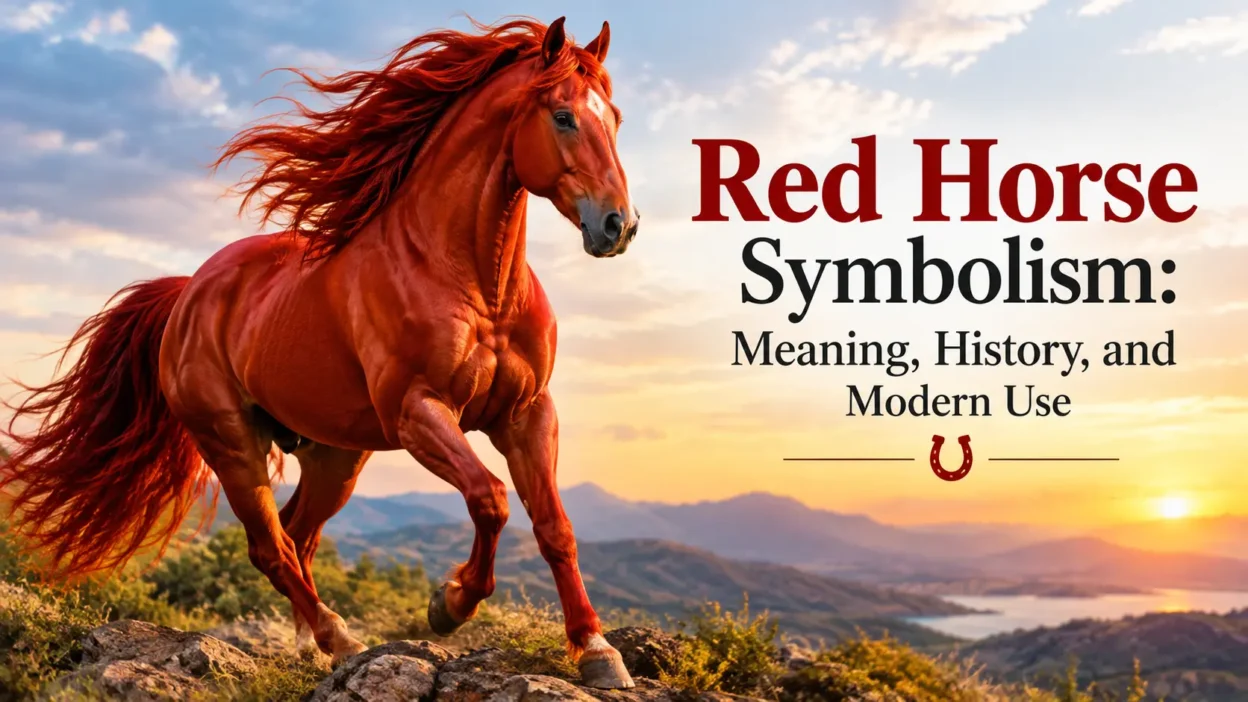
A red horse is an arresting image: a powerful animal with a color associated with fire, blood, passion, and danger. Red horse symbolism can represent courage, intense emotion, conflict, freedom, or a major change, depending on where the image appears. Its meaning is not fixed. A red horse in a painting, a religious text, a dream, or a tattoo may communicate very different ideas.
In the United States, people often connect horses with independence, movement, strength, and the American West. Red adds another layer, suggesting urgency, determination, anger, vitality, or warning. Together, the horse and its unusual color create an image that can feel either inspiring or unsettling.
The historical background matters, too. Red horses appear in biblical imagery, folklore, art, and modern popular culture. Some traditions associate them with warfare and upheaval, while others allow room for vitality, courage, and personal transformation. Understanding the context helps explain why the same image can carry both positive and negative meanings.
Quick Answer
Red horse symbolism commonly represents passion, courage, intense energy, conflict, and dramatic change in modern American culture. Historically, red horses have also appeared in religious visions and artistic traditions associated with warfare, upheaval, and powerful forces.
TL;DR
- Core meaning: A red horse can symbolize courage, passion, conflict, or transformation.
- Biblical origins: The red horse in Revelation is associated with warfare and the removal of peace.
- American interpretation: Horses suggest independence, movement, endurance, and frontier identity.
- Emotional meaning: Red can communicate urgency, anger, desire, confidence, or vitality.
- Modern use: Artists, tattoo enthusiasts, and designers use red horses to express intensity and individuality.
- Context matters: A red horse may represent freedom in one image and destruction in another.
What Does a Red Horse Look Like as a Symbol?
A red horse may appear as a naturally reddish animal, a chestnut horse depicted in heightened colors, or a symbolic creature painted bright scarlet, crimson, or vermilion. In art and illustration, the red may be realistic, exaggerated, or entirely fantastical.
The color makes the animal stand out. A brown or black horse may suggest familiar strength or restraint, while a bright red horse attracts immediate attention. Its appearance can make an ordinary scene feel urgent, emotional, heroic, or threatening.
The horse’s actions also shape the message. A red horse running across an open field can suggest freedom and forward motion. A red horse rearing with its front legs raised may communicate defiance, aggression, or resistance. A calm red horse can instead represent controlled strength and confidence.
Artists sometimes place a red horse against a pale background to emphasize isolation or individuality. Others use dark skies, flames, weapons, or crowded battle scenes to create associations with danger and upheaval.
There is no universal visual code that assigns one meaning to every red horse. Its posture, surroundings, cultural background, and intended audience all help determine what the image communicates.
The Core Meanings of Red Horse Symbolism
Several interpretations recur in modern art and popular understanding, although none applies automatically to every red horse.
Courage and personal strength
Horses have long been valued for their ability to carry people, pull loads, and move across difficult terrain. These practical qualities helped establish the horse as an image of physical strength, endurance, and dependable action.
Red can intensify those associations. A red horse may represent the willingness to act under pressure, defend a principle, or confront a difficult situation. In a personal artwork, it might stand for someone who refuses to give up when circumstances become challenging.
Passion and intense emotion
Red is commonly associated with love, desire, anger, and excitement. When combined with a horse, the color can suggest emotions that are difficult to ignore or contain.
A galloping red horse might represent ambition or enthusiasm that pushes someone forward. A tense, restless animal might express frustration or anger. In romantic art, it could suggest desire and emotional intensity, although this interpretation depends on the surrounding imagery.
Conflict and danger
Red also recalls blood, fire, warning signs, and emergency signals. A red horse can therefore symbolize violence, instability, or the threat of conflict.
This association is particularly important in biblical imagery and paintings that portray battles or disasters. In those settings, the horse’s color may signal that the scene concerns more than individual bravery; it may represent a larger crisis affecting an entire community.
Freedom and transformation
The horse’s movement offers another interpretation. A horse running without a rider can suggest independence, escape, or the desire to make one’s own decisions. Red adds urgency, making the movement appear more dramatic.
For some contemporary viewers, this combination represents leaving behind an old identity, taking a risk, or beginning a new chapter. This is a modern interpretive possibility rather than a fixed meaning inherited from one ancient tradition.
The Red Horse in the Bible and Christian Interpretation
One of the best-known religious appearances of a red horse occurs in the Book of Revelation, chapter 6, verses 3–4. In this vision, the opening of the second seal reveals a red horse whose rider receives a large sword and the authority to remove peace from the earth.
This image is part of the sequence commonly called the Four Horsemen of the Apocalypse. The horses are associated with different forms of upheaval, and the red horse is particularly connected with war, bloodshed, and the breakdown of peace.
For many Christian readers, the red horse represents the destructive consequences of human violence. The sword reinforces that interpretation, while the loss of peace shows how conflict can spread beyond the people who initiate it.
Interpretations of Revelation differ among Christian denominations and biblical scholars. Some readers understand the horsemen as images of recurring human suffering, including warfare and political instability. Others connect them to particular prophetic events or to the end times. These are religious interpretations, not universally agreed predictions.
The red horse should also be distinguished from every other red horse in religious literature. Its meaning in Revelation comes from the rider, sword, and surrounding vision, not simply from the animal’s color.
Red Horses in Earlier Biblical Imagery
Red horses appear in another biblical setting in Zechariah 1:8, where a prophet describes a vision involving a man riding a red horse among myrtle trees. Other horses of different colors appear in the surrounding passage.
Zechariah’s vision and Revelation’s horsemen share visual elements, but they do not communicate precisely the same message. Zechariah’s passage concerns a prophetic vision and questions about the condition of Jerusalem and the surrounding world. Revelation presents a sequence in which the opening of seals brings calamities.
This distinction matters because popular explanations sometimes treat every biblical red horse as a direct sign of war or disaster. The passage in which the animal appears must guide its interpretation.
The broader biblical tradition also includes horses associated with military power, royal status, and divine judgment. In the ancient world, horses were important in warfare and transportation, so their appearance could carry political and military associations that modern readers might overlook.
For Christian audiences today, a red horse in religious artwork may therefore suggest several related themes: judgment, conflict, the loss of peace, or the consequences of human choices. Its precise meaning depends on the biblical passage and the artist’s interpretation.
How Horses Became Symbols of Freedom in America
In the United States, the horse has a cultural history that extends far beyond religious imagery. Horses became central to transportation, agriculture, ranching, military activity, and travel across much of the country.
The American West played a particularly important role in shaping the horse’s modern image. In paintings, novels, rodeos, and Western films, horses came to represent mobility, independence, endurance, and life beyond established boundaries.
The historical picture is more complicated than the familiar image of a lone cowboy riding across an empty landscape. Horses were essential to Indigenous communities as well as settlers, ranchers, soldiers, and travelers, although the histories and meanings of horsemanship differed among communities. Spanish colonization and the spread of horses across North America also changed life across the Great Plains and the West.
A red horse draws on this larger American tradition when it appears in a landscape, Western-inspired artwork, or personal design. Its color may add a sense of boldness or rebellion to the familiar image of a free-moving horse.
However, red is not a standard, universal emblem of American freedom. That association comes from combining the horse’s cultural history with the color’s emotional effects and the particular artwork in which it appears.
What Red Adds to the Horse’s Meaning
The symbolism of a red horse becomes easier to understand when the meanings of the animal and the color are considered separately.
Red can signal danger, blood, anger, urgency, love, or celebration. Its meaning varies with the situation. A red stop sign communicates a warning, while red roses often communicate romantic affection. Neither meaning automatically applies to every red object.
The horse, meanwhile, can suggest stamina, movement, service, status, or independence. When the two images are combined, they produce a range of interpretations rather than one definitive message.
| Context | Possible meaning | Why it fits |
|---|---|---|
| Biblical Revelation | War and the loss of peace | The rider carries a sword and removes peace |
| Western-inspired art | Freedom and defiance | Horses are associated with frontier movement and independence |
| Personal artwork | Courage and determination | The horse suggests strength; red adds intensity |
| Romantic imagery | Passion and desire | Red often communicates strong emotion |
| Dark or apocalyptic art | Danger and upheaval | Red evokes blood, while the horse suggests force in motion |
These meanings are interpretive possibilities, not a universal dictionary. A red horse in a peaceful landscape may communicate something quite different from one charging through a battlefield.
Emotional and Psychological Interpretations
People often respond to images before they consciously analyze them. A horse in motion can create an impression of speed, strength, or escape, while a bright red color can make the scene feel more urgent.
That combination may help explain why a red horse can seem exciting to one viewer and threatening to another. Someone who associates horses with freedom may see a symbol of independence. Someone familiar with the biblical Four Horsemen may immediately think of war and judgment.
Personal experience also affects interpretation. A person who grew up around horses might associate the animal with responsibility, trust, work, or companionship. Another person may know horses primarily through films, mythology, or religious art.
In this sense, symbolism works through both shared cultural associations and individual memories. The image does not reveal a person’s personality or future, and there is no established psychological rule that makes a red horse mean the same thing to everyone.
Still, the image can serve as a useful way to express a complicated feeling. Someone might choose a red horse to represent determination during a difficult period, anger at injustice, or the desire to move forward without abandoning personal independence.
Red Horse Symbolism in Dreams
Dream interpretations frequently associate horses with freedom, motivation, instinct, or the ability to manage life’s demands. Red may add associations with anger, excitement, desire, or urgency. These are common interpretive frameworks, not scientifically established meanings for a particular dream.
The details of the dream are more useful than the color alone. Consider the horse’s behavior, the setting, and the dreamer’s emotional response.
- A red horse running freely: You might associate the scene with independence, momentum, or a desire for change.
- A red horse charging toward you: The image could reflect a feeling of pressure, confrontation, or fear.
- A calm red horse: You might connect it with confidence, controlled emotion, or personal strength.
- A red horse that cannot move: The scene could bring to mind frustration, restricted freedom, or difficulty making progress.
- Riding a red horse: You might interpret the experience as an attempt to direct strong emotions or take control of a challenging situation.
These possibilities are starting points for reflection, not predictions. Dreams do not provide reliable evidence that a particular event will occur, and a red horse is not inherently an omen of danger.
If the dream stays with you, consider what was happening in your life and which emotions the image brought up. Your personal associations may explain its significance better than a fixed dream dictionary.
Red Horse Symbolism Across Other Cultural Traditions
Horses appear in many cultural traditions, but their meanings differ according to religion, mythology, geography, and historical experience. Red does not carry an identical meaning across all these settings.
In some European artistic traditions, red horses appear in scenes of battle, royal spectacle, or religious drama. Their color may emphasize violence, vitality, or the extraordinary nature of the scene. In other works, an unusual horse color is primarily an artistic choice rather than a reference to a specific belief.
In Chinese culture, horses have associations with speed, achievement, vitality, and forward movement. Red can be associated with good fortune, celebration, happiness, and prosperity in many Chinese contexts. A red horse can therefore invite positive interpretations in contemporary decorative settings, especially when the image is designed around celebration or success. However, this combination should not be treated as one universal traditional symbol.
In Greek mythology, horses appear in stories involving gods, heroes, travel, and extraordinary creatures. The winged horse Pegasus, for example, is associated with inspiration and heroic adventure, but it is not traditionally defined by red coloring. A modern red depiction of Pegasus may combine those established associations with the contemporary symbolism of red.
These examples illustrate an important distinction: a culture may have established meanings for horses and colors without possessing one fixed traditional meaning for a red horse. Responsible interpretation begins with the specific story, object, or artistic tradition.
Red Horse Tattoos and Personal Identity
A red horse tattoo can communicate a person’s values without requiring a religious or mythological explanation. Its meaning may come from the wearer’s experience, the horse’s design, or the particular moment in life the tattoo commemorates.
Some common interpretations include:
- Independence: A horse running without a rider can represent self-direction and freedom.
- Courage: A muscular horse or one standing firmly may represent resilience during adversity.
- Passion: Bright red coloring can express enthusiasm, romantic intensity, or strong personal convictions.
- Transformation: A horse moving through flames or emerging from darkness may represent a major life transition.
- Remembrance: A tattoo of a red horse may honor a beloved animal, a family tradition, or an important personal memory.
The design changes the message. A realistic chestnut horse may look natural and understated, while a scarlet horse with exaggerated features may feel rebellious or fantastical. A red horse paired with a sword, broken chains, or a rising sun introduces additional meanings that should be interpreted individually.
Someone considering this tattoo should also distinguish personal symbolism from religious symbolism. A red horse based on Revelation may carry associations with warfare and judgment that differ sharply from a design intended to represent freedom.
Ultimately, a tattoo does not have to follow a historical definition. The wearer’s intention can be central, provided the design is not presented as an authentic cultural or religious tradition when it is actually a modern invention.
Red Horses in Art, Fashion, and Home Decor
Red horses can function as striking visual elements in modern design because the animal’s shape and the color both attract attention.
In contemporary painting, a red horse might serve as the main subject in an otherwise neutral landscape. The contrast directs the viewer toward movement, emotion, or the horse’s relationship with its surroundings. Abstract artists may use red to move away from realistic animal representation and focus instead on form and feeling.
In fashion, a red horse motif may suggest athleticism, speed, confidence, or an interest in equestrian culture. The interpretation depends on the garment, the brand’s visual identity, and the intended audience. A red horse on a sports-inspired design may communicate energy rather than spiritual significance.
Home decor offers different possibilities. A traditional equestrian painting may suggest a connection to horses, riding, or rural life. A modern red horse sculpture may introduce a dramatic focal point. In a room dominated by neutral colors, the red figure can draw attention without requiring the owner to believe in any particular symbolism.
The surrounding objects matter. A red horse displayed alongside religious imagery may invite a spiritual interpretation, while the same sculpture placed among Western photographs may suggest frontier history or personal independence.
For designers, the useful question is not simply what a red horse means. It is what the image communicates within the entire visual arrangement.
Red Horse Symbolism in Movies, Games, and Digital Culture
Modern entertainment often uses color and animal imagery to communicate a character’s role quickly. A red horse can be designed to appear heroic, dangerous, supernatural, or emotionally intense before the audience knows anything about its story.
In fantasy films and games, an unusually colored horse may belong to a magical setting or mark a character as different from ordinary people. Red armor, glowing eyes, flames, or a dark environment can reinforce the impression of danger. These details are creative choices rather than evidence of an ancient symbolic rule.
In Western entertainment, a horse may communicate loyalty, travel, escape, or a character’s connection to the land. Coloring the animal red can distinguish it from more realistic horses or give it a heightened visual identity.
Digital illustrations and social media graphics offer still more flexibility. A red horse might appear in artwork about ambition, personal growth, rebellion, or religious prophecy. Captions often shape how viewers interpret the image, especially when the illustration does not include an obvious historical or narrative reference.
It is worth separating established symbolism from marketing language. An artist or online creator may assign a red horse a particular meaning for a project, but that does not make the interpretation a universal cultural belief.
When Red Horse Symbolism Is Misunderstood or Misused
Because red horses appear in religious prophecy and dramatic artwork, they are sometimes treated as automatic warnings of disaster. This interpretation can overlook the differences between religious imagery, personal expression, and modern creative design.
Several misunderstandings are especially common.
Assuming every red horse predicts war. Revelation associates its red horse with warfare, but a red horse in a dream, painting, or tattoo does not automatically carry that biblical meaning.
Treating every red horse as a sign of good luck. Some modern decorative interpretations emphasize success, vitality, or prosperity. These associations should not be presented as universal beliefs shared by all cultures.
Confusing personal interpretation with historical fact. An individual may decide that a red horse represents recovery after hardship. That meaning can be sincere and important without being an established ancient tradition.
Claiming that a dream guarantees a future event. There is no reliable basis for concluding that dreaming about a red horse predicts an accident, conflict, financial gain, or spiritual event.
Using religious imagery without understanding its context. The red horse in Revelation belongs to a specific vision involving the removal of peace. Red horses in other passages or modern artwork may serve entirely different purposes.
A related historical distinction concerns the phrase Red Horse. In the nineteenth-century American West, Red Horse was also the name of a Minneconjou Lakota warrior associated with drawings documenting the Battle of the Little Bighorn. His name and historical work are not simply another version of the biblical red horse symbol. Treating the two as interchangeable would erase an important historical context.
The most responsible approach is to identify where an image comes from before assigning it a meaning.
How Red Horse Symbolism Has Changed Over Time
The meaning of a red horse has never depended on color alone. Its interpretation has developed through the interaction of practical horse culture, religious texts, artistic conventions, and contemporary personal expression.
In biblical literature, red horses appear within visions whose surrounding details guide their meaning. Revelation’s red horse is associated with the loss of peace and warfare, while Zechariah’s vision belongs to a different prophetic setting.
In American culture, horses acquired additional associations through transportation, ranching, military service, and Western storytelling. Their role in everyday life helped establish the horse as an image of movement, independence, and endurance.
Modern visual culture allows people to combine these traditions more freely. An artist can borrow the dramatic appearance of the apocalyptic horseman without making a religious statement. A tattoo wearer can use red to express passion rather than violence. A designer can create a red horse purely because the color makes the composition more memorable.
This evolution does not mean that historical meanings have disappeared. The biblical association with warfare remains recognizable, particularly when the image includes a sword or other apocalyptic details. Instead, modern culture has added new interpretations alongside older ones.
Understanding this history makes it easier to appreciate the image without forcing every red horse into a single explanation.
Frequently Asked Questions
What does a red horse symbolize spiritually?
A red horse may represent intense emotion, courage, conflict, or transformation in modern spiritual interpretations. In Christian contexts, the red horse in Revelation is specifically associated with warfare and the loss of peace.
Is a red horse a good or bad symbol?
It can be either, depending on the context. A red horse used to represent determination or freedom may feel positive, while one depicted in an apocalyptic scene may communicate danger and destruction.
What does a red horse mean in the Bible?
In Revelation 6:3–4, the red horse appears when the second seal is opened, and its rider receives a sword and the authority to take peace from the earth. The passage is commonly interpreted as an image of war, violence, and upheaval.
What does dreaming about a red horse mean?
A red horse in a dream might bring to mind freedom, strong emotions, ambition, or conflict, depending on the situation. Dream imagery is personal and does not reliably predict future events.
What does a red horse tattoo represent?
A red horse tattoo can represent independence, courage, passion, resilience, or a personal connection to horses. If the design draws on biblical imagery, it may instead emphasize war, judgment, or the loss of peace.
Does a red horse symbolize good luck in Chinese culture?
Red is associated with celebration, happiness, and good fortune in many Chinese cultural settings, while horses can suggest vitality and achievement. However, a red horse does not have one universal meaning across every Chinese tradition, and its interpretation depends on the setting and design.
What is the difference between a red horse and the red horseman of the Apocalypse?
A red horse is a general image that can be used in many artistic and cultural contexts. The red horseman of the Apocalypse is a specific biblical figure in Revelation whose role is associated with warfare and the removal of peace.
Conclusion
Red horse symbolism combines the horse’s associations with strength, movement, and independence with red’s associations with passion, urgency, danger, and vitality. Its meaning can shift from courage and personal freedom to warfare and upheaval, depending on the historical, religious, or artistic context.
In the United States, the image often draws on Western ideas of independence while also reflecting the influence of biblical stories, modern art, tattoos, and popular entertainment. Other cultural traditions may encourage different interpretations, so no single definition applies everywhere.
The best way to understand a red horse is to look beyond its color. Consider where the image appears, what the horse is doing, and which cultural story surrounds it. Those details reveal whether the horse represents a call to action, a warning about conflict, or simply an individual’s chosen expression of strength and freedom.


