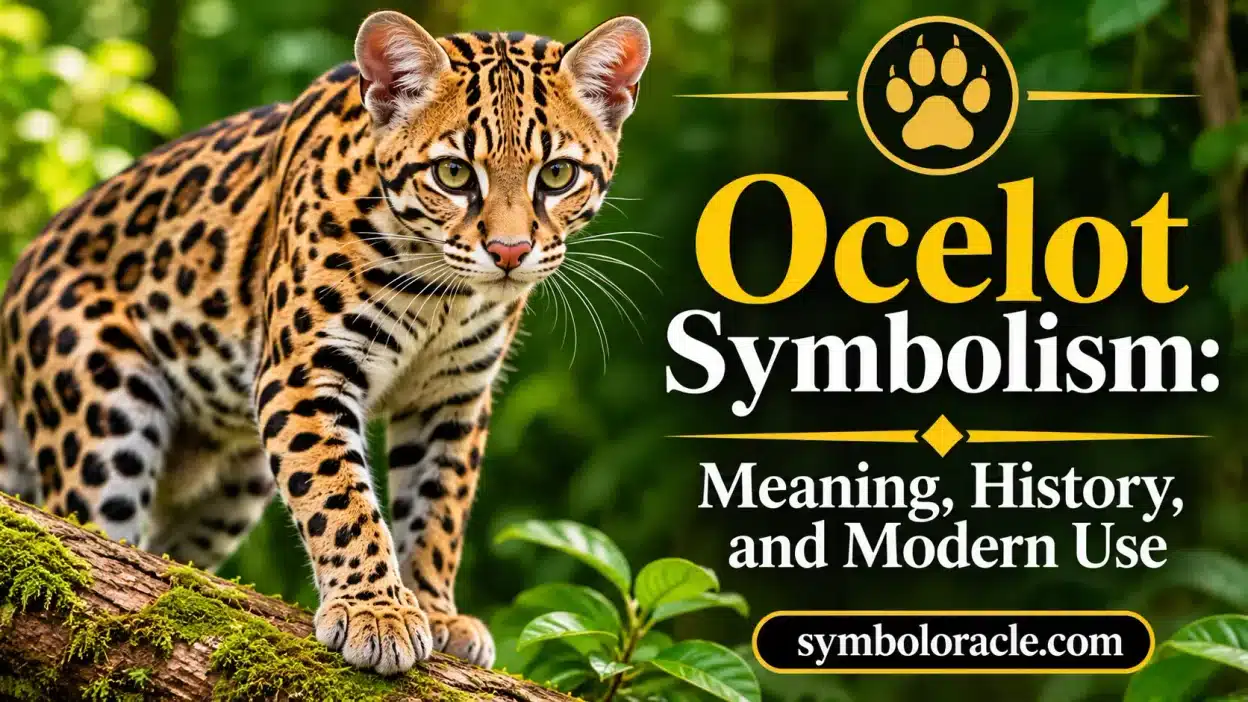
The ocelot is a beautifully patterned wild cat known for its golden coat, dark markings, sharp senses, and secretive behavior. In ocelot symbolism, these characteristics are often connected with independence, observation, adaptability, quiet confidence, and the ability to move through difficult situations without attracting unnecessary attention. Its appearance also gives it associations with individuality, natural beauty, and personal identity.
Unlike the lion or eagle, the ocelot does not have one widely established symbolic meaning in American culture. Its interpretation comes mainly from its natural behavior, its place in the wildlife of the Americas, and the historical importance of spotted wild cats in Indigenous cultures of Central America and Mexico.
Today, the animal can represent someone who values privacy, trusts personal instincts, and prefers careful action over public attention. At the same time, its endangered status in the United States has added another meaning: the importance of protecting vulnerable wildlife and preserving natural habitats.
Quick Answer: What Does Ocelot Symbolism Mean?
Ocelot symbolism commonly represents independence, stealth, adaptability, keen observation, and individuality in modern American interpretations. Historically, spotted wild cats held associations with courage, warrior identity, and authority in parts of Mesoamerica, although important distinctions exist between the ocelot and the jaguar.
TL;DR
- Independence: The ocelot represents self-reliance and personal freedom.
- Stealth: Its hunting behavior suggests patience, observation, and careful action.
- Adaptability: Its ability to live in different environments represents flexibility.
- Individuality: Its unique coat patterns suggest personal identity and self-expression.
- Historical connections: Spotted wild cats held important positions in Mesoamerican traditions.
- Conservation: Its endangered American populations represent vulnerability and environmental responsibility.
1. What Is an Ocelot and Why Is It Symbolic?
An ocelot (Leopardus pardalis) is a medium-sized wild cat native to the Americas. It lives in regions extending from southern Texas through Mexico, Central America, and much of South America. Although it resembles a small leopard, it belongs to a different group of wild cats.
Its appearance is one of its most recognizable features. The coat usually has a golden, tan, or sandy background covered with dark spots, elongated markings, and rosette-shaped patterns. Its face has distinctive dark lines, while its relatively short tail has dark bands.
Ocelots are generally solitary and most active at night or around dawn and dusk. They use thick vegetation for shelter and protection, relying on excellent eyesight, hearing, and patience when hunting.
These natural characteristics help explain why people associate the animal with particular qualities.
- Its solitary lifestyle suggests independence.
- Its nighttime activity suggests awareness and discretion.
- Its hunting technique suggests patience and strategy.
- Its patterned coat suggests individuality.
- Its ability to survive in different habitats suggests adaptability.
These are human interpretations of observable animal behavior, not scientifically established personality traits or universal spiritual meanings.
2. The Main Symbolic Meanings of the Ocelot
Ocelot imagery can communicate several ideas depending on the setting. Someone choosing an ocelot tattoo may have a different intention from someone encountering the animal in a wildlife documentary.
Nevertheless, several interpretations appear naturally from its appearance and behavior.
Independence and Self-Reliance
The ocelot spends much of its adult life alone. It hunts independently, maintains its own territory, and does not depend on a permanent social group.
This behavior makes it a natural image of self-reliance.
In personal symbolism, the animal can represent someone who enjoys independence, makes individual decisions, and feels comfortable following a path that differs from the expectations of others.
It does not necessarily suggest loneliness. Instead, it can express the ability to appreciate personal space without feeling disconnected from other people.
Stealth and Awareness
Ocelots are skilled hunters that use vegetation and darkness to approach their prey. Rather than relying on speed alone, they often depend on careful movement and timing.
As a symbol, this behavior suggests that not every situation requires immediate action.
The ocelot can represent a person who watches carefully, gathers information, and waits for a suitable opportunity before making a decision.
Adaptability and Survival
Ocelots occupy several types of environments, including tropical forests, wooded areas, and dry thorn scrub.
Their ability to live in different landscapes gives them a natural association with flexibility.
People may use the animal to represent the ability to adjust to unfamiliar circumstances, recover from setbacks, and continue moving forward when conditions change.
Individuality and Distinction
An ocelot’s coat is not identical to that of another ocelot. Each animal has a distinctive arrangement of spots, stripes, and rosettes.
This visible difference makes the animal a suitable symbol of individuality.
It can represent the idea that personal identity does not need to follow a standard pattern. Differences in appearance, background, interests, and experience can be recognized as defining characteristics rather than weaknesses.
3. Ancient Roots and Mesoamerican Connections
The historical background of spotted wild cats in Mesoamerica is particularly interesting, but it requires an important distinction.
In Nahuatl, the language associated with the Aztecs and other central Mexican communities, the word ocelotl generally referred to the jaguar. Historical translations sometimes rendered it as an ocelot, creating confusion between two different animals.
The jaguar and ocelot are both spotted cats, but they are not the same species.
This distinction matters because many historical claims about ocelot symbolism actually describe jaguar symbolism.
The Jaguar and Warrior Identity
In Aztec society, the jaguar had important connections with military status, courage, and authority.
Jaguar warriors formed a recognized military group, and jaguar imagery appeared in clothing, ceremonial objects, and artistic representations.
The combination of the eagle and jaguar also appeared in expressions associated with warrior identity.
These traditions demonstrate the importance of spotted feline imagery in Mesoamerican culture. However, they should not automatically be presented as evidence that the modern ocelot itself held the same position.
Animal Power in Indigenous Traditions
Across different Indigenous communities in the Americas, animals have served as important figures in stories, artistic traditions, and relationships with the natural world.
Wild cats could represent hunting ability, strength, territorial awareness, or connections between humans and the environment.
Their meanings varied according to community, location, and historical period.
There was never one universal Indigenous interpretation of the ocelot. Treating all Native American or Mesoamerican traditions as a single belief system would overlook important cultural differences.
4. What Ocelots Represent in Modern American Culture
In the United States, the ocelot has a particularly interesting cultural position because it is both an exotic-looking wild cat and a native American species.
Many Americans associate spotted cats with tropical forests, wildlife photography, and international conservation. However, ocelots also belong to the natural heritage of Texas.
Historically, they occupied a wider area of the southern United States, including parts of Texas, Louisiana, Arkansas, and Arizona.
Today, their remaining breeding populations in the country are concentrated in South Texas.
This geographical connection gives the animal several modern interpretations.
Regional identity: For Texans interested in native wildlife, the ocelot represents a distinctive part of the state’s natural heritage.
Environmental responsibility: Its declining population reminds people that development and habitat destruction can threaten native species.
Respect for nature: Its secretive lifestyle encourages appreciation for animals that exist outside everyday human experience.
Wildlife protection: The ocelot has become an important example of why habitat preservation and wildlife corridors matter.
Its meaning in modern America is therefore not limited to personality or artistic expression. It also has a real environmental connection.
5. Ocelot Symbolism in Different Cultural Contexts
There is no single worldwide interpretation of the ocelot. Its meaning changes depending on the culture, historical background, and way the animal is represented.
| Cultural context | Common association | Important distinction |
|---|---|---|
| Mesoamerican history | Courage, warrior identity, and authority | Many historical references concern jaguars rather than ocelots. |
| Modern United States | Independence, individuality, and wildlife protection | These are contemporary interpretations, not established traditional beliefs. |
| Latin American wildlife culture | Native biodiversity and natural heritage | Meanings vary across countries and communities. |
| Contemporary art | Camouflage, beauty, and distinctiveness | Often based on the animal’s appearance. |
| Modern personal symbolism | Privacy, observation, and adaptability | Usually an individual interpretation. |
Mexico and Central America
Ocelots are native to Mexico and Central America, where they inhabit forests, scrublands, and other vegetated environments.
Their presence in local ecosystems gives them ecological importance. They are predators that help regulate populations of smaller animals.
However, the historical importance of jaguars in Mesoamerican art should not be confused with a universal tradition of ocelot worship or spiritual interpretation.
South American Connections
In South America, ocelots are part of the wildlife found in several ecosystems.
Their presence in forests and other natural habitats can make them recognizable symbols of biodiversity and wildlife preservation.
Different communities may have their own relationships with the animal, but there is no single South American belief that defines what every ocelot represents.
Modern Global Interpretation
Outside the Americas, people often recognize the ocelot through wildlife documentaries, zoo exhibits, conservation campaigns, and animal photography.
Its spotted coat and secretive behavior make it visually distinctive.
In these settings, it often represents the beauty of wild animals and the need to protect habitats that support them.
6. The Emotional and Psychological Meaning of the Ocelot
Animals can become meaningful personal symbols because people connect their observable characteristics with human experiences.
The ocelot offers several possibilities.
Feeling Comfortable With Privacy
An ocelot does not depend on constant social interaction. Its solitary behavior can appeal to people who value quiet environments and personal boundaries.
Someone who identifies with this animal may see privacy as a healthy part of personal well-being rather than something that needs to be explained.
Trusting Observation Before Action
The ocelot’s hunting behavior provides another interpretation.
It spends time observing its surroundings before approaching prey. This can represent the importance of understanding a situation before responding.
In everyday life, that idea may relate to thoughtful decision-making, professional planning, or avoiding unnecessary conflict.
Accepting Personal Differences
The animal’s coat patterns offer a visual reminder that individuality does not require uniformity.
People may connect the ocelot with accepting their appearance, background, personality, or life experiences.
Its symbolism can be particularly relevant to someone who has learned to appreciate characteristics that once made them feel different.
Balancing Confidence With Caution
The ocelot is a capable predator, but it does not need to display itself constantly.
This creates an interesting symbolic contrast: confidence does not always have to be loud or visible.
For some people, the animal represents the ability to recognize personal strengths without constantly seeking approval.
7. What the Ocelot’s Colors and Patterns Represent
The ocelot’s appearance contributes significantly to its visual symbolism.
Its colors and markings are natural adaptations that help it blend into its surroundings. Artists and designers, however, may give these features additional meanings.
Golden and Tan Fur
The golden background of an ocelot’s coat can suggest warmth, natural beauty, confidence, and connection with the earth.
In decorative art, these shades may create an impression of elegance without the brightness associated with more vivid colors.
Black Spots and Rosettes
The dark markings provide contrast against the lighter fur.
Symbolically, this contrast can represent individuality, complexity, and the ability to remain recognizable while adapting to different environments.
Amber Eyes
The ocelot’s eyes are often represented in artwork as golden or amber.
Artists may use this feature to communicate attentiveness, awareness, and alertness.
These interpretations come from visual design rather than a formal cultural tradition.
The Meaning of Camouflage
Perhaps the most interesting visual characteristic is the relationship between the animal’s markings and its environment.
Its coat helps break up its outline among vegetation and changing light.
In symbolic art, camouflage can represent discretion, protection, and the ability to adapt without losing one’s identity.
8. Ocelot Symbolism in Dreams
Dream interpretations are personal and should not be treated as predictions or evidence of supernatural messages.
However, the appearance of an ocelot in a dream can provide an opportunity to explore feelings connected with independence, caution, privacy, or personal confidence.
The surrounding circumstances often matter more than the animal alone.
Seeing a calm ocelot: This might reflect a desire for personal space, independence, or a more peaceful environment.
Watching an ocelot hunt: The scene could bring attention to patience, planning, or an important decision that requires careful observation.
An ocelot hiding in the forest: This might connect with privacy, uncertainty, or the feeling that something in your life has not yet become clear.
An ocelot approaching you: This could represent growing confidence or a willingness to recognize a part of your personality that you usually keep private.
A threatened ocelot: This might reflect concerns about personal boundaries, vulnerability, or losing something you value.
Rather than assuming that every dream has a fixed meaning, consider what the animal made you feel and what was happening in your life at the time.
9. What Does an Ocelot Tattoo Symbolize?
An ocelot tattoo can represent independence, personal identity, patience, and appreciation for wildlife.
Unlike more common animal tattoos, such as lions, wolves, or eagles, an ocelot design can communicate a preference for something less familiar.
The meaning depends on the person choosing it.
Common interpretations include:
- Independence: A reminder to make personal decisions confidently.
- Quiet strength: Confidence without the need for attention.
- Individuality: Appreciation for personal differences.
- Adaptability: A reminder to adjust when life changes.
- Nature appreciation: Respect for wild animals and their habitats.
- Personal resilience: Recognition of the ability to overcome difficult circumstances.
Some people may also choose an ocelot tattoo because of its visual appearance.
Its distinctive markings create interesting possibilities for realistic, geometric, minimalist, and detailed black-and-gray tattoo designs.
A tattoo does not have to follow a traditional cultural meaning. It can represent a personal experience, memory, or value.
10. Ocelot Symbolism in Art, Jewelry, and Fashion
The ocelot’s coat has visual qualities that translate naturally into artistic and decorative styles.
Its combination of golden shades, dark spots, and flowing patterns can create a sophisticated appearance.
In Artwork
Artists may use ocelot imagery to explore themes of nature, camouflage, wildlife, and individuality.
A realistic portrait emphasizes the animal’s physical beauty, while an abstract illustration may focus on its markings.
In Jewelry
Ocelot-inspired jewelry may feature spotted patterns, cat-shaped pendants, or golden and black color combinations.
These designs can appeal to people who appreciate wild animals or want accessories that communicate independence and distinctive personal taste.
In Fashion
Spotted patterns have long appeared in clothing and accessories.
However, not every spotted animal print represents the ocelot. Leopard and jaguar patterns are also common, and the three animals have different coat characteristics.
An ocelot-inspired design can suggest natural elegance, individuality, and appreciation for unusual wildlife.
In Home Decor
Ocelot imagery can appear in framed wildlife photography, printed fabrics, decorative objects, and nature-inspired interiors.
A photograph of the animal may communicate a stronger interest in conservation, while an abstract spotted pattern may simply provide visual texture.
11. The Ocelot as a Symbol of Conservation and Survival
One of the most important modern meanings associated with the ocelot in the United States comes from its conservation status.
Although the species has a broad distribution across Latin America, its American populations have suffered serious declines.
Historically, ocelots occupied much more of the southern United States. Hunting, trapping, habitat destruction, and fragmentation reduced their numbers.
The species was listed as endangered under federal protections, with its status in the United States clarified in 1982.
Today, the remaining known breeding populations are concentrated in South Texas. Estimates have varied, but recent conservation reporting places the American population at roughly 100 or fewer known wild individuals, depending on the survey and counting method.
Several threats continue to affect these animals:
- Roads create risks of vehicle collisions.
- Agricultural development reduces natural habitat.
- Fragmented landscapes restrict movement between populations.
- Loss of vegetation removes essential shelter.
- Small isolated populations face genetic challenges.
This situation gives the ocelot an additional symbolic meaning: survival depends not only on individual strength but also on a suitable environment.
Its story challenges the idea that a capable animal can survive anywhere. Even an adaptable predator needs connected habitats, adequate food, and protection from human activities.
In modern American environmental discussions, the ocelot can therefore represent conservation responsibility and the importance of protecting native species.
12. Misunderstandings About Ocelot Symbolism
Because the ocelot resembles other spotted cats, several misunderstandings can affect how people interpret its symbolism.
Confusing the Ocelot With the Jaguar
This is the most important historical misunderstanding.
The jaguar had a recognized position in Aztec military and cultural traditions. Historical references to ocelotl frequently refer to the jaguar rather than the modern zoological species called the ocelot.
The animals are related members of the cat family, but their cultural histories should not be treated as interchangeable.
Assuming It Has One Universal Spiritual Meaning
There is no universally recognized spiritual definition of the ocelot.
Interpretations involving independence, stealth, or personal transformation are modern symbolic readings based on its characteristics.
They may be meaningful to individuals, but they should not be presented as established beliefs shared by all Indigenous or Latin American communities.
Treating Its Appearance as Evidence of Personality
An ocelot’s spotted coat and solitary behavior do not establish that people who admire it possess the same characteristics.
Animal symbolism is a way of expressing human ideas through nature. It is not a scientific personality test.
Confusing Conservation With Weakness
The ocelot’s endangered status in the United States does not mean that the species is naturally weak.
Its decline is closely connected with human activities, including habitat destruction and hunting.
Recognizing this difference is important because conservation symbolism should emphasize environmental responsibility rather than portray vulnerable wildlife as incapable.
13. How Ocelot Symbolism Has Changed Over Time
The meaning of the ocelot has not developed through one continuous, universally documented symbolic tradition.
Instead, different interpretations have emerged from cultural history, natural observation, art, and modern environmental concerns.
In ancient Mesoamerica, spotted feline imagery carried important associations with military identity and authority, particularly through the jaguar.
During later periods, wild spotted cats became increasingly recognizable through descriptions of American wildlife, natural history, and their distinctive coats.
In the twentieth century, commercial demand for spotted fur contributed to widespread hunting of ocelots. Their skins became associated with luxury fashion, but this popularity came at a serious cost to wildlife populations.
As conservation awareness increased, the animal acquired a different public meaning.
Today, its image can represent several ideas at once:
- Personal independence and individuality.
- Appreciation for distinctive wildlife.
- The importance of protecting natural habitats.
- The difference between visual beauty and commercial exploitation.
- The relationship between human development and animal survival.
This evolution shows how an animal’s public meaning can change when people develop a different understanding of its history and ecological importance.
14. What the Ocelot Can Teach Us About Nature and Identity
The ocelot offers an interesting way to think about the relationship between individuality and the natural world.
Its coat is distinctive, but its survival depends on blending into its surroundings. It lives independently, yet its continued existence depends on healthy ecosystems and connected habitats.
That contrast makes it particularly suitable for personal reflection.
Independence does not mean rejecting every connection. Privacy does not mean avoiding relationships. Adaptability does not mean abandoning personal identity.
The ocelot’s natural behavior provides a reminder that survival often requires understanding the environment rather than trying to control every part of it.
Its conservation story adds another lesson: individual resilience has limits when the surrounding conditions become unsuitable.
People may appreciate the ocelot for its appearance, but understanding its ecological needs gives its image greater context.
Frequently Asked Questions
1. Is the ocelot a symbol of good luck?
There is no widely established tradition identifying the ocelot as a universal good-luck symbol. However, individuals may associate it with favorable qualities such as awareness, independence, adaptability, and the ability to recognize opportunities.
2. What does an ocelot tattoo mean?
An ocelot tattoo commonly expresses personal independence, individuality, quiet confidence, and appreciation for wildlife. Its exact meaning depends on the person wearing it and the experiences or values represented by the design.
3. Is the ocelot considered sacred in Indigenous cultures?
It would be inaccurate to describe the ocelot as universally sacred across Indigenous cultures. Spotted feline imagery, particularly that of the jaguar, held important cultural and ceremonial associations in several Mesoamerican traditions, but the two animals should not be confused.
4. What does seeing an ocelot represent spiritually?
Some modern spiritual interpretations connect seeing an ocelot with trusting personal instincts, protecting privacy, and approaching situations patiently. These are personal interpretations rather than universally accepted religious teachings or established spiritual rules.
5. Does the ocelot represent strength or weakness?
The ocelot is more commonly interpreted as a symbol of quiet strength, independence, and adaptability. Its endangered status in the United States also highlights vulnerability, particularly when natural habitats are damaged.
6. What is the difference between ocelot and jaguar symbolism?
Jaguar symbolism has documented historical associations with authority, warfare, and warrior identity in Mesoamerican cultures. Ocelot symbolism today is more commonly based on its solitary behavior, distinctive coat, and ecological role, although modern interpretations sometimes borrow imagery associated with larger spotted cats.
7. Why is the ocelot important in American wildlife conservation?
The ocelot is one of the rarest native wild cats in the United States, with its remaining breeding populations concentrated in South Texas. Protecting it requires preserving suitable habitat, improving wildlife movement between isolated areas, and reducing preventable deaths on roads.
Conclusion
Ocelot symbolism is commonly associated with independence, stealth, adaptability, individuality, and quiet confidence. These interpretations come largely from the animal’s solitary lifestyle, careful hunting behavior, distinctive coat, and ability to survive in different natural environments. Historical connections with spotted wild cats also provide cultural context, although the important distinction between ocelots and jaguars must be respected.
In modern American culture, the ocelot represents more than an attractive wild cat. Its declining population in South Texas has made it a recognizable example of the importance of wildlife conservation and habitat protection.
Ultimately, the ocelot reminds us that individuality and survival are closely connected to understanding our surroundings. Its story combines the beauty of a distinctive animal with the responsibility humans have to protect the natural world.