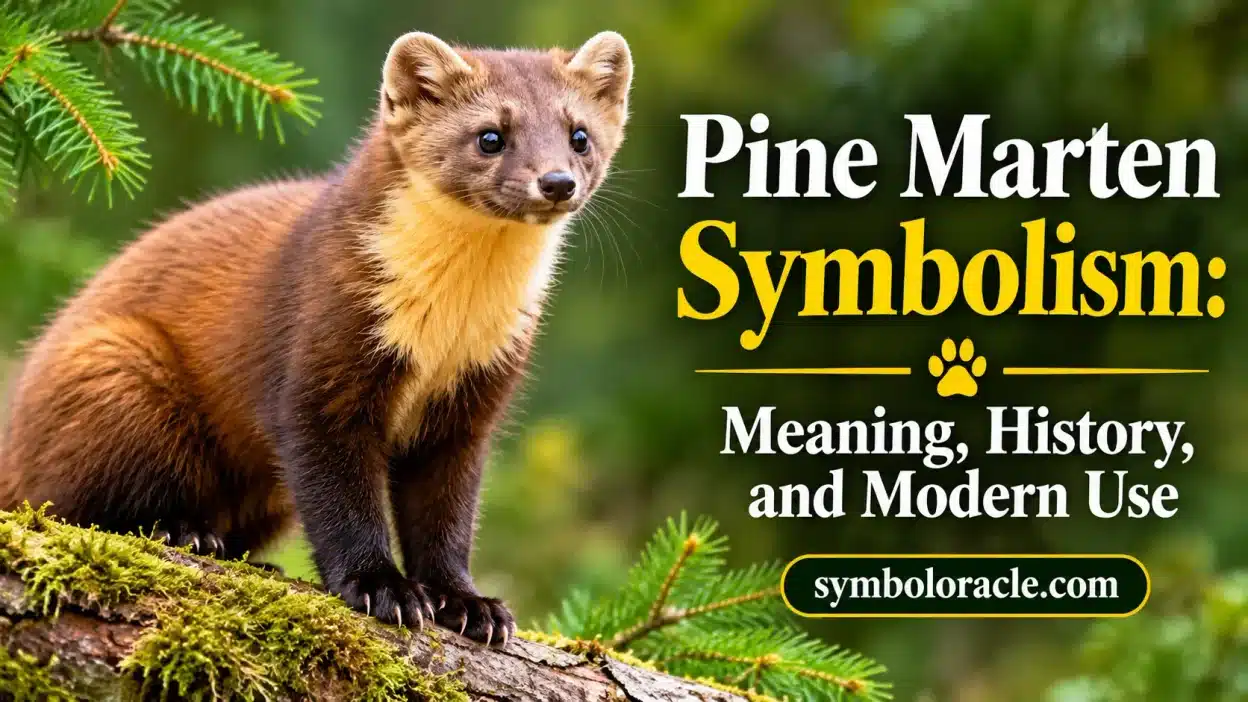
A pine marten is a small, agile woodland mammal known for its rich brown fur, pale throat patch, and remarkable climbing ability. Pine marten symbolism is commonly connected with independence, resourcefulness, adaptability, curiosity, and the ability to move confidently through difficult surroundings. Its quiet habits and preference for wooded environments also make it an interesting symbol of privacy and self-reliance.
Unlike animals that have a major role in widely recognized religious traditions or national celebrations, the pine marten has a more localized cultural history. It appears in European folklore, traditional hunting stories, and some Indigenous North American cultural traditions associated with martens.
Understanding this animal as a symbol requires separating documented cultural traditions from modern personal interpretations. Its natural behavior provides a useful starting point, while folklore and contemporary wildlife appreciation add further layers of meaning.
Quick Answer
Pine marten symbolism commonly represents independence, adaptability, cleverness, resourcefulness, and quiet confidence in modern interpretations. Historically, martens have appeared in European folklore and North American Indigenous traditions, where they have been associated with skilled hunting, determination, and survival.
TL;DR
- Independence: Represents confidence in working and living independently.
- Adaptability: Reflects the ability to adjust to changing environments.
- Resourcefulness: Symbolizes cleverness, patience, and practical problem-solving.
- European folklore: Appears in traditional stories, hunting traditions, and fur-related customs.
- Indigenous traditions: Martens have connections with certain North American clan and cultural traditions.
- Modern meaning: Represents privacy, wilderness appreciation, resilience, and individuality.
What a Pine Marten Looks Like and What Makes It Distinctive
The pine marten belongs to the weasel family, Mustelidae, which also includes otters, badgers, mink, and wolverines. It has a slender body, short legs, rounded ears, and a long, bushy tail.
Its dark brown or chestnut-colored coat contrasts with a creamy yellow or pale orange patch across its throat and upper chest. This distinctive marking is often called a bib. The animal’s appearance changes slightly with the seasons, becoming thicker and fuller during colder months.
Several physical characteristics help explain its modern symbolic associations:
- Long tail: Suggests balance, coordination, and control.
- Sharp claws: Reflect determination and the ability to overcome obstacles.
- Agile body: Suggests flexibility and quick thinking.
- Distinctive throat marking: Makes the animal recognizable and gives it an individual appearance.
- Brown coloring: Connects it visually with forests, earth, shelter, and natural surroundings.
Pine martens are excellent climbers. They move between branches, explore tree cavities, and use sheltered woodland spaces for resting and raising their young.
Their physical design makes them particularly interesting as symbols of movement, independence, and practical intelligence.
The Main Symbolic Meanings of the Pine Marten
There is no single universally established interpretation of the pine marten. Its symbolism is better understood through its natural behavior, historical associations, and cultural appearances.
Five meanings are especially suitable for understanding this animal today.
Independence
Pine martens generally live alone outside the breeding season. They establish territories and search for food independently. This behavior makes them a natural representation of self-reliance.
As a personal symbol, the animal can represent someone who values freedom, makes independent decisions, and feels comfortable following an individual path.
Adaptability
Pine martens eat a varied diet and use different woodland shelters. They can adjust their activities according to seasonal conditions and available food.
Their adaptability suggests flexibility when circumstances change.
Resourcefulness
These animals use their climbing abilities, sharp senses, and knowledge of their surroundings to locate food and avoid danger.
Symbolically, resourcefulness means making effective use of available opportunities instead of depending entirely on ideal conditions.
Quiet Confidence
Pine martens are difficult to observe in the wild. They often move through woodland without attracting attention.
This behavior provides a useful metaphor for confidence that does not require public recognition or constant attention.
Curiosity
Their exploratory behavior and ability to investigate different parts of their environment make curiosity another reasonable modern association.
A pine marten can represent the willingness to explore unfamiliar situations while remaining alert to potential risks.
Ancient Roots and Early European Associations
The pine marten has a long history of living alongside European communities. Its presence in woodland environments made it familiar to hunters, farmers, storytellers, and rural households.
However, there is an important historical distinction: not every old reference to a marten establishes a symbolic or spiritual meaning.
In many European societies, martens were valued or discussed because of their fur, hunting behavior, and relationship with woodland ecosystems. Their pelts were commercially important, and the animals sometimes appeared in traditional stories.
Over time, these practical associations became part of the animal’s broader cultural identity.
In medieval Croatia, for example, marten pelts were used as a form of payment. The Croatian currency name kuna was also the word for marten, reflecting the historical economic importance of the animal’s fur.
This association gives the marten a connection with trade, material value, and rural economic life.
It does not mean that every European community regarded the animal as a symbol of wealth. Rather, its practical importance helped preserve its place in local history and language.
Pine Martens in Irish Folklore and Traditional Stories
Ireland has a particularly interesting relationship with the pine marten.
The animal has lived on the island for thousands of years and appears in traditional accounts of Irish wildlife and folklore. Its Irish name, cat crainn, translates approximately as tree cat, describing its climbing habits.
Irish stories also connect martens with the legendary world of Fionn mac Cumhaill and the Fianna, a group of heroic warriors associated with hunting and adventure.
One traditional account describes a young Fionn encountering a marten near a camp and using its fur as a covering. Such stories place the animal within a wider landscape of hunting, survival, and encounters with wildlife.
Another historical connection involves Queen Medb in the Irish epic Táin Bó Cúailnge. She is described in traditional accounts as having a pet marten around her shoulders.
These stories do not establish one consistent spiritual meaning. Instead, they show that martens could be understood as familiar woodland animals, valuable possessions, and unusual companions.
Their presence in folklore helps explain why the animal can still suggest independence, wilderness, and resourcefulness in modern storytelling.
Marten Symbolism in Indigenous North American Traditions
Martens also have cultural significance in parts of North America.
One important example is the Marten Clan among the Anishinaabe, including Ojibwe communities. The clan is commonly identified by the name Waabizheshi.
Traditional clan systems are much more than collections of animal symbols. They can organize relationships, responsibilities, community identity, and social roles.
The marten’s natural characteristics, including agility, hunting ability, and determination, are associated with qualities discussed in accounts of this clan tradition.
It is important not to treat this as a universal Native American interpretation. Indigenous nations have distinct histories, languages, spiritual traditions, and relationships with wildlife.
Nor should the Marten Clan be reduced to a simple personality description. Its meaning belongs within the wider cultural structure of the communities that maintain the tradition.
For a general American audience, this distinction matters. Respectful interpretation means recognizing the cultural origin of a tradition rather than presenting it as a universal belief available for anyone to redefine.
Pine Marten Symbolism in the United States
The American interpretation of pine martens is shaped largely by wildlife appreciation, forest conservation, and the broader cultural importance of wilderness.
There is also a species distinction worth understanding.
The European pine marten is scientifically known as Martes martes. The American marten, also called the American pine marten in some contexts, is Martes americana. They are closely related but are different species.
American martens inhabit forested regions of northern North America, including parts of the United States. They are associated particularly with northern forests and suitable woodland habitat.
Because the European pine marten is not the animal most Americans encounter in their own forests, its symbolism in the United States is often influenced by photographs, wildlife documentaries, European folklore, and nature-inspired artwork.
In American culture, marten imagery can communicate several ideas:
- Wilderness appreciation: A connection with forests and relatively undisturbed natural environments.
- Environmental awareness: Interest in protecting wildlife and maintaining healthy habitats.
- Personal independence: A preference for freedom and self-direction.
- Outdoor identity: An appreciation for woodland exploration and wildlife observation.
- Quiet individuality: A preference for personal expression without constant public attention.
Unlike the bald eagle or American bison, the pine marten is not a major national emblem. Its American meaning is more closely connected with nature enthusiasts, wildlife communities, and people who appreciate less familiar animals.
What the Pine Marten Represents in Nature and Conservation
The pine marten’s ecological role adds another dimension to its symbolic interpretation.
It is an opportunistic feeder. Depending on its environment and the season, its diet can include rodents, birds, insects, eggs, and berries.
This varied diet reflects the animal’s ability to make use of different food sources. It also helps explain why resourcefulness is such a natural modern association.
Martens are also important members of forest ecosystems. Their feeding activities influence relationships among different species, although the effects vary by location and ecological conditions.
In some parts of Britain, researchers and conservationists have investigated relationships between pine martens, invasive gray squirrels, and native red squirrels. Findings suggest that pine martens may influence gray squirrel populations under certain conditions.
This ecological role has helped make the animal a recognizable part of woodland restoration discussions.
For American readers, the broader conservation lesson is that protecting a forest means maintaining the relationships among its inhabitants, not simply preserving individual trees.
Consequently, the marten can represent ecological balance, habitat protection, and the value of maintaining healthy natural communities.
The Emotional and Psychological Meaning of the Pine Marten
People often connect animals with personality traits because animal behavior provides familiar ways to describe human experiences.
The pine marten is especially suitable for representing someone who prefers independence but remains observant and responsive to the surrounding environment.
Its symbolism can connect with several emotional qualities.
Comfort with solitude
A pine marten’s largely solitary lifestyle can represent the ability to enjoy time alone. This does not necessarily suggest loneliness or rejection of relationships.
Instead, it can express a healthy appreciation for personal space.
Confidence without attention
The animal’s elusive behavior offers a contrast to the idea that confidence must always be visible.
It can represent someone who works quietly, trusts personal judgment, and does not depend on constant approval.
Resilience during change
Seasonal changes affect the pine marten’s coat, activity, and food sources. Its ability to function across changing conditions provides a natural metaphor for emotional flexibility.
Alertness and awareness
An animal that moves through branches and searches for food must remain aware of its surroundings. Symbolically, this can represent careful observation and thoughtful decision-making.
These are modern psychological interpretations, not scientifically established personality traits or claims about what the animal spiritually communicates.
Positive and Negative Interpretations of Pine Marten Symbolism
The pine marten is generally suitable for positive symbolism, particularly when associated with independence, cleverness, and adaptability.
However, its less familiar characteristics can also produce more complicated interpretations.
| Context | Positive Meaning | Possible Negative Interpretation |
|---|---|---|
| Solitary lifestyle | Independence and self-reliance | Isolation or emotional distance |
| Hunting behavior | Resourcefulness and determination | Aggression or opportunism |
| Elusive nature | Privacy and quiet confidence | Secrecy or avoidance |
| Climbing ability | Flexibility and ambition | Restlessness |
| Territorial behavior | Personal boundaries | Possessiveness |
These contrasts are useful because they show that symbolic meanings depend on context.
For example, choosing solitude can be a healthy expression of independence. However, avoiding every relationship or refusing support can become isolation.
Similarly, protecting personal boundaries can be positive, while becoming unnecessarily defensive can interfere with relationships.
The pine marten therefore offers a balanced symbol of independence: freedom works best when accompanied by awareness and good judgment.
Why Pine Martens Appear in Tattoos and Personal Style
Pine marten tattoos are relatively uncommon compared with designs featuring wolves, foxes, bears, or eagles. That rarity can make the animal appealing to someone who wants a nature-inspired design that feels personal rather than familiar.
A person choosing this animal might connect with its independent lifestyle, climbing ability, or association with woodland environments.
Different tattoo designs can communicate different ideas.
- Pine marten climbing a tree: Represents ambition, flexibility, and overcoming challenges.
- Pine marten sitting alone: Suggests independence, patience, and comfort with solitude.
- Pine marten in a forest: Expresses a connection with nature and wilderness.
- Pine marten with woodland flowers: Combines resourcefulness with natural beauty and renewal.
- Detailed realistic portrait: Celebrates wildlife, individuality, and appreciation for less familiar animals.
In jewelry and personal accessories, marten imagery may appear in animal pendants, woodland-inspired designs, or nature-themed collections.
These uses are primarily individual expressions. There is no established universal tattoo tradition that assigns a fixed spiritual meaning to the pine marten.
The Symbolism of the Pine Marten’s Colors
The animal’s appearance contributes to its visual associations.
Its brown coat and pale throat marking create a natural color combination that fits comfortably within woodland-inspired art and design.
Brown: Stability and connection with nature
Brown is commonly associated with soil, tree trunks, natural materials, and grounded surroundings. In animal artwork, the pine marten’s brown coat can suggest stability, practicality, and a connection with the natural world.
Cream and yellow: Warmth and individuality
The lighter throat patch creates a noticeable contrast against the darker fur. In modern artistic interpretations, this marking can suggest individuality, warmth, and recognition.
Dark woodland shades: Privacy and calm
Artists sometimes use dark greens, browns, and muted forest backgrounds to emphasize the animal’s elusive nature.
Together, these colors make the pine marten suitable for illustrations that communicate quiet confidence, natural independence, and appreciation for woodland life.
These are artistic color associations rather than traditional religious meanings attached specifically to the animal.
What Does It Mean to See a Pine Marten?
Seeing a pine marten in the wild can feel like a special experience because the animal is generally secretive and difficult to observe.
For someone interested in symbolism, the encounter might encourage reflection on independence, patience, curiosity, or the importance of noticing things that usually go unseen.
The meaning can depend on the circumstances.
- Seeing one climbing a tree: Might represent flexibility and the ability to approach challenges differently.
- Seeing one crossing a woodland path: Could suggest curiosity and exploration.
- Seeing one watching from a distance: May bring attention to privacy and careful observation.
- Seeing a mother with her young: Can encourage thoughts about protection, care, and family responsibility.
There is no established evidence that encountering a pine marten predicts good fortune, bad luck, or a particular future event.
The experience can still have personal meaning without being treated as a supernatural warning or promise.
Pine Marten Symbolism in Dreams
A pine marten appearing in a dream can be interpreted through its natural characteristics and the emotions associated with the dream.
Dream symbolism is subjective. There is no scientifically established dictionary that determines exactly what a particular animal means in every person’s dream.
Some possible interpretations include:
- A climbing pine marten: You may be thinking about progress, flexibility, or finding another way around an obstacle.
- A hiding pine marten: The image might reflect a desire for privacy or a situation you are not ready to discuss.
- A playful pine marten: Could represent curiosity, exploration, and a willingness to enjoy new experiences.
- An injured pine marten: Might bring attention to vulnerability, neglected responsibilities, or concern for something you value.
- A peaceful pine marten in a forest: Could reflect a desire for quiet surroundings and more personal freedom.
Your feelings during the dream matter more than any fixed interpretation.
For example, if you felt calm while watching the animal, the dream may connect with your appreciation for solitude. If you felt threatened, your interpretation might involve uncertainty or a need to protect personal boundaries.
Common Misunderstandings About Pine Marten Symbolism
Because the pine marten is less familiar than many other symbolic animals, several misconceptions can develop around its meaning.
The pine marten is not a universal spiritual messenger.
Some modern interpretations describe it as a sign from the universe or a supernatural guide. These ideas may be meaningful to individuals, but they should not be presented as established historical beliefs.
All marten traditions are not interchangeable.
European folklore, Croatian historical customs, and Anishinaabe clan traditions have different cultural backgrounds. They should not be combined into one invented universal mythology.
The European pine marten and American marten are not identical.
Although closely related, Martes martes and Martes americana are separate species. Their geographical histories and cultural associations should be distinguished.
A solitary animal does not automatically symbolize loneliness.
Pine martens generally live independently outside breeding periods. Their behavior is part of their natural ecology, not evidence that they reject social relationships.
The animal is not naturally a symbol of bad luck.
Hunting, livestock concerns, and conflicts with people have sometimes produced negative attitudes toward martens. Those practical conflicts do not establish a universal negative spiritual meaning.
Understanding these differences keeps modern interpretations connected to actual animal behavior and documented cultural history.
How Pine Marten Meaning Has Evolved Over Time
The cultural meaning of the marten has developed alongside changing relationships between people and wildlife.
In earlier European communities, the animal was often understood through practical experiences. Its fur had economic value, it appeared in hunting traditions, and its woodland behavior made it part of rural life.
In some communities, stories and traditional beliefs added imaginative qualities to the animal.
In parts of North America, martens also became connected with Indigenous cultural traditions, including clan identities that carry meanings beyond simple animal comparisons.
During the modern period, wildlife conservation changed how many people viewed these mammals. Instead of seeing them primarily as sources of fur or potential nuisances, conservation communities increasingly emphasized their ecological importance and the protection of forest habitats.
Today, the animal can represent several overlapping ideas:
- Independent thinking and personal freedom.
- Practical intelligence and adaptability.
- Respect for wildlife and forest ecosystems.
- Privacy and confidence without attention.
- Cultural heritage and traditional relationships with nature.
This evolution does not mean that older interpretations disappeared. Rather, modern meanings have developed alongside historical associations, conservation awareness, and personal artistic expression.
How to Interpret the Pine Marten as a Personal Symbol
If you feel connected to the pine marten, consider which of its characteristics best reflects your experiences.
Its independence might appeal to someone building a life around personal decisions. Its adaptability might connect with someone facing major changes. Its elusive nature might represent a preference for privacy and a quieter lifestyle.
You can also consider the animal’s environment.
A pine marten does not survive through strength alone. It depends on observation, movement, shelter, and the ability to use available resources. These characteristics make it an interesting reminder that success does not always require being the strongest or most noticeable person in a situation.
A useful personal interpretation might be:
Move independently, remain observant, and adapt without losing your sense of direction.
That interpretation reflects the animal’s actual characteristics without claiming that it carries a universal supernatural message.
Frequently Asked Questions
What does a pine marten symbolize spiritually?
In modern spiritual interpretations, the pine marten can represent independence, adaptability, resourcefulness, and quiet confidence. These associations are personal interpretations rather than universally established religious teachings.
Is a pine marten a symbol of good luck?
There is no widely documented tradition that makes the pine marten a universal good-luck symbol. However, its appearance in nature may feel fortunate because sightings are relatively uncommon in many of its habitats.
What does a pine marten tattoo mean?
A pine marten tattoo can express independence, curiosity, personal freedom, and a connection with woodland wildlife. The meaning depends on the design and the individual’s reasons for choosing the animal.
What does a pine marten represent in Native American culture?
Martens have cultural associations in certain Indigenous North American traditions. For example, the Anishinaabe have a Marten Clan, associated with a wider system of community identity and responsibilities. Interpretations should remain specific to the relevant Indigenous nation and tradition.
Is the pine marten a symbol of independence?
Yes, independence is a natural modern interpretation because pine martens generally live alone outside the breeding season. Their ability to establish territories and find food independently also supports this association.
What does seeing a pine marten mean?
A wildlife encounter does not have one guaranteed spiritual meaning. Some people interpret the experience as a reminder to appreciate nature, remain curious, or become more comfortable with independence.
What is the difference between pine marten and American marten symbolism?
The European pine marten (Martes martes) and American marten (Martes americana) are different but closely related species. Their symbolic interpretations can overlap because of similar behaviors, although their cultural and geographical histories are not identical.
Conclusion
Pine marten symbolism centers on independence, adaptability, resourcefulness, curiosity, and quiet confidence. Its natural behavior makes these associations understandable, while European folklore and certain Indigenous North American traditions provide additional cultural context.
In modern American culture, the animal is best understood as a nature-inspired symbol rather than a major religious or national emblem. Its image appeals to people who appreciate wildlife, personal freedom, and the value of living without constantly seeking attention.