
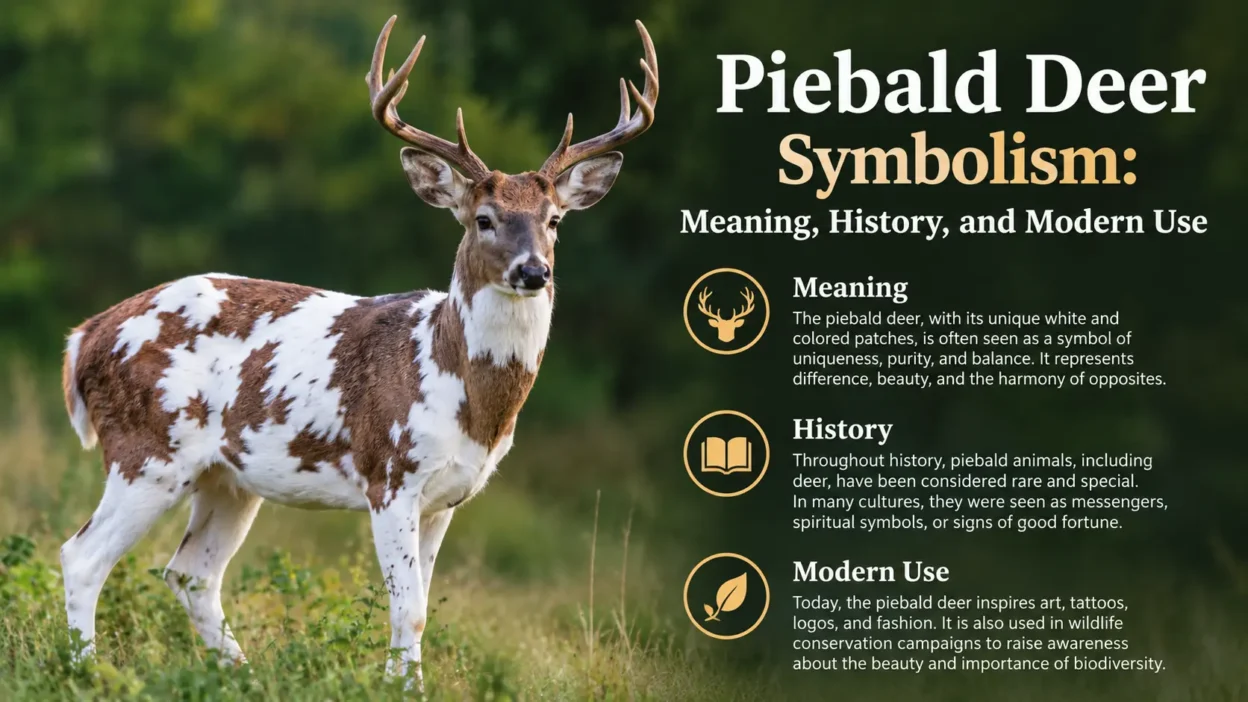
A piebald deer is one of the most unusual sights a person can encounter in the American woods. Its coat combines ordinary brown coloring with irregular areas of white, making the animal stand apart from the rest of a herd. Because these markings are rare and naturally occurring, piebald deer symbolism often centers on individuality, rarity, change, and the feeling that an ordinary moment has become unexpectedly significant.
The animal itself has a straightforward biological explanation. Piebald coloring comes from an inherited pigmentation variation, not from a supernatural condition. Still, unusual animals have long encouraged people to create stories around what they see, and white or partly white deer appear in folklore from several parts of the world.
In the United States, the meaning depends heavily on context. A wildlife observer may see a remarkable example of genetic variation, while a hunter may associate the animal with old superstitions about luck. Someone encountering a piebald deer during a difficult period may instead treat the sighting as a personal reminder of resilience or change.
Quick Answer
Piebald deer symbolism commonly represents rarity, individuality, change, and an unusual moment of awareness in modern American culture. Historically, unusually white deer have also appeared in folklore as omens, sacred animals, guides, or signs connected with luck and the supernatural.
TL;DR
- Piebald deer commonly symbolize rarity and individuality.
- Their unusual coat comes from inherited pigmentation variation.
- White deer appear in folklore as omens and special animals.
- American hunting traditions include both respect and bad-luck superstitions.
- Modern interpretations often connect sightings with change and personal reflection.
- Piebald deer are not the same as albino deer.
What Is a Piebald Deer?
A piebald deer is a deer with irregular areas of white hair mixed with its normal darker coat. In North America, the term is most often applied to white-tailed deer.
The amount of white can vary considerably. One animal may have only a few white patches on its body, while another may be almost completely white with scattered brown areas. The pattern is not the same from one deer to another.
Piebald deer are uncommon. Wildlife agencies generally describe them as occurring in less than one percent of white-tailed deer in many populations, although local rates can differ.
The condition is inherited and affects pigmentation. It is not a disease or a sign that the animal is spiritually different from other deer.
This distinction matters because the physical rarity of the animal is one reason people assign unusual meanings to it. Seeing something that almost never appears in the landscape naturally attracts attention.
What Piebald Deer Commonly Symbolize in the United States
In modern American culture, a piebald deer can symbolize individuality without separation.
The deer remains part of the herd, but its appearance is different. That contrast makes it an easy symbol for people who think about identity, belonging, and standing out while still being connected to a community.
Other common interpretations include:
- Rarity: The sighting is unusual because piebald deer are uncommon.
- Individuality: The distinctive coat represents being visibly different.
- Change: An unexpected encounter can become a personal marker for a transition.
- Awareness: Seeing a rare animal can encourage someone to slow down and notice their surroundings.
- Resilience: A piebald deer can represent adapting despite physical differences.
- Respect for nature: The animal may remind people that nature does not always follow familiar patterns.
These are modern symbolic interpretations rather than biological properties of the deer. A piebald deer does not objectively predict an event or carry a universal message.
The meaning usually comes from the person, community, or tradition interpreting the encounter.
Why Rare Deer Become Symbols
Rarity plays an important role in symbolism.
Humans tend to notice things that break an established visual pattern. A normal deer can blend into a woodland environment. A deer with large white patches is much easier to notice.
That visual difference can create the impression that the animal deserves special attention.
The same process appears in other forms of symbolism. Unusual flowers, unusual weather, unusual animal colors, and unexpected natural events have frequently become subjects of stories and personal interpretations.
A piebald deer provides an especially strong example because the animal is already associated with forests, seasons, wildlife, and movement through the landscape. Its unusual appearance adds another layer to an image that already carries cultural associations.
For this reason, a person who sees one may remember the encounter for years even without believing in supernatural explanations.
Ancient and Historical Roots of White Deer Folklore
The broader symbolism of white deer is older than the modern term “piebald deer.
White deer, white stags, and unusually colored deer appear in European folklore and literature as extraordinary animals. In Celtic and medieval traditions, the white stag could function as a creature associated with the otherworld or as an animal that leads a person into an important quest.
Arthurian stories also helped establish the image of the elusive white deer as something difficult to capture and symbolically important.
The association is not limited to Europe. Stories about unusually colored deer appear in different cultural settings, although the meanings are not identical.
This distinction is important. There is no single ancient belief about white deer shared by all cultures. Different societies created their own explanations based on local religion, landscape, hunting practices, and folklore.
Some traditions treated the animal as a positive omen. Others associated it with danger, the supernatural, or a warning.
Piebald Deer and Native American Traditions
Claims about Native American beliefs surrounding piebald or white deer are common, but they should be treated carefully.
Native American nations have distinct histories, religions, languages, and relationships with animals. It is misleading to describe a single belief as though every Indigenous community shared it.
Some documented and reported traditions attach special significance to unusually white animals or deer. In some contexts, a white deer may be viewed as unusual, spiritually significant, or worthy of respect.
The important point is that these beliefs belong to particular cultural traditions rather than to a single universal “Native American symbolism.”
Modern articles sometimes combine beliefs from unrelated nations and present them as one tradition. That can erase important differences between communities.
A respectful interpretation is to say that certain Indigenous traditions have regarded unusual animals as spiritually or culturally significant while avoiding claims that all Native peoples share the same interpretation.
The White Deer as a Sign or Omen
An unusual deer can easily become an omen in folklore because it combines two features that humans often associate with signs: rarity and unexpected appearance.
A person who encounters a piebald deer after making an important decision may remember the sighting as confirmation that a new chapter is beginning. Someone dealing with loss might interpret it as a comforting reminder of a person or period in their life.
Folklore can give this experience a larger cultural framework.
However, an omen is an interpretation, not a scientific prediction. There is no established biological evidence that seeing a piebald deer predicts good fortune, death, a major life event, or a particular future outcome.
The symbolic value can still be meaningful without treating the encounter as a supernatural forecast.
Piebald Deer Symbolism and Hunting Culture
Hunting culture has contributed some of the strongest American stories surrounding unusual white deer.
One widespread superstition holds that killing a white or piebald deer brings bad luck. In some versions, the hunter is supposedly unable to have successful hunts afterward. Other versions become much more severe.
These stories are part of hunting folklore rather than established facts.
The superstition also reflects an understandable cultural tension. Hunters may view deer as wildlife and a legal game species, while an unusually colored animal can feel exceptional enough to inspire hesitation.
In some communities, individual hunters voluntarily choose not to harvest a piebald deer. Others follow the regulations of their state without giving the animal any special status.
The legal treatment also varies by jurisdiction, so folklore should not be confused with wildlife law.
The Difference Between Piebald and Albino Deer
Piebald and albino deer are often confused, but they are not the same.
| Feature | Piebald Deer | Albino Deer |
|---|---|---|
| Coat | White and brown patches | Generally completely white |
| Eyes | Usually normally pigmented | Typically pink or reddish |
| Pattern | Irregular areas of white | Little or no normal pigmentation |
| Cause | Inherited pigmentation variation | Genetic absence of normal melanin production |
| Appearance | Highly variable | More uniformly pale |
This difference also affects symbolism.
A piebald deer represents contrast because its normal coloring remains alongside white patches. An albino deer, by comparison, presents a much more complete absence of ordinary coloration.
Folklore sometimes treats both animals as “white deer,” but biologically they are different conditions.
What a Piebald Deer Can Represent Emotionally
The emotional symbolism of a piebald deer often comes from its unusual appearance rather than from a fixed cultural rule.
For some people, the animal represents being different without being defective. Its presence in a herd can become a useful metaphor for individuality: a creature can look different while remaining part of the same social world.
It may also represent resilience.
Some piebald deer have no obvious physical problems and can survive normally. Others may have skeletal or internal abnormalities associated with the condition. That variation makes it important not to assume that every piebald deer has the same experience.
As a personal symbol, the animal can therefore suggest adapting to circumstances rather than achieving some ideal of perfection.
This interpretation is particularly common in modern personal symbolism, where animals are often used to express identity rather than fixed religious doctrine.
Piebald Deer Symbolism in Personal Encounters
A person who sees a piebald deer may give the experience meaning because of what was happening at the time.
For example, someone moving to a new city might remember seeing one shortly before leaving home. Another person might encounter one during a period of grief or uncertainty. Someone interested in wildlife might simply appreciate the sighting as a rare natural event.
The same animal can therefore carry completely different meanings.
A useful way to interpret a personal encounter is to consider three things:
- What was happening in your life?
- What did you notice or feel when you saw the deer?
- What meaning remains after the moment has passed?
This approach keeps the symbolism personal without claiming that the animal objectively sent a message.
Piebald Deer in Tattoos and Personal Style
A piebald deer tattoo can combine several ideas at once.
The deer itself may represent gentleness, independence, nature, alertness, or connection to the outdoors. The unusual white markings can add individuality and contrast.
Someone might choose a piebald deer tattoo to represent:
- embracing a distinctive identity
- surviving a difficult transition
- connection to nature
- an important encounter with wildlife
- respect for an unusual animal
- family memories connected with hunting or the outdoors
The design can also be combined with forests, mountains, flowers, antlers, stars, or seasonal imagery.
The meaning depends heavily on the person’s story. There is no universal tattoo dictionary that assigns one fixed interpretation to a piebald deer.
Piebald Deer in Art, Decor, and Modern Media
The visual contrast of brown and white makes piebald deer naturally attractive in artwork and photography.
Wildlife photographers may feature them because their unusual appearance immediately distinguishes them from ordinary whitetails. Home decor can use deer imagery to suggest forests, cabins, hunting traditions, autumn, or rural life.
In digital culture, photographs of rare animals can spread quickly because viewers are often surprised by what they see. A piebald deer can therefore become symbolic even when the original photograph was intended simply to document wildlife.
This is one way modern symbolism differs from older folklore. Social media does not require a formal religious or cultural tradition for an image to acquire meaning. A photograph can become associated with ideas such as uniqueness, good fortune, or “signs” simply because many people respond to it in similar ways.
Piebald Deer and the Symbolism of Change
Change is one of the most natural modern interpretations of an unusual deer sighting.
A deer normally blends into its environment. A piebald deer does not do so as easily. Its appearance creates a visible break from what people expect.
That contrast makes it a useful metaphor for periods when life no longer looks familiar.
Someone beginning a career, ending a relationship, moving away from home, recovering from hardship, or entering a new stage of adulthood might connect with the image of an animal that is visibly different but still moving through the same landscape.
The symbolism is not that change will necessarily bring good or bad results. Instead, the deer can represent the fact that difference and transition are part of ordinary life.
Common Misunderstandings About Piebald Deer
Several myths surround these animals.
One common misconception is that every piebald deer is albino. It is not. Piebald deer retain normal pigmentation in many parts of the body.
Another misconception is that piebald coloring is itself a disease. The coloration is an inherited genetic condition, although some piebald deer can also have associated physical abnormalities.
A third misunderstanding is that seeing one guarantees good luck or bad luck. That belief belongs to folklore and personal interpretation, not wildlife science.
It is also inaccurate to treat every story about white deer as evidence of one ancient universal tradition. White-deer folklore developed in different cultures and changed across time.
Separating biology from folklore makes the symbolism more useful. It allows people to appreciate the story without confusing cultural belief with scientific fact.
What Piebald Deer Symbolism Means Today
In 2025 and 2026, the symbolism of a piebald deer is often less about supernatural prediction and more about personal interpretation.
Modern Americans may encounter the animal through wildlife photography, social media, hunting communities, nature walks, tattoos, artwork, or personal experience.
The central ideas are usually straightforward:
rarity, individuality, contrast, change, awareness, and respect for nature.
For some people, older ideas about omens and luck remain important. For others, the deer is simply a rare genetic variation that makes the natural world more interesting.
Both responses can exist without requiring the same belief system.
The modern meaning is therefore flexible. A piebald deer can be scientifically understood as an unusual animal while also serving as a personal symbol.
Frequently Asked Questions
What does a piebald deer symbolize?
A piebald deer commonly symbolizes rarity, individuality, change, and noticing something unusual in nature. In folklore, white or unusually colored deer have also been associated with omens, guidance, luck, and supernatural encounters.
Is seeing a piebald deer considered good luck?
Some folklore treats an encounter with a white or piebald deer as a positive sign, while hunting traditions in some places associate killing one with bad luck. There is no scientific evidence that seeing a piebald deer predicts future luck.
What does a piebald deer tattoo mean?
A piebald deer tattoo can represent individuality, resilience, connection to nature, or a meaningful personal encounter. The white-and-brown pattern may emphasize the idea of being different while still belonging.
Is a piebald deer the same as an albino deer?
No. A piebald deer has irregular white areas mixed with normally colored hair and usually has normally pigmented eyes. An albino deer has a much more complete loss of pigmentation and typically has pink or reddish-looking eyes.
Do Native American cultures consider piebald deer sacred?
Some Indigenous traditions have given unusual white animals or deer special cultural or spiritual significance, but there is no single belief shared by all Native American nations. Specific traditions should be discussed in their own cultural contexts rather than combined into one general rule.
Why are piebald deer so rare?
Piebald coloration results from an inherited genetic variation affecting pigmentation. The trait is uncommon in wild white-tailed deer populations, although its frequency can vary between local populations.
Does a piebald deer mean change is coming?
Some modern spiritual and personal interpretations use the animal as a symbol of transition or change because its unusual appearance breaks the normal pattern of the herd. That is a symbolic interpretation, not evidence that the animal predicts a future event.
Conclusion
A piebald deer stands out because it is both familiar and unusual. It is still a deer moving through the same woods, but its irregular white markings make it visually different from the rest of the herd. That contrast helps explain why people have connected unusual deer with individuality, rarity, change, luck, and special encounters.
The history of piebald deer symbolism includes folklore about white animals, hunting superstitions, cultural traditions, and modern personal interpretations. None of these meanings is universal, and the biological explanation remains simple: the distinctive coloring comes from inherited variation in pigmentation.
For a modern observer, perhaps the most grounded meaning is also the simplest. Seeing a rare animal can remind us to pay attention to the ordinary landscape, because nature does not always look the way we expect.


