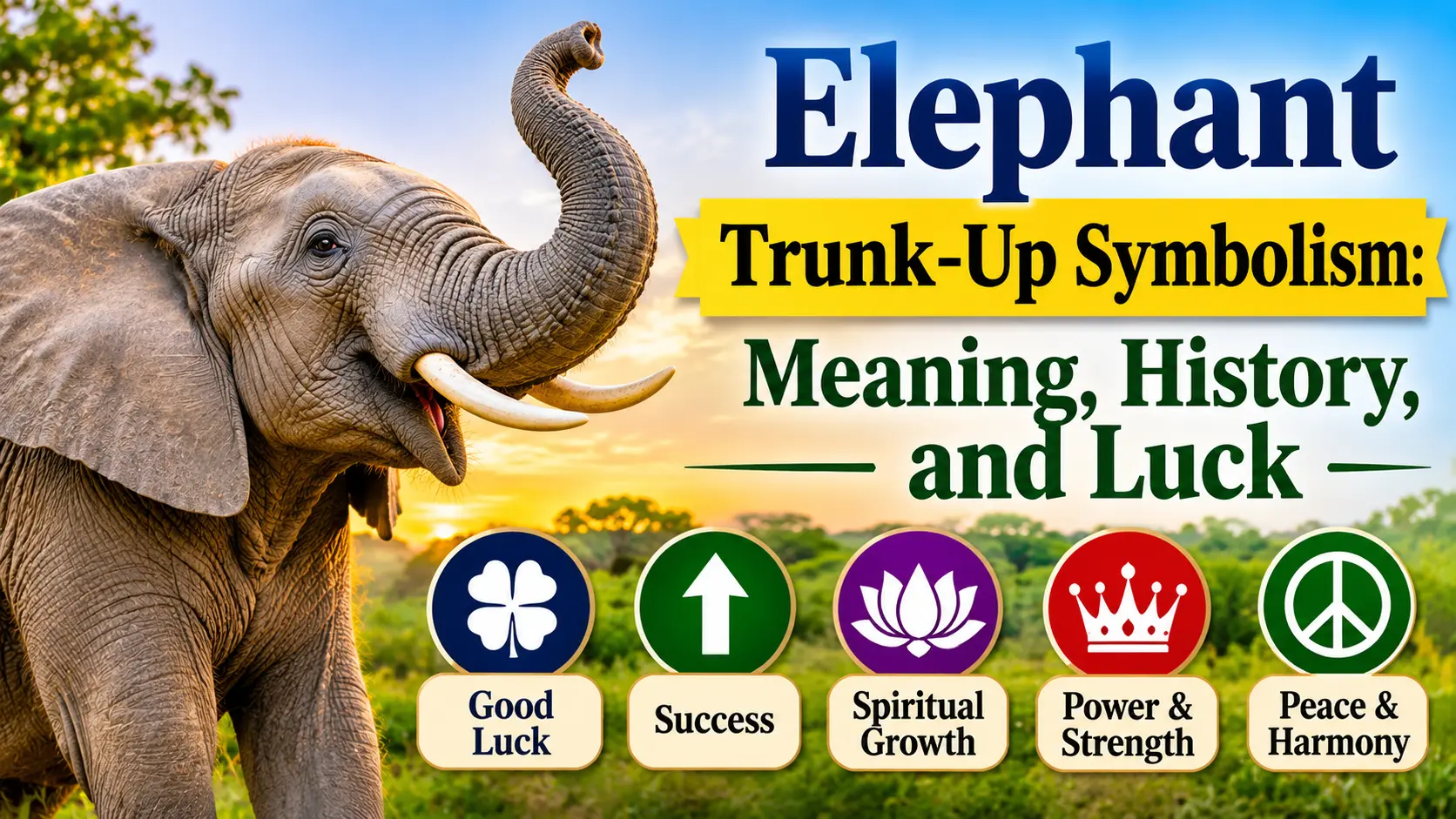
An elephant with its trunk raised is commonly displayed as a sign of good luck, prosperity, and positive beginnings. Elephant trunk-up symbolism appears in American homes, jewelry, gifts, artwork, and decorative objects, where the raised trunk is often understood as a welcoming gesture associated with good fortune. However, the meaning has several cultural layers, and the familiar belief about trunk direction is not the same as the elephant’s older religious significance.
Elephants have held important places in the traditions of India, Southeast Asia, and other parts of the world. Their size, intelligence, social behavior, and physical strength have made them natural symbols of stability, wisdom, protection, and endurance. In Hinduism, the elephant-headed deity Ganesha adds another important dimension through his association with wisdom and the removal of obstacles.
In the United States, the raised-trunk elephant has become especially recognizable as a household good-luck charm. People give elephant figurines as presents, display them on shelves, and choose them for tattoos or jewelry. Understanding the difference between traditional elephant symbolism and the more recent trunk-up superstition makes the symbol easier to appreciate.
Quick Answer
Elephant trunk-up symbolism commonly represents good luck, prosperity, happiness, and welcoming new opportunities in modern American culture. More broadly, elephants have historical associations with wisdom, strength, protection, and royal or religious significance, particularly in South Asian and Southeast Asian traditions.
TL;DR
- Good luck: A raised trunk is widely associated with attracting good fortune.
- Prosperity: Elephant figures often represent financial success and abundance.
- Protection: Elephants symbolize strength, security, and the ability to overcome difficulties.
- Wisdom: Their intelligence connects them with patience, knowledge, and thoughtful decisions.
- Cultural history: Ganesha and sacred elephants contribute to the animal’s religious significance.
- Modern America: Raised-trunk elephants appear in gifts, home decor, jewelry, and tattoos.
What Does an Elephant With Its Trunk Up Represent?
The raised-trunk elephant is most commonly associated with good fortune. In American decorative traditions, people often believe that an elephant with its trunk pointing upward attracts luck, welcomes positive experiences, and encourages prosperity.
The image is easy to recognize. A small elephant statue might stand on a desk, sit beside a doorway, or appear among other decorative objects. Its trunk curves upward, creating an impression of celebration or greeting.
Several meanings are commonly attached to this position:
- Good fortune: The elephant represents a wish for favorable circumstances.
- Success: It can symbolize progress toward personal or professional goals.
- Abundance: The figure is sometimes associated with financial stability and prosperity.
- Protection: Its large size and strength suggest security.
- Positive beginnings: It can serve as a reminder to approach new experiences with confidence.
These meanings overlap, but they are not identical. Someone might choose an elephant for protection rather than wealth, while another person might give one as a simple expression of encouragement.
It is also important to understand that the raised-trunk belief is primarily a modern folk custom. There is no established universal religious rule requiring elephant figures to have their trunks raised to bring good luck.
Why the Elephant Became a Symbol of Good Luck
The elephant’s association with good fortune has several cultural foundations. In South Asia, the animal has long appeared in religious art, royal settings, stories, and ceremonial traditions.
Its physical characteristics help explain some of its symbolic associations. Elephants are strong but can also perform delicate tasks with their trunks. They form close social groups, care for their young, and demonstrate complex behavior.
These qualities have made the animal an appealing representation of:
- Physical and emotional strength
- Intelligence and careful judgment
- Family bonds and loyalty
- Long life and endurance
- Stability during difficult circumstances
Religious traditions added further meaning. In Hinduism, Ganesha is particularly important because people seek his blessings before beginning new activities and important undertakings.
Over time, representations of elephants also became popular decorative objects outside their original cultural settings. In Western households, the animal gradually developed an additional identity as a good-luck charm.
The distinction matters: the elephant’s historical cultural significance is much older and broader than the specific belief that its trunk must point upward.
Ancient Roots and the Religious History of Elephants
Elephants have appeared in South Asian art and religious traditions for many centuries. Their presence in temples, sculptures, royal processions, and ceremonial objects reflects their importance in societies where the animals were closely connected with political authority and religious life.
In ancient India, elephants were associated with kingship, military strength, and prestige. Rulers used trained elephants in warfare and public ceremonies. Their size and impressive appearance made them suitable symbols of authority.
Religious traditions also developed important elephant imagery.
In Hinduism, elephants appear in stories and depictions connected with several deities. Ganesha, with his recognizable elephant head, became one of the most widely worshipped figures in the Hindu religious tradition.
In Buddhist traditions, the white elephant appears in accounts connected with the Buddha’s birth. A traditional story describes Queen Maya dreaming of a white elephant before giving birth to Siddhartha Gautama.
These traditions helped establish the elephant as more than an image of physical strength. It became associated with wisdom, auspicious beginnings, spiritual significance, and royal dignity.
However, these historical meanings should not be confused with the modern decorative rule about trunk direction. The religious importance of elephants does not depend on a universal trunk-up requirement.
Ganesha and the Meaning of Wisdom and New Beginnings
One of the most important connections in elephant symbolism comes from Ganesha.
Ganesha is a Hindu deity recognized by his elephant head and human body. He is traditionally associated with wisdom, learning, success, and the removal of obstacles. Many Hindus honor him before beginning a new undertaking, including ceremonies, journeys, educational activities, and business ventures.
His elephant head carries important symbolic associations.
Wisdom and understanding: Ganesha’s large head is commonly interpreted as representing the ability to think broadly and understand complex matters.
Careful judgment: His trunk can perform both powerful and delicate tasks. This ability is often interpreted as an image of discernment and adaptability.
Removing obstacles: Ganesha is known as the remover of obstacles, making him especially relevant to people facing challenges or starting something new.
Learning and creativity: Students, artists, and people beginning professional projects may seek his blessings.
For this reason, an elephant can remind people of the importance of preparation, patience, and thoughtful action.
There is an important cultural distinction, though. Ganesha is a sacred deity, not simply a decorative good-luck elephant. A plain elephant figurine and a religious representation of Ganesha do not automatically carry the same meaning. SFO Museum+2
What the Raised Trunk Means in American Culture
In the United States, a raised-trunk elephant is widely recognized as a positive symbol. People often associate it with welcoming good luck, celebrating success, and keeping a hopeful attitude.
The belief appears in everyday decorative traditions rather than in one specific American religious practice.
For example, someone moving into a new house might receive a small elephant statue as a housewarming present. A business owner might keep one on a desk as a reminder of prosperity and success. Another person might display an elephant near the entrance because it represents protection and a welcoming atmosphere.
The raised trunk is sometimes explained as catching good luck or directing positive fortune toward the household. These are interpretations of folk belief, not established facts about how luck works.
American interpretations commonly include:
- Household happiness: A wish for peace and positive experiences at home.
- Financial prosperity: Hope for business growth and economic stability.
- Personal success: Encouragement during a new stage of life.
- Protection: A symbolic reminder of strength and security.
- Celebration: An image that communicates excitement and optimism.
The symbol has also become popular because it is easy to understand without requiring detailed knowledge of its cultural background.
However, the American trunk-up superstition should not be presented as an ancient Hindu or Buddhist teaching. Its precise origin is uncertain, and its popularity in Western decorative culture appears to be considerably more recent than the religious traditions associated with elephants. USC Digital Folklore Archives+2
Elephant Trunk-Up vs. Trunk-Down Symbolism
One of the most common questions about elephant figurines concerns the direction of the trunk. Many American decorative traditions distinguish between raised and lowered trunks, assigning different meanings to each position.
The familiar belief says that a raised trunk attracts good fortune, while a lowered trunk may represent bad luck or the loss of positive opportunities. However, this interpretation is not universal.
A lowered trunk can also be interpreted positively. Some people associate it with calmness, humility, grounded strength, or the ability to preserve good fortune rather than display it.
The following table compares common modern interpretations.
| Elephant position | Common symbolic meaning | Associated ideas |
|---|---|---|
| Trunk raised | Good luck and prosperity | Success, celebration, opportunity |
| Trunk lowered | Calmness and grounded strength | Patience, stability, reflection |
| Trunk extended forward | Welcome and openness | Connection, generosity, greeting |
| Trunk curved inward | Protection and care | Security, affection, preservation |
| Trunk touching an object | Connection and interaction | Attention, intelligence, curiosity |
These interpretations are symbolic, not fixed cultural rules. The animal’s posture, the artist’s intention, and the owner’s personal beliefs can all influence its meaning.
There is no reliable basis for believing that a lowered-trunk elephant automatically brings misfortune. Someone who prefers that design does not need to consider it an unlucky object.
Elephant Symbolism in Different Cultures
Elephants have different meanings across the world. Their symbolism depends on religious beliefs, regional history, artistic traditions, and people’s relationships with the animal.
India
In India, elephants are strongly connected with Hindu religious imagery, particularly Ganesha. They can represent wisdom, auspicious beginnings, prosperity, and the removal of obstacles. Elephants also have historical connections with royal authority and ceremonial life.
Thailand
Elephants have an important place in Thai cultural history. White elephants, in particular, have traditionally been associated with royal prestige and auspiciousness. Their significance goes beyond ordinary decorative good-luck beliefs.
Buddhist traditions
The white elephant appears in traditional accounts of Queen Maya’s dream before the Buddha’s birth. In this context, the animal is associated with an auspicious event and the spiritual importance of the Buddha’s arrival.
China
Elephants appear in Chinese art and decorative traditions as auspicious animals. Some interpretations connect the Chinese word for elephant, xiàng, with favorable associations through its sound and related wordplay. Elephant imagery may also appear alongside objects representing peace and prosperity.
Southeast Asia
Across parts of Southeast Asia, elephants have historically represented royal authority, strength, ceremonial importance, and good fortune. Their meanings vary by country and religious setting.
These examples show why it is inaccurate to assign one universal meaning to every elephant figure. The raised-trunk superstition popular in American homes is only one interpretation among many. smb.museum+2
Strength, Patience, and Protection: The Emotional Meaning
Elephants often communicate emotional qualities that people admire or want to develop in their own lives.
Their physical strength is an obvious reason for their association with protection. However, their social behavior also contributes to their symbolic meaning.
Elephants live in family groups and maintain important social relationships. Adult females often play central roles in caring for younger members and maintaining group connections.
This behavior makes the elephant a natural symbol of family responsibility, loyalty, and care.
Its emotional associations include several distinct qualities.
Patience: An elephant can represent the ability to remain steady rather than react immediately to every difficulty.
Resilience: Its size and strength make it an appealing image of endurance during challenging periods.
Family loyalty: The animal’s social relationships connect it with commitment, care, and belonging.
Confidence: A large elephant can symbolize the confidence to face difficult situations without becoming overwhelmed.
Emotional stability: Its association with steadiness makes it suitable for people who value balance and consistency.
For some Americans, an elephant figurine is not primarily about attracting money or luck. It is a personal reminder to remain dependable, protect loved ones, and approach problems with patience.
Why Elephant Figures Are Popular in American Homes
Elephant figurines have become familiar decorative objects in American households. They are available in materials such as brass, ceramic, wood, stone, glass, and porcelain.
Their popularity comes partly from their recognizable shape and partly from their positive associations.
People use them in different parts of the home:
- Entryways: An elephant can represent a welcoming household and a wish for good fortune.
- Living rooms: Decorative figures can express an interest in cultural art or traditional symbolism.
- Home offices: Some people display elephants as reminders of determination and professional success.
- Bedrooms: Smaller figures may represent emotional security and family affection.
- Bookshelves: Elephant sculptures can communicate an appreciation for animals, history, or art.
Elephants are also common housewarming and birthday gifts. A raised-trunk figure can express a wish that the recipient experiences happiness, success, and stability in a new chapter of life.
The material and design can change the impression. A traditional brass elephant may feel connected to heritage and craftsmanship, while a simple ceramic figure may suit a modern minimalist interior.
Elephant Trunk-Up Symbolism in Tattoos and Personal Style
An elephant tattoo can represent personal values, family connections, strength, and good fortune. When the trunk points upward, the design often emphasizes optimism and the desire for positive experiences.
Different tattoo styles can communicate different intentions.
Minimalist elephant tattoos
A small outline of an elephant can represent quiet strength, patience, or a personal connection with the animal. Its simple appearance makes it suitable for people who prefer understated designs.
Raised-trunk elephant tattoos
This design is commonly selected to represent good luck, achievement, and hope for future opportunities.
Elephant family tattoos
Several elephants walking together may represent family bonds, loyalty, and the importance of protecting loved ones.
Ganesha tattoos
A depiction of Ganesha has a specific Hindu religious identity. People considering this design should understand its religious significance rather than treating it as an ordinary elephant illustration.
Decorative elephant tattoos
Patterns, flowers, geometric shapes, and ornamental details can give the animal a personal meaning connected with creativity, cultural appreciation, or individual experiences.
For many people, an elephant tattoo marks a personal milestone. It may represent overcoming a difficult period, becoming a parent, remembering a family member, or developing greater confidence.
The raised trunk adds an additional message of hope, but its meaning ultimately depends on the person wearing the design.
Elephants as Gifts: What Does Giving One Mean?
An elephant figurine can be a thoughtful gift because it communicates several positive wishes without requiring a long explanation.
In American gift-giving culture, the raised-trunk elephant is particularly suitable for occasions associated with change, celebration, and future success.
Common occasions include:
- Housewarming celebrations: A wish for happiness, security, and good fortune in a new home.
- Graduations: Encouragement to pursue education and professional opportunities.
- Weddings: A symbolic wish for a stable relationship and a lasting family bond.
- Birthdays: A reminder of health, happiness, and a successful year ahead.
- New businesses: A wish for prosperity, confidence, and steady growth.
- Retirement: Recognition of experience, patience, and a comfortable new chapter.
A gift does not need to have a religious meaning to be meaningful. Someone might simply appreciate elephants or enjoy collecting animal sculptures.
When giving an elephant associated with a specific religious tradition, it is worth understanding that tradition and choosing an appropriate representation. A Ganesha sculpture, for example, should be treated with the respect given to a sacred Hindu image.
The Psychological Appeal of the Raised-Trunk Elephant
Why do people continue to display elephant figures even when they do not strongly believe in luck?
Part of the answer lies in the psychological role of symbols.
A familiar object can serve as a reminder of something a person values. An elephant on a desk might remind its owner to remain patient during difficult work. A figurine near the front door might represent the hope of maintaining a peaceful household.
This is different from believing that the object controls future events.
The raised trunk also creates a visual impression of movement and celebration. Compared with an elephant standing with its trunk lowered, the raised position can appear more energetic and expressive.
People may associate this posture with:
- Optimism about the future
- Confidence during uncertainty
- Appreciation for personal achievements
- A desire for financial or emotional security
- Gratitude for family and relationships
The figure becomes meaningful through repeated personal association. If someone receives an elephant from a loved one during an important life event, its emotional value may remain long after the original occasion.
In this way, the object can function as a personal reminder rather than a supernatural guarantee.
Elephant Symbolism in Fashion, Jewelry, and Modern Design
Elephant imagery appears in modern accessories because the animal has a recognizable shape and several widely understood positive associations.
Jewelry is one of the most common ways people carry the symbol.
Elephant necklaces: A pendant may represent protection, family love, or good fortune. Some people wear one as a reminder of a personal belief.
Bracelets and charms: Small elephant charms can symbolize friendship, loyalty, or encouragement.
Rings: Elephant designs can represent stability, commitment, or confidence.
Clothing and accessories: Elephant patterns sometimes appear on scarves, bags, printed fabrics, and decorative accessories.
Artwork: Elephant illustrations can communicate admiration for wildlife, cultural heritage, or traditional craftsmanship.
In contemporary American design, the animal can also represent environmental awareness. People who support elephant conservation may choose elephant imagery to express concern for wildlife and natural habitats.
This association is different from the good-luck interpretation, even though both can appear in the same design.
Misunderstandings and Misuse of Elephant Symbolism
Elephant imagery is generally associated with positive ideas, but several misunderstandings can occur when cultural traditions are mixed together.
Mistaking the trunk-up rule for an ancient religious teaching
The belief that only an elephant with its trunk raised brings luck is widespread in modern decorative culture. However, its exact historical origin is uncertain, and it should not be presented as a universal Hindu or Buddhist rule.
Treating every elephant statue as Ganesha
Ganesha is a specific Hindu deity with a distinct religious identity. A plain elephant statue is not automatically a representation of Ganesha.
Assuming a lowered trunk represents misfortune
This is a superstition rather than an established cultural fact. Many people appreciate lowered-trunk elephants for their calm appearance and alternative interpretations.
Using religious imagery without understanding it
Religious figures should not be reduced to fashionable good-luck objects without consideration for their cultural significance. Understanding the tradition helps people use such imagery respectfully.
Confusing symbolic appreciation with wildlife protection
Displaying an elephant figurine does not necessarily support real elephants. Some decorative traditions have historically involved ivory, an issue connected with wildlife exploitation and conservation.
Modern buyers can appreciate elephant designs without purchasing products made from ivory. Ethical alternatives include wood, recycled materials, ceramic, brass, and other non-wildlife-derived materials.
Recognizing these distinctions allows people to enjoy the symbol without spreading inaccurate cultural claims.
How Elephant Symbolism Has Changed Over Time
The elephant’s meaning has developed through religious traditions, royal history, international trade, and modern popular culture.
In earlier South Asian traditions, elephants were closely associated with religious figures, rulers, ceremonies, and social status. Their importance came from their practical roles as well as their cultural and spiritual associations.
As elephant imagery spread through international trade and decorative art, people outside these regions developed their own interpretations.
In the United States, the animal gradually became a familiar decorative symbol of good fortune. The raised-trunk superstition became especially popular in household ornaments and gift-giving traditions.
Modern interpretations have expanded further. Today, elephants can represent wildlife conservation, family relationships, emotional resilience, and personal identity.
The following timeline summarizes this development:
| Period | Main association | Cultural development |
|---|---|---|
| Ancient South Asia | Strength and religious significance | Elephants appear in royal and religious traditions |
| Early Hindu traditions | Wisdom and auspicious beginnings | Ganesha becomes an important elephant-headed deity |
| Buddhist history | Auspiciousness | White elephant imagery appears in traditional birth narratives |
| 19th century onward | Cultural exchange and decorative art | Elephant imagery circulates more widely internationally |
| 20th century | Good luck and household decoration | Raised-trunk elephant figurines gain popularity in Western homes |
| 21st century | Personal identity and conservation | Tattoos, jewelry, gifts, and wildlife awareness expand its uses |
The exact starting point of the modern trunk-direction superstition remains uncertain. What is clear is that it should be distinguished from the much older religious and cultural significance of elephants.
What an Elephant With Its Trunk Up Can Mean for You
The meaning of an elephant figure often depends on why someone chooses it and where they place it.
If you are considering one for your home, you might see it as a symbol of optimism and a wish for good fortune. If you are giving it to someone else, it can communicate encouragement, affection, and hopes for future success.
Its meaning can also be more personal.
Someone beginning a new career might connect the elephant with determination. A parent might appreciate its association with family care. Someone recovering from a difficult experience might see it as a reminder of resilience.
There is no single interpretation that everyone must follow. Cultural history provides context, while individual experiences give the symbol personal meaning.
Frequently Asked Questions
1. Is an elephant with its trunk up a sign of good luck?
Yes, in popular American superstition, an elephant with its trunk raised is considered a sign of good luck and prosperity. People often display these figures in their homes or workplaces as reminders of positive opportunities and success.
2. What does an elephant with its trunk down symbolize?
A lowered-trunk elephant is sometimes associated with calmness, patience, grounded strength, and stability. Although some superstitions describe it as unlucky, there is no universal cultural rule that gives it a negative meaning.
3. What does an elephant tattoo with its trunk up mean?
An upward-facing trunk in an elephant tattoo commonly represents optimism, good fortune, success, and new opportunities. Depending on the design, it can also communicate personal strength, family loyalty, or overcoming challenges.
4. Is the elephant a religious symbol in Hinduism?
Yes. Elephants have important religious associations in Hinduism, particularly through Ganesha, the elephant-headed deity associated with wisdom and the removal of obstacles. However, an ordinary elephant figurine is not automatically a religious representation of Ganesha.
5. Where should you place an elephant statue in your home?
Many people place elephant statues near entryways, on living room shelves, or in home offices because they associate them with welcoming energy, protection, and success. There is no universally required placement, so choose a location that suits your home and personal beliefs.
6. Does an elephant symbolize wealth and prosperity?
Yes, elephants are commonly associated with prosperity, abundance, and good fortune in several cultural and decorative traditions. In modern American homes, they are often given as gifts to express wishes for financial success and a stable future.
7. Why are elephants considered symbols of family and loyalty?
Elephants live in close social groups and maintain important family relationships. Their cooperative behavior, care for younger members, and strong social connections make them natural symbols of loyalty, protection, and family commitment.
Conclusion
An elephant with its trunk raised commonly represents good luck, prosperity, optimism, and positive beginnings in American culture. Its broader symbolism includes wisdom, strength, protection, family loyalty, and endurance, with important historical connections to Hindu and Buddhist traditions.
The familiar belief about trunk direction is a relatively recent decorative superstition with no clearly established ancient origin. It should not be confused with the religious significance of Ganesha or the cultural importance of elephants in South and Southeast Asia.
Ultimately, elephant trunk-up symbolism offers a simple way to express hope for good fortune while celebrating qualities such as patience, resilience, and care for others. Whether displayed in a home, given as a gift, or chosen as a tattoo, the elephant’s meaning is strongest when its cultural background and personal significance are both understood.