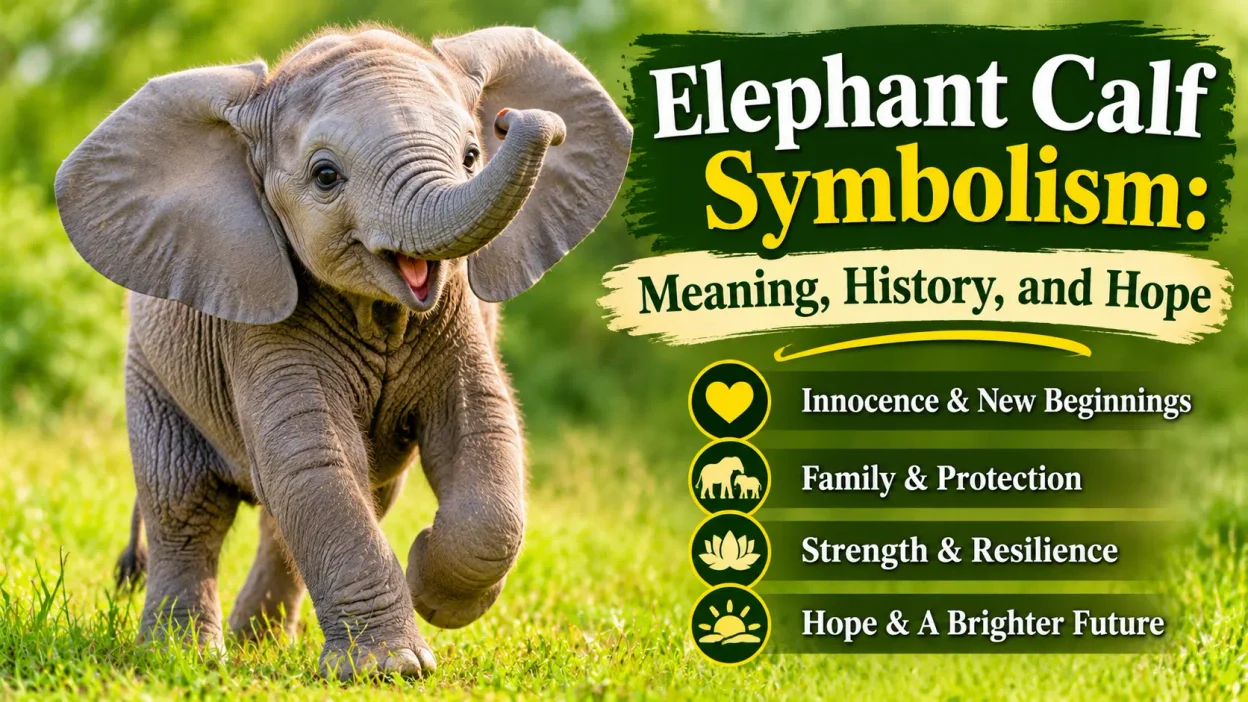
An elephant calf is often seen as a symbol of innocence, family love, protection, and new beginnings. In elephant calf symbolism, the young animal represents the early stages of life, when trust, care, and guidance shape the future. Its small size beside enormous adult elephants creates a natural image of vulnerability supported by strength.
People may encounter elephant calves in wildlife photographs, children’s stories, paintings, jewelry, tattoos, and conservation campaigns. Their appeal goes beyond their appearance. A young elephant depends on its mother and other members of the herd, making it an especially meaningful symbol of family responsibility and community support.
In the United States, elephant calves often appear in artwork and personal gifts celebrating childhood, motherhood, friendship, and fresh starts. Their symbolism also connects with older Asian religious traditions in which elephants represent wisdom, good fortune, and spiritual strength.
Understanding this symbol requires looking at both the animal’s real behavior and the cultural meanings people have attached to elephants over time.
Quick Answer
Elephant calf symbolism commonly represents innocence, new beginnings, family bonds, protection, and personal growth in modern American culture. Its wider historical associations connect with the elephant’s traditional meanings of wisdom, strength, good fortune, and spiritual protection in several Asian cultures.
TL;DR
- Innocence: A young elephant represents childhood, curiosity, and an open heart.
- Family: Its dependence on the herd reflects love, loyalty, and belonging.
- Protection: Adult elephants surrounding calves symbolize safety and collective responsibility.
- Growth: A calf represents learning, developing confidence, and moving toward independence.
- Cultural history: Elephants carry associations with wisdom, prosperity, and sacred traditions.
- Modern meaning: Calf imagery appears in gifts, tattoos, children’s art, and conservation campaigns.
What an Elephant Calf Represents as a Symbol
An elephant calf is a young elephant, usually recognizable by its smaller body, relatively short trunk, rounded features, and close relationship with adult herd members. Newborn calves can stand within a short time after birth, but they still depend heavily on their mothers and family groups for nourishment, protection, and learning.
These physical and behavioral characteristics shape the animal’s symbolic meaning.
Unlike an adult elephant, which commonly represents authority, wisdom, endurance, and physical strength, a calf emphasizes the beginning of those qualities. It suggests potential rather than achievement.
A calf may represent:
- A child beginning to understand the world.
- A new relationship that needs patience and care.
- A family growing through the arrival of a baby.
- Someone learning to become independent.
- A vulnerable person receiving support from others.
Its symbolism is not limited to childhood. Adults may also identify with a young elephant when they are entering a new stage of life, learning unfamiliar skills, or rebuilding confidence after a difficult experience.
The central idea is that growing into strength does not mean starting without help.
Innocence, Curiosity, and the Beauty of Childhood
One of the most recognizable meanings of a baby elephant is innocence.
Young elephants explore their surroundings through touch, movement, play, and interaction with other members of their herd. Their early attempts to control their trunks can look awkward, and they often investigate objects and unfamiliar situations with curiosity.
These behaviors make the calf a natural image of childhood.
In American visual culture, young elephants frequently appear in nursery decorations, children’s books, stuffed animals, greeting cards, and baby shower designs. Their rounded bodies and gentle appearance make them suitable for celebrating the early years of life.
The symbolism can also express a desire to preserve curiosity as people grow older.
For example, an elephant calf illustration in a child’s bedroom might represent the freedom to explore and learn. An adult who chooses a calf design for personal artwork might associate it with remembering childhood, remaining open-minded, or approaching unfamiliar experiences without fear.
In this sense, innocence does not mean a lack of intelligence. It represents an early stage of discovery before experience has fully shaped a person’s understanding.
Family Bonds and the Meaning of Belonging
Family is among the strongest meanings associated with elephant calves because their actual social lives are built around close relationships.
Female elephants generally live in family groups organized around related females. Mothers, sisters, daughters, and other relatives maintain social connections, while young calves receive attention from several members of the group.
Researchers describe this cooperative care as allomothering. It occurs when females other than the mother help protect, comfort, or assist a young calf.
This behavior gives the calf a wider symbolic meaning than the relationship between a mother and child alone.
It can represent:
- Support from grandparents and extended family.
- Older siblings helping younger children.
- Friends providing encouragement during difficult periods.
- Communities sharing responsibility for vulnerable members.
- The importance of belonging to a supportive group.
For American readers, this association is particularly familiar in family photography, Mother’s Day gifts, baby announcements, and artwork celebrating grandparents.
A mother elephant walking beside her calf may symbolize parental devotion. A group of elephants surrounding a young one can represent an extended family that shares responsibility rather than leaving everything to one person.
The image reminds viewers that healthy growth often depends on more than individual effort.
Motherhood, Nurturing, and Protective Love
A young elephant’s relationship with its mother gives the animal a clear connection to motherhood and nurturing care.
Elephant mothers invest considerable time in raising their calves. They provide milk, guide their movements, maintain physical contact, and help them navigate the social structure of the herd. Other females may also step in when a calf needs attention or protection.
This behavior explains why mother-and-calf elephant imagery is frequently used to express parental love.
In American culture, the image can communicate several related ideas:
Unconditional love: A mother staying close to her calf represents a parent’s commitment to a child.
Emotional security: The presence of a protective adult suggests that a child has a safe place to grow.
Patience: Raising a young elephant requires time, attention, and repeated guidance, much like raising a human child.
Generational connection: The relationship between mothers, daughters, and grandmothers can represent the passing of family knowledge and traditions.
A mother elephant and her calf can also be meaningful to someone remembering a parent or celebrating the arrival of a new family member. The image expresses affection without requiring words.
Protection, Safety, and Community Strength
Elephant calves are physically smaller and more vulnerable than adult elephants. When danger appears, adult members of the herd may position themselves around younger animals.
This protective behavior creates one of the clearest visual meanings associated with a group of elephants and a calf: strength used to protect someone who cannot yet protect themselves.
The symbolism is especially relevant in discussions about childhood safety, family responsibility, and community care.
In American artwork, a small elephant standing between two larger elephants can represent the protection provided by parents. A calf surrounded by several adults can communicate a broader idea of collective support.
This meaning also applies outside family relationships.
For example, a teacher supporting a young student, an older sibling helping a younger one, or a community protecting its most vulnerable members can all be represented through this imagery.
Protection in this context is not about controlling another person’s life. It is about creating the security someone needs to develop confidence and independence.
New Beginnings, Hope, and Personal Growth
An elephant calf also represents the beginning of a journey.
A newborn elephant enters the world with a family around it, but it still has many things to learn. It gradually develops coordination, communication skills, social relationships, and independence.
This natural process makes the calf an appealing symbol of personal growth.
People may connect with this meaning during important life changes, including:
- Starting a new career.
- Beginning a relationship.
- Welcoming a child.
- Moving to another city.
- Returning to education.
- Recovering after a difficult period.
A young elephant does not become an experienced adult immediately. Its development takes years, which makes it a useful reminder that progress can happen gradually.
For someone beginning a challenging project, an elephant calf may represent the courage to start small without feeling embarrassed about being inexperienced.
Its message is practical: a person’s current abilities do not determine everything they may eventually become.
Wisdom and Learning Through Experience
Elephants are widely associated with intelligence, memory, and social learning. These associations also influence how people interpret young elephants.
However, there is an important distinction between adult and calf symbolism.
An adult elephant often represents accumulated experience and knowledge. A calf represents the process of acquiring those qualities.
Young elephants learn by observing their mothers and other members of their herd. They develop skills through repeated experiences, social interaction, and exploration.
Consequently, a calf can symbolize:
- Learning from experienced people.
- Respecting family traditions.
- Developing judgment over time.
- Remaining willing to ask questions.
- Understanding that knowledge requires practice.
In a personal or educational setting, a young elephant can represent a student who has potential but still needs guidance.
It also offers a different interpretation of wisdom. Being wise does not always mean knowing the answer. Sometimes it means recognizing what you have not learned yet.
Ancient Roots and Cultural Elephant Symbolism
The elephant has a long history in the religious art, mythology, and cultural traditions of Asia and Africa. However, the specific symbolism of a calf should not automatically be treated as identical to the symbolism of an adult elephant.
Many older traditions focus on the elephant as a whole rather than assigning a separate universal meaning to its young.
In Hindu traditions, elephants are closely associated with Ganesha. This elephant-headed deity is widely honored as a remover of obstacles and is associated with wisdom, learning, and auspicious beginnings.
Elephants also appear in Hindu mythology through Airavata, the celestial elephant associated with the god Indra.
In Buddhist traditions, elephants can represent mental strength, patience, and spiritual qualities. A well-known Buddhist birth narrative describes Queen Maya dreaming of a white elephant before the birth of Siddhartha Gautama.
These traditions help explain why elephant imagery can suggest good fortune, protection, and spiritual significance.
When a young elephant appears in contemporary art influenced by these traditions, viewers may interpret it through the wider cultural associations of the elephant. However, it would be inaccurate to claim that every Asian tradition gives elephant calves the same specific meaning.
Elephant Calf Symbolism in the United States
In the United States, elephant imagery has several different cultural associations.
The elephant is familiar from children’s entertainment, zoos, wildlife documentaries, toys, political imagery, and conservation campaigns. A calf generally emphasizes the gentle, family-oriented side of this familiar animal.
American interpretations commonly include:
Family and childhood: Baby elephant illustrations are popular in nursery art, children’s books, baby shower decorations, and gifts celebrating new parents.
Friendship and loyalty: A calf accompanied by other elephants can represent dependable relationships and long-term connections.
Hope and fresh starts: The arrival of a young elephant can represent a new family member or the beginning of an important chapter.
Wildlife protection: Conservation imagery uses young elephants to communicate the importance of protecting future generations of animals.
There is also an American political association worth distinguishing. The elephant is the traditional symbol of the Republican Party, but this political meaning does not automatically apply to every elephant calf illustration.
A baby elephant used in a nursery or wildlife poster is not necessarily making a political statement. Context, design, and accompanying imagery determine how viewers are likely to understand it.
Cross-Cultural Interpretations of Young Elephants
Elephants have different meanings across cultural and religious traditions. Their shared associations with strength and social relationships create some similarities, but the details vary.
| Cultural context | Wider elephant associations | Possible calf interpretation |
|---|---|---|
| Hindu traditions | Ganesha, wisdom, auspicious beginnings | Learning, blessings, and new stages of life |
| Buddhist traditions | Mental strength, patience, spiritual qualities | Early development and the potential for growth |
| African cultural contexts | Community, heritage, and relationships with wildlife | Family continuity and the protection of young life |
| Modern American culture | Family, childhood, conservation, and loyalty | Innocence, belonging, and new beginnings |
| Contemporary decorative art | Good fortune, affection, and welcoming imagery | A gentle expression of care and hope |
African cultures are diverse, and elephants have different roles in different communities. Some traditions connect them with leadership, heritage, and ceremonial life, while others emphasize their relationship with local environments.
It is also important not to confuse cultural traditions with modern commercial interpretations. A decorative baby elephant sold as a good-luck charm does not necessarily represent an established religious belief.
Emotional and Psychological Meaning
People often respond emotionally to elephant calves because their appearance combines physical vulnerability with the visible presence of a protective family.
The contrast between a small calf and a large adult elephant can encourage feelings of tenderness, affection, and reassurance.
Several emotional associations are especially common.
Comfort: A calf close to its mother can remind someone of the security of being cared for.
Nostalgia: Young elephants may bring back memories of childhood, family experiences, or an earlier stage of life.
Hope: Their development represents the possibility of becoming more capable with time.
Belonging: Their close relationships with other elephants reflect the human desire for connection and acceptance.
Responsibility: A calf’s dependence on others can remind people that caring for someone requires consistency and attention.
These are cultural and personal interpretations, not fixed psychological rules. Someone who associates an elephant calf with a difficult childhood may understand the image differently from someone who sees it as a celebration of parenthood.
Personal memories often influence symbolic meaning as much as traditional associations do.
Why Elephant Calves Appear in Tattoos and Personal Jewelry
Elephant tattoos are popular among people who want to represent family, loyalty, wisdom, or personal strength. Choosing a calf instead of an adult elephant changes the emphasis.
A young elephant tattoo often communicates a more personal and emotional message.
Common interpretations include:
- Mother and calf: A lasting connection between parent and child.
- Two calves: Sibling relationships, childhood friendship, or shared growth.
- A calf with a herd: Family unity and community support.
- A walking calf: A new journey or stage of personal development.
- A playful calf: Joy, curiosity, and maintaining a youthful outlook.
Jewelry featuring baby elephants can carry similar meanings.
A small elephant pendant may be given to celebrate a pregnancy, birth, birthday, or family milestone. Some people also choose elephant jewelry as a reminder of a loved one or a relationship they value.
Design details can influence interpretation. A mother-and-calf pendant emphasizes nurturing, while a single calf surrounded by flowers may suggest renewal and innocence.
The meaning ultimately comes from the intention behind the design rather than from a universal symbolic rule.
Elephant Calves in Dreams and Personal Reflection
Some people search for the meaning of seeing a baby elephant in a dream.
In popular dream interpretation, a young elephant is often connected with new responsibilities, family relationships, innocence, and developing confidence.
The surrounding details can change the interpretation.
- Seeing a healthy calf: May reflect hope, happiness, or a new opportunity.
- Seeing a mother with her calf: May bring attention to family bonds or a desire for emotional security.
- Helping a baby elephant: May reflect a sense of responsibility toward someone who needs support.
- Seeing a lost calf: May represent worries about separation, vulnerability, or feeling unsupported.
- Watching a calf play: May encourage a return to curiosity, enjoyment, and simple pleasures.
Dream interpretations are subjective. There is no scientific evidence that a baby elephant appearing in a dream predicts a particular event or guarantees good fortune.
A more useful approach is to consider what the animal reminded you of and whether its situation connects with something happening in your life.
Modern Use in Art, Home Decor, and Conservation
Elephant calves have become familiar subjects in modern visual culture because they communicate affection and family connection without requiring complicated imagery.
In American homes, they appear in nursery prints, children’s blankets, wall decorations, stuffed animals, and personalized gifts.
Their use extends beyond children’s spaces.
An elephant calf painting can represent a family growing together. A mother-and-calf sculpture may express parental love. A wildlife photograph can encourage viewers to appreciate the social lives of elephants.
Conservation organizations also use images of young elephants to explain why protecting wildlife matters.
The survival of a calf depends on more than its own development. Its family relationships, habitat, access to food and water, and protection from human threats all matter.
This gives the image a practical environmental meaning. Protecting a young elephant also means protecting the social group and natural environment that allow it to grow.
On social media, baby elephant photographs and videos are frequently shared for their playful and affectionate qualities. Some viewers simply enjoy the animal’s appearance, while others use the imagery to express family appreciation or support for wildlife conservation.
Common Misunderstandings About Elephant Calf Symbolism
Although elephant calves are usually associated with positive ideas, some interpretations need clarification.
1. Every baby elephant represents good luck.
Good fortune is a recognized association of elephants in some Asian cultural traditions. However, it is not a universal or scientifically established meaning of every calf image.
2. Elephant calves always symbolize motherhood.
Motherhood is one interpretation, but young elephants can also represent childhood, friendship, learning, and personal development.
3. A baby elephant has the same meaning in every religion.
Hindu, Buddhist, and other cultural traditions have different beliefs and stories involving elephants. Their meanings should not be treated as interchangeable.
4. Elephant imagery is always nonpolitical in America.
The elephant is also associated with the Republican Party. Although a calf illustration is often decorative or family-oriented, the surrounding context can influence its interpretation.
5. A calf symbolizes weakness.
A young elephant is vulnerable because it is still developing, but vulnerability is not the same as weakness. The animal’s symbolism often focuses on the support that makes growth possible.
Recognizing these differences helps keep interpretations respectful and grounded.
How Elephant Calf Symbolism Has Evolved Over Time
The meaning of elephant calves has developed alongside changing attitudes toward animals, family life, and wildlife conservation.
In older religious and cultural traditions, elephants were often connected with royalty, sacred stories, prosperity, and spiritual qualities. Their young were generally understood within the wider importance of elephants and family groups.
Later, elephant imagery became familiar in Western entertainment, children’s literature, toys, and public displays. This helped establish the animal as a recognizable figure in popular culture.
In the modern United States, baby elephant imagery has increasingly become associated with childhood, family affection, and wildlife awareness.
Conservation has also influenced its interpretation. As public understanding of habitat loss, poaching, and the social needs of elephants has grown, a calf can represent the future of an endangered or threatened animal population.
The meaning has not completely replaced older associations. Instead, different interpretations now exist side by side.
An elephant calf can represent family love in a nursery, cultural heritage in religious artwork, and wildlife protection in an environmental campaign.
Its meaning depends on where it appears and why someone chooses to use it.
Frequently Asked Questions
1. What does an elephant calf symbolize spiritually?
An elephant calf can represent new beginnings, protection, learning, and the development of wisdom. When viewed through Hindu or Buddhist traditions, its meaning may also connect with the broader spiritual associations of elephants, although interpretations vary.
2. What does a baby elephant symbolize in a tattoo?
A baby elephant tattoo commonly represents innocence, family relationships, loyalty, and personal growth. A mother-and-calf design is particularly suitable for expressing the connection between a parent and child.
3. Does an elephant calf symbolize good luck?
It can. Elephants are associated with good fortune and auspicious beginnings in some Asian traditions, particularly in Hindu and Buddhist cultural settings. A baby elephant decoration may borrow these associations, but good luck is not its only meaning.
4. What does a mother elephant and baby symbolize?
A mother elephant and her calf usually represent parental love, nurturing, protection, and family unity. The image can also express the importance of guidance and support between generations.
5. Is an elephant calf a symbol of innocence?
Yes. Its young age, playful behavior, and dependence on its family make it a common representation of childhood innocence and curiosity. It can also symbolize the freedom to learn through experience.
6. What does a baby elephant symbolize in a dream?
A baby elephant in a dream may reflect family concerns, a new responsibility, personal growth, or a desire for emotional security. The interpretation depends on the dream’s circumstances and the dreamer’s personal associations.
7. What is the difference between elephant and elephant calf symbolism?
An adult elephant more commonly represents wisdom, endurance, authority, and strength, while a calf emphasizes innocence, learning, protection, and potential. Both can represent family loyalty and social connection.
Conclusion
Elephant calves symbolize innocence, family bonds, protection, new beginnings, and the gradual development of confidence. Their close relationships with mothers and other herd members explain why they are especially meaningful in discussions of childhood, parenthood, and community support.
In the United States, elephant calf symbolism appears in family gifts, nursery decorations, tattoos, personal artwork, and wildlife conservation. Its older cultural associations also connect with the elephant’s importance in Hindu and Buddhist traditions.
Perhaps the most meaningful idea behind a young elephant is that growing into strength takes time. A calf begins life surrounded by others who help it learn, develop, and find its place in the world. That image offers a simple reminder that care and guidance are not obstacles to independence; they are often what make independence possible.