The narwhal is often called the unicorn of the sea because of the long, spiraling tusk that extends from the head of this Arctic whale. In modern American culture, narwhal symbolism commonly represents uniqueness, individuality, imagination, curiosity, and the ability to stand apart without losing one’s connection to a community. Its unusual appearance also connects it with Arctic life, Inuit traditions, and centuries of stories about mysterious creatures.
Unlike many animals associated with familiar religious or cultural symbols, the narwhal has a meaning shaped by both its real-life importance and the legends surrounding its tusk. For Inuit communities, it has long been a source of food, materials, knowledge, and cultural identity. In European history, its tusk became associated with the mythical unicorn and was sometimes treated as a rare object with extraordinary properties.
Today, Americans encounter narwhals in children’s books, ocean-themed decorations, environmental campaigns, toys, jewelry, and popular culture. Understanding the animal’s symbolism means looking beyond its resemblance to a unicorn and considering the people, traditions, and natural environment connected to it.
Quick Answer
Narwhal symbolism commonly represents individuality, uniqueness, curiosity, imagination, and the courage to be different in modern American culture. Historically, the animal has also been associated with Inuit cultural traditions, Arctic survival, and European unicorn legends inspired by its distinctive tusk.
TL;DR
- Individuality: The unusual tusk represents standing apart and embracing personal differences.
- Imagination: Its unicorn-like appearance connects it with fantasy, wonder, and creative thinking.
- Inuit heritage: The animal represents Arctic knowledge, traditional hunting, food, and cultural continuity.
- Mystery: Its remote habitat and unusual appearance encourage curiosity about the natural world.
- Environmental awareness: It represents the importance of protecting vulnerable Arctic ecosystems.
- Modern identity: Its image appears in fashion, children’s products, tattoos, and ocean-themed designs.
What Does a Narwhal Look Like?
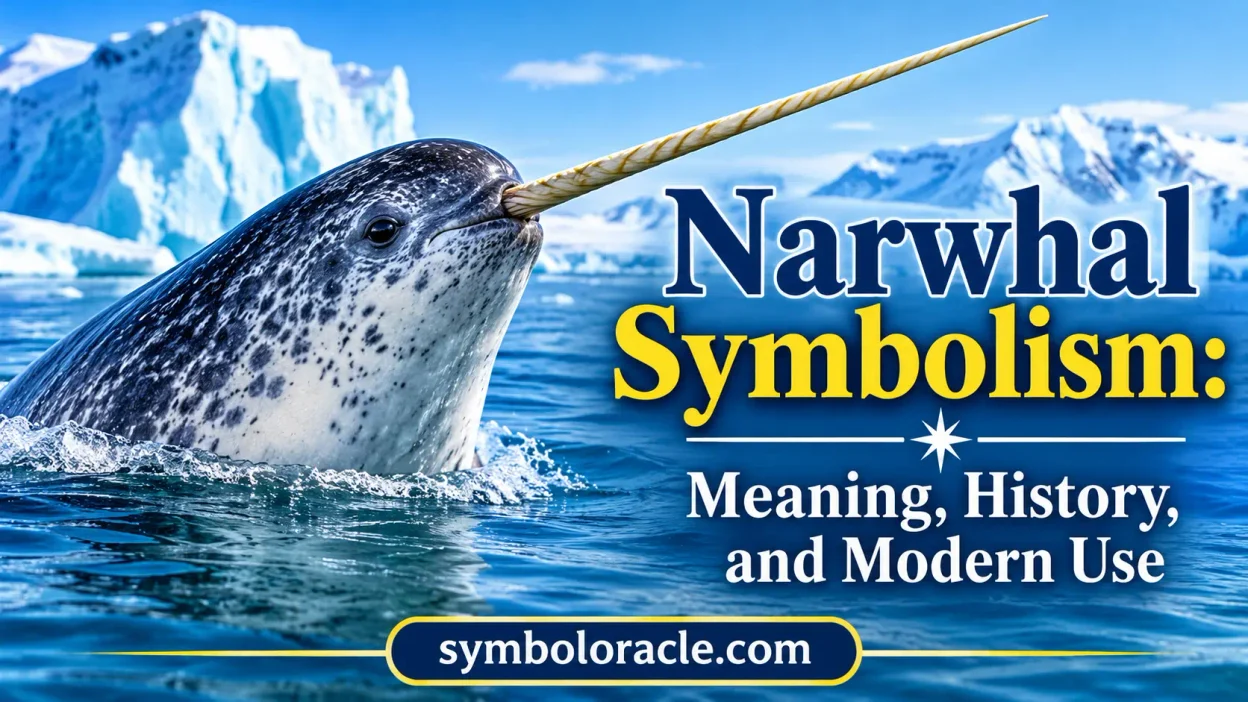
A narwhal is a medium-sized toothed whale that lives in Arctic waters around Greenland, Canada, and parts of the northern Atlantic. It has a rounded head, a thick body, short flippers, and mottled gray, black, and white skin.
Its most recognizable feature is the long spiral tusk that usually grows from the upper jaw of an adult male. Despite its horn-like appearance, the tusk is actually an elongated tooth. It can grow several feet long, making the animal look as though it carries a unicorn horn through the ocean.
Most female narwhals do not develop an external tusk, although rare exceptions occur. Some males also develop two tusks.
The animal’s appearance helps explain why it has become such a recognizable symbol. Its body resembles a whale, but its tusk gives it an almost imaginary quality.
In American illustrations, the narwhal is often shown swimming beneath icy water, surrounded by snowflakes, blue waves, or other Arctic animals. Children’s designs sometimes exaggerate its tusk and facial features, making it appear friendly and playful.
These visual characteristics support several modern interpretations, particularly uniqueness, imagination, and curiosity.
The Main Symbolic Meanings of the Narwhal
Narwhals do not have one universal symbolic meaning. Their interpretations depend on cultural background, historical knowledge, and the setting in which the animal appears.
However, several associations have become especially recognizable in contemporary American culture.
1. Individuality and Being Different
The narwhal’s unusual tusk makes it an obvious symbol of individuality.
Most whales do not have anything resembling a long spiral horn. The narwhal’s distinctive appearance therefore offers a natural comparison to people whose personalities, interests, or experiences make them different from those around them.
In modern American design and popular culture, the animal is frequently used to communicate self-acceptance. A narwhal illustration on a notebook, shirt, or personal accessory can represent the idea that being unusual is not something that needs correcting.
This interpretation is especially common in children’s products and youth-oriented designs, where the narwhal is presented as a friendly creature that stands out without being threatening.
Its message is simple: differences can be part of what makes someone recognizable.
2. Imagination and Fantasy
The resemblance between a narwhal’s tusk and a unicorn horn connects the animal with fantasy.
For centuries, people in Europe encountered narwhal tusks without necessarily knowing which animal produced them. These unusual objects helped strengthen stories about unicorns and other extraordinary creatures.
That historical connection continues to influence modern illustrations, books, toys, and entertainment.
In American children’s culture, narwhals frequently appear alongside mermaids, unicorns, rainbows, and other imaginary creatures. They are particularly suitable for stories that combine real wildlife with elements of fantasy.
As a symbol, the narwhal can represent creative thinking, storytelling, and the ability to imagine possibilities beyond ordinary experience.
3. Curiosity and Discovery
The narwhal lives in an environment that remains difficult for humans to observe directly.
Its Arctic habitat, seasonal movements, and unusual physical features have encouraged scientific investigation for generations. Even its tusk has attracted questions about its biological purpose.
This makes the animal a natural symbol of curiosity and discovery.
In educational settings, a narwhal image can encourage children to explore marine biology, Arctic geography, animal behavior, and environmental science.
For adults, it can represent an interest in learning about unfamiliar subjects or questioning assumptions.
The animal reminds people that something unusual does not automatically belong to the world of fantasy. Sometimes, nature produces things that are more surprising than fiction.
4. Independence and Self-Confidence
A narwhal’s distinctive appearance can also represent confidence in one’s identity.
Its tusk makes it visually different from other whales, but it remains part of a social species that lives and travels in groups.
This creates an interesting symbolic contrast. The animal can represent personal distinction without suggesting that individuality requires isolation.
In modern American interpretations, it may communicate the value of being comfortable with personal differences while maintaining friendships, family relationships, and community connections.
This meaning is especially appropriate for personal artwork, gifts, and accessories associated with self-expression.
5. Mystery and the Unknown
The Arctic environment contributes another layer of meaning.
Narwhals spend much of their lives in cold northern waters, sometimes beneath extensive sea ice. Their habitat is remote, and observing their behavior can be challenging.
For this reason, they are often associated with the unknown, exploration, and the limits of human understanding.
In artwork and storytelling, a narwhal swimming beneath an icy surface can suggest something waiting to be discovered.
This interpretation is not necessarily spiritual. It can simply express fascination with unfamiliar places and the natural world.
Ancient Inuit Connections and Cultural Origins
Any serious discussion of narwhal symbolism must recognize the animal’s importance to Inuit communities.
Inuit peoples have lived across Arctic regions of Greenland, Canada, and Alaska for generations. Their relationship with narwhals developed through direct knowledge of the animal, its seasonal movements, and the resources it provides.
Narwhals have traditionally supplied food, blubber, skin, and ivory. The skin and blubber, commonly known as maqtaaq or related regional spellings, are particularly important in Inuit food traditions.
These uses demonstrate that the animal’s cultural importance is not based only on its unusual appearance.
The narwhal represents a relationship between people and their environment built through observation, hunting knowledge, food preparation, sharing, and community life.
Its tusk also became an important material for carving and trade.
In Inuit communities, narwhal artwork and storytelling have helped preserve knowledge about the Arctic animal. Its image can communicate cultural continuity and familiarity with a landscape that outsiders may know only through photographs or scientific descriptions.
It is important not to reduce Inuit interpretations to a single universal meaning. Inuit communities are diverse, and traditions differ across regions and generations.
For many Inuit people, the narwhal is not simply a fantasy creature or decorative symbol. It is a real animal connected to livelihood, cultural knowledge, and relationships with the Arctic environment.
The Inuit Legend Behind the Narwhal’s Tusk
One of the best-known stories explaining the narwhal’s appearance comes from Inuit oral traditions.
In versions recorded during the late nineteenth and early twentieth centuries, a woman becomes connected to the origin of the narwhal’s tusk.
The story describes a woman whose hair is twisted or braided into a shape resembling a horn. During a conflict involving a whale, she is pulled into the water and transformed into a narwhal. Her twisted hair becomes the animal’s distinctive tusk.
Different recorded versions contain variations in the characters and events.
This story is important because it explains the animal through a cultural narrative rather than a biological account. It also reflects the relationship between Inuit storytelling, the Arctic environment, and the distinctive characteristics of local wildlife.
The legend should not be treated as a universal belief shared by every Inuit community. It is one recorded tradition among a wider range of cultural knowledge.
For modern readers, it provides a reminder that animals can carry meanings that are much older and more specific than the interpretations commonly found in contemporary merchandise.
How Narwhals Became Connected to Unicorn Legends
The narwhal’s connection to European unicorn mythology is one of the most unusual parts of its history.
During the medieval period, narwhal tusks reached European markets through northern trade networks. Because many Europeans had never seen a living narwhal, the tusks could appear to be evidence of an extraordinary animal.
Their long, spiraling shape resembled the single horn traditionally attributed to the unicorn.
As a result, some narwhal tusks were sold and displayed as unicorn horns.
These objects were especially valuable because unicorn horns were believed to possess extraordinary protective and medicinal properties. In some European traditions, they were associated with purity and the ability to detect or neutralize poison.
Narwhal ivory therefore acquired a reputation that extended far beyond its actual biological origin.
Over time, European naturalists increasingly recognized that these supposed unicorn horns came from a real Arctic whale.
This history helped establish the narwhal as a symbol connecting science, mythology, and human imagination.
It also explains why the expression “unicorn of the sea” remains so popular in American culture.
What Narwhal Symbolism Means in the United States
In the United States, the narwhal is generally understood through a combination of wildlife education, fantasy imagery, and personal expression.
Unlike the bald eagle or American bison, it does not have an established national symbolic role. Its modern meaning is more informal and often influenced by children’s entertainment and ocean-themed products.
Several interpretations are especially common.
Individual identity: The narwhal’s unusual appearance makes it suitable for designs celebrating personal differences and self-acceptance.
Childhood imagination: Its resemblance to a unicorn gives it a place in fantasy-themed books, toys, birthday decorations, and classroom materials.
Marine education: Schools, aquariums, and wildlife organizations use narwhal imagery to introduce Arctic ecosystems and marine mammals.
Environmental awareness: Its dependence on Arctic sea ice makes it relevant to discussions about climate change and wildlife conservation.
Creative personality: The animal’s unusual appearance makes it attractive to people who enjoy distinctive, playful, and unconventional designs.
American interpretations tend to focus more on individuality and imagination than on the animal’s traditional role in Arctic communities.
However, greater awareness of Indigenous knowledge and environmental issues has encouraged a broader understanding of its cultural importance.
Narwhal Symbolism Across Different Cultural Contexts
The narwhal’s meaning changes depending on the historical and cultural setting.
| Cultural Context | Symbolic Association | Historical or Modern Connection |
|---|---|---|
| Inuit communities | Cultural continuity and Arctic knowledge | Food traditions, hunting, storytelling, and artistic expression |
| Medieval Europe | Purity and extraordinary protection | Narwhal tusks were sometimes presented as unicorn horns |
| Modern United States | Individuality and imagination | Children’s entertainment, fashion, gifts, and personal accessories |
| Marine education | Discovery and wildlife knowledge | Arctic biology and environmental learning |
| Contemporary conservation | Ecological awareness | Interest in Arctic sea ice and marine ecosystems |
These interpretations should not be treated as interchangeable.
The historical European belief in unicorn horns, for example, is different from the practical and cultural relationship Inuit communities have maintained with the animal.
Recognizing these differences helps prevent a simplified interpretation of the narwhal as nothing more than a magical whale.
Emotional and Psychological Meaning
People often connect with animal symbols because certain physical characteristics remind them of personal experiences or feelings.
The narwhal’s appearance can support several emotional interpretations.
Feeling Comfortable With Differences
People who have felt unusual or misunderstood may identify with the narwhal because of its distinctive appearance.
Its tusk makes it recognizable, but it does not make the animal less of a whale.
This can create a useful comparison with human identity. A person’s differences do not remove their place within a family, friendship group, or wider community.
Curiosity About Life
The narwhal can also represent the excitement of learning something unexpected.
Its biology challenges ordinary expectations about what a whale should look like. That quality makes it an appealing symbol for people who enjoy discovery, science, exploration, and creative ideas.
Connection With Childhood
For many Americans, narwhals are associated with childhood because of their appearance in toys, illustrated books, cartoons, and fantasy-themed merchandise.
Their rounded bodies and unusual tusks make them easy to turn into friendly characters.
As a result, a narwhal can communicate playfulness, comfort, and a connection to childhood memories.
Respect for Nature
The animal’s Arctic habitat can create an emotional connection with remote landscapes and wildlife.
For people concerned about environmental protection, the narwhal may represent the importance of preserving species that depend on fragile ecosystems.
These associations are personal interpretations rather than established psychological diagnoses or universal emotional responses.
What Does a Narwhal Mean in Dreams?
Dream interpretations involving narwhals are generally modern and personal rather than part of a widely established traditional dream system.
If someone dreams about a narwhal, the animal may bring attention to themes such as individuality, curiosity, imagination, or something unfamiliar in their life.
The details of the dream can influence its personal meaning.
- Swimming narwhal: May reflect curiosity, emotional exploration, or interest in an unfamiliar experience.
- Narwhal with a long tusk: Could represent individuality, confidence, or a characteristic that makes someone stand out.
- A group of narwhals: May suggest belonging, companionship, or finding acceptance within a community.
- A narwhal in clear water: Could represent a desire for understanding or a clearer perspective.
- An injured narwhal: May reflect concern about vulnerability, environmental damage, or something the dreamer wants to protect.
There is no scientific evidence that dreaming about a narwhal predicts future events.
A more useful approach is to consider what the animal represents to the individual. Someone who associates narwhals with childhood may interpret the dream differently from someone interested in Arctic wildlife.
Narwhal Symbolism in Tattoos and Personal Style
Narwhal tattoos are often chosen for their unusual appearance and associations with individuality.
A small narwhal tattoo can represent a person’s playful personality, love of marine animals, or appreciation for creatures that do not fit ordinary expectations.
The design can also communicate a connection with imagination and fantasy.
Different tattoo styles create different impressions.
Minimalist narwhal: A simple outline can represent individuality without making the design overly decorative.
Narwhal with a unicorn horn: This style emphasizes imagination, fantasy, and the animal’s connection to unicorn legends.
Narwhal beneath Arctic waves: This design can express an interest in marine life, exploration, and environmental protection.
Narwhal with stars: The combination often creates a dreamy appearance associated with creativity and wonder.
Narwhal with other whales: This design can emphasize companionship and the relationship between individual identity and community.
In jewelry and fashion, narwhal imagery is commonly used for playful self-expression. Pendants, earrings, printed clothing, and small accessories often feature the animal as a recognizable and friendly design.
The meaning ultimately depends on the wearer rather than a fixed cultural rule.
Narwhal Symbolism in Art, Decor, and Popular Culture
Narwhals have become familiar in American visual culture because they combine a real animal with an appearance that seems almost imaginary.
In children’s bedrooms, ocean-themed decorations often feature narwhals alongside dolphins, whales, mermaids, and other marine creatures.
Their rounded bodies and distinctive tusks make them suitable for illustrations, plush toys, wall art, and bedding.
In educational settings, narwhal artwork can introduce children to Arctic wildlife without requiring complicated scientific explanations.
In digital culture, narwhal illustrations and animated characters are often used to communicate humor, friendliness, and a playful personality.
Their visual appeal also makes them popular in fantasy-themed merchandise.
However, the narwhal’s popularity should not be confused with its historical importance. A cartoon narwhal used in a children’s product represents a modern creative interpretation, not necessarily an accurate reflection of Inuit cultural traditions.
Both forms of representation can exist, provided their differences are respected.
The Narwhal as a Symbol of Arctic Conservation
Beyond its connection with fantasy, the narwhal represents a real environmental concern.
Narwhals depend on Arctic marine ecosystems, including areas influenced by seasonal sea ice. Changes in ice conditions, ocean temperatures, shipping activity, and human disturbance can affect their habitat.
Climate change has become an important part of discussions about Arctic wildlife because the region is experiencing significant environmental changes.
The narwhal’s dependence on its northern environment makes it a useful example when explaining why protecting Arctic ecosystems matters.
In American environmental education, images of narwhals can encourage interest in marine conservation and the relationship between wildlife and climate.
The animal also helps communicate an important idea: protecting a species involves protecting the conditions that allow it to survive.
For Inuit communities, conservation discussions must also recognize traditional knowledge, local food systems, and the importance of community participation in wildlife management.
It would be misleading to portray every narwhal hunt as automatically destructive. Subsistence hunting has a longstanding cultural and practical role in Inuit communities, and wildlife management must account for biological evidence as well as Indigenous knowledge and rights.
Common Misunderstandings About Narwhal Symbolism
The narwhal’s unusual appearance has produced several misunderstandings.
Separating fact from interpretation helps readers understand its symbolism more accurately.
The narwhal is not a mythical creature. It is a real toothed whale that lives in Arctic waters. Its resemblance to a unicorn comes from its distinctive tusk.
The tusk is not a horn. It is an elongated tooth that usually develops in males. Calling it a horn is common in casual descriptions, but it is not biologically accurate.
Not every narwhal has a visible tusk. Most females do not develop an external tusk, and rare exceptions exist among both sexes.
The unicorn connection does not explain every cultural meaning. European beliefs about unicorn horns are different from Inuit relationships with narwhals.
The animal does not have one universal spiritual meaning. Associations with imagination, independence, and uniqueness are modern interpretations rather than beliefs shared by all cultures.
A narwhal tattoo does not have one fixed message. Its meaning depends on the person’s experiences, interests, and reasons for choosing the design.
These distinctions are important because popular imagery can sometimes overshadow the animal’s actual biology and cultural history.
How Narwhal Meaning Has Changed Over Time
The narwhal’s symbolic identity has developed through several different stages.
Its earliest cultural significance was connected to the lives of Arctic communities that depended on knowledge of the animal and its environment.
For Inuit communities, it became part of traditional food systems, artistic practices, hunting knowledge, and oral storytelling.
Later, narwhal tusks entered European trade networks. Their unusual appearance contributed to beliefs about unicorn horns and the extraordinary properties associated with them.
As scientific knowledge expanded, the supposed unicorn horn became recognized as a real whale’s tooth.
This did not eliminate the animal’s connection with fantasy. Instead, it gave that connection a different character. People could now appreciate the narwhal as a genuine animal whose appearance seemed almost imaginary.
In contemporary America, its symbolic meaning has expanded into children’s entertainment, personal identity, creative design, and environmental education.
The animal now occupies an interesting position between wildlife and fantasy.
Its history demonstrates how the meaning of an animal can change as different societies encounter it, study it, trade its materials, and represent it in art.
Frequently Asked Questions About Narwhal Symbolism
1. What does a narwhal symbolize spiritually?
In contemporary spiritual interpretations, a narwhal may represent individuality, curiosity, imagination, and acceptance of personal differences. These associations are modern interpretations rather than a single established spiritual tradition.
2. Is a narwhal a symbol of uniqueness?
Yes. Its unusual spiral tusk makes it a recognizable modern symbol of individuality and being different. In American popular culture, it is often used to celebrate people who embrace their distinctive personalities.
3. What does a narwhal tattoo symbolize?
A narwhal tattoo can represent self-expression, creativity, imagination, or a personal interest in marine wildlife. Some people also choose it because of its connection to unicorn legends and childhood memories.
4. What does a narwhal represent in Inuit culture?
The narwhal has practical, cultural, and artistic importance for Inuit communities. It is connected to traditional food systems, hunting knowledge, materials, storytelling, and relationships with the Arctic environment.
5. Why is the narwhal called the unicorn of the sea?
The name comes from its long spiral tusk, which resembles a unicorn’s horn. Historically, narwhal tusks were sometimes traded in Europe as supposed unicorn horns because people did not know their actual origin.
6. Is narwhal symbolism positive or negative?
Modern American interpretations are generally positive, emphasizing individuality, curiosity, imagination, and environmental awareness. Historical stories and cultural traditions can contain more complicated themes, so its meaning depends on the context.
7. What does a narwhal symbolize in dreams?
A narwhal in a dream may represent personal differences, curiosity, emotional exploration, or an unfamiliar situation. Dream meanings are subjective, so the dreamer’s personal associations are more useful than treating any interpretation as a prediction.
Conclusion
Narwhal symbolism brings together individuality, imagination, curiosity, and the importance of cultural and environmental connections. Its unusual tusk has inspired unicorn legends, while its place in Inuit communities reflects a much older relationship between people and the Arctic environment.
In modern American culture, the narwhal is often seen as a friendly reminder that being different can be something worth celebrating. Yet its meaning extends beyond children’s illustrations and fantasy merchandise. It also represents a real Arctic animal with a distinctive biological history and an important place in Indigenous knowledge and traditions.
The narwhal’s story offers a useful distinction between what people imagine and what nature actually creates: sometimes, the real world is unusual enough to inspire its own legends.