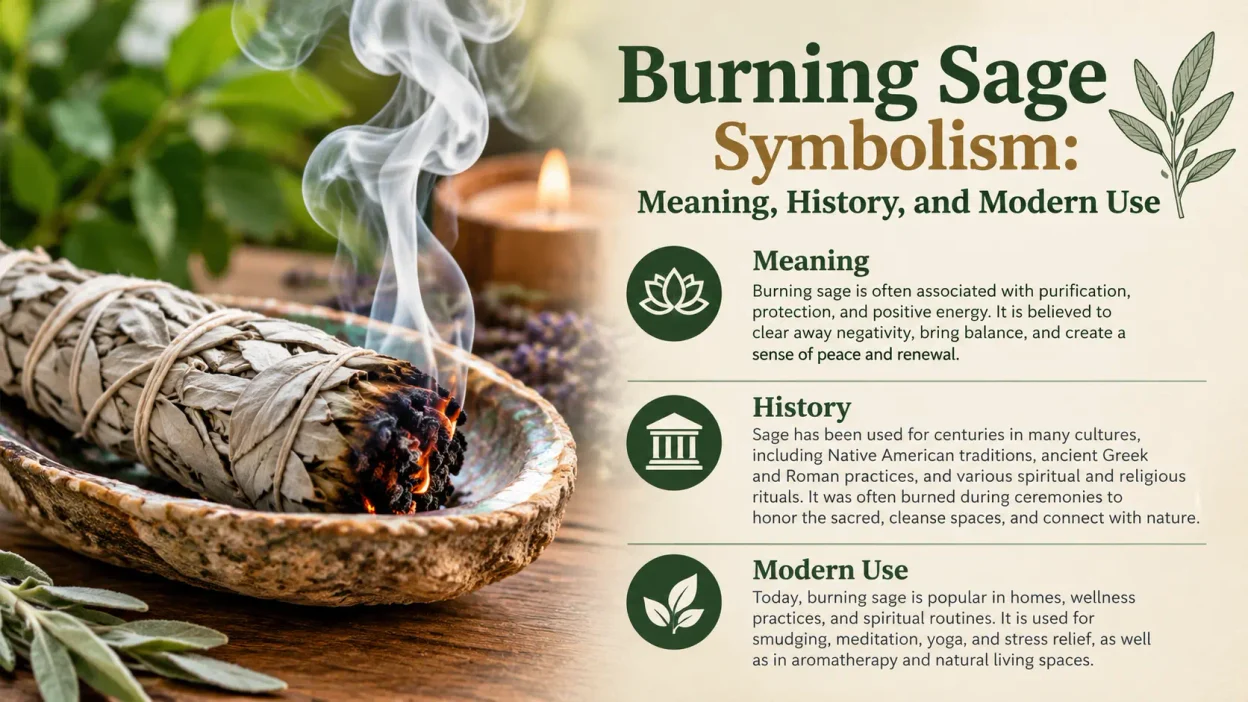
Burning sage symbolism is commonly associated with cleansing, protection, renewal, and the intention to create a calmer environment. In the United States, people often encounter the practice when someone lights a bundle of dried sage during a personal ritual, meditation session, home-cleansing ceremony, or spiritual gathering. The rising smoke can represent the release of unwanted feelings, the closing of one chapter, or the beginning of another.
The practice has a longer and more complicated history than its popularity in modern wellness culture might suggest. Different Indigenous communities have their own relationships with sacred plants, ceremonial burning, and spiritual traditions. Sage is also a culinary and medicinal herb with a history of practical use, so burning it does not carry the same meaning in every setting.
Understanding the symbolism means looking beyond the idea that smoke automatically removes negative energy. For some people, the ritual expresses religious or spiritual beliefs. For others, it provides a moment to pause, reflect, and mark a transition. Its meaning depends on the plant, the tradition, the person’s intentions, and the cultural context in which the practice takes place.
Quick Answer
Burning sage commonly symbolizes cleansing, protection, renewal, and the intention to release unwanted influences in modern American spiritual and wellness practices. Historically, particular sage species have held ceremonial, medicinal, and practical importance in different communities, including some Indigenous traditions, where their meanings and uses are specific to cultural teachings.
TL;DR
- Burning sage often represents cleansing, renewal, protection, and fresh beginnings.
- Some Indigenous communities use sacred plants within distinct ceremonial traditions.
- Modern Americans may burn sage during meditation, reflection, or life transitions.
- Smoke can serve as a symbolic reminder to pause and set intentions.
- Cultural respect matters when using practices connected to Indigenous traditions.
- Ventilation and fire safety are essential when burning dried herbs indoors.
1. What Burning Sage Looks Like and How It Is Used
Burning sage usually involves lighting dried leaves or a small bundle of plant material and allowing it to produce fragrant smoke. Some people use loose leaves in a heat-resistant bowl, while others choose tightly bound bundles commonly sold for spiritual or wellness practices.
The plant itself matters. Garden sage (Salvia officinalis) is widely known as a culinary herb, while white sage (Salvia apiana), native to parts of the southwestern United States and northwestern Mexico, has particular cultural importance to some Indigenous communities. These plants are related, but they are not interchangeable in every cultural or ceremonial context.
The smoke is often the most recognizable part of the ritual. It rises, moves through the air, and gradually disappears. People may interpret this movement as a representation of letting go, carrying a prayer, or marking a transition.
The physical act is straightforward, but its symbolic meaning depends on the person performing it. Burning a herb for its scent is different from using it in a religious ceremony or treating it as part of a personal spiritual practice.
2. Cleansing: The Most Common Modern Meaning
Cleansing is one of the most widely recognized meanings of burning sage in contemporary American wellness culture. The word can refer to a spiritual intention, an emotional reset, or the symbolic act of preparing a space for something new.
For example, someone moving into a new apartment might burn an herb while setting intentions for a peaceful home. Another person might use a quiet ritual after a difficult week to mark the transition from stress to rest.
In these situations, cleansing does not necessarily mean removing a physical substance. It represents a desired change in how a person relates to a place, memory, or experience.
The distinction is important because claims about spiritual cleansing are matters of belief rather than scientifically established effects of smoke. A ritual may feel meaningful to the person performing it without proving that invisible negative forces have been removed.
This interpretation also explains why the practice appeals to people who are not connected to a particular religion. They may value the opportunity to pause, reflect, and make a conscious decision about how they want to approach the next stage of life.
3. Protection and the Desire for Safety
Burning sage can symbolize protection, particularly when someone uses it before entering a new phase of life or after an experience that left them feeling unsettled.
Protection may have a spiritual meaning for people who believe a ritual can guard against harmful influences. For others, it expresses a more personal wish to feel secure, establish boundaries, or regain control over a familiar environment.
Consider someone who has experienced a difficult relationship and wants their home to feel like their own again. They might burn a small amount of sage as part of a deliberate transition, pairing the ritual with cleaning the room, rearranging furniture, or setting new personal boundaries.
The smoke becomes a visible reminder of an intention rather than proof of supernatural protection.
It is also important to recognize that protection has different meanings across cultural traditions. A ceremony performed within an Indigenous community may involve specific teachings, prayers, responsibilities, or relationships that cannot be reduced to the general wellness concept of protecting a home.
Understanding those differences prevents a broad modern interpretation from being mistaken for a universal traditional meaning.
4. Renewal, Fresh Starts, and Life Transitions
Renewal is another common interpretation of burning sage. Because the smoke appears briefly and then fades, it can serve as a symbol of transition: something ends, and attention turns toward what comes next.
People may associate the ritual with moving homes, beginning a new job, ending a relationship, recovering from a difficult period, or preparing for a personal milestone.
The meaning is often created by the occasion. Burning sage before unpacking in a new house may represent establishing a fresh beginning. Using it after a period of reflection may mark a decision to leave an old habit behind.
American culture contains many comparable rituals. People light candles for remembrance, open windows to freshen a room, or clear out belongings when beginning a new chapter. These actions differ in their traditions and beliefs, but they can share the purpose of giving a transition a visible form.
Burning sage can serve a similar role for those who choose it. Its significance comes from the intention attached to the act, not from a guarantee that the future will unfold differently.
5. Indigenous Traditions and the Importance of Cultural Context
Some Indigenous peoples in North America use sage and other plants in ceremonies connected with prayer, purification, healing, community, and relationships with the natural world. However, Indigenous cultures are diverse, and there is no single practice shared by every Native nation.
The plants used, the way they are prepared, the meaning of the smoke, and the people permitted to conduct particular ceremonies can differ between communities. In some settings, ceremonial knowledge is taught through family, community, or spiritual leadership rather than through public instructions.
This context matters because contemporary retail culture often presents sage burning as a universal ritual with a standardized set of steps. That presentation can erase the specific cultural relationships from which some modern practices have been borrowed.
For Indigenous practitioners, a ceremony may involve obligations and teachings that go far beyond the idea of making a room feel lighter. It may express community identity, prayer, continuity, or a relationship with land and plants.
Respect begins by acknowledging that these traditions belong to living communities. Reading about a practice does not automatically provide the cultural knowledge or permission associated with participating in it.
6. The Difference Between Sage Burning and Smudging
The terms burning sage and smudging are sometimes used interchangeably in the United States, especially in retail descriptions and wellness discussions. However, they do not mean exactly the same thing in every context.
Burning sage describes the physical act of setting dried sage leaves or a bundle alight. The action might be undertaken for fragrance, personal reflection, or a spiritual purpose.
Smudging commonly refers to specific ceremonial practices among some Indigenous peoples, although terminology and methods vary across communities. Such practices may involve sacred plants, prayers, intentions, and established cultural teachings.
Calling every instance of burning a herb “smudging” can blur these distinctions. It may also imply that a person is performing an Indigenous ceremony when they are actually following a modern, generalized wellness ritual.
A more precise description explains what is happening without assuming that all smoke-based practices have the same origin or significance.
This distinction is not simply about choosing the right word. It helps preserve the difference between an ordinary botanical practice, an individual’s spiritual routine, and a ceremony embedded in a particular community’s traditions.
7. Sage in Ancient and European Herbal Traditions Burning Sage Symbolism
Sage has a long history of practical use in Mediterranean and European traditions. Garden sage was valued as a culinary herb and was also used in historical herbal medicine. Its familiar aroma, durable leaves, and availability helped make it a useful plant in household gardens.
The name Salvia is associated with Latin words relating to health and well-being. This linguistic history reflects the plant’s longstanding reputation as a useful herb, although historical beliefs about its medicinal properties should not be confused with modern clinical evidence.
Sage also appeared in historical religious and folk practices. In some European traditions, aromatic plants were burned or carried in attempts to ward off illness, unpleasant odors, or perceived harmful influences. Such customs varied widely and often combined practical concerns with spiritual beliefs.
These examples help explain why sage can carry associations with protection and purification in some contemporary interpretations. However, they do not establish that modern sage-burning rituals descend from one ancient ceremony.
The history of a plant is not the same as the history of every practice involving it. Garden sage’s culinary and medicinal past, Indigenous ceremonial uses of particular plants, and contemporary wellness rituals should be examined as related but distinct subjects.
8. What Burning Sage Means in Modern American Homes
In the United States, burning sage has become visible in home-wellness routines, meditation spaces, yoga settings, and discussions of spiritual self-care. Some people use it when moving into a new home, while others associate it with quiet reflection or preparing a room for meditation.
The practice can also function as a personal marker of intention. Someone might pause before lighting the bundle and decide what they want to focus on: patience, clarity, gratitude, or a calmer response to stress.
For some Americans, this is explicitly spiritual. Others approach the ritual as a sensory experience that helps them slow down and shift attention away from daily demands.
These interpretations reflect the variety of beliefs found in contemporary American life. People combine religious traditions, family customs, secular wellness practices, and individual routines in different ways.
There is no need to assume that everyone who burns sage believes in supernatural cleansing. Nor should the practice be described as merely decorative when it holds genuine spiritual significance for someone else.
The most accurate interpretation starts with the person, setting, and purpose involved.
9. Emotional and Psychological Symbolism
Rituals can help people organize experiences that otherwise feel difficult to define. A deliberate action, repeated in a familiar sequence, may create a sense of structure during periods of uncertainty or change.
Burning sage can provide that structure for some individuals. Gathering the materials, lighting the leaves, observing the smoke, and spending a few quiet minutes in reflection create a clear beginning and ending.
The symbolism may also help a person express feelings without immediately putting them into words. Someone who feels overwhelmed might associate the disappearing smoke with releasing tension, even though the smoke itself does not demonstrate that the underlying problem has been resolved.
This distinction separates symbolic meaning from a medical claim. A personal ritual may support reflection or relaxation, but it is not a substitute for professional mental health care when that care is needed.
The emotional value of the practice can come from attention, expectation, familiarity, and personal belief. Those factors help explain why one person finds the ritual comforting while another finds it unnecessary or unconvincing.
10. Spiritual Interpretations and Religious Differences
In modern spiritual settings, sage burning may be associated with prayer, intention-setting, meditation, or a desire to create a meaningful atmosphere. Some people interpret the smoke as a symbolic carrier of prayers, while others see the ritual as a way to focus their thoughts.
These interpretations are not universal religious teachings. The meaning depends on the person’s beliefs and the tradition in which the action takes place.
Christian, Jewish, Buddhist, Hindu, Indigenous, and other religious communities have different histories and attitudes toward incense, aromatic plants, prayer, and purification. Even within a single religion, practices may differ by denomination, region, family, and community.
For example, incense has established roles in several religious traditions, but that does not mean sage burning automatically has the same significance as incense used in a formal religious service. Similar physical actions can carry different meanings because their prayers, teachings, and ritual settings differ.
It is therefore misleading to describe burning sage as a universal religious requirement or to claim that all spiritual traditions interpret its smoke in the same way.
A respectful explanation makes room for individual belief while recognizing the boundaries of specific religious practices.
11. Sage, Nature, and the Meaning of the Smoke
Plants can symbolize the relationship between human life and the natural world. Sage’s recognizable scent, textured leaves, and connection to gardens give it associations with the earth, cultivation, and the use of natural materials.
The smoke introduces another layer of interpretation. It moves beyond the plant’s original shape, becoming visible for a short time before dispersing. People may associate this movement with change, impermanence, or the passing of an intention from thought into action.
These meanings are interpretive rather than universal. Smoke may suggest prayer to one person, remembrance to another, and simply fragrance to someone else.
The plant’s identity also matters. Sage is a name applied to numerous species in the Salvia genus, which includes plants with different appearances, habitats, and uses. Not every species is traditionally used for burning, and not every sage plant has the same cultural significance.
Recognizing the diversity of the plant helps keep its symbolism grounded in botanical reality instead of treating all plants called sage as interchangeable spiritual objects.
12. Modern Uses in Personal Rituals, Art, and Social Media
Burning sage appears in contemporary lifestyle photography, wellness content, spiritual art, and home-design imagery. Dried bundles are sometimes shown beside candles, crystals, journals, or other objects associated with meditation and personal reflection.
In these settings, sage can communicate a particular aesthetic: natural materials, quiet surroundings, intentional living, and an interest in spiritual or holistic practices.
Some people also use images of smoke or sage leaves in digital profiles and artwork to express an interest in renewal, boundaries, or personal growth. A drawing of sage may carry these associations without implying that the person regularly burns it.
Tattoos and jewelry featuring sage leaves can similarly suggest a connection to nature, healing, remembrance, or a personal turning point. Their meanings are individual rather than standardized.
Social media has made the practice easier to discover, but it can also simplify cultural traditions into attractive images and short instructions. A photograph rarely communicates the history or responsibilities associated with a ceremony.
When interpreting modern depictions, consider whether the image represents a personal wellness routine, a cultural tradition, or simply a visual preference. That distinction helps prevent assumptions about a person’s beliefs or background.
13. Positive and Negative Interpretations of Burning Sage
Burning sage is often presented positively, but its symbolism can change according to the beliefs of the people involved.
| Context | Common symbolic meaning | Important distinction |
|---|---|---|
| Moving into a new home | Renewal and a fresh beginning | A personal ritual does not guarantee a better outcome |
| Meditation or reflection | Focus and intentional awareness | Benefits may be subjective |
| Spiritual ceremony | Prayer, purification, or other culturally specific meanings | Practices differ between traditions |
| Difficult life transition | Letting go and setting boundaries | The ritual does not resolve every underlying problem |
| Retail and social media imagery | Wellness, nature, and self-care | Commercial portrayals may omit cultural history |
Some people view sage burning positively because it gives form to an intention. Others object to its use when sacred traditions are commercialized or represented inaccurately.
There can also be practical concerns. Smoke may irritate the respiratory system, trigger symptoms in sensitive individuals, and affect indoor air quality. A ritual that feels calming to one person may be uncomfortable or unsafe for another.
These differences do not make the symbol inherently good or bad. They show that meaning depends on cultural context, personal beliefs, and the consequences of the practice.
14. Cultural Appropriation, Sustainability, and Responsible Use
One of the most important modern debates concerns the commercial sale of white sage and the adaptation of Indigenous ceremonies for mainstream wellness markets.
Some Indigenous people and cultural educators have raised concerns about outsiders using sacred practices without understanding their cultural setting, particularly when those practices are marketed as universal techniques for removing negative energy. The issue is not that every non-Indigenous person has the same intentions or that every use of sage is identical. It is that commercialization can detach a practice from the community and teachings that give it meaning.
Sustainability is another consideration. Demand for certain plants can place pressure on wild populations when harvesting is poorly managed. The environmental impact depends on the species, its habitat, the source of the material, and how it is collected or cultivated.
Anyone considering the practice can take several reasonable steps:
- Learn which plant species they are buying and where it was grown or harvested.
- Avoid assuming that a commercial bundle reproduces an Indigenous ceremony.
- Seek information from Indigenous educators when exploring a specific Indigenous tradition.
- Consider whether a non-burning ritual, such as quiet reflection or opening a window, better suits the intended purpose.
- Respect people who do not want smoke in shared or indoor spaces.
Responsible use does not require dismissing personal spirituality. It requires recognizing that cultural meaning, ecological responsibility, and personal intention can all matter at once.
15. Safety and the Limits of Spiritual Claims
Because burning sage produces smoke and involves an open flame, practical safety deserves attention. Use a heat-resistant container, keep burning material away from curtains and other combustible objects, and never leave it unattended. Ensure suitable ventilation and avoid exposing children, pets, or people with respiratory sensitivities to the smoke.
Anyone who finds smoke irritating can choose an alternative ritual that does not involve combustion. A quiet moment, written intention, room cleaning, or another personally meaningful action can mark a transition without burning plant material.
It is also important to separate spiritual beliefs from claims that can be tested scientifically. Some people believe sage can clear negative energy or protect a space from harmful influences. Those are spiritual interpretations, not established scientific findings.
Burning an aromatic plant should not be treated as a reliable way to disinfect a room, cure illness, or replace medical treatment. The presence of smoke does not establish that a space has become healthier or spiritually protected.
A grounded approach allows people to value the ritual’s personal significance while remaining honest about its physical effects and limitations.
Frequently Asked Questions
What does burning sage symbolize spiritually?
Burning sage may symbolize cleansing, protection, prayer, renewal, or the intention to release unwanted influences. The exact meaning depends on the person’s beliefs and, where relevant, the cultural tradition in which the practice takes place.
Is burning sage a good sign or a bad sign?
Neither interpretation is universal. Many people associate it with a positive fresh start, while others focus on cultural concerns or practical issues involving smoke and indoor air quality.
What does burning sage in a new home mean?
In contemporary American wellness practices, it often represents welcoming a new chapter and establishing intentions for the household. Some people use it as a personal ritual, while others prefer cleaning, decorating, or another symbolic act.
Is burning sage part of Native American traditions?
Some Indigenous communities use particular sage species and other plants in ceremonies, but practices differ among Native nations. It is inaccurate to treat all Indigenous communities as sharing one ceremony or to assume that a commercial sage-burning routine reproduces those traditions.
Does burning sage remove negative energy?
Some spiritual traditions and individual practitioners believe that it does. There is no established scientific evidence that burning sage removes supernatural negative energy, although a personal ritual may help someone reflect or feel more settled.
What does the smoke symbolize when burning sage?
The smoke may represent release, prayer, transition, or the temporary nature of an experience. These interpretations depend on context; smoke does not carry one fixed symbolic meaning across all cultures.
Can you burn sage without following a religious tradition?
Some people burn herbs as part of a personal, nonreligious reflection or wellness routine. However, if the practice draws on a specific Indigenous ceremony, it is important to distinguish that tradition from a generalized personal ritual and to respect its cultural context.
Conclusion
Burning sage symbolism centers on cleansing, protection, renewal, and the intention to begin again. In modern American life, the practice can serve as a personal marker of change, a moment of reflection, or an expression of spiritual belief. Its meaning is not fixed, and its history includes distinct botanical, cultural, and ceremonial traditions that deserve careful treatment.
The most thoughtful interpretation recognizes both personal meaning and cultural responsibility. Sage can be a reminder to pause, reconsider priorities, or mark a transition, but it should not be treated as a universal remedy or as proof that unseen forces have changed.
Ultimately, a meaningful ritual is best understood through the intention behind it, the tradition that informs it, and the care with which it is practiced.