A purple butterfly is often associated with transformation, hope, spiritual connection, and remembrance. In the United States, purple butterfly symbolism has also developed a specific meaning in hospitals and bereavement communities, where it can acknowledge the loss of a baby or signal that a patient is approaching the end of life. Its interpretation depends on where it appears and what the person using it intends to communicate.
The butterfly already carries familiar associations with change because of its transformation from caterpillar to adult. Purple adds another layer, connecting the insect with dignity, reflection, individuality, and, in some settings, grief. Together, these elements create a symbol that can express both the possibility of a new beginning and the importance of remembering someone who is gone.
Understanding this symbol requires looking beyond its appearance. Its meanings come from several sources, including ancient ideas about the soul, modern color associations, personal experiences, and specific practices developed to support grieving families.
Quick Answer
Purple butterfly symbolism commonly represents transformation, hope, remembrance, and spiritual connection in modern American culture. Historically, butterflies have been associated with the soul and the cycle of life, while purple has carried associations with dignity, spirituality, and mourning.
TL;DR
- Transformation reflects the butterfly’s change from caterpillar to adult.
- Purple adds associations with dignity, reflection, and spirituality.
- In some hospitals, the symbol acknowledges pregnancy or infant loss.
- Tattoos and jewelry can express personal growth or remembrance.
- The butterfly’s meaning depends on cultural context and individual experience.
What Does a Purple Butterfly Look Like?
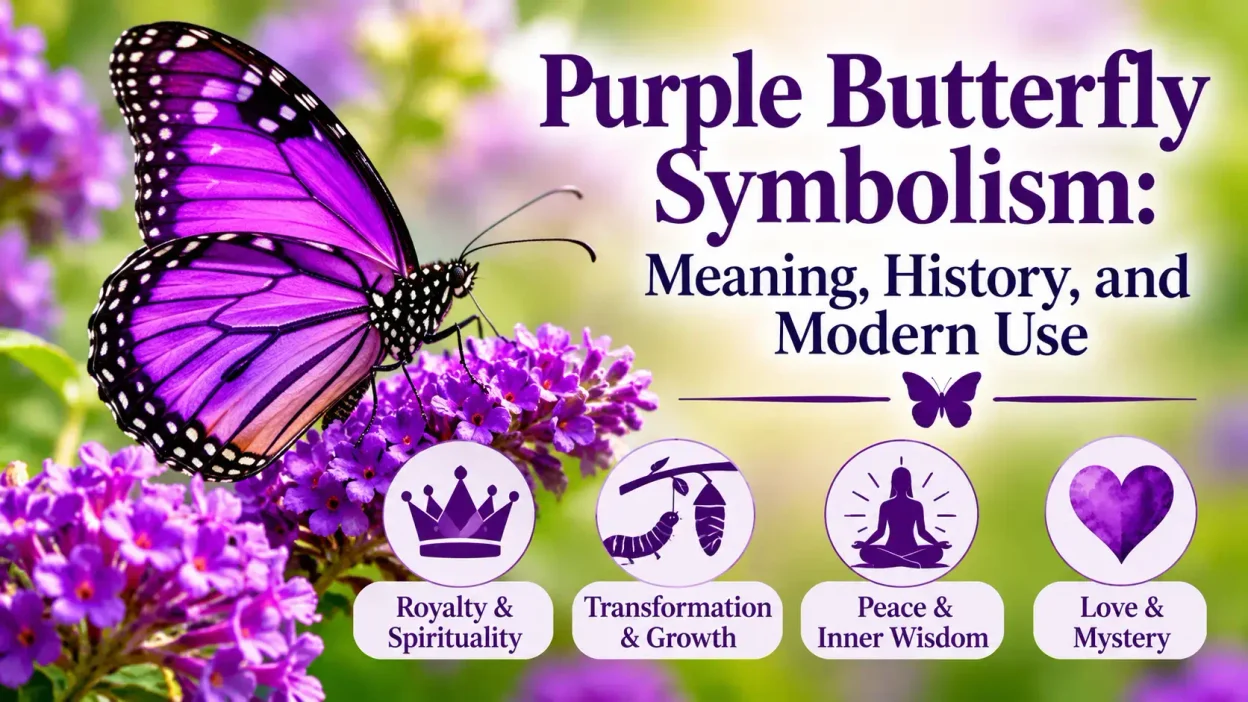
A purple butterfly can refer to an actual butterfly with purple wings or an artistic image combining the insect with the color purple.
In nature, some butterflies display purple or violet coloring, often alongside black, blue, or iridescent markings. The color may appear differently depending on the angle of light, making certain species seem to shift between blue and purple.
In symbolic designs, the butterfly is usually represented with two pairs of wings, a narrow body, and symmetrical patterns. The wings may be solid purple, decorated with floral details, or combined with white, silver, pink, or black.
The design itself can influence interpretation. A delicate purple butterfly with pale wings may suggest gentleness or hope. A darker butterfly surrounded by flowers may communicate remembrance or mourning. A bright, colorful butterfly may emphasize creativity and personal change.
People encounter these designs on tattoos, necklaces, greeting cards, memorial items, clothing, hospital signs, and digital illustrations.
The important distinction is that an image of a purple butterfly does not automatically carry one universal meaning. Its setting and purpose matter.
The Main Symbolic Meanings of a Purple Butterfly
Several meanings commonly overlap when people interpret this symbol.
Transformation and Personal Growth
Transformation is the butterfly’s most familiar association. Its life cycle provides a visible example of change: an egg develops into a caterpillar, the caterpillar enters a chrysalis, and an adult butterfly eventually emerges.
People often connect this process with major changes in their own lives, such as recovering from a difficult experience, leaving an unhealthy relationship, beginning a new career, or developing a stronger sense of identity.
Purple can add a sense of personal significance to that transformation. Rather than simply representing change, a purple butterfly may suggest a change that has involved reflection, emotional maturity, or a renewed understanding of oneself.
For someone who has overcome a difficult period, the image can represent the person they have become rather than only the hardship they experienced.
Hope and New Beginnings
A butterfly’s emergence from its chrysalis makes it a natural image of possibility.
In American culture, butterflies frequently appear in springtime decorations, gardens, greeting cards, and designs celebrating new beginnings. Their movement from one stage of life to another makes them suitable for marking personal milestones.
A purple butterfly may represent hope after a period of uncertainty, especially when the color is paired with lighter shades or a bright background.
However, hope does not always mean that everything will turn out as expected. It can also represent the ability to continue living meaningfully while facing uncertainty.
Remembrance and the Continuing Bond With Someone
Butterflies are frequently used in memorial art because their movement and delicate appearance can suggest the continuing presence of a loved one in memory.
A purple butterfly may appear on a memorial card, a piece of jewelry, or a tattoo honoring someone who has died.
For some people, it represents the belief that a loved one’s spirit continues after death. Others understand it more personally, as a reminder of the person’s influence, personality, or place in their life.
The symbol does not require a religious belief. Someone can use a butterfly to remember a loved one without believing it represents a literal soul.
Spiritual Connection
Purple is often associated with spirituality, contemplation, and the search for meaning. When combined with a butterfly, these associations can produce an image of spiritual development or a connection between physical life and something beyond it.
For some Americans, the symbol suggests the soul’s journey. For others, it represents personal reflection, inner peace, or a growing awareness of life’s larger questions.
These interpretations are personal rather than universal. A purple butterfly is not a formal religious symbol shared by every spiritual tradition.
Why Purple Changes the Meaning of the Butterfly
The butterfly contributes the idea of transformation. Purple changes the emotional character of that transformation.
In many modern American settings, purple is associated with dignity, creativity, individuality, and reflection. It also appears in religious art, ceremonial clothing, memorial designs, and awareness campaigns.
Historically, purple dyes were expensive and difficult to produce. In several societies, purple textiles became associated with wealth, authority, and social distinction. Those associations helped establish the color’s connection with dignity and prestige.
Today, purple is widely available, so its social meaning is no longer limited to wealth or status. It can instead communicate individuality, artistic expression, or a personal connection to spirituality.
The combination of purple and a butterfly therefore offers several possible readings:
- A transformation that has personal or emotional significance.
- A hopeful change accompanied by reflection.
- A spiritual understanding of life’s transitions.
- A memorial image that expresses love and respect.
Purple does not make every butterfly a symbol of grief or spirituality. It gives the image additional associations that can become more important in particular settings.
Ancient Roots: Butterflies and the Soul
The butterfly’s association with the soul has roots in ancient Greek thought.
The Greek word psychē could refer to the soul or life principle, and it was also used for a butterfly or moth. This linguistic connection helped establish a relationship between the insect and ideas about life, death, and the soul’s existence beyond the body.
In Greek and Roman art, butterflies sometimes appeared in funerary settings. The winged figure of Psyche, whose name carried the same association with the soul, became an important artistic representation of this connection.
Yet ancient butterfly symbolism was not limited to the soul. Classical representations also connected butterflies with themes of the body, desire, beauty, and mortality.
The butterfly’s association with death was therefore more complicated than a simple belief that it represented a person’s spirit leaving the body.
Purple was not a necessary part of this ancient symbolism. The historical connection between butterflies and the soul developed independently of the modern purple butterfly image.
This distinction matters because contemporary interpretations often combine older butterfly traditions with more recent ideas about color.
How Purple Acquired Associations With Dignity and Spirituality
Purple’s historical associations developed partly through the materials used to produce it.
In the ancient Mediterranean world, certain purple dyes were obtained from sea snails and required considerable labor to manufacture. The resulting textiles were expensive and could become markers of wealth, authority, and social position.
In later European traditions, purple continued to appear in ceremonial clothing, religious settings, and images of authority. Its associations varied across periods and institutions, but dignity and distinction remained important themes.
Modern Americans encounter purple in many different contexts. It appears in religious art, graduation decorations, memorial designs, fashion, and creative branding.
The color can suggest contemplation or spirituality without communicating a particular religious belief.
When purple is combined with a butterfly, these associations may encourage an interpretation involving personal growth, the soul, or a meaningful life transition.
There is no single historical event that established purple butterfly symbolism as a universal tradition. The modern image brings together several symbolic associations that developed at different times.
What Purple Butterflies Mean in the United States
In the United States, purple butterfly symbolism has several distinct interpretations.
For many people, the first association is personal transformation. A purple butterfly tattoo may represent recovery, a new beginning, or a major change in identity.
In memorial settings, the image can communicate love, remembrance, and the continuing importance of someone who has died.
It also has a more specific meaning in some healthcare environments. Purple butterflies are used to acknowledge the loss of a baby from a multiple birth, and some hospitals use butterfly symbols to communicate that a patient is approaching the end of life.
These healthcare meanings are not interchangeable with the general symbolism of transformation.
A purple butterfly on a hospital door or neonatal cot may communicate information about a family’s circumstances rather than express an individual’s spiritual beliefs.
The meaning also depends on the institution. Hospitals and care facilities may use different symbols, and a butterfly displayed in one setting does not necessarily have the same meaning in another.
For Americans, this makes the purple butterfly an unusually flexible symbol. It can be a private expression of identity, a memorial image, or a practical sign used to encourage compassionate care.
The Purple Butterfly in Infant Loss and Bereavement
One of the most important modern uses of the purple butterfly is its connection with pregnancy and infant loss.
The Purple Butterfly Project began after a mother in the United Kingdom, Mille Smith, lost one of her twin daughters, Skye, while her surviving daughter, Callie, received neonatal care.
Smith wanted a way to acknowledge the baby who had died while also helping hospital staff and other families understand the surviving baby’s circumstances.
A purple butterfly was developed for use on neonatal cots and incubators when a surviving baby had lost a multiple-birth sibling.
The symbol helps communicate that the family has experienced a loss. It can prevent insensitive questions or comments, such as congratulating parents on their twins without knowing that one baby has died.
The choice of purple also allows the symbol to be used without assigning a gender to the baby who died.
The project has spread internationally, including to hospitals in the United States.
For bereaved parents, the symbol can serve several purposes:
- It acknowledges the baby who died.
- It recognizes that the surviving child was part of a multiple birth.
- It helps hospital staff approach the family with greater sensitivity.
- It allows the family to remember the baby without repeatedly explaining the loss.
The purple butterfly is not a replacement for grief support or compassionate communication. It is a visual acknowledgment of an experience that might otherwise remain invisible.
It also does not mean that every purple butterfly represents infant loss. Outside this specific context, the image may have an entirely different purpose.
Purple Butterflies in End-of-Life Care
Some hospitals and care facilities use purple butterfly signs to identify patients who are approaching the end of life.
In these settings, the butterfly may be placed near a patient’s room or bed to alert staff that the patient and family need particular sensitivity.
The sign can encourage staff to respect family wishes, provide appropriate support, and avoid unnecessary interruptions during a difficult time.
Some institutions use the symbol only with the patient’s or family’s agreement.
In this context, the butterfly represents neither a prediction about what will happen nor a general statement about the patient’s spiritual beliefs. It is a practical communication tool connected with compassionate care.
The meaning can differ between hospitals, so visitors should not assume that every purple butterfly sign communicates the same information.
This healthcare use also illustrates an important aspect of modern symbolism: a familiar image can become a shared sign within a specific community, even when its meaning is not widely known outside that setting.
Purple Butterfly Symbolism Across Different Contexts
The following table compares common interpretations of the symbol in the United States.
| Context | Common Meaning | Important Distinction |
|---|---|---|
| Personal growth | Transformation, recovery, new beginnings | Usually reflects an individual’s experience |
| Memorials and tattoos | Remembrance, love, continuing connection | Does not require belief in an afterlife |
| Spiritual art | The soul, reflection, spiritual development | Interpretation depends on personal beliefs |
| Neonatal care | A multiple-birth sibling has died | A specific healthcare communication symbol |
| End-of-life care | A patient and family need sensitive support | Meaning depends on the facility’s policy |
| Fashion and decor | Creativity, individuality, beauty | Often decorative rather than symbolic |
The setting is often the most reliable clue to the intended meaning.
Purple Butterfly Symbolism in Other Cultures
Butterflies appear in many cultural traditions, but their meanings differ.
In some Mexican and Mexican American traditions, butterflies are associated with remembrance and the return of loved ones during Día de los Muertos. Monarch butterflies are especially familiar in these contexts because of their seasonal migration and the cultural traditions connected with them.
This association should not be generalized to every butterfly species or every Mexican family.
In ancient Greek culture, the butterfly’s relationship with the soul developed through language, philosophy, and art. The winged figure of Psyche remains one of the best-known examples.
In some East Asian artistic traditions, butterflies can represent happiness, love, or marital affection. Chinese art, for example, includes butterfly imagery associated with romantic and joyful themes.
These traditions do not establish a universal meaning for purple butterflies. They demonstrate that butterfly symbolism has developed in different directions across cultures.
Purple also has different cultural and religious associations. In some settings, it is associated with authority or religious observance; in others, it may suggest mourning, spirituality, or celebration.
A purple butterfly used in the United States may therefore combine several cultural influences, but its meaning should not be attributed to a particular tradition without evidence.
Emotional and Psychological Meaning
The emotional appeal of a purple butterfly often comes from the contrast between its appearance and the experiences it represents.
Butterflies are delicate, mobile, and visually striking. They can suggest freedom or possibility, but their short adult lives can also remind people of mortality.
Purple adds an emotional tone that may feel reflective, dignified, or personal.
For someone recovering from a difficult experience, the image may represent the ability to move forward without denying the past.
For someone grieving, it may offer a way to remember a loved one while acknowledging that life continues.
For another person, it may simply represent beauty or a connection with nature.
Color psychology can help explain why people associate purple with certain emotions, but it cannot establish what an individual must feel when seeing the color. Personal experiences, cultural background, and the circumstances surrounding the symbol all influence interpretation.
A purple butterfly can be comforting to one person and painful to another, particularly when it is associated with a loss they have experienced.
Its emotional meaning comes from the relationship between the image and the person interpreting it.
Why People Choose Purple Butterfly Tattoos
Purple butterfly tattoos are often chosen to represent an important personal experience.
The butterfly provides a recognizable image of change, while purple can make the design feel more individual or emotionally significant.
Common tattoo meanings include:
Recovery after hardship. The butterfly can represent surviving a difficult period and developing a new understanding of oneself.
Personal identity. Purple may express creativity, individuality, or a connection with spirituality.
Remembrance. A purple butterfly can honor a loved one who has died, particularly when combined with a name, date, or other personal detail.
A new beginning. The image may mark a major life change, such as graduating, ending a relationship, or beginning a new chapter.
The design can also communicate different meanings depending on its details.
A butterfly emerging from a chrysalis emphasizes transformation. A butterfly surrounded by flowers may suggest renewal. A butterfly with a name or date may serve as a memorial.
A purple butterfly tattoo does not have a standardized meaning that can be reliably inferred from the image alone.
It is best understood through the wearer’s own explanation, particularly when the tattoo relates to grief or a significant personal event.
Purple Butterfly Jewelry, Fashion, and Home Decor
Purple butterfly designs appear in jewelry, clothing, accessories, and home decorations.
A necklace or pendant may represent a personal milestone, a loved one, or an interest in nature. Some people choose purple butterfly jewelry as a memorial item, while others wear it because they like the design.
In fashion, the butterfly can suggest movement, individuality, and a playful or artistic style. Purple may make the image more noticeable or give it a more reflective appearance.
In home decor, butterfly artwork is often used in bedrooms, gardens, craft spaces, and areas intended to feel peaceful or uplifting.
A purple butterfly displayed in a memorial garden may have a different purpose from one printed on a decorative pillow.
The same image can therefore function as a personal symbol, a memorial object, or simply an attractive design.
When selecting a purple butterfly item for someone else, context matters. A memorial design may be meaningful to a grieving person, but it may also bring up difficult feelings. It is worth considering the recipient’s preferences rather than assuming the symbol will automatically provide comfort.
Purple Butterflies in Digital Culture and Social Media
On social media, purple butterflies can communicate personal experiences through a small, recognizable image.
People may use them in profile pictures, memorial posts, captions, or illustrations about change and self-discovery.
A purple butterfly emoji or graphic can represent hope, remembrance, or a personal milestone. However, digital meanings are often shaped by the surrounding text and the community using the image.
Some online communities may use purple butterflies as part of a specific awareness campaign or personal tradition. Those meanings should not be assumed to apply across all platforms.
The symbol’s visual simplicity makes it suitable for digital communication, but it can also create ambiguity.
A purple butterfly posted without explanation might refer to a loved one, a new beginning, a healthcare experience, or nothing more than an appreciation of butterflies.
The image alone is not enough to determine someone’s circumstances or emotional state.
Common Misunderstandings About Purple Butterfly Symbolism
Several assumptions can lead to incorrect interpretations of this symbol.
Every Purple Butterfly Represents Death
This is incorrect. Although the purple butterfly has specific meanings in some healthcare and bereavement settings, it is also widely used to represent personal growth, hope, creativity, and remembrance.
The context determines whether the image is connected with death.
Purple Butterflies Have One Universal Spiritual Meaning
There is no single spiritual interpretation shared by all cultures or religions.
Some people associate butterflies with the soul, while others see them as reminders of change or the natural world. Purple adds further associations, but these meanings are not universal.
A Purple Butterfly Is Always a Sign From a Deceased Loved One
Some people interpret seeing a butterfly as a personal reminder of someone who has died. That experience can be meaningful without establishing that the butterfly was sent by the deceased.
There is no reliable evidence that a purple butterfly appearing in nature predicts a particular event or confirms communication with the dead.
The Symbol Always Indicates a Specific Medical Condition
A purple butterfly used in healthcare may communicate a particular circumstance within a hospital’s own system. It does not have one standardized medical meaning across all facilities.
Visitors should follow the guidance provided by the care team rather than interpret the symbol independently.
How Purple Butterfly Symbolism Has Evolved
The meaning of the butterfly has changed as people have used it in different cultural and personal settings.
In ancient Greek and Roman traditions, the butterfly became associated with the soul, death, and other aspects of human existence. Later artistic traditions developed additional connections with mortality, beauty, and the fleeting nature of life.
The color purple developed its own associations with authority, dignity, and spirituality. Modern uses of purple expanded beyond ceremonial and religious settings into fashion, personal expression, and everyday design.
In contemporary American culture, the butterfly is commonly used to express transformation and new beginnings. Purple can make that message more personal or reflective.
The development of the Purple Butterfly Project introduced another meaning: acknowledging the loss of a baby from a multiple birth. Some hospitals also use purple butterfly signs in end-of-life care.
These meanings coexist rather than replacing one another.
The same symbol can represent a new beginning in one person’s life and the memory of someone who has died in another’s. Its meaning is shaped by the history of the image, the setting in which it appears, and the experience of the person using it.
Frequently Asked Questions
What does a purple butterfly symbolize spiritually?
A purple butterfly may represent the soul, spiritual growth, reflection, or a connection with something beyond ordinary life. These interpretations are personal and vary across religious and cultural traditions.
What does a purple butterfly tattoo mean?
A purple butterfly tattoo commonly represents transformation, recovery, individuality, or remembrance. Its exact meaning depends on the wearer’s experience and any additional elements in the design.
Does a purple butterfly symbolize death or a deceased loved one?
It can represent remembrance or the loss of a loved one, particularly in memorial settings. However, purple butterflies also symbolize hope, personal growth, and new beginnings, so death is not their universal meaning.
What does a purple butterfly mean in a hospital?
In some hospitals, a purple butterfly indicates that a baby has lost a multiple-birth sibling or that a patient is approaching the end of life. The precise meaning depends on the healthcare facility and its established practices.
Is a purple butterfly a good or bad symbol?
A purple butterfly is generally associated with positive or reflective meanings, including hope, transformation, and remembrance. Its connection with grief in some settings does not make it a bad symbol.
Does a purple butterfly mean someone is sending a message from heaven?
Some people interpret butterflies as personal reminders of deceased loved ones or signs of spiritual connection. This is a matter of individual belief rather than an established fact.
What is the difference between a purple butterfly and a regular butterfly symbol?
A regular butterfly commonly represents transformation, freedom, and new beginnings. Adding purple may introduce associations with spirituality, dignity, individuality, or remembrance, depending on the context.
Conclusion
Purple butterfly symbolism brings together the butterfly’s familiar association with transformation and the color purple’s connections with reflection, dignity, and spirituality. In modern American culture, the image can represent personal growth, hope, remembrance, or a meaningful life transition.
Its significance is especially important in some healthcare and bereavement settings, where a purple butterfly acknowledges the loss of a baby or communicates the need for sensitive end-of-life care. These specific uses demonstrate how a symbol can become a practical expression of compassion as well as a personal image.
Ultimately, a purple butterfly does not carry one fixed message. Its meaning comes from the history of the image, the circumstances in which it appears, and the experiences of the people who choose to use it.