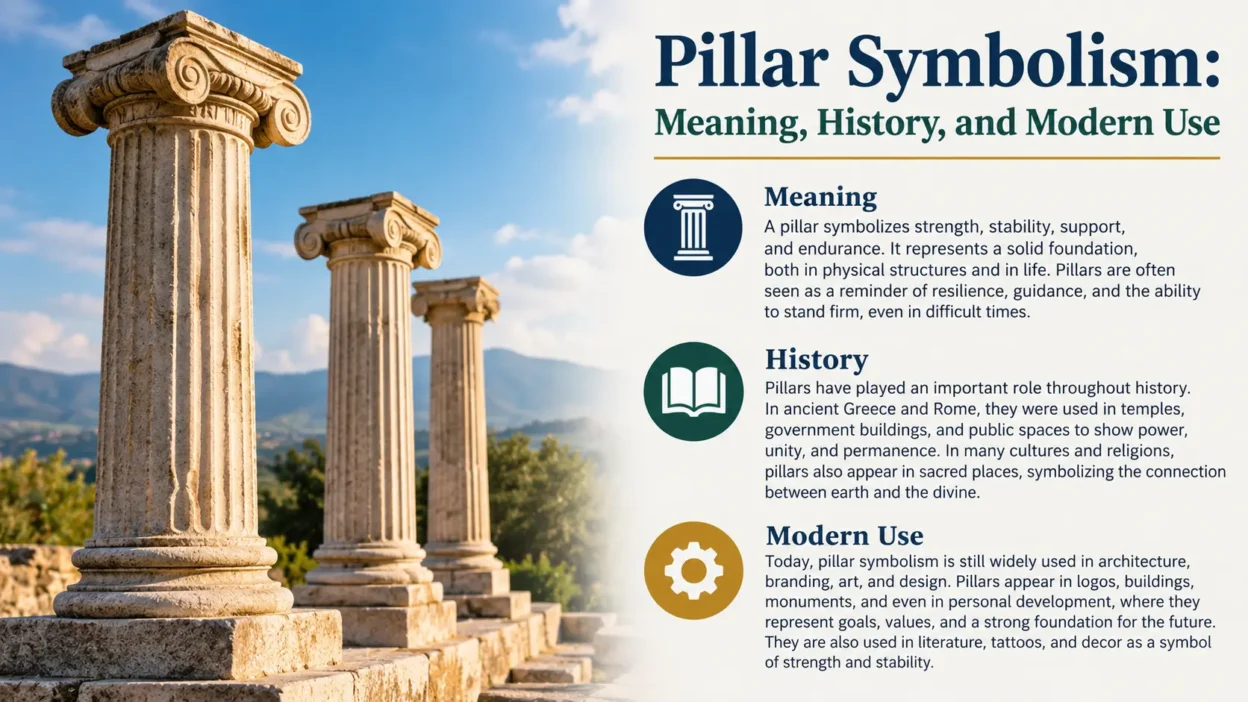
Pillars are among the most recognizable forms in architecture, appearing in temples, government buildings, memorials, homes, churches, and public spaces. Their physical role is straightforward: a column can support weight and help hold a structure in place. Over time, that practical function helped give the pillar symbolic associations with stability, strength, order, and support.
People also use pillars to communicate ideas that have little to do with construction. A row of columns can suggest dignity or civic tradition, while a single memorial column may mark remembrance. In religious settings, pillars can represent spiritual foundations, sacred boundaries, or divine support.
In the United States, pillars are especially familiar because classical architecture became closely associated with public institutions and national monuments. From the Lincoln Memorial to the World War II Memorial, columns and pillars can turn architectural structure into a visual statement about unity, history, sacrifice, and continuity.
Quick Answer
Pillar symbolism commonly represents strength, stability, support, and a firm foundation in modern American culture, especially in architecture, memorials, religion, and personal design. Historically, pillars also carried religious, ceremonial, political, and social meanings, including ideas of sacred order, authority, establishment, and remembrance.
TL;DR
- Pillars commonly symbolize strength, stability, support, and endurance.
- Ancient temples used pillars for both structure and ceremonial display.
- American architecture often connects columns with civic ideals and national history.
- Biblical pillars can represent establishment, strength, sacred space, and witness.
- Broken pillars may symbolize loss, death, destruction, or interrupted continuity.
- Today, pillars appear in tattoos, decor, memorials, jewelry, and digital design.
What a Pillar Represents Symbolically
The simplest symbolic meaning of a pillar comes from what it does. A structural column carries weight and transfers that load toward the ground. Because people can see this relationship between support and stability, pillars naturally became visual metaphors for dependable foundations.
This is why phrases such as “a pillar of the community” describe someone considered reliable or important to a group. The person is not literally holding up a building, but the metaphor suggests that others depend on them.
Pillars can therefore represent:
- Strength
- Stability
- Support
- Reliability
- Endurance
- Foundation
- Order
- Authority
- Continuity
- Protection
The exact meaning depends on the setting. A courthouse with tall classical columns communicates something different from a memorial made of weathered stone pillars.
Ancient Roots and Early Symbolism
Pillars have been used in architecture for thousands of years across the Mediterranean, Near East, and other regions. They could support roofs and entrances, but monumental columns also helped distinguish important buildings from ordinary structures.
In ancient religious architecture, a column could mark an entrance or frame a sacred space. Its height drew the eye upward, while its permanence suggested that the building and the institution connected to it were intended to endure.
Greek and Roman architectural traditions later made columns particularly influential in Western visual culture. The Doric, Ionic, and Corinthian orders developed recognizable proportions and decorative systems that continued to influence European and American architecture centuries later.
This history matters because many modern American buildings use classical columns even when the building itself has no direct connection to ancient religion. The form became a visual language associated with permanence, ceremony, public authority, and tradition.
Pillars in Biblical and Religious Symbolism
Pillars have several important appearances in the Hebrew Bible and later religious interpretation.
One of the best-known examples is the pair of bronze pillars associated with Solomon’s Temple. The biblical account names them Jachin and Boaz. Their precise original function has been debated, and scholars have questioned whether they were structural supports or monumental, freestanding features.
Their names have commonly been interpreted in relation to establishment and strength. Jachin is associated with the idea of establishing or making firm, while Boaz is associated with strength. This pairing helped later readers understand the pillars as more than decorative objects.
The Bible also uses pillar imagery in other ways. A pillar can function as a marker, witness, support, or visible sign of something significant. The imagery of a pillar of cloud and a pillar of fire, for example, connects vertical forms with guidance and divine presence.
These examples show why religious pillar symbolism should not be reduced to one meaning. Depending on the passage or tradition, a pillar can relate to physical support, sacred presence, witness, guidance, authority, or permanence.
What Pillars Symbolize in the United States
In the United States, pillars are strongly connected with public architecture.
Classical columns became common in American civic and institutional buildings, partly because early American architects and designers drew heavily from Greek and Roman architectural traditions. The result was a visual association between columns and ideas such as government, law, education, citizenship, and public responsibility.
This symbolism can be seen in courthouses, capitol buildings, museums, universities, libraries, and memorials.
The Lincoln Memorial offers a particularly clear example. Its 36 Doric columns represented the states in the Union at the time of Lincoln’s death. The architecture therefore turns individual columns into a larger statement about national unity.
The World War II Memorial in Washington, D.C., uses 56 granite pillars to represent the states, territories, and District of Columbia connected to the wartime United States. The pillars are joined visually by a bronze rope, reinforcing the memorial’s theme of national unity.
This is an important distinction: the meaning of a pillar in American public life often comes from the relationship between the pillars, not just from the individual column.
Pillars, Strength, and Stability
Strength is probably the most immediate association people make with a solid stone or architectural pillar.
A pillar looks stable because it is vertical, grounded, and designed to withstand pressure. This makes it an easy visual metaphor for physical and moral strength.
A person may describe a dependable friend as “a pillar of strength.” A community leader may be called “a pillar of the community.” In both cases, the language suggests someone who remains reliable when circumstances become difficult.
The symbolism can also apply to institutions. A legal system, family, community, or organization may be described as resting on certain “pillars.” The metaphor implies that removing those foundations could weaken the larger structure.
This is why pillars frequently appear in logos, organizational identities, and institutional imagery.
Pillars as Symbols of Foundation and Support
A foundation is usually hidden, but a pillar is visible. That difference gives pillars an interesting symbolic role.
They represent support that can be seen.
In personal symbolism, a pillar may represent a person, belief, relationship, or principle that helps someone remain steady. A tattoo of a pillar, for example, could be chosen to represent family support or a commitment to remain dependable.
In organizational language, pillars often describe the main principles supporting a project or institution. A company might refer to its values as its “three pillars,” while an educational institution may organize its mission around several foundational principles.
The image works because the physical metaphor is easy to understand: remove essential support, and the larger structure becomes vulnerable.
Pillars and Authority in American Architecture
Tall columns can also communicate authority.
This is partly a result of historical architectural associations. Important temples, palaces, government buildings, and monuments often received more elaborate architectural treatment than ordinary structures. Over generations, viewers learned to associate monumental scale and classical forms with institutions that carried social importance.
In America, this association appears in government buildings and courthouses that use classical columns at their entrances.
The columns do not automatically prove that an institution is fair, strong, or legitimate. Instead, they create a visual language of seriousness and permanence.
That distinction matters. Symbolism communicates an intended impression; it does not establish whether the institution deserves that impression.
The Symbolism of Two Pillars
Two pillars create meanings that a single pillar may not.
A pair can suggest balance, symmetry, partnership, or a threshold. When two columns stand on either side of an entrance, they frame the transition between one space and another.
This arrangement appears in religious buildings, civic architecture, monuments, and ceremonial entrances.
The biblical Jachin and Boaz provide one of the most influential examples of paired pillars. Their names have been interpreted in connection with establishment and strength, creating a symbolic pairing rather than a single isolated meaning.
Two pillars can also suggest complementary forces. One may represent one side of an idea while the other represents its counterpart. However, claims that every pair of pillars represents a specific cosmic or mystical duality go beyond what can be established from the architectural form alone.
Context determines the interpretation.
Pillars in Freemasonry
Pillar symbolism has a particularly visible role in Freemasonry because Masonic traditions draw extensively on imagery associated with Solomon’s Temple.
The two pillars known as Jachin and Boaz are commonly represented in Masonic symbolism. They connect the lodge environment with the biblical account of the Temple and have acquired additional interpretations within Masonic ritual and teaching.
Masonic interpretations often associate pillars with concepts such as strength, stability, wisdom, moral development, and support. Some traditions also use the pillars to represent complementary principles or the threshold between ordinary and ritual space.
It is important to distinguish this later symbolism from the original biblical account. The modern Masonic interpretation developed over time and should not automatically be treated as the meaning intended by the ancient biblical writers.
Pillars and Memorials in American Culture
Pillars are especially effective in memorial design because they combine permanence with physical absence.
A standing stone structure can suggest that something important continues to be remembered even after the people or events connected to it have passed.
American memorial architecture uses pillars in several ways. They can represent states, groups, military service, victims, communities, or historical events.
The meaning can change dramatically depending on design.
A polished marble column may communicate dignity and continuity. Rough stone pillars may suggest endurance. A broken column may suggest a life cut short or an interrupted history. A group of pillars may represent collective identity rather than individual strength.
The National World War II Memorial demonstrates how repeated pillars can turn architecture into a record of collective participation.
What a Broken Pillar Symbolizes
A complete pillar usually suggests stability. A broken pillar reverses that message.
Broken columns have often been used in memorial and funerary art to suggest death, loss, interruption, or a life that ended before its expected completion.
The symbolism is based on contrast. A pillar is normally expected to stand upright and remain intact. When it is fractured or collapsed, the visual expectation has been violated.
This can make the broken pillar particularly suitable for memorial contexts.
However, a broken pillar does not have one universal meaning. In a contemporary artwork, it might represent political collapse, historical destruction, personal hardship, or the rebuilding of something damaged.
The surrounding imagery determines which interpretation makes the most sense.
Pillar Symbolism in Emotional and Psychological Contexts
People often respond to pillars through familiar ideas about safety and dependence.
A sturdy pillar may evoke feelings of security, reliability, order, and confidence. A damaged pillar can create an opposite emotional response because viewers understand what structural failure could mean.
This makes pillar imagery useful when someone wants to express an identity built around dependability.
A person might choose a pillar tattoo after overcoming a difficult period, not because pillars have a universal psychological meaning, but because the physical metaphor provides a simple way to represent standing firm.
The emotional meaning is therefore personal as well as cultural. The same image can represent family for one person, faith for another, and personal resilience for someone else.
Pillars in Tattoos, Jewelry, and Personal Style
Pillar imagery appears in tattoos and decorative objects because the form is visually simple and easy to personalize.
A tattoo may show:
- A single classical column
- Two temple pillars
- A broken pillar
- A pillar supporting an arch
- A pillar combined with flowers
- A pillar paired with religious imagery
- Jachin and Boaz
- A minimalist geometric column
A complete pillar can suggest stability or personal foundations. A broken one can represent survival after loss or a disrupted period of life. Two pillars may represent a relationship, family members, complementary values, or a personal balance.
There is no universal tattoo dictionary that determines what a pillar tattoo must mean. The owner’s story and accompanying symbols often matter more than the object alone.
How Pillars Appear in Modern Design and Digital Culture
Modern designers continue to use pillars because their shape communicates structure quickly.
A logo containing columns may suggest tradition, education, law, architecture, heritage, or institutional authority. A digital illustration may use simplified pillars to represent foundations or major principles.
Social media graphics sometimes use classical columns to create an antique or formal aesthetic. Fashion and interior design may use column shapes simply for visual symmetry rather than symbolism.
This is an important feature of modern symbolism: not every use is symbolic in a serious cultural sense. Sometimes a pillar is chosen because it looks elegant, balanced, or architectural.
Common Pillar Meanings by Context
| Context | Meaning in the USA | Common Associations | Notes |
|---|---|---|---|
| Government buildings | Authority and permanence | Law, citizenship, tradition | Often uses classical architecture |
| Memorials | Remembrance and continuity | Service, sacrifice, history | Meaning depends on the monument |
| Religious settings | Foundation and sacred order | Faith, worship, divine support | Traditions vary by religion |
| Tattoos | Personal stability | Family, resilience, values | Highly individual |
| Interior design | Elegance and structure | Symmetry, heritage, formality | May be decorative rather than symbolic |
| Freemasonry | Strength and moral foundations | Jachin, Boaz, Temple symbolism | Specific meanings come from Masonic tradition |
Cross-Cultural Meanings of Pillars
Pillars appear across many cultures, but their meanings are not identical.
In classical Greek and Roman architecture, columns became central elements of monumental building traditions. Different architectural orders developed recognizable proportions and decorative features.
In ancient Near Eastern religious architecture, monumental pillars could mark important spaces and entrances. The biblical Temple tradition later gave paired pillars an influential religious history.
In South Asian architecture, columns have also served structural, decorative, and religious functions across different periods and traditions. Their symbolic meanings vary according to the building and religious context.
In East Asian architecture, posts and columns have long been essential structural elements, although their symbolism should not simply be interpreted through Western classical ideas.
The safest approach is to treat the pillar as a broad architectural form whose meaning changes with culture, period, material, placement, and purpose.
Common Misunderstandings About Pillar Symbolism
One common mistake is assuming that every pillar represents strength. Sometimes a column is simply structural.
Another mistake is treating modern interpretations as ancient facts. A symbolic meaning developed by a later religious, artistic, or fraternal tradition may be important, but it should not automatically be projected backward onto the original culture.
The same problem occurs with claims that every pillar represents a specific masculine and feminine principle, a particular spiritual energy, or a hidden ancient code. Some traditions genuinely use such interpretations, but they belong to those traditions rather than being universal facts about pillars.
Pillar symbolism is most accurately understood by asking three questions: Where is the pillar? What surrounds it? What purpose does the structure serve?
How Pillar Meaning Has Changed Over Time
The physical function of pillars has remained relatively stable, but their symbolic uses have expanded.
Ancient builders used columns as structural and monumental elements. Religious traditions connected them with sacred spaces, establishment, witness, and divine order. Classical architecture turned columns into recognizable systems of proportion and decoration.
European architectural traditions carried those forms forward, and American architects later adopted classical designs for government buildings, universities, monuments, and memorials.
Today, the pillar can operate on several levels at once. It may be an actual structural component, a reference to classical architecture, a memorial device, a religious image, or a metaphor for personal reliability.
Its meaning has therefore become more flexible rather than disappearing.
Frequently Asked Questions
What does a pillar symbolize spiritually?
A pillar can symbolize spiritual foundation, stability, divine support, sacred order, or a connection between earthly and sacred space. The specific interpretation depends on the religious tradition and the setting in which the pillar appears.
What does a pillar tattoo mean?
A pillar tattoo can represent stability, family support, personal values, resilience, or a strong foundation. A broken pillar may instead represent loss, hardship, or a major interruption in someone’s life.
What do two pillars symbolize?
Two pillars can symbolize balance, partnership, stability, or a threshold between spaces. In specific religious and Masonic traditions, named pillars such as Jachin and Boaz have additional established meanings.
What does a broken pillar symbolize?
A broken pillar commonly represents loss, death, destruction, interrupted continuity, or a life cut short. In modern artwork, it can also represent political or personal collapse and the possibility of rebuilding.
Why are pillars common on American government buildings?
Classical columns became associated with public institutions, civic authority, permanence, and historical tradition. Their widespread use in American government architecture reflects the country’s long engagement with Greek and Roman architectural models.
Are pillars always symbols of strength?
No. Pillars are often simply structural or decorative elements. Their symbolic meaning depends on context, especially their location, condition, arrangement, inscriptions, and relationship to the surrounding building.
What are Jachin and Boaz?
Jachin and Boaz are the names given in the Hebrew Bible to two bronze pillars placed at the entrance of Solomon’s Temple. Their names are commonly associated with establishment and strength, and later Jewish and Masonic traditions developed additional interpretations around them.
Conclusion
Pillar symbolism is closely connected to the physical qualities of the pillar itself. Because pillars support structures and remain firmly grounded, they naturally became symbols of strength, stability, support, foundation, and continuity.
In American culture, those meanings are especially visible in civic architecture, memorials, religious buildings, and personal design. A pillar can represent a nation held together by many parts, a person who supports others, a spiritual foundation, or a memory preserved through architecture.
The most accurate interpretation depends on context. A pillar is not locked into one universal meaning, and its symbolism becomes clearer when its history, placement, design, and surrounding imagery are considered together.