
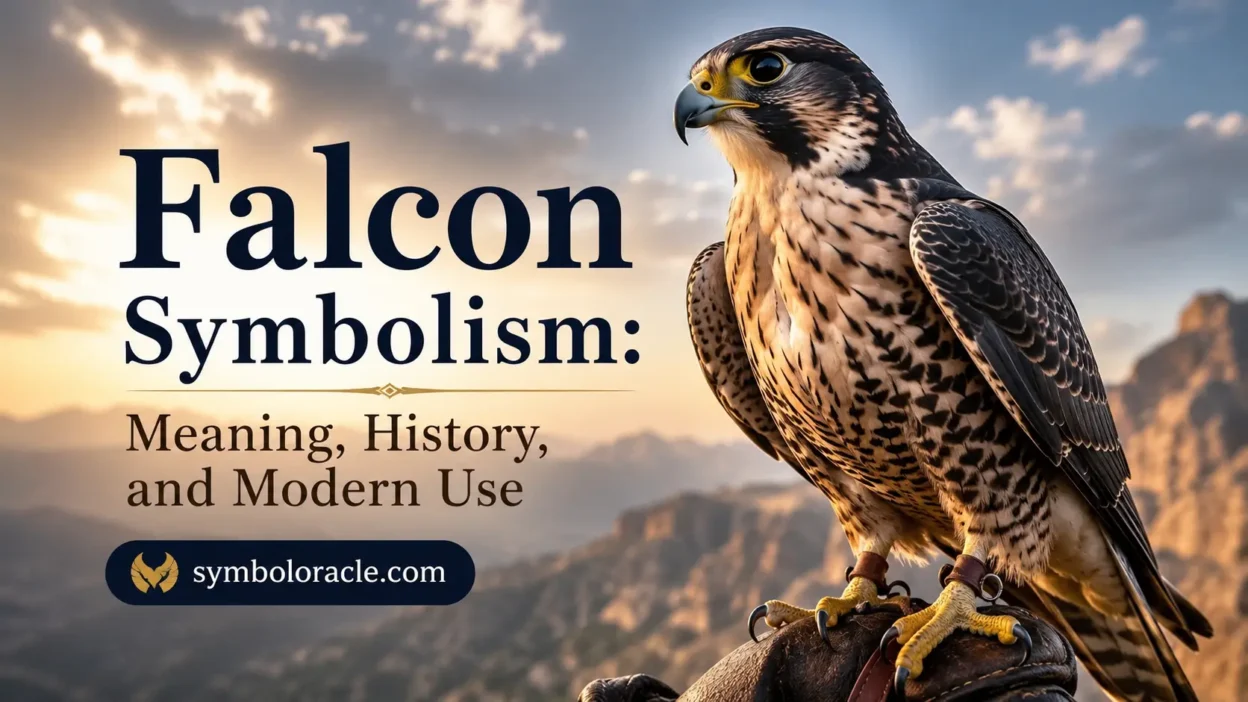
Falcons have captured human attention for thousands of years because of their extraordinary speed, sharp eyesight, and remarkable hunting abilities. Today, falcon symbolism often represents focus, freedom, ambition, leadership, and clear vision. Whether seen soaring overhead, featured in a school mascot, or chosen as a tattoo, the falcon continues to communicate ideas that people recognize almost instantly.
In the United States, falcons are admired not only as birds of prey but also as symbols of excellence, determination, and independence. Their image appears in sports, military traditions, conservation efforts, and popular culture, giving them meanings that extend well beyond nature.
Unlike mythical creatures whose symbolism depends largely on legend, the falcon’s reputation comes from observable behavior. Its speed, precision, and intelligence have inspired symbolic interpretations across civilizations while remaining relevant in modern life.
Quick Answer
Falcon symbolism most commonly represents focus, freedom, confidence, and decisive action in modern American culture. Historically, falcons also symbolized royal authority, divine protection, skilled leadership, and the ability to see opportunities before others.
TL;DR
- Represents focus, vision, and determination.
- Rooted in ancient hunting and royal traditions.
- Symbolizes independence in modern America.
- Popular in tattoos, sports, and military imagery.
- Different cultures emphasize different symbolic qualities.
- Often reflects ambition balanced with discipline.
What a Falcon Is and Why People Notice It
Falcons belong to a group of birds of prey known for incredible speed and precision. The peregrine falcon, for example, is widely recognized as the fastest animal on Earth during its hunting dive, reaching speeds well over 200 miles per hour.
Physically, falcons are compact birds with pointed wings, powerful talons, and exceptional eyesight. Unlike larger eagles that rely on strength, falcons often rely on speed, timing, and accuracy.
These natural characteristics explain why people consistently associate falcons with intelligence rather than brute force. Their symbolism comes from observable behavior rather than imagination alone.
People encounter falcons in wildlife, conservation programs, educational institutions, sports logos, aviation imagery, and wildlife photography. Even those who have never seen one in person usually recognize the bird as a symbol of skill and excellence.
The Core Meaning of Falcon Symbolism Today
In contemporary American culture, the falcon represents several closely connected ideas.
First, it symbolizes clear vision. Falcons can detect prey from remarkable distances, making them a natural emblem for seeing possibilities that others miss.
Second, it represents focus. Rather than chasing everything at once, a falcon concentrates on one objective before acting.
Third, it symbolizes swift action. The bird waits patiently, then moves with extraordinary speed when the right opportunity appears.
Finally, the falcon represents self-confidence. It acts independently, relying on its own abilities rather than the protection of a group.
Together, these qualities explain why businesses, athletic teams, schools, and military organizations frequently adopt the falcon as their emblem.
Ancient Roots of Falcon Symbolism
Long before modern wildlife science, ancient societies noticed the falcon’s remarkable abilities.
Because it flew high above the landscape while maintaining sharp awareness of what happened below, many early civilizations viewed it as a messenger between heaven and earth. Its ability to dominate the sky without appearing chaotic suggested order, authority, and control.
Falconry—the practice of training falcons to hunt alongside humans—also contributed to symbolic meaning. Developing a successful partnership required patience, discipline, and mutual trust. As a result, falcons became associated with wisdom, skill, and responsible leadership rather than simple aggression.
Over time, these practical observations blended with mythology, religious beliefs, and royal traditions, creating symbolic meanings that spread across continents.
Falcons in Ancient Egypt and Other Early Civilizations
Few cultures connected themselves to the falcon as strongly as ancient Egypt.
The falcon became associated with divine kingship and protection because its commanding flight reflected ideals of watchfulness and authority. Egyptian rulers often linked themselves with falcon imagery to express legitimate leadership and the responsibility to maintain order.
Elsewhere in the ancient world, falcons appeared in hunting traditions and royal courts. Their rarity, intelligence, and usefulness made them valuable companions for nobles and rulers.
Unlike symbols based purely on mythology, the falcon’s cultural importance grew from both practical experience and spiritual interpretation.
Falcon Symbolism in Medieval Europe
During the Middle Ages, falconry became one of Europe’s most respected aristocratic pursuits.
Owning and training a falcon required considerable resources and expertise. Because of this, the bird became closely associated with noble status, education, and refined discipline.
Medieval literature often portrayed falcons as symbols of:
- Honor
- Loyalty
- Noble conduct
- Strategic thinking
- Courage under pressure
Rather than representing uncontrolled strength, the falcon symbolized controlled excellence—using ability wisely instead of recklessly.
What the Falcon Symbolizes in the United States
Modern American interpretations emphasize achievement through discipline.
People often associate falcons with:
- Independence
- Personal ambition
- Competitive excellence
- Sharp decision-making
- Leadership earned through ability
This symbolism appears throughout American society.
Schools choose falcons as mascots because they represent academic and athletic excellence.
Military organizations value the bird’s precision, awareness, and discipline.
Businesses sometimes use falcon imagery to suggest innovation, speed, and strategic thinking.
Wildlife organizations also promote the falcon as a conservation success story, particularly after peregrine falcon populations recovered following environmental protection efforts.
Unlike symbols connected primarily to wealth or authority, the falcon often represents earned success through preparation and skill.
Falcon Symbolism Across Different Cultures
Although many cultures admire falcons, they do not always emphasize the same qualities.
| Cultural Context | Meaning in the USA | Common Associations | Notes |
| Modern America | Focus and achievement | Leadership, independence | Common in sports and education |
| Ancient Egypt | Divine authority | Protection, kingship | Linked with sacred rulership |
| Medieval Europe | Noble discipline | Honor, falconry | Associated with aristocracy |
| Middle Eastern traditions | Skilled partnership | Hunting, respect | Falconry remains culturally significant |
| East Asian interpretations | Observation and strategy | Awareness, patience | Often admired for precision |
Despite these differences, nearly every tradition respects the falcon’s intelligence and exceptional hunting ability.
Emotional and Psychological Meaning
Psychologically, the falcon represents mental clarity.
People who identify with falcon symbolism often value:
- Independent thinking
- Self-control
- Confidence
- Patience before action
- Long-term goals
Unlike symbols that encourage constant activity, the falcon reminds people that careful observation often matters more than immediate movement.
Its behavior reflects an important lesson: waiting for the right opportunity is not the same as doing nothing.
This perspective makes the falcon appealing to people pursuing careers, education, entrepreneurship, or personal growth.
Falcon Symbolism in Religion and Spiritual Traditions
Religious interpretations differ across traditions, but several common themes appear repeatedly.
Because falcons soar high above the earth, they have often symbolized perspective, guidance, and closeness to the heavens.
In ancient Egypt, the bird represented divine kingship and protective authority.
In some later spiritual traditions, falcons became symbols of vigilance, wisdom, and moral awareness rather than supernatural power.
Modern spiritual interpretations frequently describe the falcon as encouraging thoughtful decision-making, disciplined action, and attention to life’s opportunities. These ideas generally reflect symbolic interpretation rather than formal religious doctrine.
Why Falcons Appear in Tattoos, Jewelry, and Personal Style
Falcon imagery has become increasingly popular in personal expression.
Tattoos commonly represent:
- Personal freedom
- Determination
- Career ambition
- Recovery after setbacks
- Confidence
- Independence
Jewelry featuring falcons often emphasizes elegance, resilience, or leadership rather than luxury alone.
In fashion and graphic design, stylized falcons communicate speed, precision, and modern sophistication. Their streamlined silhouette naturally fits logos, athletic branding, and minimalist artwork.
Because the bird carries widely recognized meanings without being overly common, many people see it as both distinctive and timeless.
Falcons in Sports, Aviation, and Popular Culture
The falcon’s natural abilities make it an ideal symbol for competitive environments.
Sports teams adopt falcon mascots because they represent speed, accuracy, teamwork, and determination.
Military aviation frequently uses birds of prey, including falcons, to express precision, situational awareness, and technical excellence.
In films, novels, and video games, falcons often accompany characters known for intelligence, independence, or strategic thinking rather than overwhelming physical strength.
These modern uses reinforce symbolic meanings that have existed for centuries while introducing them to new audiences.
Common Misunderstandings About Falcon Symbolism
Several misconceptions surround the falcon.
One common misunderstanding is that falcons symbolize aggression. In reality, their symbolism emphasizes controlled precision rather than violence. They hunt efficiently because survival requires accuracy, not unnecessary conflict.
Another misconception is that falcons represent solitude alone. Although they hunt independently, falconry demonstrates their ability to form cooperative relationships with skilled human handlers.
Some people also confuse falcons with hawks or eagles. While these birds share certain symbolic qualities, each has developed its own cultural identity. Eagles often represent national strength and authority, hawks symbolize awareness and vigilance, while falcons are more closely associated with speed, focus, and disciplined execution.
How Falcon Symbolism Has Changed Over Time
The meaning of the falcon has gradually evolved alongside society.
In ancient civilizations, it primarily reflected divine authority and royal legitimacy.
During the medieval period, it became a symbol of noble education and disciplined hunting.
By the nineteenth and twentieth centuries, interest shifted toward wildlife appreciation and conservation.
Today, Americans are more likely to associate the falcon with personal achievement, resilience, strategic thinking, and environmental stewardship than with royalty.
This evolution illustrates how symbols adapt while preserving their core characteristics. The falcon still represents exceptional ability, but modern culture places greater emphasis on individual accomplishment than inherited status.
Falcon Symbolism in Everyday Life
Many people encounter falcon symbolism without consciously thinking about it.
It appears in:
- School mascots
- Corporate branding
- Outdoor recreation
- Wildlife conservation campaigns
- Clothing and accessories
- Military insignia
- Athletic competitions
- Nature documentaries
- Digital artwork and social media
Its continued popularity reflects qualities that remain widely admired: intelligence, preparation, confidence, and purposeful action.
Rather than belonging to one religion or culture, the falcon has become a broadly recognized symbol that adapts easily to contemporary life.
Frequently Asked Questions
What does a falcon symbolize spiritually?
Spiritually, the falcon is often associated with awareness, clear judgment, and disciplined action. Many modern interpretations see it as a reminder to observe carefully before making important decisions rather than acting impulsively.
Is a falcon a positive symbol?
Yes. Across most cultures, falcons are viewed positively because they represent intelligence, focus, courage, and competence. Negative interpretations are relatively uncommon and usually relate to the bird’s role as a predator rather than its symbolic meaning.
What does a falcon tattoo mean?
A falcon tattoo commonly symbolizes independence, ambition, resilience, and confidence. Some people also choose it to represent overcoming challenges through patience and skill instead of force.
How is falcon symbolism different from eagle symbolism?
Both birds symbolize leadership, but they emphasize different qualities. Eagles usually represent authority, national identity, and strength, while falcons more often symbolize precision, speed, strategic thinking, and focused determination.
Does the falcon have religious significance?
Yes. Ancient Egyptian religion gave the falcon an important sacred role connected with kingship and protection. In other traditions, the bird has symbolized vigilance, wisdom, and elevated perspective rather than serving as a central religious figure.
Why do so many schools and sports teams use falcons?
Falcons naturally represent excellence under pressure. Their speed, intelligence, and precision make them effective symbols for organizations that value discipline, teamwork, preparation, and achievement.
Conclusion
The enduring appeal of the falcon comes from qualities people can easily recognize in the natural world. Its remarkable vision, extraordinary speed, and disciplined hunting style have inspired symbolic meanings that span ancient civilizations, medieval traditions, and modern American culture.
Today, falcon symbolism most often reflects focus, independence, strategic thinking, and earned success. While interpretations have evolved over time, the bird continues to remind people that lasting achievement is often built on patience, preparation, and the confidence to act when the moment is right.