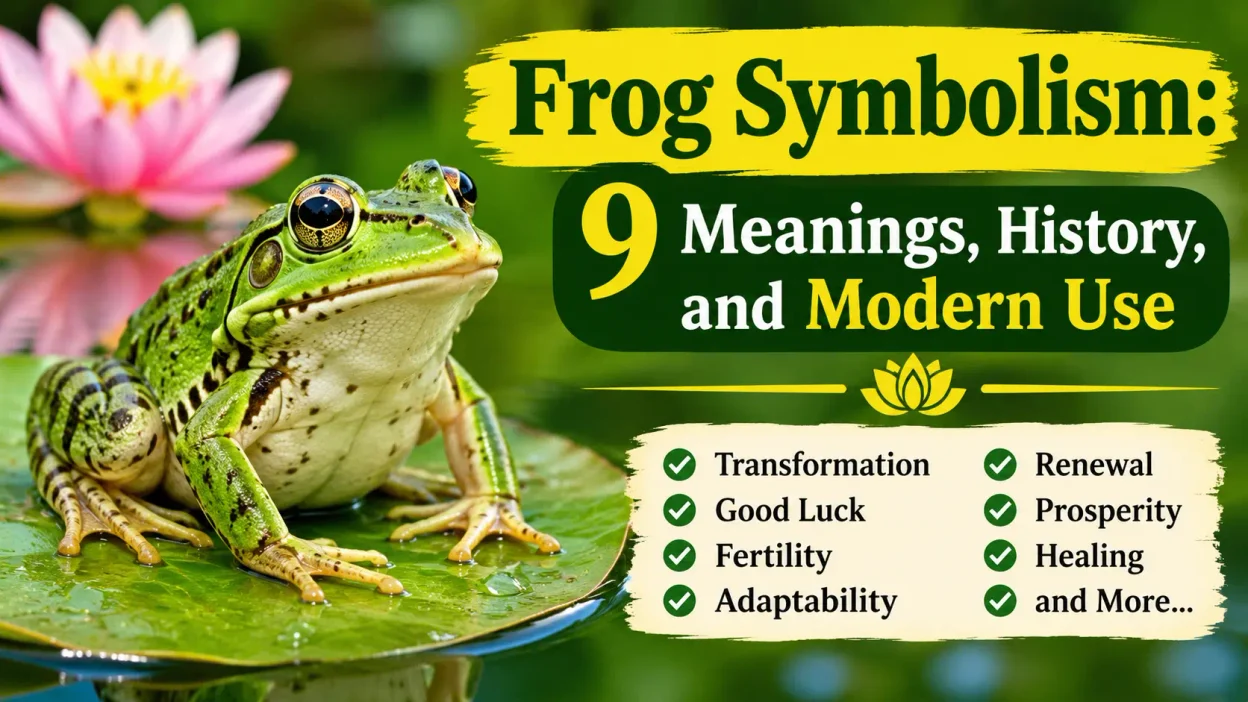
A frog is often associated with transformation, renewal, fertility, and good fortune. In frog symbolism, this small amphibian represents the ability to adapt to change, move between different environments, and begin a new stage of life. Its connection to water, seasonal rainfall, and the natural cycle of growth has also made it an important figure in folklore and religious traditions.
People encounter frog imagery in many places, including jewelry, tattoos, garden decorations, children’s stories, artwork, and spiritual objects. Some see a frog as a reminder to welcome change, while others associate it with prosperity, emotional growth, or a connection to nature.
Its meaning is not identical across cultures. Ancient Egyptians connected frogs with birth and regeneration, Japanese traditions associate them with safe returns and good fortune, and European folklore sometimes presents them as creatures of enchantment or transformation. Understanding these different interpretations helps explain why frogs continue to appear in modern American art and everyday life.
Quick Answer
Frog symbolism commonly represents transformation, renewal, fertility, adaptability, and good luck in modern American culture. Historically, frogs were connected with life-giving water, agricultural abundance, birth, and regeneration, while different cultures developed their own beliefs about their protective and spiritual significance.
TL;DR
- Transformation: Metamorphosis represents personal growth and major life changes.
- Renewal: Frogs are associated with fresh beginnings and regeneration.
- Fertility: Their connection to water and reproduction links them with abundance.
- Good fortune: Japanese and Chinese traditions associate frogs with luck and prosperity.
- Adaptability: Their ability to live in water and on land suggests flexibility.
- American culture: Frogs appear in folklore, gardens, tattoos, literature, and environmental imagery.
1. What Frogs Represent in Symbolism
Frogs carry several meanings because of their unusual life cycle, habitat, and behavior. Unlike animals that remain in one environment, frogs begin life in water and eventually develop the ability to live on land. This natural change has influenced how people interpret them.
The most common symbolic associations include:
- Transformation: A tadpole develops into an adult frog, making the animal an image of personal development.
- New beginnings: Its life cycle suggests moving beyond an earlier stage and starting again.
- Fertility: Frogs reproduce in water and can appear in large numbers during breeding seasons.
- Prosperity: Their association with rain, crops, and fertile land connects them with abundance.
- Adaptability: Their ability to function in aquatic and terrestrial environments suggests flexibility.
- Protection: Some cultural traditions treat frog figures as good-luck charms or protective objects.
These meanings are related, but they are not interchangeable. A frog used in a garden design may represent nature and rainfall, while one carried as a charm may communicate a wish for good fortune.
2. The Physical Characteristics Behind Frog Symbolism
A frog’s appearance helps explain why people have assigned it so many different meanings.
Its rounded body, prominent eyes, strong hind legs, and ability to jump make it visually recognizable. Its movement is especially significant. A frog does not walk steadily like many mammals; it moves through sudden jumps, often disappearing into water or vegetation.
This behavior can suggest:
- Taking a leap toward an opportunity.
- Moving forward despite uncertainty.
- Leaving an uncomfortable situation.
- Approaching change with flexibility.
The frog’s skin and habitat also matter. Many species depend on moist environments, ponds, wetlands, and streams. Their presence can reflect the condition of nearby ecosystems, making them useful symbols of environmental health.
Their physical transformation provides another important association. A tadpole has a tail and lives in water, while an adult frog develops legs and undergoes major anatomical changes. This visible development gives the animal a natural connection to growth and transition.
3. Ancient Egyptian Beliefs About Frogs and Rebirth
Ancient Egypt provides one of the clearest historical examples of positive frog symbolism.
The annual flooding of the Nile supported agriculture and renewed the surrounding land. After floodwaters receded, frogs became abundant in the wet soil and shallow water. Their sudden appearance made them closely associated with fertility, life, and regeneration.
The connection also appeared in Egyptian religion through Heqet (also spelled Heket), a goddess associated with childbirth and fertility. She was represented as a frog or as a woman with a frog’s head.
Frog-shaped amulets were made and worn for protection, fertility, and safe childbirth. Some were also connected with the hope of rebirth after death.
This historical example explains why frogs became associated with more than reproduction. In Egyptian thought, the animal could represent the continuation of life and the possibility of renewal.
The distinction is important: these beliefs belonged to a particular religious and agricultural setting. They should not be treated as universal beliefs shared by every ancient civilization.
4. Water, Rain, and Agricultural Abundance
Water is one of the strongest connections in frog symbolism.
Frogs depend on suitable moisture and aquatic habitats for important stages of their lives. Their calls often become noticeable during rainy periods, and many species gather around temporary pools when breeding conditions are favorable.
For farming communities, rainfall meant more than a change in weather. It supported crops, replenished water supplies, and helped maintain the natural resources people depended on.
This relationship encouraged associations between frogs and:
- Rain arriving after dry weather.
- Healthy crops and productive soil.
- The return of seasonal growth.
- The replenishment of rivers and ponds.
- Natural abundance and survival.
Some traditional Maya accounts connect frogs with the coming of rain and agricultural activity. In these settings, frogs were understood within a wider relationship between weather, farming, and community life.
For modern readers, this symbolism can represent a period when conditions finally become favorable after a difficult or unproductive stage.
5. Frog Symbolism in American Culture
In the United States, frogs have a broad range of meanings rather than one fixed cultural interpretation.
Many Americans first encounter frog imagery through children’s books, cartoons, fairy tales, toys, and nature education. These familiar experiences often give frogs a friendly, playful, or adventurous personality.
Other interpretations come from folklore, religion, gardening, environmental awareness, and personal beliefs.
Several American contexts are especially relevant:
Nature and environmental awareness: Frogs are frequently used in educational materials about wetlands, pollution, biodiversity, and conservation. Their sensitivity to environmental changes makes them recognizable representatives of healthy ecosystems.
Gardens and outdoor decoration: Frog statues, stepping stones, fountains, and ornaments often communicate a love of nature. A frog beside a pond may simply reflect the wildlife that belongs in that setting.
Children’s entertainment: Animated frogs and fictional characters make the animal approachable. They are often portrayed as clever, funny, curious, or capable of surprising transformations.
Personal growth: Some Americans use frog imagery to represent a fresh start, especially after a major change in relationships, work, or personal circumstances.
Good fortune: Frog figurines and decorative objects are sometimes given as gifts to express hopes for prosperity, happiness, or positive change.
In American culture, the meaning usually depends on where the image appears and what the person using it intends to communicate.
6. Frog Symbolism in Different Cultures
Frogs have appeared in different cultural traditions, but their meanings vary considerably.Japan: Safe returns and good fortune
In Japanese, the word kaeru means frog and is also associated with the verb meaning to return. This wordplay has helped make frog figures popular as charms for travelers hoping to return home safely.
Frog ornaments can also represent the return of money, happiness, or something previously lost. At some Japanese shrines, frog figures are connected with religious traditions and local deities.
China: Wealth and prosperity
Chinese decorative traditions include the three-legged money frog, often called Jin Chan or Chan Chu. It is commonly shown with coins and is associated with wealth, financial opportunity, and prosperity.
This figure is especially recognizable in some feng shui arrangements. Its placement and the traditions surrounding it vary, so it should not be confused with the symbolism of every ordinary frog image.
Mesoamerica: Rain and agriculture
Some ancient Maya traditions associated frogs and toads with rainfall and agricultural fertility. Their calls and seasonal appearances connected them with the natural conditions needed for crops to grow.
Indigenous traditions of the American Southwest
Frog and tadpole imagery appears in some Pueblo artistic traditions. Historical descriptions of Zuni pottery, for example, connect tadpole imagery with spring rains and frogs with later seasonal rainfall. Such interpretations are specific to particular cultural objects and traditions, not a universal Native American belief.
Mesopotamia: Life and fertility
Frogs were also associated with fertility and life-giving water in ancient Mesopotamian traditions. Their presence around the Tigris and Euphrates helped connect them with the rivers that supported agricultural communities.
These examples show that the same animal can communicate different ideas depending on a community’s environment, religious traditions, and history.
7. Frog Symbolism in Christianity and the Bible
Christian interpretations of frogs are more complicated than the positive associations found in some other traditions.
In the Book of Exodus, frogs form the second plague sent upon Egypt. They spread throughout the land and entered homes, creating an overwhelming disturbance. Within this biblical narrative, they represent divine judgment and the consequences of Pharaoh’s refusal to release the Israelites.
Frogs also appear in Revelation 16:13, where three frog-like spirits emerge from the mouths of the dragon, the beast, and the false prophet. In that passage, they are associated with deceptive spiritual influences.
These passages explain why frogs sometimes appear in Christian discussions of impurity, disorder, and evil.
However, the Bible does not establish that every frog represents something sinful or harmful. The meaning comes from the particular passages in which the animal appears.
This distinction matters when interpreting modern artwork or decorative objects. A frog statue does not automatically communicate a biblical warning or religious message.
8. Transformation and the Meaning of Personal Growth
The frog’s development from tadpole to adult is one of the clearest natural examples of transformation.
A tadpole does not simply become a larger version of itself. Its body changes substantially. It develops legs, loses its tail, and gradually adapts to a different way of living.
This makes the frog a useful symbol for personal transitions such as:
- Moving from childhood into adulthood.
- Beginning a new career after years in another profession.
- Recovering confidence after a difficult experience.
- Adjusting to a new relationship or family situation.
- Developing a different understanding of personal identity.
The transformation does not happen instantly. It involves several stages, and each stage has a different purpose.
For someone experiencing a major life change, a frog can represent the idea that development takes time. An earlier version of yourself does not have to determine what comes next.
9. Emotional and Psychological Meaning
Frogs can communicate different emotions depending on the situation and the individual viewing them.
Their playful appearance often creates feelings of curiosity and amusement. Their association with ponds, rainfall, and green landscapes can also suggest calmness and a connection with the natural world.
Several emotional associations are particularly common.
Hope: A frog emerging after rainfall can suggest that favorable conditions are returning after a difficult period.
Courage: Its sudden jumps can represent the willingness to take a chance rather than remain in a familiar situation.
Patience: The gradual development from tadpole to adult reflects the time required for meaningful change.
Acceptance: The frog’s ability to live in different environments can represent adjusting to circumstances without losing one’s sense of identity.
Freedom: Its movement between water and land can suggest independence and the ability to explore different possibilities.
These are interpretations rather than established psychological rules. A person who dislikes frogs may associate them with discomfort instead of hope or happiness.
The emotional meaning of an animal symbol depends partly on personal memories and experiences.
10. Frog Symbolism in Literature and Folklore
Frogs have played memorable roles in European fairy tales, fables, and literary works.
One familiar example is the Frog Prince, best known through the Brothers Grimm collection. In the story, an enchanted prince takes the form of a frog and eventually returns to human form.
The story has influenced modern interpretations of frogs as symbols of hidden potential, transformation, and unexpected beauty.
The frog’s outward appearance does not reveal its complete identity. This makes it useful in stories about looking beyond first impressions.
Frogs also appear in Aesop’s fables. In The Frogs Who Desired a King, a group of frogs asks Zeus for a ruler. The story becomes a warning about demanding a change without considering its consequences.
These literary traditions create two different interpretations:
- The fairy-tale frog represents transformation and the discovery of unexpected qualities.
- The fable frog represents collective behavior, poor judgment, and the consequences of dissatisfaction.
In American popular culture, these stories continue through children’s books, animated films, classroom activities, and adaptations of traditional fairy tales.
11. What Different Frog Colors Can Represent
Frog colors can add another layer of meaning, especially in tattoos, artwork, illustrations, and decorative objects.
However, color interpretations are usually based on general cultural associations rather than a universal symbolic system.
| Frog color | Common symbolic association | Possible interpretation |
|---|---|---|
| Green | Nature, growth, renewal | Personal development and environmental connection |
| Yellow | Happiness, optimism, warmth | A cheerful outlook and positive change |
| Blue | Calmness, trust, peace | Emotional balance and thoughtful decisions |
| Red | Passion, courage, vitality | Taking action and embracing opportunities |
| Black | Mystery, protection, change | Facing uncertainty or an important transition |
| White | Simplicity, peace, purity | A fresh start or a desire for clarity |
Green is particularly recognizable because it is associated with vegetation, spring, and the natural environments where many frogs live.
A blue frog illustration may communicate calmness, while a bright yellow frog might be chosen simply because its appearance is cheerful.
There is no universal rule that assigns one spiritual meaning to every frog color. Artistic style, cultural background, and personal intention all influence interpretation.
12. Why People Choose Frog Tattoos and Jewelry
Frog imagery can work well in personal accessories because it carries several recognizable meanings without requiring a complicated design.
A person may choose a frog tattoo to represent a period of personal change, a difficult experience they have overcome, or a new chapter in life.
Other common motivations include:
Transformation tattoos: A frog or tadpole design can represent personal development and a willingness to change.
Nature-inspired tattoos: Frogs can express an appreciation for wildlife, wetlands, and environmental protection.
Good-luck designs: Some people choose frog imagery because of its associations with prosperity and safe returns in other cultural traditions.
Playful designs: Cartoon frogs, small frog illustrations, and humorous designs can communicate creativity and a relaxed personality.
Memorial designs: A frog may also commemorate someone who loved nature, gardening, wildlife, or a particular animal.
Jewelry offers similar possibilities. Frog pendants, rings, charms, and earrings can serve as personal reminders of growth or good fortune.
The meaning of a tattoo or accessory is ultimately personal. A person does not need to follow an ancient tradition to give a frog image individual significance.
13. Frog Imagery in Modern Design and Digital Culture
Frogs have a distinctive place in contemporary visual culture.
In gardens, frog sculptures are common decorative choices for ponds, fountains, and outdoor spaces. Their association with water makes them a natural fit for landscape design.
In home decor, ceramic frogs, miniature figures, paintings, and patterned fabrics can create a playful atmosphere. Some designs emphasize nature, while others use exaggerated eyes and bright colors to make the animal look humorous.
Digital culture has introduced another dimension.
Pepe the Frog, a cartoon character created by artist Matt Furie for the comic Boy’s Club, became widely circulated as an internet meme. People adapted the character to express sadness, happiness, frustration, humor, and many other emotions.
Its meaning became more complicated when some online communities adopted particular versions for racist and antisemitic messaging and political extremism.
This is an important example of how a familiar animal image can acquire meanings that have little connection to its original cultural associations.
In general, ordinary frog illustrations remain common in entertainment, fashion, social media, and decorative design. Their interpretation depends on the specific image and its surrounding context.
14. Negative Meanings, Misunderstandings, and Cultural Misuse
Frogs are not always interpreted positively.
In some European folklore, frogs and toads became associated with witchcraft, poison, unpleasant appearances, and supernatural danger. Medieval and early modern stories sometimes portrayed them as companions of witches or ingredients in magical preparations.
Christian biblical imagery also contributed to negative interpretations through the plagues of Exodus and the frog-like spirits in Revelation.
These associations helped establish a contrast between the frog as a sign of fertility in some ancient societies and the frog as an unsettling creature in parts of later European tradition.
There are several common misunderstandings worth avoiding.
Assuming every frog represents good luck: This interpretation is especially familiar from Japanese and Chinese traditions, but it is not universal.
Treating all frogs as fertility symbols: Historical connections with reproduction and childbirth are important, particularly in ancient Egypt, but not every frog image has that purpose.
Confusing frogs with toads: Frogs and toads belong to the same broader amphibian order, but they have different physical characteristics and sometimes different associations in folklore.
Assigning a universal spiritual message: A frog appearing in a dream, garden, or piece of artwork does not have one objectively established meaning.
Judging people by a frog meme: Pepe’s political associations developed through particular online uses. An ordinary frog illustration or meme is not automatically evidence of extremist beliefs.
A careful interpretation considers the original image, its cultural background, and the reason it is being used.
15. How Frog Symbolism Has Changed Over Time
The meaning of frogs has developed alongside changes in religion, agriculture, storytelling, and popular culture.
In ancient agricultural societies, frogs were closely connected with water, rainfall, and the natural conditions that supported food production. Their seasonal appearance made them recognizable signs of environmental renewal.
Ancient Egyptians developed particularly strong associations with fertility and rebirth, including the religious imagery of Heqet.
Later European religious and literary traditions introduced more complicated interpretations. Biblical accounts connected frogs with divine punishment, while folklore associated them with witchcraft and supernatural transformations.
Fairy tales helped restore a more favorable image. The Frog Prince encouraged readers to consider hidden identity, unexpected change, and the possibility of transformation.
In modern America, the frog has become a flexible cultural image. It can represent nature conservation, humor, personal growth, childhood memories, prosperity, or internet culture.
One important change is that modern interpretations are less dependent on a single religious or historical tradition. People now select frog imagery for individual reasons, combining older associations with contemporary interests.
The animal’s meaning has expanded, but its connection to water, growth, and change remains recognizable.
Frequently Asked Questions
1. What does seeing a frog symbolize?
Seeing a frog is commonly interpreted as a reminder of change, growth, renewal, or new opportunities. Some people also associate it with good fortune, although its meaning depends on personal beliefs and cultural background.
2. Is a frog a symbol of good luck?
Yes, frogs are considered lucky in several cultural traditions. In Japan, frog charms are associated with safe returns, while the Chinese three-legged money frog is connected with wealth and prosperity.
3. What does a frog symbolize spiritually?
In modern spiritual interpretations, frogs can represent transformation, emotional renewal, adaptability, and the movement into a new stage of life. These interpretations are personal beliefs rather than meanings shared by every religion.
4. What does a frog tattoo mean?
A frog tattoo often represents personal transformation, resilience, nature, or a fresh beginning. Some people choose it as a reminder of a major life change, while others simply appreciate frogs and their playful appearance.
5. What does a green frog symbolize?
A green frog commonly represents nature, growth, renewal, and fertility. Its color reinforces associations with vegetation, springtime, and healthy natural environments.
6. Are frogs positive or negative symbols?
Frogs can have both positive and negative associations. Ancient Egyptian traditions connected them with fertility and rebirth, while certain biblical passages and European folklore associated them with disorder, impurity, or witchcraft.
7. What does a frog symbolize in dreams?
Some people interpret a frog in a dream as a representation of personal change, emotional development, or an upcoming transition. However, dream interpretations are subjective, and there is no scientifically established meaning that applies to everyone.
Conclusion
Frogs represent transformation, renewal, fertility, adaptability, and good fortune across many cultural traditions. Their natural life cycle and close relationship with water explain why they became associated with growth, seasonal change, and the continuation of life. Ancient Egyptian religion, Japanese folklore, Chinese decorative traditions, and European fairy tales each contributed different interpretations.
In modern American culture, frog symbolism appears in tattoos, jewelry, gardens, literature, environmental education, and digital entertainment. Its meaning can be cheerful, spiritual, historical, or entirely personal.
Ultimately, the frog reminds us that change is a natural part of life. Its journey from tadpole to adult offers a simple image of development: becoming something different does not mean losing the value of what came before.