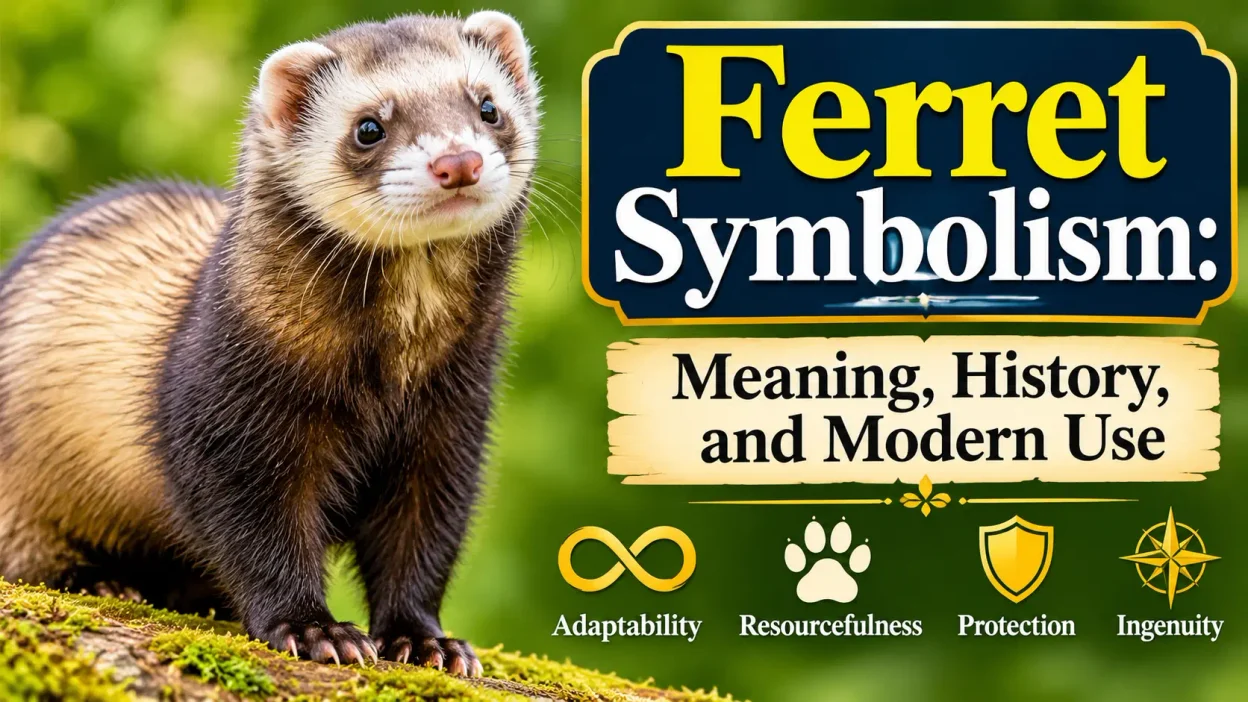
A ferret is a small, slender mammal known for its curious nature, playful behavior, quick movements, and habit of exploring places other animals might avoid. Ferret symbolism commonly represents curiosity, cleverness, resourcefulness, playfulness, and the ability to discover things hidden from view. Its unusual combination of independence and affection also makes it an interesting symbol of individuality and companionship.
People encounter ferrets in different ways. Some know them as energetic household pets, while others recognize them through wildlife conservation, animal photography, folklore, or popular culture. Their behavior often inspires comparisons with people who enjoy investigating unfamiliar situations, finding unexpected solutions, and approaching life with a sense of adventure.
Unlike animals associated with established religious traditions or widely documented mythological stories, ferrets do not have one universal symbolic meaning. Much of their modern interpretation comes from their actual behavior, their long relationship with humans, and the cultural impressions they create.
Understanding these connections helps explain why the ferret has become a recognizable symbol of curiosity, mischief, intelligence, and independent thinking.
Quick Answer: What Does Ferret Symbolism Mean?
Ferret symbolism commonly represents curiosity, cleverness, playfulness, resourcefulness, and independence in modern American culture. Historically, ferrets were associated with hunting, practical problem-solving, and discovering hidden things because of their ability to enter narrow spaces and locate prey underground.
TL;DR: Key Meanings of Ferret Symbolism
- Curiosity: Exploring unfamiliar places and asking questions.
- Cleverness: Finding solutions through observation and intelligence.
- Resourcefulness: Making use of available opportunities.
- Playfulness: Approaching everyday experiences with humor and energy.
- Independence: Maintaining individuality while enjoying companionship.
- Discovery: Finding information, objects, or opportunities hidden from view.
1. What Makes the Ferret a Symbolic Animal?
The ferret belongs to the mustelid family, which also includes weasels, otters, badgers, and martens. Domestic ferrets are slender animals with elongated bodies, short legs, small ears, and flexible movements that allow them to explore tight spaces.
Their physical appearance contributes to their symbolic associations. A ferret can disappear into a small opening, investigate an unfamiliar object, and quickly emerge somewhere unexpected. These behaviors naturally suggest exploration, investigation, and adaptability.
Their personalities add another dimension. Domestic ferrets often play, hide objects, investigate household surroundings, and interact with their owners. Their movements can appear mischievous, especially when they discover something interesting.
Several characteristics explain their symbolic appeal:
- Their curiosity suggests a desire for knowledge.
- Their flexible bodies represent adaptability.
- Their playful movements suggest humor and enjoyment.
- Their investigative behavior represents discovery.
- Their independent nature reflects individuality.
These associations come primarily from observation rather than a single ancient symbolic tradition.
2. Curiosity and the Desire to Explore
Curiosity is one of the most recognizable meanings associated with ferrets.
A ferret rarely seems satisfied with simply observing its surroundings. It investigates unfamiliar objects, explores narrow spaces, and follows interesting smells. This behavior makes it a natural representation of people who enjoy discovering how things work.
In everyday American culture, curiosity is generally considered a valuable quality. It is connected with learning, creativity, scientific thinking, and personal development.
A ferret can therefore represent someone who:
- Enjoys asking questions.
- Investigates unfamiliar situations.
- Looks beyond first impressions.
- Learns through direct experience.
- Finds excitement in discovering something new.
For example, someone starting a business, learning a new skill, or traveling somewhere unfamiliar might identify with the ferret’s exploratory personality.
However, curiosity also requires judgment. Exploring everything without considering risks can lead to trouble. The ferret offers a reminder that curiosity is most useful when combined with awareness.
3. Cleverness, Intelligence, and Quick Thinking
Ferrets are often associated with cleverness because of their problem-solving behavior and ability to navigate complicated environments.
They can learn routines, recognize familiar people, respond to training, and investigate ways to reach interesting objects. Their intelligence is particularly noticeable when they work around obstacles or discover how to access something hidden.
Symbolically, these qualities connect ferrets with:
- Quick thinking.
- Observation.
- Strategic behavior.
- Creative problem-solving.
- Mental flexibility.
In modern American storytelling, clever animals often represent characters who succeed through intelligence rather than physical strength.
The ferret fits this pattern. It is relatively small, but its curiosity and ability to navigate difficult spaces make it appear resourceful.
This symbolism can be especially meaningful for people who value practical intelligence. It suggests that success does not always require being the strongest person in a situation. Sometimes, careful observation and a creative approach are more useful.
4. Resourcefulness and Finding Hidden Opportunities
The ferret’s association with resourcefulness comes partly from its historical working relationship with humans.
People used domesticated ferrets to pursue rabbits into underground burrows. Their narrow bodies and hunting instincts made them useful for reaching places that humans could not easily access.
This practical role helped create an association between ferrets and finding things that remain hidden.
The expression “ferret out” reflects this connection. It means to discover information or locate something through persistent investigation. The expression developed from the animal’s traditional hunting behavior. FDA+1
As a symbol, the ferret can represent the ability to:
- Recognize opportunities others overlook.
- Work with limited resources.
- Investigate complicated problems.
- Find answers through persistence.
- Adapt when the original plan fails.
In American professional culture, these qualities connect naturally with entrepreneurship, research, journalism, and problem-solving.
A person who keeps investigating a difficult problem until finding an answer might use the ferret as a personal representation of persistence and practical intelligence.
5. Historical Origins of Ferret Symbolism
Ferrets have been connected with human activities for more than two thousand years, although the details of their early domestication are not completely settled.
Ancient Greek writings contain descriptions that researchers have associated with ferrets or closely related animals. By the first century BCE, the Greek historian Strabo described their use in hunting rabbits in the Mediterranean region.
Their primary historical purpose was practical rather than spiritual. People valued their ability to enter rabbit burrows and drive animals toward hunters waiting outside.
Over time, ferrets became useful in several parts of Europe for hunting and controlling rodents.
Their historical roles gradually created associations with:
| Historical activity | Symbolic association | Explanation |
|---|---|---|
| Rabbit hunting | Resourcefulness | Finding prey in difficult places |
| Rodent control | Practical intelligence | Solving everyday problems |
| Working alongside humans | Cooperation | Supporting human activities |
| Exploring underground spaces | Discovery | Reaching hidden locations |
| Carrying or hiding objects | Mischief | Unexpected and playful behavior |
These historical connections help explain the animal’s modern symbolic identity. However, there is limited evidence of a single established ancient religious or spiritual meaning specifically associated with ferrets. ferret.org+1
6. Ferret Symbolism in American Culture
In the United States, ferrets are most commonly recognized as unusual and entertaining household pets.
Their popularity increased during the late twentieth century, particularly during the 1980s and 1990s. Before becoming familiar companion animals, ferrets had already been used in parts of the American West for hunting and protecting stored grain from rodents.
The change from working animal to household companion influenced how Americans perceive them.
Today, ferrets are often associated with:
Personality and individuality: Their unusual appearance and energetic behavior make them appealing to people who appreciate less conventional pets.
Companionship: Their interactions with owners can represent affection, trust, and social connection.
Playful living: Their enthusiasm for games and exploration makes them symbols of enjoying ordinary experiences.
Practical intelligence: Their history as working animals connects them with usefulness and problem-solving.
Nonconformity: Because ferrets are less conventional pets than dogs and cats, they can represent personal preferences that differ from mainstream expectations.
American interpretations are generally based on domestic animal culture rather than formal folklore or religious traditions. FDA+1
7. Playfulness, Humor, and Enjoying Life
Ferrets are particularly associated with playfulness.
Domestic ferrets often chase toys, hide objects, investigate household items, and engage in energetic movements. Their behavior can make even ordinary situations entertaining.
This creates a connection between ferrets and the ability to enjoy life without taking every situation too seriously.
As a symbolic animal, the ferret can represent:
- A humorous personality.
- Enjoyment of simple experiences.
- Spontaneous behavior.
- Creative expression.
- A willingness to try unfamiliar activities.
In American culture, playfulness is often connected with childhood, friendship, entertainment, and personal freedom.
A ferret may therefore appeal to someone who wants to maintain a sense of humor while handling adult responsibilities.
Its symbolism is not necessarily about avoiding serious matters. Instead, it suggests that enjoyment and responsibility can exist together.
8. Independence and Personal Freedom
Although domestic ferrets can form close relationships with their owners, they also display independent behavior.
They enjoy investigating their surroundings and may become absorbed in an activity without seeking constant attention.
This balance between companionship and independence creates an interesting symbolic interpretation.
The ferret can represent someone who values relationships but does not want to lose personal identity.
Its symbolism may connect with:
- Personal freedom.
- Self-confidence.
- Independent decision-making.
- Individual preferences.
- Respect for personal boundaries.
In modern American culture, individuality is frequently associated with personal expression and the freedom to choose one’s own direction.
The ferret’s independent personality fits this interpretation, especially for people who enjoy social relationships while maintaining their own interests.
It can also serve as a reminder that healthy companionship does not require constant dependence.
9. Ferret Symbolism in Different Cultures
Ferrets do not have an equally established symbolic position across all cultures. Their meanings are more closely connected with regional experiences, historical uses, and relationships with related animals.
Ancient Greece and the Mediterranean
Historical accounts connect ferrets with rabbit hunting and human settlement. Their practical usefulness provides the strongest documented cultural association. References to their behavior also contributed to impressions of cleverness and theft.
Medieval and European traditions
Ferrets became familiar working animals in parts of Europe, particularly where rabbit hunting was common. Their association with hunting, animal control, and household usefulness shaped their cultural identity.
Modern European culture
In several European countries, ferrets are still recognized in connection with traditional hunting practices, although their role varies by region. They are also kept as companion animals.
Modern East Asian interpretations
Ferrets do not have one widely established symbolic meaning across East Asian cultures. Interpretations can differ according to local familiarity with the animal, contemporary pet culture, and individual artistic expression.
Indigenous North American traditions
It is important not to confuse the domestic ferret with native North American wildlife. The black-footed ferret is a distinct native species with its own ecological history. Claims that domestic ferrets have a universal meaning in Indigenous spiritual traditions should not be made without specific cultural evidence.
Overall, the ferret’s symbolism is more behavior-based than religion-based.
10. Black-Footed Ferret Symbolism and Conservation
The black-footed ferret adds an important American conservation dimension to ferret symbolism.
Unlike the domesticated pet ferret, the black-footed ferret is a wild species native to North America. It once occupied large areas of the Great Plains, where it depended heavily on prairie dog colonies for food and shelter.
Habitat changes, prairie dog eradication, and disease contributed to its dramatic population decline.
By the late twentieth century, the species was believed to have disappeared from the wild. In 1981, a population was rediscovered near Meeteetse, Wyoming. Conservationists captured the remaining animals to establish a breeding program, and later efforts returned captive-bred ferrets to suitable habitats. National Zoo+2
This history gives the black-footed ferret a different symbolic meaning from its domestic relative.
It can represent:
- Conservation and environmental responsibility.
- Survival under difficult conditions.
- Scientific cooperation.
- Recovery after population decline.
- The importance of protecting natural habitats.
Its recovery story also provides a meaningful example of how conservation programs can help prevent a species from disappearing.
For American readers, the black-footed ferret represents more than an interesting animal. It connects wildlife protection with the future of the country’s grassland ecosystems.
11. Emotional and Psychological Meaning
Ferret symbolism can also be understood through the emotions people associate with the animal.
A playful ferret may create feelings of amusement, affection, and warmth. Its curious behavior can encourage people to approach familiar surroundings with renewed interest.
Different characteristics may suggest different emotional qualities.
Curiosity and excitement: The ferret can represent the anticipation of discovering something unfamiliar.
Affection and companionship: Its relationship with human caretakers can symbolize trust and emotional connection.
Confidence and independence: Its willingness to explore independently can suggest comfort with personal identity.
Mischief and humor: Its playful behavior may represent a personality that enjoys laughter and unexpected experiences.
Adaptability: Its ability to navigate complicated environments can represent emotional flexibility and adjusting to changing circumstances.
Psychologically, people often connect animals with qualities they recognize in themselves. Someone who enjoys exploration may identify with the ferret, while another person may associate it with a beloved pet.
These interpretations are personal associations rather than established psychological diagnoses or universal meanings.
12. What Does It Mean When a Ferret Appears in a Dream?
A ferret appearing in a dream can be interpreted through the animal’s recognizable characteristics, although dreams do not have fixed or scientifically established symbolic meanings.
The details of the dream and the dreamer’s personal experiences matter more than any universal interpretation.
Here are some possible associations:
| Dream situation | Possible symbolic interpretation |
|---|---|
| A playful ferret | Enjoyment, humor, and curiosity |
| A ferret exploring a hole | Investigating an unanswered question |
| A ferret hiding something | Privacy or concealed information |
| A friendly ferret | Trust and companionship |
| A frightened ferret | Feeling uncertain or vulnerable |
| A ferret escaping | Desire for independence or freedom |
For example, dreaming about a ferret exploring a small opening might reflect an interest in discovering something unfamiliar.
A dream about a missing ferret could connect with concerns about responsibility, attachment, or losing something important.
These are reflective interpretations, not predictions. A dream about a ferret does not automatically indicate that something good or bad will happen.
13. Ferret Symbolism in Tattoos, Jewelry, and Personal Style
Ferret imagery can be used in personal artwork, tattoos, accessories, and decorative designs.
Unlike commonly recognized symbols such as butterflies, owls, or lions, ferret designs usually communicate individual interests rather than widely shared cultural meanings.
People may choose ferret imagery for several reasons.
Curiosity: A ferret tattoo can represent a personality that enjoys learning, exploring, and discovering new things.
Personal independence: Someone who identifies with the animal’s independent behavior may use its image as a reminder to maintain individuality.
Pet remembrance: Many people choose animal tattoos to honor pets that have played an important role in their lives.
Humor and personality: A playful ferret design may communicate an energetic, unconventional, or humorous personality.
Conservation awareness: A black-footed ferret tattoo can represent wildlife protection and concern for endangered species.
Jewelry and decorative objects featuring ferrets are often chosen because of personal attachment or appreciation for the animal.
In these contexts, the meaning comes from the owner’s relationship with the animal rather than an established symbolic code.
14. Positive and Negative Meanings Associated With Ferrets
Ferrets are generally associated with positive qualities, but their behavior also creates less favorable interpretations.
Their habit of hiding objects, investigating restricted spaces, and moving unexpectedly can be interpreted as mischievous or secretive.
This gives the animal a combination of positive and negative associations.
| Positive symbolism | Negative symbolism |
|---|---|
| Curiosity | Intrusiveness |
| Cleverness | Cunning behavior |
| Independence | Uncooperative behavior |
| Playfulness | Irresponsibility |
| Resourcefulness | Manipulation |
| Discovery | Unwanted interference |
The distinction depends on context.
For example, curiosity is useful when someone investigates a problem carefully. However, the same quality can become intrusive when someone ignores another person’s privacy.
Likewise, cleverness can represent creative problem-solving or dishonest manipulation.
The ferret therefore provides an interesting example of how one characteristic can be interpreted differently depending on intention and circumstances.
15. Common Misunderstandings About Ferret Symbolism
Several misconceptions can lead people to misunderstand what ferrets represent.
Ferrets are not universally associated with bad luck.
There is no widely established American tradition that identifies ferrets as general signs of misfortune. Their mischievous appearance should not be confused with an established negative spiritual meaning.
Ferrets are not the same as weasels or black-footed ferrets.
Although these animals belong to the same broader family, they have different biological identities. Their symbolic interpretations should not automatically be treated as interchangeable.
There is no single universal spiritual meaning.
Some modern spiritual interpretations connect ferrets with intuition, adaptability, or discovering hidden truths. These are contemporary personal interpretations rather than universally documented religious beliefs.
A ferret appearing in a dream is not a prediction.
Dream interpretation is subjective. Personal emotions and experiences provide a more reasonable starting point than claims about guaranteed future events.
Ferrets do not represent dishonesty by nature.
Their tendency to hide objects may inspire playful comparisons with stealing or secrecy, but these associations should not be treated as evidence of a negative personality.
Understanding these distinctions keeps ferret symbolism grounded in actual behavior and documented cultural history.
16. How Ferret Symbolism Has Evolved in Modern Life
The symbolic identity of the ferret has changed as its relationship with humans has developed.
In earlier periods, people mainly valued ferrets for their practical abilities. Hunting, pest control, and other working activities shaped their reputation.
During the twentieth century, their role gradually expanded. As domestic ferrets became more familiar household companions in the United States, their public image shifted toward playfulness, affection, and individuality.
Today, two different interpretations exist alongside each other.
The domestic ferret represents curiosity, companionship, cleverness, and unconventional personality. The black-footed ferret represents native wildlife, conservation, and the importance of restoring threatened ecosystems.
Digital culture has also made unusual pet behaviors more visible. Photographs and videos of ferrets exploring, playing, and hiding objects introduce their personalities to audiences who may never have encountered one in person.
This modern visibility has helped establish the ferret as an animal associated with humor and curiosity.
Its meaning continues to depend on the context in which people encounter it. A pet owner may see affection, a conservationist may see ecological recovery, and an artist may see individuality.
The animal’s symbolic identity is therefore not fixed. It develops through human experience and changing cultural relationships.
Frequently Asked Questions About Ferret Symbolism
1. What does a ferret symbolize spiritually?
In modern personal spirituality, ferrets are sometimes associated with curiosity, adaptability, cleverness, and discovering hidden information. These interpretations are contemporary symbolic associations rather than established teachings shared by major religions.
2. Is ferret symbolism positive or negative?
Ferret symbolism is generally positive, representing intelligence, playfulness, independence, and resourcefulness. Negative interpretations sometimes connect the animal with secrecy, mischief, or intrusive curiosity.
3. What does a ferret tattoo symbolize?
A ferret tattoo can represent curiosity, individuality, humor, and independent thinking. It may also serve as a memorial to a beloved pet or express an interest in wildlife conservation.
4. What does seeing a ferret mean?
Seeing a ferret can remind someone of curiosity, exploration, and finding unexpected opportunities. Its personal meaning depends on the circumstances and the individual’s relationship with the animal.
5. What does a black-footed ferret symbolize?
The black-footed ferret can symbolize wildlife conservation, survival, ecological recovery, and environmental responsibility. Its history in the American Great Plains makes it particularly relevant to discussions about endangered species.
6. What does a ferret symbolize in dreams?
A ferret in a dream may represent curiosity, hidden information, playfulness, or a desire for independence. The animal’s behavior and the dreamer’s personal feelings provide useful context for interpreting the experience.
7. Are ferrets associated with good luck?
Ferrets are not widely recognized as traditional good-luck symbols in American culture. However, individuals may personally associate them with positive opportunities, cleverness, and successful problem-solving.
Conclusion
Ferret symbolism centers on curiosity, cleverness, resourcefulness, playfulness, and independence. These associations come largely from the animal’s natural behavior and its long history of working alongside humans. In modern American culture, domestic ferrets are especially connected with companionship and unconventional personalities.
The black-footed ferret adds another dimension through its conservation history, representing survival, environmental responsibility, and the recovery of threatened wildlife.
Ultimately, the ferret reminds us that intelligence is not always about strength or size. Sometimes, it is about staying curious, exploring unfamiliar places, and finding an unexpected way forward.