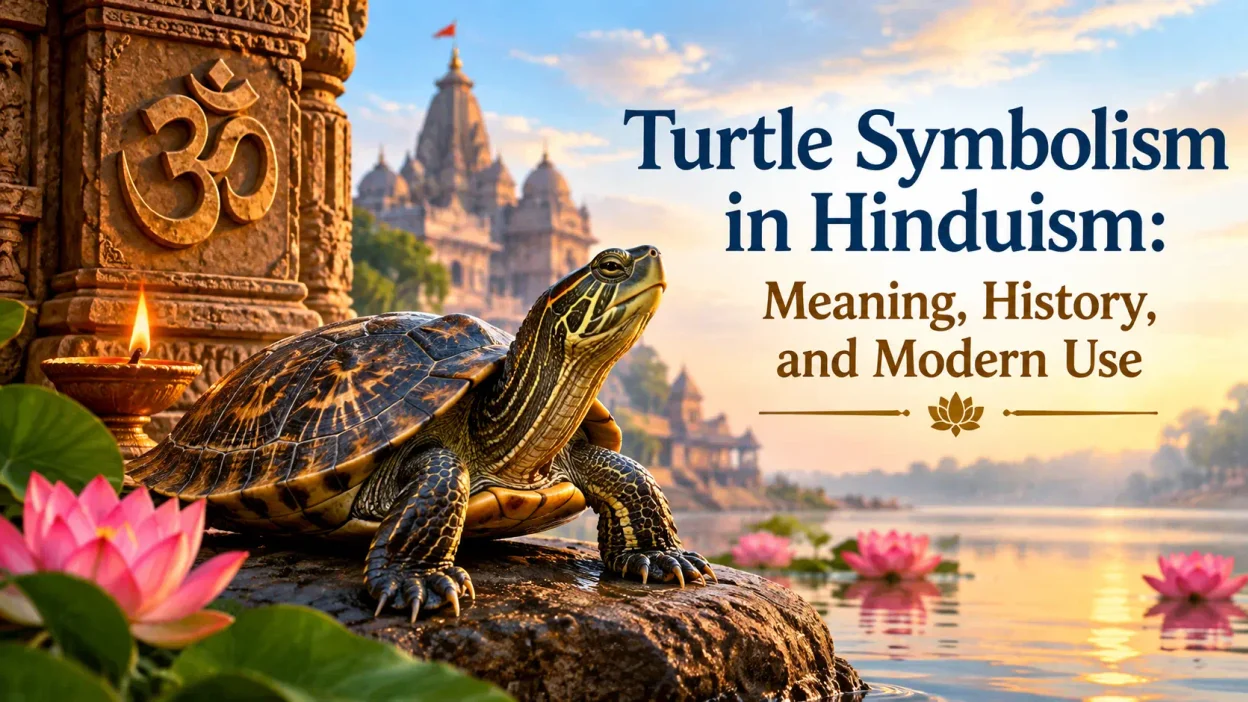
Turtle symbolism in Hinduism is closely connected to patience, stability, longevity, and the preservation of cosmic order. One of its most important expressions appears in the story of Kurma, the turtle incarnation of Lord Vishnu, who supports Mount Mandara during the churning of the cosmic ocean. This story gives the turtle a religious significance that extends beyond its slow movements or long lifespan in nature.
For Hindus, the turtle can represent the relationship between the visible world and the deeper forces believed to sustain it. Its protective shell offers a useful image of security and restraint, while its ability to withdraw its limbs suggests control over the senses. These ideas appear in religious storytelling, philosophical teachings, temple traditions, and contemporary discussions of spiritual discipline.
In the United States, people may encounter Hindu turtle symbolism through yoga, meditation, home decor, jewelry, or interest in Indian mythology. Understanding the tradition behind these images helps distinguish established Hindu teachings from modern interpretations that assign animals universal spiritual meanings. The turtle’s significance is especially clear when its religious stories are considered alongside the values of steadiness, self-control, and responsibility that they communicate.
Quick Answer
Turtle symbolism in Hinduism commonly represents stability, patience, protection, and self-control, especially through the sacred story of Kurma, Lord Vishnu’s turtle incarnation. In Hindu mythology and philosophy, the turtle also supports cosmic order and illustrates the practice of withdrawing the senses to develop inner discipline.
TL;DR
- Kurma is the turtle incarnation of Lord Vishnu.
- The turtle supports Mount Mandara during the churning of the cosmic ocean.
- Its shell can represent protection, stability, and groundedness.
- Bhagavad Gita teachings compare sense control to a turtle withdrawing its limbs.
- Hindu turtle symbolism connects mythology with spiritual discipline and cosmic order.
- Modern American interpretations should respect the tradition’s religious context.
1. What the Turtle Represents in Hinduism
The turtle holds several related meanings in Hindu traditions, including stability, endurance, protection, and disciplined behavior. Its importance comes not only from its physical characteristics but also from the stories and teachings in which it appears.
The most recognizable religious connection is Kurma, an avatar of Vishnu. In Hindu belief, Vishnu preserves and sustains cosmic order, and his turtle form plays a crucial role in a story about restoring balance and obtaining the treasures hidden within the cosmic ocean.
The turtle also appears as an image of self-restraint in Hindu philosophy. When a turtle draws its head and limbs into its shell, it offers a comparison for a person who learns to govern the senses rather than react to every distraction.
These meanings are related, but they are not identical. Kurma’s role emphasizes divine support and preservation, while the philosophical comparison emphasizes personal discipline. Together, they explain why the turtle can represent both the stability of the larger universe and the steadiness an individual seeks to develop.
2. Kurma: The Sacred Turtle Avatar of Lord Vishnu
In Hindu tradition, Kurma is the tortoise or turtle incarnation of Lord Vishnu, the deity associated with preserving and sustaining the universe. Kurma is commonly counted as the second avatar in the Dashavatara, the traditional list of ten principal avatars of Vishnu.
The word kurma refers to a tortoise or turtle. In religious art, Kurma is often depicted as a large turtle supporting a mountain, or as a divine figure combining human and turtle features. These images connect the animal with Vishnu’s role in maintaining cosmic stability.
Kurma’s importance comes from what he does rather than simply what he looks like. When a mountain threatens to sink during a cosmic undertaking, Vishnu takes turtle form and provides the foundation needed for the work to continue.
This makes Kurma an image of dependable support. His contribution may happen beneath the surface, away from the most visible action, yet the entire undertaking depends on him. The story offers a religious understanding of strength that does not require display or domination.
For readers learning about Hindu mythology, this distinction matters. Kurma is not merely a turtle that happens to appear in a sacred story. He is a form of Vishnu whose role expresses divine preservation through practical, essential support.
3. The Churning of the Cosmic Ocean
Kurma’s best-known story is Samudra Manthana, meaning the churning of the ocean. This episode appears in Hindu mythological literature, including the Mahabharata and later Puranic traditions, with variations in the details.
The gods, known as devas, and the asuras, often described as powerful opponents of the gods, join forces to churn the cosmic ocean. They seek amrita, the nectar associated with immortality. Mount Mandara serves as the churning rod, while the serpent Vasuki serves as the rope.
The enormous mountain begins to sink because it lacks a stable foundation. The effort cannot succeed unless something supports it. Vishnu therefore assumes the form of Kurma and bears the mountain on his back.
With this support in place, the churning continues, and various extraordinary beings and treasures emerge from the ocean. Accounts differ in their descriptions and sequence, but the episode commonly includes Lakshmi, the goddess associated with prosperity, and the nectar of immortality.
The turtle’s role is essential to the story’s structure. The gods and asuras perform the visible labor, but their work depends on Kurma’s steady support beneath the mountain.
The symbolism is straightforward without being simplistic: major achievements require a foundation that can withstand pressure. In Hindu religious thought, Kurma’s support also reflects Vishnu’s responsibility for sustaining cosmic order when that order is threatened.
4. Why Kurma Represents Stability and Support
The mountain resting on Kurma’s back gives the turtle a direct connection to stability. Without the turtle, the churning would fail before it could produce its intended results. Kurma’s strength makes continued action possible.
This image can be understood on several levels. Cosmologically, it portrays divine support as a condition for maintaining order. Ethically, it suggests that useful work depends on reliability rather than recognition. Personally, it offers a comparison for remaining steady when responsibilities become difficult.
For example, a family member who quietly supports others through a difficult period may embody the ordinary human quality associated with this image. A teacher who provides consistent guidance or a community member who keeps an important project moving may serve a similar role.
These examples are modern applications, not claims that Hindu scripture assigns a specific religious status to such people. They illustrate why Kurma’s story remains understandable outside its original mythological setting.
The turtle’s stability should not be confused with stubbornness. Kurma supports a task that must continue; his steadiness serves a purpose. The lesson is not to resist every change, but to provide reliable support when a worthwhile undertaking faces uncertainty.
5. The Turtle and Self-Control in the Bhagavad Gita
One of the clearest philosophical connections between a turtle and Hindu spiritual discipline appears in the Bhagavad Gita, chapter 2, verse 58.
In this verse, Krishna compares a person who withdraws the senses from their objects to a tortoise drawing its limbs inside its shell. The comparison appears in a discussion of steady wisdom and the ability to avoid being controlled by immediate attractions.
The image is easy to understand. A turtle can withdraw its exposed limbs when necessary. In the verse, this behavior illustrates a person’s ability to regulate attention and responses rather than follow every impulse.
The teaching is not simply about hiding from the world. It concerns mastery over one’s reactions. Someone practicing self-control can recognize an appealing or distracting experience without automatically allowing it to dictate their behavior.
Consider a person who feels provoked during an argument. Instead of responding immediately with anger, that person pauses, considers the situation, and chooses a measured response. This illustrates the general principle of restraint, although the verse’s full spiritual meaning extends beyond everyday emotional management.
The Bhagavad Gita uses the turtle as a teaching image, not as a claim that turtles possess human wisdom. Its natural behavior becomes a way to explain how disciplined attention supports clearer judgment.
6. Protection, the Shell, and Spiritual Boundaries
A turtle’s shell provides another natural basis for symbolic interpretation. It protects vulnerable parts of the animal and gives it a distinctive physical form. In a religious or reflective context, this can suggest shelter, security, and the importance of maintaining appropriate boundaries.
The turtle’s shell also provides a useful comparison for inner steadiness. A person may need protection from unnecessary distraction, social pressure, or destructive habits to preserve the time and attention required for spiritual practice.
However, protection does not have to mean complete withdrawal. The lesson associated with the Bhagavad Gita is about governing the senses, not rejecting all contact with other people or ordinary responsibilities.
A balanced interpretation recognizes the difference between healthy boundaries and avoidance. Someone may need to step away from a stressful situation to think clearly, then return and address the problem responsibly.
The turtle’s shell makes this idea easy to picture. It represents a protected space from which a person can regain composure, rather than a permanent barrier against the world.
7. Longevity, Patience, and Endurance
Turtles are often associated with long life because some species live for many decades. This natural characteristic has contributed to the turtle’s wider symbolic connection with endurance, patience, and a life that unfolds over an extended period.
In Hindu contexts, these qualities can complement the meanings associated with Kurma, although they should not all be treated as direct teachings from the same myth. The religious story emphasizes divine support, while longevity is a broader association that readers may bring to the animal.
Patience is especially relevant to the churning of the ocean. The task requires sustained effort and cooperation before its desired outcome appears. Kurma’s role allows that process to continue, making the story a natural illustration of the relationship between a stable foundation and a difficult undertaking.
In modern life, this meaning may appeal to people pursuing education, raising a family, developing a skill, or working toward a long-term goal. Progress often requires consistency rather than immediate results.
The turtle does not suggest that slow progress is always better. Instead, it offers a reminder that worthwhile efforts sometimes need time, persistence, and dependable support.
8. The Turtle and Cosmic Order in Hindu Mythology
Kurma’s role in the churning story connects the turtle with dharma and the maintenance of an ordered world, although the concepts should not be treated as interchangeable. Dharma can refer to duty, right conduct, moral order, and the principles that sustain life and society, depending on the context.
The churning of the ocean involves cooperation between opposing groups. Their interests are not identical, and the process is difficult, but it produces consequences that extend beyond any single participant. Kurma provides the foundation that allows the undertaking to proceed.
This does not mean the story portrays every participant as morally equivalent or every form of cooperation as virtuous. Hindu mythological narratives often explore complicated relationships among divine beings, asuras, desire, power, and cosmic responsibility.
Kurma’s specific contribution is clearer: he supplies what the situation lacks. The mountain needs support, and Vishnu provides it.
That role makes the turtle a useful image of the conditions that allow order to survive disruption. Stability is not necessarily the absence of movement or conflict. Sometimes it is the underlying support that allows a difficult process to reach its outcome.
9. Turtle Symbolism Compared With Other Hindu Symbols
Hindu religious traditions use many animals and natural images to express different aspects of divine activity and spiritual life. Comparing them helps clarify what makes the turtle distinctive.
| Symbol | Common Hindu association | Connection to the turtle |
|---|---|---|
| Turtle or tortoise | Stability, divine support, sense control | Represents Kurma and disciplined restraint |
| Lotus | Purity, spiritual unfolding, divine association | Both can express spiritual ideas through natural forms |
| Elephant | Strength, wisdom, auspiciousness, and Ganesha | Emphasizes different qualities from Kurma’s foundational support |
| Serpent | Divine power, protection, renewal, and cosmic imagery | Vasuki plays a central role in the ocean-churning story |
| Cow | Nourishment, generosity, and sacred significance in many Hindu communities | Highlights sustaining care through a different animal image |
These associations vary across texts, regions, and religious communities. A single animal does not carry precisely the same meaning in every Hindu tradition.
The turtle’s distinctive contribution is particularly clear in the Kurma story. Rather than representing a visible display of power, it provides the support on which an enormous undertaking depends. In the Bhagavad Gita, the turtle also serves as an example of controlled senses, giving it a philosophical role that is different from the lotus, elephant, or cow.
10. Turtle Symbolism in the United States Today
In the United States, Hindu turtle symbolism appears in religious art, educational material about Indian mythology, yoga settings, meditation spaces, and personal objects inspired by Hindu traditions.
Some Americans encounter Kurma through illustrations of Vishnu’s avatars or depictions of the churning of the ocean. Others discover the turtle’s connection to self-control while studying the Bhagavad Gita or exploring Hindu philosophy.
The symbol may also appear in home decor and jewelry. A person might choose a turtle figure to represent patience or stability, while someone familiar with Hindu mythology may select a Kurma image because of its specific religious significance.
These uses should not automatically be treated as equivalent. A decorative turtle chosen for its appearance has a different context from a sacred image used in worship or a representation of Vishnu’s avatar.
For American readers, the most respectful approach is to learn what the image means within the tradition before assigning it a personal interpretation. This is especially important when an object represents a deity rather than simply an animal.
11. Turtle Figures in Home Decor and Vastu Beliefs
Some Hindu-influenced and Indian household traditions associate turtle figures with stability, protection, prosperity, or a well-ordered home. These associations are often discussed in connection with Vastu Shastra, a traditional Indian system concerned with the design and arrangement of buildings and living spaces.
Modern advice about placing a turtle figurine in a particular room or direction varies considerably. Some recommendations come from specific interpretive traditions, while others circulate through contemporary lifestyle content without clear agreement about their origins or authority.
It is therefore important to distinguish the broad religious symbolism of Kurma from particular claims about household objects. Vishnu’s turtle incarnation has a clear place in Hindu mythology, and the Bhagavad Gita explicitly uses the tortoise as a comparison for sense control. Not every modern claim about a turtle statue has the same scriptural foundation.
An American homeowner who appreciates Hindu art may display a turtle image as a reminder of steadiness or as an expression of interest in Indian religious culture. Someone following a particular Vastu tradition may approach the object differently.
Neither practice should be reduced to a promise that a figurine will automatically attract wealth, prevent misfortune, or change a person’s destiny. Religious symbolism can carry meaning without guaranteeing a material result.
12. Tattoos, Jewelry, and Personal Meaning
Turtle tattoos and jewelry often communicate patience, resilience, protection, or a connection with nature. When a design specifically depicts Kurma or includes imagery from the churning of the cosmic ocean, it may also express interest in Hindu mythology or devotion to Vishnu.
The distinction between a general turtle design and a religious image matters. A simple turtle outline may reflect someone’s appreciation of wildlife or a personal reminder to remain patient. A depiction of Kurma may carry a more specific connection to Hindu religious stories.
Before choosing a design associated with a sacred tradition, it is worth understanding its imagery and intended meaning. Some religious representations include recognizable features of deities, while others draw on mythological scenes that may not be obvious to an unfamiliar viewer.
A person does not need to be Hindu to study or appreciate Hindu mythology, but respect requires more than borrowing an image because it looks attractive. Learning the story behind the symbol makes a personal choice more informed.
13. Cross-Cultural Meanings and Important Distinctions
Turtles appear in the mythology and folklore of many cultures, but their meanings are not identical. Some traditions associate turtles with the structure of the world, while others emphasize longevity, creation, protection, or a connection between different realms.
For example, certain Indigenous North American traditions include turtle imagery in accounts of the land’s origins, sometimes associated with the name Turtle Island. These traditions are diverse, belonging to distinct peoples and communities, and should not be treated as one universal Native American belief.
Chinese cultural traditions also associate the tortoise with longevity and, in some historical settings, cosmic order and divination. These connections developed in different religious and philosophical contexts from the Hindu stories of Kurma.
Such comparisons can reveal shared human interest in the turtle’s shell, survival, and relationship with land and water. They do not establish that every culture inherited the same beliefs or that a turtle has one universal spiritual meaning.
For Hindu symbolism, Kurma and the Bhagavad Gita provide the most relevant foundations. Cross-cultural comparisons are useful when they clarify similarities and differences, not when they erase the history of individual traditions.
14. Common Misunderstandings About Hindu Turtle Symbolism
One misunderstanding is that every turtle image in Hindu culture represents Lord Vishnu. Kurma is a specific divine incarnation, but an ordinary turtle illustration may instead serve as decoration or express a broader association with patience and stability.
Another misconception is that Hindu teachings require everyone to withdraw from the world. The turtle comparison in the Bhagavad Gita concerns control over the senses; it does not simply recommend isolation or refusing to participate in daily life.
People may also assume that turtle figures always guarantee good fortune. Although some household traditions associate turtle images with favorable qualities, claims about guaranteed wealth or protection go beyond what can responsibly be concluded from the symbolism alone.
Finally, Hinduism is not a single, uniform system of interpretation. Practices differ among Vaishnava, Shaiva, Shakta, Smarta, and other communities, as well as among regional traditions and individual households. The prominence given to Kurma or to a decorative turtle may therefore vary.
Understanding these distinctions makes it possible to appreciate the turtle’s religious importance without turning a varied tradition into a list of universal rules.
Frequently Asked Questions
What does a turtle symbolize in Hinduism?
A turtle can symbolize stability, protection, endurance, and self-control. Its religious significance is especially associated with Kurma, Vishnu’s turtle incarnation, and the comparison between a tortoise withdrawing its limbs and a disciplined person controlling the senses.
Who is Kurma in Hindu mythology?
Kurma is an avatar of Lord Vishnu who supports Mount Mandara during the churning of the cosmic ocean. His role allows the process to continue and connects the turtle with divine preservation and the support needed to sustain a difficult undertaking.
What does the turtle represent in the Bhagavad Gita?
In chapter 2, verse 58, Krishna uses a tortoise withdrawing its limbs as a comparison for withdrawing the senses from their objects. The verse teaches disciplined attention and steady wisdom rather than simple avoidance of the outside world.
Is a turtle considered lucky in Hinduism?
Some household traditions associate turtle figures with prosperity, stability, or protection, particularly in discussions of Vastu. However, these beliefs vary, and a turtle image should not be understood as a universal guarantee of good luck.
What does a turtle statue mean in a Hindu home?
Its meaning depends on the household’s beliefs and the statue’s context. It may represent Kurma, serve as a decorative reminder of steadiness, or reflect a particular Vastu practice, but not every turtle figure has a formal religious role.
Can non-Hindus use turtle symbolism inspired by Hinduism?
People of different backgrounds can study and appreciate Hindu stories and art. When using an image of Kurma or another sacred figure, learning its religious context and avoiding misleading claims about its meaning helps show appropriate respect.
What is the difference between Kurma and general turtle symbolism?
Kurma is a specific avatar of Vishnu with an established role in Hindu mythology. General turtle symbolism may include patience, longevity, and protection, but those broader associations do not automatically make every turtle image a representation of the deity.
Conclusion
Turtle symbolism in Hinduism brings together divine preservation, stability, patience, and disciplined living. Through Kurma, the turtle becomes the foundation that allows the churning of the cosmic ocean to continue, while the Bhagavad Gita uses its protective behavior to explain the importance of controlling the senses.
For modern American readers, these teachings offer a way to explore Hindu mythology beyond decorative images or generalized claims about luck. The turtle’s meaning depends on its context, whether it appears in a sacred story, a philosophical teaching, a work of religious art, or a personal object.
The central lesson is that steadiness has value when it supports purposeful action. In the story of Kurma, the turtle does not need to dominate the scene; its contribution makes the entire undertaking possible.