
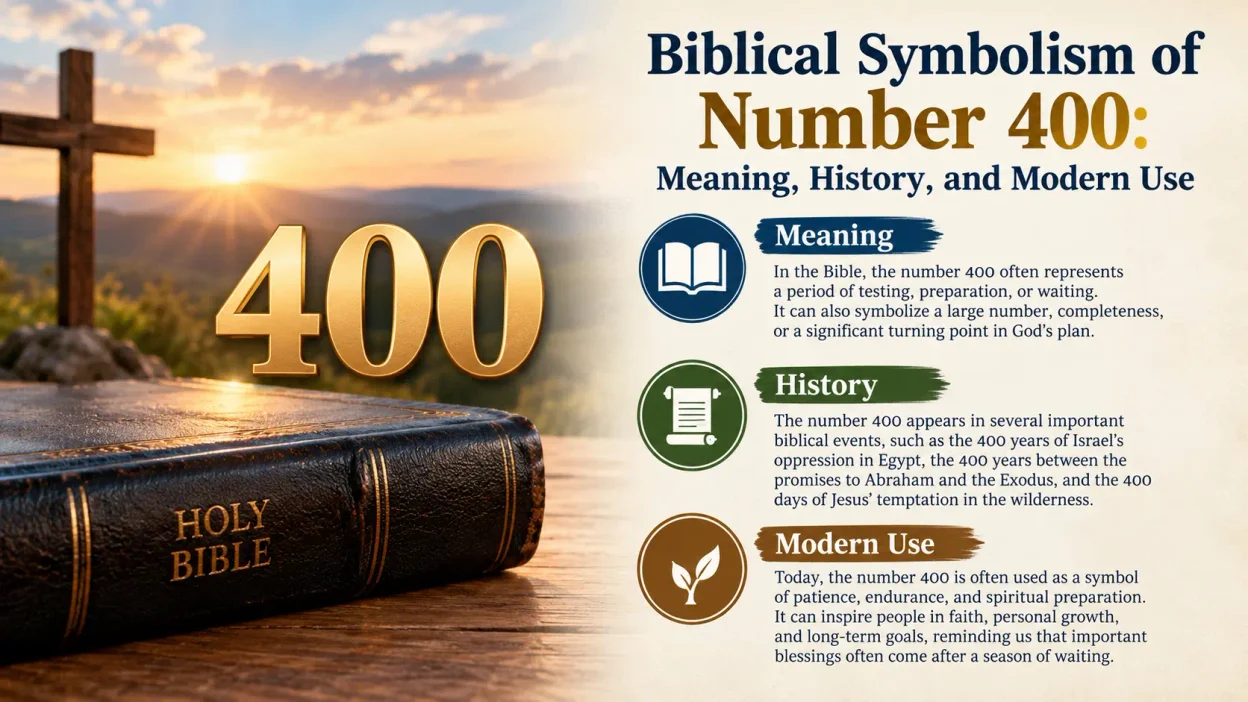
The biblical symbolism of number 400 is often associated with long periods of hardship, waiting, oppression, and eventual deliverance. In the Bible, the number appears in accounts involving Abraham’s descendants, Israel’s time in Egypt, and other significant periods, making it a useful number to study when exploring biblical history and interpretation.
For modern American Christians and Bible readers, 400 can raise questions about God’s promises, the timing of deliverance, and the relationship between suffering and spiritual growth. Some readers also approach the number through biblical numerology, looking for patterns that connect different passages. However, it is important to distinguish what the biblical text explicitly says from meanings later readers assign to numbers.
The number 400 does not have one universally established meaning throughout Scripture. Its significance depends on the passage, the historical setting, and the way the number functions in the narrative. Examining its best-known appearances provides a clearer understanding of how it has been interpreted in Jewish and Christian traditions.
Quick Answer
The biblical symbolism of number 400 is commonly associated with extended periods of waiting, hardship, oppression, and preparation for change, especially because of the prophecy concerning Abraham’s descendants and their time in Egypt. In biblical interpretation, these accounts can also prompt reflection on God’s promises, human endurance, and deliverance, although Scripture does not assign 400 one fixed spiritual meaning in every passage.
TL;DR
- The number 400 appears in several important biblical narratives.
- Genesis connects 400 years with the affliction of Abraham’s descendants.
- Exodus presents Israel’s departure from Egypt as a defining act of deliverance.
- David’s 400 men illustrate the formation of a group around a future king.
- Biblical context matters more than assigning numbers universal meanings.
- Modern Christian interpretations often connect 400 with patience, endurance, and hope.
1. What Does the Number 400 Mean in the Bible?
The number 400 appears in biblical accounts of time, family history, conflict, and leadership. Its meaning changes according to the event being described, so readers should avoid treating every appearance as evidence of the same hidden message.
One of its most significant appearances occurs in Genesis 15:13, where God tells Abram that his descendants will live as foreigners in another land, experience oppression, and endure a period associated with 400 years. The passage connects the number with suffering before a later deliverance.
Other appearances have different purposes. In 1 Samuel 22:2, David gathers a group of about 400 distressed, indebted, and dissatisfied men who come to him while he is hiding from Saul. The number identifies the size of a group rather than explicitly describing a spiritual process.
These examples show why context matters. In one passage, 400 is part of a prophecy about generations of hardship; in another, it describes the people gathering around David. The broader themes readers draw from these accounts should remain connected to their particular narratives.
2. The Historical and Cultural Background of Numbers in Scripture
Numbers in the ancient Near East could communicate quantities, measurements, periods of time, and relationships within a narrative. Biblical writers used numbers for ordinary counting as well as for details that became significant within religious history.
Modern readers sometimes assume that every biblical number carries a hidden numerical code. That approach can overlook the practical purpose of many figures. A number may identify a person’s age, the size of a group, a period of service, or the length of a journey without requiring an additional symbolic interpretation.
At the same time, some numbers recur in ways that have attracted sustained attention from Jewish and Christian interpreters. Seven, for example, is associated with the creation account and the Sabbath, while twelve frequently appears in descriptions of Israel’s tribes and Jesus’ apostles.
The number 400 invites a similar examination, but its interpretation requires special care. Its most important appearances are connected by themes that readers can explore, yet the Bible does not provide a universal formula stating that 400 always represents one particular spiritual principle.
3. The Prophecy of 400 Years in Genesis 15
Genesis 15 contains the passage most commonly associated with the number 400. God speaks to Abram about the future of his descendants, explaining that they will become strangers in a land that is not theirs and experience oppression before eventually leaving with possessions.
The prophecy places present uncertainty within a much longer story. Abram receives promises concerning descendants and land, but their fulfillment will not occur immediately. The reference to 400 years introduces an extended period between the promise and the descendants’ eventual experience of freedom.
For readers, the passage raises questions about waiting, suffering, and the difference between receiving a promise and seeing it fulfilled. Abram’s story does not suggest that every hardship has an obvious explanation or that every believer should expect a particular timetable. Instead, the passage presents a specific promise within the biblical account of Israel’s origins.
The number also establishes a historical horizon larger than an individual’s lifetime. The events concern descendants who will live generations after Abram, making the promise a story about family identity and the future of a people.
4. What the 400 Years in Egypt Represent
The account of Israel in Egypt is central to Jewish and Christian understandings of the number 400. The Israelites eventually experience forced labor under Egyptian authority, and their suffering becomes the setting for the story of Moses and the Exodus.
In later interpretation, the period associated with 400 years is often connected with oppression followed by liberation. Readers may see a pattern in which a community endures hardship before reaching a turning point, but the biblical narrative is more specific than a general lesson about suffering.
The oppression of the Israelites is tied to their identity as a people and to the unfolding of God’s covenant promises. The Exodus is not merely an individual success story; it describes the departure of an enslaved community and the beginning of its journey toward a new relationship with God and a land of its own.
This background explains why 400 is frequently discussed in sermons and Bible studies about endurance and deliverance. The number recalls a difficult chapter in Israel’s story, while the Exodus emphasizes that oppression does not define the final outcome of the narrative.
5. Why Biblical Chronology Makes the Number More Complicated
One important detail is that the Bible’s descriptions of Israel’s time in Egypt do not all present the same duration in the same way. Genesis 15:13 mentions 400 years of affliction, while Exodus 12:40–41 gives a period of 430 years associated with the sojourn of the Israelites and their ancestors.
These figures have led to different interpretations of biblical chronology. Some readers understand the 400 years as a rounded period of oppression, while others connect it with the broader time during which Abraham’s descendants lived as foreigners. The precise relationship between the figures depends on how the relevant passages are understood.
There is also a textual difference worth knowing. The Hebrew text of Exodus 12:40 describes the sojourning of the Israelites in Egypt, while the ancient Greek translation includes references to Egypt and Canaan. This difference has influenced how some interpreters calculate the period.
For anyone studying biblical numerology, this is an important reminder: a number’s significance cannot be separated from the passage in which it appears. Historical and theological interpretation should account for differences in wording instead of forcing every figure into one uniform timeline.
6. The Connection Between 400 and God’s Promises
One reason readers associate 400 with faith and patience is its connection to the promise given to Abraham. The promise extends beyond Abraham’s own lifetime, requiring the biblical narrative to follow several generations before reaching the Exodus.
This creates a distinction between the moment a promise is given and the moment its fulfillment becomes visible. Abraham does not personally witness every event described in the prophecy. The story instead places his descendants within a larger account of covenant, suffering, and eventual freedom.
For Christians, this can provide a framework for reflecting on patience and trust. A promise may concern a future that an individual cannot fully see, while its meaning develops across a much longer period. However, the passage does not establish that every delay in a person’s life has been assigned a specific divine timetable.
The most responsible application is to consider what the narrative actually teaches about Abraham’s relationship with God and the future of his descendants. The number 400 becomes meaningful through that story rather than through a general rule that every long wait must end in a particular outcome.
7. Endurance, Suffering, and Deliverance
The association between 400 and hardship often leads to discussions about endurance. In Genesis and Exodus, the number belongs to a story in which Abraham’s descendants face oppression before their departure from Egypt.
Endurance in this context does not mean that oppression is good or that suffering should be accepted without question. The Exodus narrative presents Israel’s forced labor as a condition from which the people need liberation. Their suffering is part of the problem the story addresses, not an ideal to celebrate.
For modern readers, this distinction matters. Biblical reflection on hardship can encourage perseverance, but it should not be used to tell people experiencing abuse, exploitation, or injustice that they must remain in harmful circumstances because a period of suffering has spiritual value.
The Exodus instead offers a story of movement away from oppression. Its emphasis on liberation provides a basis for discussing justice, communal identity, and hope without claiming that the number 400 predicts when an individual difficulty will end.
8. The 400 Men Who Gathered Around David
The number appears in another important account in 1 Samuel 22:2. While David is fleeing from King Saul, people experiencing distress, debt, and dissatisfaction gather around him. The passage describes their number as approximately 400.
This group differs greatly from the generations of Israelites associated with the Egyptian oppression. Here, 400 describes people who come together around a leader facing danger and uncertainty.
The scene can support a discussion of leadership, solidarity, and the formation of a community. David is not yet securely established as king, and those who gather around him are not presented as an elite force enjoying the benefits of established power. They are people facing their own difficulties.
Some modern Christian interpretations connect this passage with the idea that leadership can emerge during unstable periods. That is a reasonable thematic application, but it is not the same as saying that the number itself has a fixed meaning of leadership or spiritual transformation.
The passage’s value lies in the situation it describes: a group of troubled people becomes associated with a figure whose future role in Israel’s history will be significant.
9. Other Biblical Appearances of 400
The Bible contains additional references to 400, and they demonstrate why the number should not be assigned one meaning in every setting.
| Biblical passage | What the number refers to | Interpretive significance |
|---|---|---|
| Genesis 15:13 | A period of 400 years associated with the affliction of Abraham’s descendants | Oppression, covenant history, and anticipated deliverance |
| Judges 21:12 | Four hundred young women from Jabesh-gilead | A specific event in Israel’s troubled tribal history |
| 1 Samuel 22:2 | Approximately 400 men gathering around David | Community and the early formation of David’s following |
| 1 Samuel 25:13 | Four hundred men accompanying David toward Nabal | A military force within a conflict involving hospitality and retaliation |
| 2 Samuel 2:30 | Nineteen of David’s men, in addition to Asahel, compared with 360 of Abner’s men in the reported losses | A numerical account of conflict rather than a universal spiritual code |
These passages serve different narrative purposes. Some record a period of time, others identify people involved in a conflict, and still others describe events in Israel’s social and political history.
The lesson is not that 400 lacks significance. Rather, its significance emerges from the event being described. The passage about Abraham’s descendants naturally supports discussion of oppression and deliverance, while the accounts involving David invite attention to leadership, conflict, and community.
10. What 400 Means in Jewish and Christian Interpretation
The number’s most influential religious associations begin with the Hebrew Bible, which Christians call the Old Testament. Genesis and Exodus establish the central narrative involving Abraham’s descendants and their eventual departure from Egypt.
In Jewish tradition, the Exodus is foundational to the identity and religious memory of the Jewish people. It is remembered in the Passover story, which recounts Israel’s liberation from Egyptian slavery. The number 400 can therefore enter discussions of covenant history and the generations leading up to that liberation.
Christian readers also interpret these passages within the broader biblical story of God’s relationship with humanity. Some Christian teaching draws connections between Israel’s deliverance and themes of redemption, freedom, and faithfulness. Such applications are theological interpretations, not evidence that 400 carries an identical meaning in every biblical passage.
Both traditions contain diverse approaches to biblical interpretation. Jewish commentators and Christian theologians do not necessarily agree on every chronological or symbolic question, and neither community should be treated as having one universal explanation of the number.
A respectful interpretation begins with the Jewish setting of the Exodus narrative and recognizes the significance of that history in Jewish religious life before considering how Christians apply it within their own theological frameworks.
11. The Spiritual Meaning of 400 for Modern American Christians
In the United States, Christians may encounter the number 400 in sermons, Bible-study discussions, devotional writing, and online explanations of biblical numerology. It is often used as a starting point for reflecting on long periods of waiting, perseverance through adversity, and the hope of eventual freedom.
These applications can be meaningful when they remain grounded in the biblical story. For example, someone studying Genesis 15 might reflect on the difference between a promise and its fulfillment, while a discussion of Exodus might focus on the movement from slavery toward freedom.
Problems arise when an interpretation becomes a prediction. The biblical reference to 400 years does not establish that a modern person will experience exactly 400 days, months, or years of difficulty, nor does it provide a formula for forecasting personal events.
A responsible modern application distinguishes historical meaning from personal reflection. The narrative can help readers consider patience, justice, and hope without promising that a specific outcome will occur after a numerically defined period.
This approach also makes the number relevant to people who study Scripture for its historical and literary dimensions rather than seeking a personal prophecy in every numerical detail.
12. The Emotional and Psychological Associations of 400
Numbers can influence how people organize and understand experience. A large number may suggest an extended duration, while a round figure can make a long period easier to remember and communicate. In the biblical narrative, 400 years conveys a span far beyond the ordinary experience of one person.
That scale changes the reader’s perspective. The prophecy in Genesis is not about a brief setback or a difficult season lasting a few months. It concerns descendants whose lives unfold across generations.
This can prompt reflection on family memory, collective suffering, and the way communities preserve stories about injustice and freedom. The Exodus becomes more than an account of individual survival because its consequences shape a people’s shared identity.
Still, these are interpretive observations, not established psychological effects of the number 400 itself. There is no reliable basis for claiming that seeing 400 repeatedly causes a particular emotion or guarantees a spiritual event.
Its emotional significance comes primarily from the biblical stories in which it appears and the meaning readers draw from those accounts.
13. Misinterpretations and Misuse of Biblical Number 400
Modern discussions of biblical numbers sometimes present interpretations with more certainty than the text supports. The number 400 may be described as an absolute code for testing, completion, judgment, or a guaranteed breakthrough, even though Scripture does not consistently define it in those terms.
Another common mistake is to confuse a devotional application with a direct biblical teaching. A preacher may use the 400-year period as an illustration of patience, but that does not establish a universal rule that every believer must endure a particular length of hardship.
The same caution applies to claims about angel numbers or repeated numerical sightings. Some contemporary spiritual communities interpret recurring numbers as personal messages, but that practice is distinct from interpreting the number within its biblical setting. The two approaches should not be treated as interchangeable.
There is also a risk in using the story of Israel’s suffering to discourage people from seeking help or opposing injustice. The Exodus account concerns liberation from oppression; it should not be reduced to an instruction to remain passive during harmful circumstances.
A careful interpretation acknowledges what the passage says, identifies what can reasonably be inferred, and leaves room for uncertainty where the text does not provide a definite answer.
14. How the Meaning of 400 Has Evolved Over Time
The earliest meaning of 400 in the biblical narratives depends on the events being recounted. In Genesis, it belongs to a prophecy about Abraham’s descendants, while in the books describing David it can refer to the size of a group involved in a particular event.
Later Jewish and Christian interpretation developed these passages within larger discussions of covenant, historical memory, faith, and redemption. The Exodus, in particular, became a foundational story of liberation in Jewish religious life and an important theme in Christian theology.
Modern biblical numerology sometimes goes further by assigning each number a stable spiritual definition. This can make numerical interpretation accessible, but it may also obscure differences between passages and traditions.
Today, 400 is most commonly discussed in relation to the biblical period of affliction and the eventual Exodus. Readers may apply that story to questions of patience, injustice, and hope, provided they distinguish personal reflection from a meaning explicitly established by Scripture.
The number’s continuing relevance comes from the narratives in which it appears, not from a single definition that must apply everywhere.
Frequently Asked Questions
1. What is the biblical symbolism of number 400?
The biblical symbolism of number 400 is most often associated with the period of affliction described in Genesis 15:13 and the later deliverance of Israel from Egypt. Other passages use the number to describe groups of people, so its meaning depends on the context.
2. Is the number 400 a sign of God’s timing?
Some readers use the 400-year prophecy to reflect on the difference between receiving a promise and seeing it fulfilled. However, the passage does not establish 400 as a universal timetable for personal prayers, blessings, or future events.
3. Why does the Bible mention both 400 and 430 years?
Genesis 15:13 refers to 400 years associated with the affliction of Abraham’s descendants, while Exodus 12:40–41 gives a 430-year period connected with the sojourning of the Israelites and their ancestors. Interpreters differ on how the periods relate, partly because the wording and textual traditions differ.
4. Does 400 symbolize deliverance in Christianity?
Many Christians associate the number with deliverance because the prophecy concerning Abraham’s descendants is connected to the Exodus story. This is a contextual theological interpretation, not a rule that the number always represents deliverance.
5. What does the number 400 mean in Jewish tradition?
Its most important association is with the biblical account of Abraham’s descendants and their eventual liberation from Egypt. The Exodus is central to Jewish religious memory, especially in the observance of Passover, although interpretations of the chronology vary.
6. What does it mean to keep seeing the number 400?
Seeing 400 repeatedly does not, by itself, establish a biblical message or predict a future event. A person may choose to use the number as a reminder to study Scripture, but claims about a personal divine message require caution.
7. Is 400 considered a holy number in the Bible?
The Bible includes several important references to 400, but it does not explicitly classify the number as universally holy. Its religious significance comes from the passages in which it appears and the interpretations developed around those events.
Conclusion
The biblical symbolism of number 400 is rooted primarily in the story of Abraham’s descendants, their period of affliction, and their eventual liberation from Egypt. Other passages use the number to describe groups involved in Israel’s history, showing that its significance depends on the particular narrative rather than one universal numerical rule.
For modern American Bible readers, 400 can provide a useful starting point for reflecting on patience, collective suffering, covenant history, and freedom. These themes are most meaningful when they remain connected to Scripture instead of becoming predictions about personal circumstances.
Ultimately, the number 400 invites readers to examine how biblical narratives connect generations, promises, and historical change. Understanding the story behind the number is more valuable than assigning it a meaning the text does not establish.