
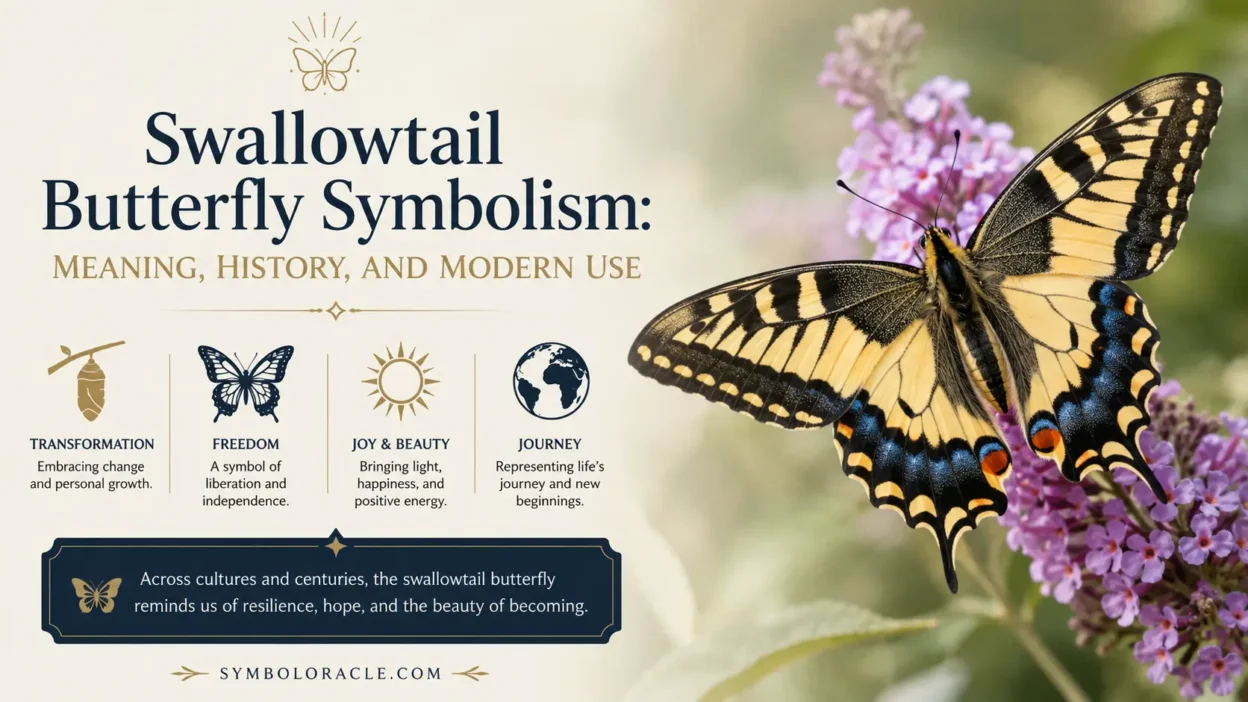
A swallowtail is easy to notice: broad wings, striking patterns, and, in many species, slender extensions that resemble a bird’s forked tail. Swallowtail butterfly symbolism most often centers on transformation, renewal, freedom, resilience, and the ability to move into a new stage of life.
Those meanings are partly inherited from the broader symbolism of butterflies. A caterpillar’s transformation into a winged adult has made butterflies natural images of change across art, religion, literature, and personal expression. The swallowtail adds its own visual character. Its confident flight, dramatic colors, and familiar presence in American gardens give it associations with vitality, independence, summer, and connection to the living landscape.
At the same time, there is no single ancient tradition assigning one universal meaning to every swallowtail species. Many interpretations people encounter today are modern readings built on older butterfly imagery rather than a separate historical code.
Quick Answer
Swallowtail butterfly symbolism commonly represents transformation, renewal, freedom, resilience, and positive personal change in modern American culture. Historically, these ideas grow mainly from broader butterfly associations with the soul, metamorphosis, mortality, and renewed life rather than from one ancient swallowtail-specific tradition.
TL;DR
- Swallowtails commonly represent transformation, renewal, freedom, and personal growth.
- Their life cycle naturally connects them with major transitions.
- Ancient butterfly imagery sometimes represented the soul and mortality.
- Americans often associate swallowtails with gardens, summer, and native wildlife.
- Tattoos frequently use them to mark change, independence, or remembrance.
- Species-specific spiritual claims should be treated cautiously.
What Makes a Swallowtail Distinctive?
Swallowtails belong to the butterfly family Papilionidae, a large group found across much of the world. Many species have narrow extensions projecting from the hindwings, producing the forked silhouette that inspired the common name. The family includes hundreds of species, although not every member actually has a pronounced tail.
In the United States, familiar examples include the eastern tiger swallowtail, black swallowtail, spicebush swallowtail, pipevine swallowtail, zebra swallowtail, and western tiger swallowtail.
Their appearance matters symbolically. A swallowtail can seem delicate when resting on a flower yet surprisingly energetic in flight. Bright yellow, black, blue, orange, cream, and iridescent markings make different species visually memorable.
That combination of delicacy and movement helps explain why people often read the butterfly as representing strength that does not need to look forceful.
What the Swallowtail Commonly Means in the United States
For most Americans, the swallowtail does not have one fixed ceremonial definition. Its meaning depends on context.
| Context | Common Meaning | Why It Fits | Important Note |
|---|---|---|---|
| Personal growth | Transformation | Butterfly metamorphosis creates an obvious change metaphor | Usually a modern interpretation |
| New beginnings | Renewal | Adult emergence suggests entering another stage | Not a prediction of future events |
| Tattoos | Freedom and independence | Flight suggests movement beyond old limits | Meaning varies by wearer |
| Memorial imagery | Soul, memory, transition | Older butterfly traditions connect wings with the soul | Beliefs differ by religion |
| Gardens and wildlife | Beauty and ecological connection | Swallowtails are familiar visitors to flowers and native plants | Also reflects real natural history |
| State symbolism | Regional identity | Some U.S. states officially recognize swallowtails | Civic meaning differs from spiritual meaning |
Transformation is the strongest recurring idea because it is grounded in the butterfly’s actual development. Freedom and resilience come more from human interpretation of its movement, survival, and appearance.
Transformation and the Courage to Change
The most natural symbolic reading comes from metamorphosis.
A swallowtail begins as an egg, becomes a caterpillar, enters the pupal stage, and finally emerges as an adult butterfly. The stages look so different that they provide a ready metaphor for major personal transitions.
Someone might therefore choose a swallowtail image after finishing school, leaving a difficult relationship, becoming a parent, recovering from a major setback, changing careers, or rebuilding life after a loss.
The symbolism is more useful when transformation is understood as a process rather than an instant miracle. The caterpillar does not simply decide to become something different. Its development requires distinct stages.
In personal symbolism, that can represent accepting an uncomfortable period between an old identity and a new one.
Renewal and the Meaning of a New Beginning
Transformation and renewal overlap, but they are not identical.
Transformation focuses on becoming different. Renewal emphasizes beginning again with changed circumstances.
For that reason, swallowtails can work well as images for fresh starts. A person may retain memories, skills, relationships, and parts of an earlier identity while still entering a distinctly new chapter.
Seasonal encounters reinforce the idea. In much of the United States, adult butterflies become noticeable during warmer months when vegetation is growing and flowers are blooming.
The result is an easy association between butterflies, warmth, movement, and life returning to the landscape.
Renewal here should not be confused with erasing the past. The more grounded interpretation is continuation through change.
Freedom, Movement, and Independence
A flying swallowtail has little visual resemblance to the caterpillar that came before it. That contrast makes flight an especially effective image of release.
In contemporary art and personal symbolism, the butterfly may represent leaving restrictions behind, choosing an independent direction, or gaining enough confidence to move freely.
A swallowtail tattoo after a major life decision, for example, may communicate: I can move forward on my own terms.
The symbol does not have to mean escaping another person. Freedom can also refer to abandoning an outdated self-image, social expectation, fear, or habit.
Its usefulness comes from the image of movement itself. Open wings imply possibility rather than permanence.
Resilience Hidden Behind a Delicate Appearance
Butterflies are frequently described as fragile, yet their real lives involve predators, weather, seasonal changes, and dependence on suitable habitat and host plants.
Swallowtail caterpillars also possess remarkable defensive adaptations. Eastern tiger swallowtail larvae change appearance as they develop, while swallowtail caterpillars have a specialized defensive structure called an osmeterium that can be exposed when threatened.
This makes resilience a particularly fitting modern interpretation.
Symbolically, the swallowtail can suggest remaining responsive rather than becoming hardened. Its apparent delicacy does not prevent it from surviving, adapting, feeding, reproducing, and moving through a demanding environment.
For people drawn to quieter forms of strength, that distinction can make the image more meaningful than symbols based on physical dominance.
Beauty, Joy, and the American Summer Garden
Not every symbolic meaning has to involve hardship.
Swallowtails are also associated with ordinary pleasure: flowers, warm weather, gardens, parks, hiking trails, and long summer afternoons.
Eastern tiger swallowtails are among the better-known large butterflies across the eastern United States. Their yellow-and-black wings make them highly visible around flowering plants and woodland edges.
Black swallowtails can appear surprisingly close to home because their caterpillars use plants in the carrot family. Garden plants such as dill, parsley, fennel, and carrots can serve as hosts.
That everyday familiarity gives the butterfly a second kind of symbolism: noticing beauty that is temporary without needing to possess it.
A swallowtail may remain at a flower for only a short time. Part of the pleasure comes from paying attention while it is there.
Ancient Roots: Butterflies, Psyche, and the Soul
The oldest symbolism relevant to the swallowtail usually belongs to butterflies as a broader category.
In classical Mediterranean imagery, butterflies became associated with the human soul. The Greek concept of psyche carried meanings connected with both soul and life, and later artistic representations of Psyche sometimes gave her butterfly wings.
Classical and later European artworks preserved this relationship. A Roman sarcophagus in the British Museum, for example, includes butterfly-winged Psyche imagery that has been interpreted in relation to the departing soul. The subject continued into later European sculpture, including portrayals of Psyche with butterfly wings.
This background helps explain why butterflies became suitable memorial symbols.
It does not prove that ancient Greeks assigned modern meanings such as “self-improvement” specifically to swallowtails. Those interpretations developed much later.
Butterflies in Christian Art and Resurrection Imagery
European Christian art also strengthened the connection between butterflies, death, and renewed life.
The progression from caterpillar to chrysalis to winged adult offered artists an intuitive visual analogy: earthly life, apparent death, and emergence into another state.
In European art, butterflies could therefore refer to the soul or to resurrection, particularly when included in works containing broader religious symbolism.
Modern Christians may still interpret butterfly imagery through ideas of resurrection, hope, or life beyond death.
However, the swallowtail itself is not a biblical emblem with a fixed scriptural meaning. Claims that a particular swallowtail species carries a specific message directly established by the Bible go beyond the historical evidence.
Its Christian meaning comes primarily from the wider butterfly tradition.
Cross-Cultural Meaning Requires Careful Distinctions
Butterflies appear in many cultural traditions, but one species should not automatically inherit the beliefs attached to another.
A useful example comes from Mexico, where monarch butterflies have distinctive cultural associations connected with migration, remembrance, and traditions surrounding the return of ancestors. Those beliefs are linked to monarchs and their extraordinary seasonal migration, not to every butterfly species worldwide.
This distinction matters because modern symbolism websites sometimes blend Greek, Mexican, Indigenous, Asian, and Christian traditions into one supposedly universal butterfly meaning.
Culture does not work that way.
A swallowtail can certainly remind an individual of an ancestor or carry spiritual significance within a family. That personal meaning is valid as personal symbolism. It should simply not be presented as an ancient cultural belief unless there is evidence connecting the specific tradition with that butterfly.
The Swallowtail in American Regional Identity
Swallowtails have meaning in the United States that goes beyond private symbolism.
Virginia officially recognizes the tiger swallowtail as its state insect. The species appears in the Commonwealth’s official list of state emblems, reflecting the butterfly’s strong regional familiarity.
Oklahoma chose the black swallowtail as its official state butterfly in 1996. The designation highlighted not mystical qualities but the butterfly’s ecological relationship with plant life and pollination.
These examples reveal a distinctly American layer of meaning: local nature as civic identity.
A butterfly can symbolize a state because residents recognize it as part of the landscape they share. That interpretation connects symbolism with conservation, gardening, education, and regional pride.
Does the Butterfly’s Color Change Its Meaning?
Color can influence how people interpret a swallowtail, but there is no universal dictionary assigning one spiritual message to each species.
A bright yellow tiger swallowtail may feel cheerful, energetic, or summery because yellow already carries strong associations with sunlight and visibility in American design.
A mostly black swallowtail can produce a more dramatic response. Some people connect black with mystery, mourning, seriousness, protection, or transition.
Blue accents may suggest calmness or individuality, while orange markings can add warmth and vitality.
These are color associations layered onto the butterfly rather than scientifically or historically fixed meanings.
That distinction is especially important with black butterflies. Seeing one is not evidence that death, disaster, or misfortune is approaching.
Tattoos, Jewelry, and Personal Style
Swallowtails work particularly well in tattoos because their wings provide a recognizable silhouette while allowing considerable artistic variation.
A tattoo may mark independence, recovery, adulthood, a move to a new place, a relationship milestone, or a commitment to personal growth.
The direction of the design can alter the visual message. Wings spread outward may emphasize freedom and confidence. A smaller butterfly in flight may suggest movement or transition. Flowers can shift the design toward growth, memory, nature, or a specific relationship.
Jewelry uses many of the same associations but often emphasizes beauty and movement more than biography.
In both cases, personal intention matters more than a supposedly universal definition. Two people can wear nearly identical swallowtails for completely different reasons.
Grief, Memorials, and Remembering Someone
Butterflies often appear in memorial contexts because transformation, flight, and older soul imagery can provide a gentle visual language for death.
A swallowtail used after losing someone may represent continuing love, the release of suffering, the passage from one state to another, or simply a memory tied to a particular person.
Sometimes the meaning begins with an actual encounter. A butterfly appearing during a funeral, anniversary, or period of grief may become personally significant because of when it was noticed.
That experience can matter emotionally without requiring a supernatural explanation.
The butterfly can function as a memory cue: each later encounter brings the person or moment back to mind.
Emotional and Psychological Meaning
Symbols often work by giving an abstract experience a visible form.
Change is difficult to draw. A butterfly makes it visible.
A person going through uncertainty may identify with the chrysalis stage because the old situation has ended while the next one is not fully formed. Someone who has recently gained independence may focus instead on open wings and flight.
The same image can therefore communicate vulnerability and confidence at different times.
This flexibility explains part of the swallowtail’s appeal. It allows people to represent identity as something capable of developing rather than something permanently fixed.
The butterfly does not need to predict an event to be psychologically useful. Its value can come simply from helping someone describe what they are experiencing.
Common Misunderstandings About Swallowtail Meaning
The biggest mistake is treating symbolic interpretation as biological fact.
Finding a swallowtail near your house does not scientifically indicate that money, romance, death, pregnancy, or spiritual awakening is about to occur.
Another problem is species confusion. Meanings associated with monarch migration, for example, should not automatically be presented as traditional swallowtail beliefs.
Likewise, a black swallowtail should not be labeled a bad omen simply because Western culture sometimes associates black with death.
Online interpretations can also become too precise. Claims such as “seeing three swallowtails means a specific event will happen within seven days” belong to modern divination systems, not documented natural or historical symbolism.
A more credible approach separates three things: documented cultural tradition, broadly shared modern symbolism, and individual interpretation.
How the Meaning Has Changed Over Time
The butterfly’s symbolism did not develop as one continuous tradition.
Classical imagery helped establish connections with the soul. Christian European art expanded associations with resurrection and life after death. Later decorative art often used butterflies simply because they were beautiful.
Modern culture shifted the emphasis again.
Today, transformation is frequently psychological rather than theological. A butterfly can represent becoming more confident, rebuilding after hardship, leaving an old identity, or accepting change.
Environmental awareness has added another layer. For gardeners and wildlife enthusiasts, seeing a swallowtail may also represent healthy habitat and the relationship between native plants, caterpillars, flowers, and pollinators.
That ecological meaning is particularly appropriate because many swallowtail species depend on specific larval host plants. Black swallowtails use plants in the parsley family, while tiger, spicebush, zebra, and other swallowtails rely on different plants during their caterpillar stages.
The modern symbol therefore sits at the intersection of personal change and real natural relationships.
Frequently Asked Questions
What does seeing a swallowtail butterfly mean?
Seeing one is commonly interpreted as a reminder of transformation, renewal, freedom, or appreciating a temporary moment. There is no scientific evidence that an encounter predicts a particular future event.
What does a swallowtail symbolize spiritually?
In contemporary spiritual use, it may represent the soul, transition, renewal, or moving from one stage of existence into another. These interpretations draw largely from older butterfly symbolism rather than one universal swallowtail tradition.
What does a swallowtail tattoo mean?
A tattoo often represents personal transformation, independence, resilience, or beginning a new chapter. Memorial tattoos may instead emphasize remembrance, continued emotional connection, or peaceful transition.
Is a black swallowtail a bad omen?
No established evidence makes the black swallowtail a universal bad omen. Negative interpretations usually come from broader associations with the color black rather than from the butterfly itself.
Does the swallowtail symbolize love?
It can represent love when used in jewelry, tattoos, wedding imagery, or gifts, especially when the design is connected to growth or a relationship entering a new stage. Love is a contextual meaning rather than the swallowtail’s primary historical association.
Does a swallowtail symbolize someone who has died?
It can in personal or memorial symbolism. Older traditions connecting butterflies with the soul help explain this interpretation, but seeing a butterfly should not be presented as proof that a deceased person is communicating.
What is the difference between monarch and swallowtail symbolism?
Both can represent transformation because both undergo metamorphosis. Monarchs also carry distinctive associations with long-distance migration and particular Mexican remembrance traditions, so those culturally specific meanings should not automatically be transferred to swallowtails.
Conclusion
The strongest meanings attached to swallowtail butterfly symbolism come from a simple combination of biology and human experience: dramatic transformation, flight after confinement, survival through vulnerable stages, and the brief beauty of an adult butterfly moving through the landscape.
Older traditions add associations with the soul, mortality, and renewed life, while modern Americans often use the swallowtail more personally—as a sign of independence, recovery, remembrance, environmental connection, or entering a new chapter.
Its meaning does not depend on believing that a butterfly carries a predetermined message. Sometimes the most useful symbolism comes from what the animal actually demonstrates: change can alter the shape of a life without erasing the life that came before.


