
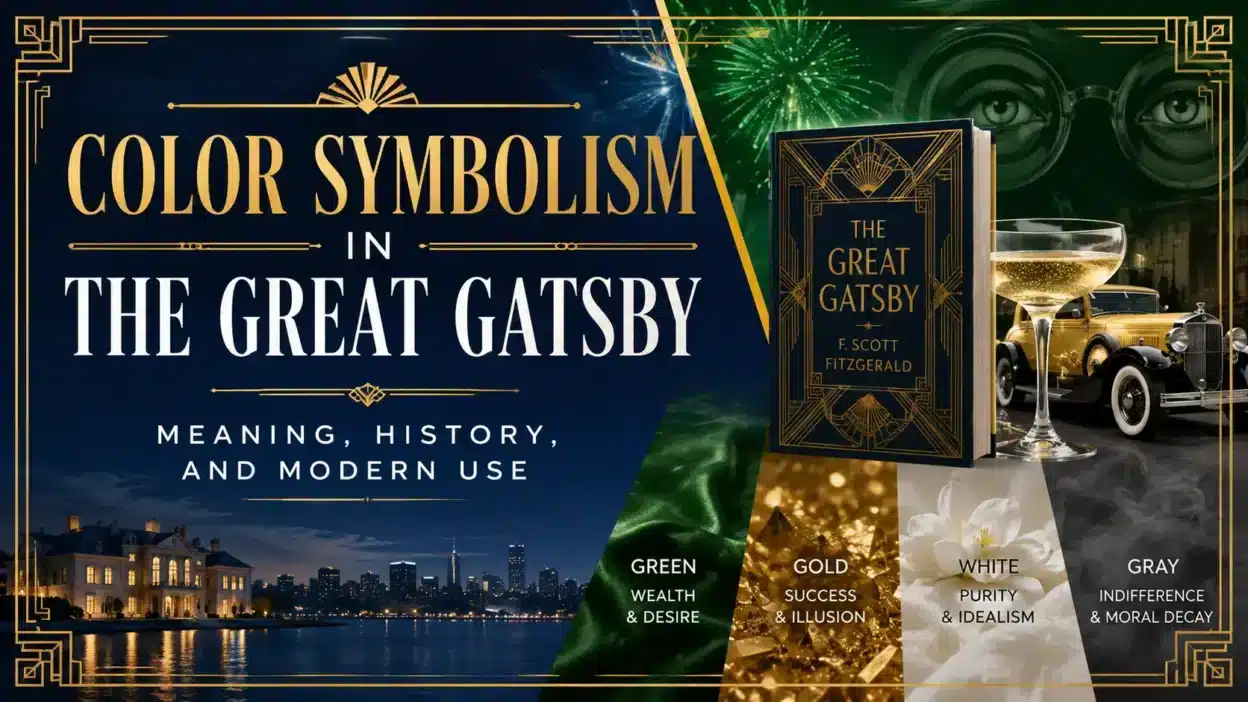
Few American novels use color as intentionally as F. Scott Fitzgerald’s The Great Gatsby. Rather than serving as simple visual details, colors help reveal characters’ ambitions, emotions, social status, and moral struggles. Understanding color symbolism in The Great Gatsby gives readers a deeper appreciation of how Fitzgerald tells his story without always stating ideas directly.
Published in 1925, the novel reflects the optimism and uncertainty of the Jazz Age, a period marked by wealth, consumer culture, and changing social values. Fitzgerald carefully selected recurring colors to reinforce larger themes such as the American Dream, illusion, class division, love, and corruption.
A century later, American students continue studying these symbols in classrooms, while filmmakers, artists, and literary critics regularly reference the novel’s distinctive color palette. Its symbolism remains relevant because the emotions behind the colors—hope, envy, innocence, ambition, and loss—still resonate today.
Quick Answer
Color symbolism in The Great Gatsby commonly represents the contrast between dreams and reality in modern American literary interpretation. Historically, Fitzgerald used recurring colors such as green, white, yellow, blue, and gray to illustrate wealth, innocence, social class, moral decline, hope, and the changing American Dream.
TL;DR
- Green symbolizes hope and unreachable dreams.
- White often masks innocence with deception.
- Yellow reflects wealth mixed with corruption.
- Gray represents emptiness and moral decay.
- Blue suggests distance, loneliness, and illusion.
- Colors deepen the novel’s central themes.
Why Color Matters in The Great Gatsby
Unlike many novels where color simply describes scenery, Fitzgerald uses colors almost like another language. Certain shades appear repeatedly around specific characters, places, or objects, encouraging readers to connect visual details with emotional meaning.
This technique allows readers to notice patterns. A color that first appears hopeful may later reveal disappointment. Another may seem beautiful on the surface but gradually expose dishonesty beneath.
Because the colors recur throughout the novel, they become part of the story’s structure rather than decorative details.
The Green Light: Hope, Desire, and the American Dream
No color is more famous in The Great Gatsby than green.
The green light at the end of Daisy Buchanan’s dock represents Gatsby’s greatest hope: winning Daisy back and recreating an idealized past. Although physically close across the bay, it remains emotionally and socially distant.
For many American readers, the green light also symbolizes:
- ambition
- opportunity
- future success
- perseverance
- dreams that remain just out of reach
As the novel progresses, the light changes from a symbol of possibility into a reminder that some dreams cannot survive reality.
Today, many literature classes also connect the green light with the broader American Dream—the belief that hard work can achieve happiness and success, even when those goals prove elusive.
White: Purity, Wealth, and False Innocence
White traditionally symbolizes purity, honesty, and innocence in American culture. Fitzgerald intentionally challenges those expectations.
Daisy and Jordan are frequently surrounded by white clothing, white rooms, and bright interiors. At first, these images suggest elegance and virtue.
However, readers gradually discover that appearances can be misleading.
Instead of representing genuine innocence, white often symbolizes:
- carefully maintained appearances
- privilege
- emotional distance
- hidden selfishness
- social refinement without moral responsibility
The contrast between visual purity and questionable behavior becomes one of Fitzgerald’s sharpest critiques of upper-class society.
Yellow and Gold: Wealth with Two Different Meanings
Although readers often group yellow and gold together, Fitzgerald uses them differently.
Gold usually represents established wealth, prestige, and old-money respectability.
Yellow, meanwhile, often signals wealth that is flashy, excessive, or morally questionable.
Examples include Gatsby’s luxurious automobile and extravagant parties, where brilliant colors create excitement but also foreshadow tragedy.
This distinction reflects America’s growing consumer culture during the 1920s. Expensive possessions could create the appearance of success without providing lasting happiness or integrity.
Gray: Moral Emptiness and Social Neglect
Gray dominates the Valley of Ashes, one of the novel’s most memorable settings.
Unlike the bright mansions of East Egg and West Egg, this industrial wasteland appears lifeless and colorless.
Gray symbolizes:
- hopelessness
- poverty
- spiritual exhaustion
- forgotten communities
- consequences of unchecked wealth
The Valley of Ashes reminds readers that prosperity often depends on invisible labor and unequal opportunity.
Even today, many American readers interpret this setting as a criticism of economic inequality and environmental neglect.
Blue: Distance, Isolation, and Reflection
Blue appears less frequently than green or white but carries emotional weight.
Blue often surrounds Gatsby himself through descriptions of gardens, clothing, and moonlit settings.
Rather than representing happiness, Fitzgerald uses blue to suggest:
- loneliness
- emotional separation
- nostalgia
- uncertainty
- unattainable ideals
The calm appearance of blue often hides inner sadness, reflecting Gatsby’s inability to bridge the gap between fantasy and reality.
Silver: Luxury and Modern Elegance
Silver appears in descriptions of expensive automobiles, fashionable clothing, and glamorous settings.
During the Jazz Age, silver represented sophistication, technological progress, and refined wealth.
Within the novel, silver also suggests movement and glamour. Yet these polished surfaces rarely reveal genuine emotional connection.
The color reminds readers that material beauty can coexist with emotional emptiness.
The Eyes of Doctor T. J. Eckleburg and Faded Colors
Although the giant billboard is known primarily for its enormous blue eyes, its faded paint is equally important.
The weathered advertisement represents a world where commercial images outlast personal values.
Its worn colors suggest:
- declining ideals
- moral uncertainty
- forgotten responsibility
- spiritual emptiness
Readers have long debated whether the billboard symbolizes God, society’s conscience, or simply the illusion that someone is always watching.
How Fitzgerald Uses Color to Define Social Class
Colors help distinguish different social groups throughout the novel.
| Context | Meaning in the USA | Common Associations | Notes |
|---|---|---|---|
| Green Light | Hope and ambition | American Dream | Future remains distant |
| White Clothing | Apparent innocence | Wealth, elegance | Appearance hides flaws |
| Yellow Car | Flashy success | Luxury, danger | Leads toward tragedy |
| Gray Valley | Poverty | Industrial decline | Moral neglect |
| Blue Settings | Reflection | Loneliness, distance | Emotional isolation |
Rather than directly explaining class differences, Fitzgerald lets readers observe them through recurring visual patterns.
Color Symbolism and the American DreamColor Symbolism in The Great Gatsby
The novel’s colors ultimately revolve around one central idea: the American Dream.
Green encourages optimism.
Gold celebrates achievement.
Yellow questions whether wealth alone creates fulfillment.
Gray exposes those left behind.
White reveals that appearances can hide uncomfortable truths.
Together, these colors illustrate both the promise and limitations of American success during the 1920s.
Emotional and Psychological Meaning of the Colors
Readers often connect the novel’s colors with recognizable emotions.
Green reflects longing.
Blue conveys quiet sadness.
Gray expresses emotional fatigue.
White creates uncertainty because it appears innocent while concealing complexity.
Yellow generates excitement but also anxiety.
These emotional responses explain why the novel continues to resonate with readers nearly a century after publication.
Cross-Cultural Perspectives on the Colors
Many of Fitzgerald’s color choices align with broader cultural traditions while taking on uniquely American meanings.
Green often symbolizes growth and renewal in Western cultures, making its connection to hope understandable. White commonly represents purity in North America and Europe, though in several East Asian traditions it is associated with mourning. Gold has long symbolized prosperity across many civilizations, while gray frequently conveys age, hardship, or uncertainty.
Fitzgerald draws on these familiar associations but adapts them to critique American society rather than simply reinforce traditional symbolism.
Color Symbolism in Modern American Education and Popular Culture
Today, millions of American students encounter The Great Gatsby in high school and college literature courses.
Teachers frequently encourage students to trace recurring colors as a way of understanding symbolism and character development.
Beyond the classroom, the novel’s color symbolism appears in:
- film adaptations
- theater productions
- artwork
- literary discussions
- educational videos
- classroom presentations
- book clubs
- social media analyses
Modern adaptations often emphasize the novel’s vivid colors through costume design, lighting, and cinematography to help contemporary audiences recognize Fitzgerald’s symbolic patterns.
Common Misunderstandings About the Colors
One common mistake is believing each color has only one fixed meaning.
Fitzgerald intentionally gives colors multiple layers depending on the scene and character.
Another misunderstanding is assuming white always represents goodness or that yellow always represents greed.
Instead, meanings shift with context.
This complexity is one reason the novel remains widely studied. The colors invite interpretation rather than providing simple answers.
How the Meanings Have Evolved Since 1925
When the novel was first published, many readers focused primarily on its depiction of wealthy society.
Later generations increasingly viewed its colors as symbols of broader American experiences.
Today, readers often connect the green light with personal goals, career ambitions, or dreams beyond romance. Gray has gained relevance in conversations about economic inequality, while white continues to spark discussions about appearance versus authenticity.
These evolving interpretations show how literary symbolism can remain meaningful as society changes.
Frequently Asked Questions
What does the green color symbolize in The Great Gatsby?
Green primarily represents Gatsby’s hope for the future and his dream of being reunited with Daisy. More broadly, it symbolizes the promise and limitations of the American Dream.
Why is white associated with Daisy Buchanan?
White reflects Daisy’s graceful appearance and privileged lifestyle, but Fitzgerald also uses it to question whether outward beauty truly reflects inner character. The contrast between appearance and reality is central to her symbolism.
What does the yellow car represent?
The yellow automobile symbolizes flashy wealth, public display, and the dangers of valuing status over responsibility. Its role in the novel also connects it with tragedy and the consequences of reckless ambition.
Why is the Valley of Ashes gray?
Gray represents neglect, poverty, and moral emptiness. The setting reminds readers that the prosperity enjoyed by some exists alongside hardship experienced by others.
Are the colors based on traditional color symbolism?
Many are. Fitzgerald builds on familiar Western associations with colors such as green, white, and gold while adapting them to express the social realities of 1920s America and the novel’s themes.
Why do teachers emphasize color symbolism?
Following recurring colors helps students recognize how Fitzgerald develops themes without explaining everything directly. It demonstrates how imagery can shape meaning across an entire novel.
Conclusion
Fitzgerald’s use of color transforms ordinary descriptions into a carefully organized system of meaning. Green captures hope, white questions appearances, yellow exposes the risks of material success, gray reflects social neglect, and blue expresses emotional distance. Together, these colors reveal the novel’s exploration of ambition, class, identity, and disappointment.
A century after its publication, color symbolism in The Great Gatsby continues to help readers understand not only the novel itself but also enduring questions about success, appearance, and the American Dream. Its lasting influence comes from the way familiar colors communicate complex ideas with remarkable clarity, inviting each new generation to look beyond what is seen on the surface.