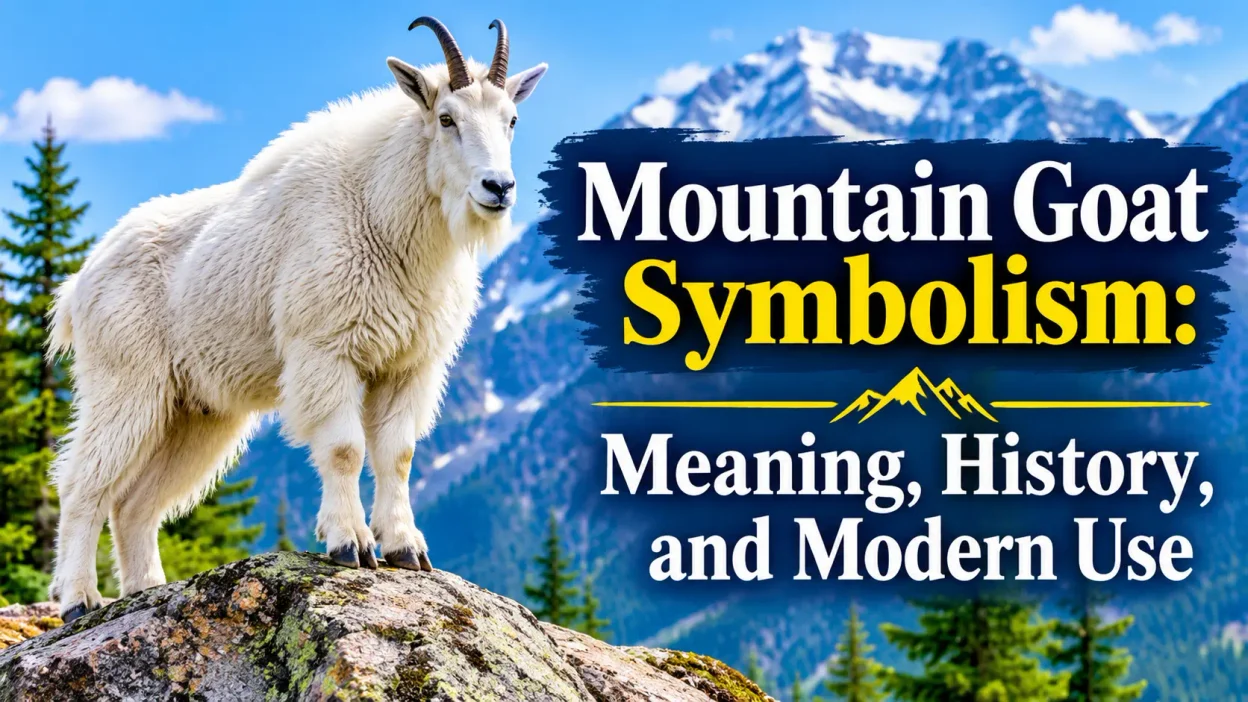
A mountain goat standing on a narrow cliff ledge is an unusual sight. Its white coat blends with the snow, its hooves grip uneven rock, and its body remains steady where another animal might struggle. These qualities help explain why mountain goat symbolism is commonly connected with resilience, independence, determination, and the ability to overcome difficult challenges.
In the United States, mountain goats are closely associated with the rugged landscapes of the northern Rocky Mountains, Alaska, and the Pacific Northwest. Their natural ability to climb steep terrain has made them fitting symbols of confidence, ambition, and self-reliance. However, their cultural significance extends beyond modern ideas about personal strength.
For Indigenous peoples of the Pacific Northwest, mountain goats have also been important sources of food, clothing materials, trade, and ceremonial textiles. Their wool, horns, and hides carry cultural histories that should not be reduced to general ideas about courage or perseverance.
Understanding this animal’s symbolism means looking at both its behavior in the wild and the communities that have valued it over generations.
Quick Answer
Mountain goat symbolism commonly represents resilience, independence, determination, sure-footedness, and the ability to overcome difficult obstacles in modern American culture. Historically, mountain goats also held important cultural, material, and ceremonial significance among Indigenous peoples of the Pacific Northwest.
TL;DR
- Resilience: Continuing forward despite difficult conditions.
- Independence: Depending on personal ability and judgment.
- Determination: Pursuing challenging goals with patience.
- Confidence: Remaining steady in uncertain situations.
- Indigenous heritage: Representing important traditions of Northwest Coast communities.
- Adaptability: Surviving in demanding mountain environments.
What a Mountain Goat Looks Like and What Makes It Distinctive
The North American mountain goat (Oreamnos americanus) is a sturdy, white-coated mammal that lives in mountainous regions of western North America. Despite its common name, it is not a true goat. It belongs to the bovid family, which also includes cattle, sheep, and other hoofed mammals.
Several physical features make it easy to recognize:
- White coat: Thick, shaggy fur protects it from freezing temperatures and harsh mountain weather.
- Black horns: Both males and females have short, pointed black horns that curve slightly backward.
- Strong legs: Muscular forequarters help the animal climb steep slopes.
- Specialized hooves: Split hooves with flexible inner pads provide traction on narrow rock surfaces.
- Compact body: Its sturdy build helps it maintain balance on uneven ground.
Mountain goats are commonly found in Alaska, Washington, Montana, Idaho, and parts of the northern Rocky Mountains. They also live in the Cascade and other western mountain ranges.
Their appearance contributes to their symbolic associations. The white coat suggests winter, endurance, and survival, while their horns and climbing ability can suggest confidence and determination.
However, their most recognizable feature is their ability to move across difficult terrain without appearing unsettled.
The Main Symbolic Meanings of Mountain Goats
Mountain goats can represent several related qualities, but their symbolism usually begins with their natural behavior.
Resilience and endurance
Mountain goats survive in places where cold temperatures, limited food, and rough terrain create constant challenges. Their ability to remain in these environments makes them natural symbols of endurance.
People may connect this quality with recovering from setbacks, continuing through difficult periods, and developing emotional strength.
Independence and self-reliance
A mountain goat often appears alone on a distant ridge or rocky ledge. This image encourages associations with independence and the ability to make decisions without depending on constant approval from others.
It can represent someone who values personal freedom and trusts their own judgment.
Determination and ambition
The animal’s climbing ability provides a clear image of working toward a difficult goal. A steep mountain becomes a representation of an obstacle, while the goat reaching higher ground represents persistence.
This meaning is particularly relevant to people pursuing education, careers, business goals, or personal changes.
Balance and confidence
Mountain goats must place their feet carefully. One careless movement can create serious danger.
Symbolically, this behavior represents careful judgment, patience, and confidence that comes from preparation rather than arrogance.
Adaptability
The animal changes its movements and feeding locations according to seasonal conditions. Its survival depends on responding to the environment rather than following one fixed routine.
This makes it a useful symbol of flexibility and practical intelligence.
Historical Origins of Mountain Goat Symbolism
Unlike some animals associated with ancient written mythology, the mountain goat does not have one universally accepted symbolic origin. Its meaning developed through different relationships between people, animals, and mountain landscapes.
For Indigenous communities in the Pacific Northwest, mountain goats were much more than animals observed from a distance. They provided meat, wool, horns, and bones that supported everyday life and cultural practices.
Mountain goat wool was particularly valuable. Skilled weavers used it to produce blankets and garments, sometimes combining it with other natural fibers. These textiles required considerable knowledge, labor, and access to mountain resources.
The animal’s materials also entered trade networks between communities. Its wool and finished textiles could carry economic and social importance.
Over time, mountain goats also became recognizable elements of the cultural identity of Northwest Coast communities. Their presence in traditional material culture demonstrates a relationship built on practical knowledge, artistic skill, and respect for the natural environment.
This historical background is important because it offers a more specific explanation of the animal’s significance than simply describing it as a symbol of strength.
Mountain Goat Symbolism in Indigenous Pacific Northwest Cultures
The Pacific Northwest has some of the strongest historical connections between mountain goats and Indigenous cultural traditions.
Among Coast Salish communities, mountain goat wool has been used in weaving for generations. Traditional textiles included blankets and garments created through specialized weaving techniques.
These objects were not simply ordinary pieces of clothing. They could carry ceremonial, social, and cultural importance.
Tlingit, Haida, and Tsimshian communities also have historical connections to mountain goat wool textiles and Northwest Coast weaving traditions. In particular, Chilkat-style and related ceremonial robes demonstrate the importance of skilled fiber work and regional exchange.
The meaning of these materials should be understood within the individual communities that produced and valued them. It would be inaccurate to assign one identical spiritual interpretation to every Indigenous nation.
For the Tulalip Tribes and other communities involved in mountain goat conservation, the animal also represents an ongoing relationship with ancestral landscapes and traditional resources.
Today, cultural continuity includes both preserving traditional knowledge and protecting the mountain goat populations that make these practices possible.
What Mountain Goats Represent in American Culture
In modern American culture, mountain goats are strongly associated with wilderness, adventure, and the ability to handle difficult situations.
Their natural habitat gives them a recognizable connection to the American West. National parks, mountain trails, wildlife photography, and outdoor recreation all contribute to this image.
1. The spirit of outdoor adventure
For hikers, climbers, and nature enthusiasts, mountain goats represent the freedom and challenge of exploring wild landscapes.
Seeing one standing on a steep mountain can remind people that nature operates according to its own conditions. Humans must adapt to the environment rather than expect the environment to adapt to them.
2. Personal achievement
The image of a mountain goat climbing toward a high ridge works well as a metaphor for reaching a difficult goal.
It can represent graduation, career development, athletic achievement, or overcoming a personal setback.
3. Western identity
In parts of the western United States, mountain goats are recognizable symbols of alpine wildlife. Their presence helps distinguish high-elevation landscapes from forests, deserts, and coastal environments.
4. Environmental awareness
Mountain goats also represent the importance of protecting fragile mountain ecosystems. Their dependence on suitable alpine habitat makes them relevant to conversations about wildlife management and climate change.
These meanings are especially visible in nature education, conservation campaigns, and outdoor communities.
The Spiritual Meaning of a Mountain Goat
In contemporary spiritual interpretations, a mountain goat can represent discipline, inner stability, independence, and the willingness to move through challenging periods.
These interpretations are personal rather than universal religious teachings.
The mountain itself often represents a difficult journey, while the goat symbolizes the ability to keep moving through that journey. This combination creates an image of someone who does not expect every path to be easy but remains committed to reaching a meaningful destination.
Some people also associate the animal with grounded confidence. Its ability to maintain balance on narrow ledges suggests the importance of staying centered when life becomes uncertain.
Another interpretation connects the mountain goat with personal growth. Reaching a higher elevation can represent gaining experience, understanding, or a broader perspective.
It is important to distinguish these modern spiritual readings from established Indigenous cultural traditions. A personal spiritual interpretation does not automatically represent a teaching shared by a particular tribe or religion.
Psychological and Emotional Meaning
The mountain goat can serve as a psychological symbol because its behavior reflects qualities people often want to develop in themselves.
Self-confidence: The goat’s steady movement across difficult terrain can represent trusting one’s preparation and abilities.
Emotional resilience: Its survival in harsh conditions can suggest the capacity to recover after disappointment or hardship.
Patience: Climbing safely requires choosing each step carefully. This reflects the value of avoiding rushed decisions.
Personal boundaries: Its preference for rugged, secure terrain can suggest the importance of knowing where one feels safe and comfortable.
Courage: Moving across a steep mountainside provides a visual connection with facing fear without allowing it to control every decision.
The animal can also represent a healthier understanding of ambition. Progress does not always require speed. Sometimes the best way forward is to move slowly, recognize risks, and maintain balance.
For someone experiencing a major life transition, this interpretation may feel particularly relevant.
Mountain Goat Symbolism in Different Contexts
The same animal can communicate different ideas depending on where it appears and how people use its image.
| Context | Symbolic meaning | Common association |
|---|---|---|
| Personal growth | Persistence and development | Overcoming challenges |
| Spiritual interpretation | Inner stability and direction | Finding personal balance |
| Indigenous cultural traditions | Heritage and continuity | Weaving and ceremonial textiles |
| Outdoor culture | Adventure and endurance | Mountain climbing |
| Conservation | Ecological responsibility | Protecting alpine habitats |
| Personal identity | Independence and confidence | Self-reliance |
The table shows why context matters. A mountain goat on an outdoor organization logo may communicate adventure, while the same animal represented in a traditional textile may carry a much more specific cultural meaning.
Mountain Goat Symbolism in Tattoos and Personal Style
Mountain goat tattoos are often chosen by people who identify with independence, determination, and outdoor adventure.
Unlike some animal tattoos that have established religious or mythological associations, a mountain goat tattoo usually communicates a personal message. Its meaning depends on the person’s experiences and the design.
Common interpretations include:
- A goat climbing a mountain: Working toward a difficult goal.
- A mountain goat standing on a cliff: Confidence and personal independence.
- A mountain goat with snow-covered peaks: Endurance and connection with nature.
- A goat head with prominent horns: Strength, courage, and determination.
- A minimalist goat outline: A quiet expression of individuality and self-reliance.
Some people choose mountain goat imagery because they enjoy hiking, mountaineering, or spending time in the wilderness. Others use it as a reminder of a difficult period they successfully overcame.
Mountain goat designs can also appear on necklaces, outdoor clothing, artwork, and decorative objects.
When choosing a design inspired by Indigenous Northwest Coast traditions, it is important to recognize that traditional patterns and ceremonial textiles have specific cultural histories. They should not be treated as interchangeable decorative motifs.
The Meaning of the Mountain Goat’s White Coat and Horns
The mountain goat’s physical appearance contributes to several modern symbolic interpretations.
Its white coat is particularly noticeable against dark rock and green mountain vegetation.
In general American color symbolism, white is often associated with:
- Cleanliness and simplicity
- Peace and calmness
- Fresh beginnings
- Winter and natural beauty
- Clarity and openness
When applied to a mountain goat, these associations can suggest a calm personality that remains steady under pressure.
Its black horns offer a visual contrast. In personal artwork, they may represent protection, confidence, or the ability to defend personal boundaries.
However, these are interpretations of visual features, not fixed meanings established across cultures.
The animal’s actual horns serve biological purposes. They are not evidence that mountain goats possess aggression or supernatural protection.
Mountain Goat Symbolism Across Different Cultural Traditions
Mountain goats do not have one shared meaning across world religions and cultures.
Their symbolic significance is most clearly documented among communities that historically lived near their natural range, particularly along the Pacific Northwest Coast.
In these communities, the animal’s wool and other materials became part of important cultural practices.
Elsewhere, people may interpret mountain goats through their resemblance to other mountain-dwelling animals. This can create associations with climbing, survival, and independence, but those interpretations should not be confused with specific historical traditions.
It is also useful to distinguish mountain goats from domestic goats, ibexes, and other wild caprines.
For example, the ibex appears in various Eurasian artistic and historical traditions. Although it shares some physical similarities with the North American mountain goat, the two animals have different geographical histories.
Likewise, general stories about goats in Greek mythology or religious traditions do not automatically describe the symbolism of Oreamnos americanus.
A responsible interpretation begins with the actual animal and the cultural setting in which its image appears.
What Does Seeing a Mountain Goat Symbolize?
Seeing a mountain goat in the wild can create a memorable experience, particularly for someone visiting a national park or exploring a mountain trail.
Some people interpret the encounter as a personal reminder to remain determined, trust their abilities, or continue working toward a difficult goal.
Others connect it with a desire for freedom, solitude, or a closer relationship with nature.
A mountain goat sighting can also encourage practical reflection. Its ability to move across steep terrain demonstrates the value of preparation, awareness, and careful decision-making.
There is no established evidence that seeing a mountain goat predicts a future event or guarantees good fortune.
The meaning of the experience depends on the observer’s circumstances and personal beliefs.
For someone facing an important decision, the animal might represent the need to choose a reliable path rather than the fastest one.
Negative and Less Common Interpretations
Mountain goat symbolism is generally positive in contemporary American interpretations, but not every association is favorable.
Its solitary appearance can suggest isolation or emotional distance. A person who strongly identifies with independence may sometimes struggle to accept support from others.
Its determination can also be interpreted as stubbornness. Continuing toward a goal is valuable, but refusing to change direction when circumstances demand it can become harmful.
Other less favorable interpretations include:
- Risk-taking: Confidence can become carelessness when someone ignores danger.
- Emotional distance: Independence can turn into an unwillingness to connect with others.
- Stubborn ambition: Pursuing success without considering consequences can create problems.
- Excessive pride: Personal strength does not mean someone must handle every difficulty alone.
These interpretations are not traditional negative meanings attached to the species. They are possible human readings of qualities associated with the animal.
The distinction matters because mountain goats are not symbols of recklessness. Their survival actually depends on selecting suitable terrain and avoiding unnecessary risks.
Mountain Goats, Conservation, and the Changing Meaning of Wilderness
Mountain goats have become important animals in American wildlife conservation.
Their survival depends on suitable alpine and subalpine habitats, including rocky slopes, mountain meadows, and areas that provide protection from predators.
Climate change creates additional pressure on these environments. Rising temperatures can alter snow conditions, vegetation, and the availability of suitable high-elevation habitat.
In Glacier National Park, for example, warming conditions have raised concerns about the long-term suitability of habitat for mountain goats, particularly near the southern edge of their native range.
Wildlife management also involves balancing human recreation with the needs of mountain animals. Hiking, tourism, and other activities can affect wildlife when people approach animals too closely or disturb important habitat.
This conservation perspective adds another layer to the animal’s modern meaning.
A mountain goat is not simply an image of personal strength. It is also a living species that depends on a healthy natural environment.
Its symbolism can therefore encourage people to think about responsibility, habitat protection, and the relationship between human activity and wildlife.
How Mountain Goat Symbolism Has Evolved Over Time
The meaning of mountain goats has changed as human relationships with the animal have changed.
Historically, many Indigenous communities valued mountain goats for their meat, wool, horns, and other materials. Their importance was connected to practical needs, cultural identity, artistic production, trade, and ceremonial life.
As national parks, wildlife photography, and outdoor recreation became more prominent in American culture, the animal increasingly became recognizable as an emblem of alpine wilderness.
In contemporary personal expression, its image is often used to communicate determination, independence, and the ability to overcome obstacles.
Three broad stages help explain this development:
- Traditional relationships: Mountain goats were valued as important natural resources and cultural elements among communities within their range.
- Wildlife and wilderness identity: Their distinctive appearance and climbing ability became closely associated with western mountain landscapes.
- Modern personal symbolism: People began using the animal’s natural qualities as visual expressions of ambition, confidence, resilience, and individuality.
These stages are not a replacement of one meaning with another. Traditional cultural connections continue, while modern interpretations have developed alongside them.
The animal can represent different things to different people without losing its historical importance.
Common Misunderstandings About Mountain Goat Symbolism
Several misunderstandings can make interpretations of mountain goats less accurate.
1. Mountain goats are not domestic goats.
Despite their name, they are a distinct wild species native to northwestern North America. Their natural behavior and habitat differ from those of farm goats.
2. Every mountain goat encounter is not a spiritual sign.
Some people attach personal meaning to wildlife encounters, but there is no universal spiritual message associated with seeing one.
3. All Indigenous communities do not share one interpretation.
The cultural importance of mountain goats varies between nations and communities. Specific traditions should be understood within their own histories.
4. Independence does not mean complete isolation.
Mountain goats may appear solitary, but they also live in groups. Their behavior does not support the idea that success always requires avoiding other people.
5. Climbing ability does not mean taking unnecessary risks.
Mountain goats rely on specialized physical adaptations and careful habitat selection. Their behavior is better understood as skilled movement than reckless bravery.
Understanding these distinctions makes the animal’s symbolism more meaningful and avoids turning biological facts or cultural traditions into unsupported claims.
Frequently Asked Questions
1. What does a mountain goat symbolize spiritually?
A mountain goat can symbolize personal growth, determination, independence, and inner stability in contemporary spiritual interpretations. People may view its ability to climb difficult terrain as a reminder to remain committed to their goals.
2. What does a mountain goat tattoo mean?
A mountain goat tattoo commonly represents resilience, ambition, confidence, and self-reliance. Its meaning can become more personal when connected to someone’s experiences with outdoor adventure or overcoming hardship.
3. Is a mountain goat a symbol of strength?
Yes. Its muscular body, specialized hooves, and ability to navigate steep mountain environments make it a natural representation of physical and mental endurance. It can also suggest strength through patience and careful judgment.
4. What does a mountain goat represent in Native American culture?
Mountain goats have important cultural and material significance among several Indigenous communities of the Pacific Northwest. Their wool, horns, and hides have been used in traditional textiles, tools, clothing, and ceremonial objects, although meanings differ between communities.
5. Is mountain goat symbolism positive or negative?
Mountain goat symbolism is generally positive, especially when associated with persistence, independence, and confidence. However, its qualities can also suggest stubbornness, isolation, or excessive ambition when interpreted negatively.
6. What does it mean when you see a mountain goat in the wild?
A mountain goat sighting can personally represent resilience, freedom, or a connection with nature. There is no universally accepted prediction or spiritual message attached to the encounter.
7. Why are mountain goats associated with overcoming obstacles?
Mountain goats are naturally adapted to steep, rocky environments that would be difficult for many other animals to navigate. Their climbing ability provides a clear metaphor for making steady progress despite challenging circumstances.
Conclusion
Mountain goats represent resilience, independence, determination, and the ability to maintain balance under difficult conditions. Their natural climbing skills explain many of the qualities people associate with them in modern American culture.
However, their significance extends beyond personal motivation. Indigenous communities of the Pacific Northwest have long valued mountain goats for their materials, traditional textiles, trade, and cultural practices. These connections remain an important part of the animal’s history.
Ultimately, mountain goat symbolism brings together two meaningful ideas: the ability to adapt to a demanding environment and the importance of maintaining a connection with the natural world. Its most practical lesson is that reaching higher ground requires more than ambition; it requires patience, judgment, and a steady approach.