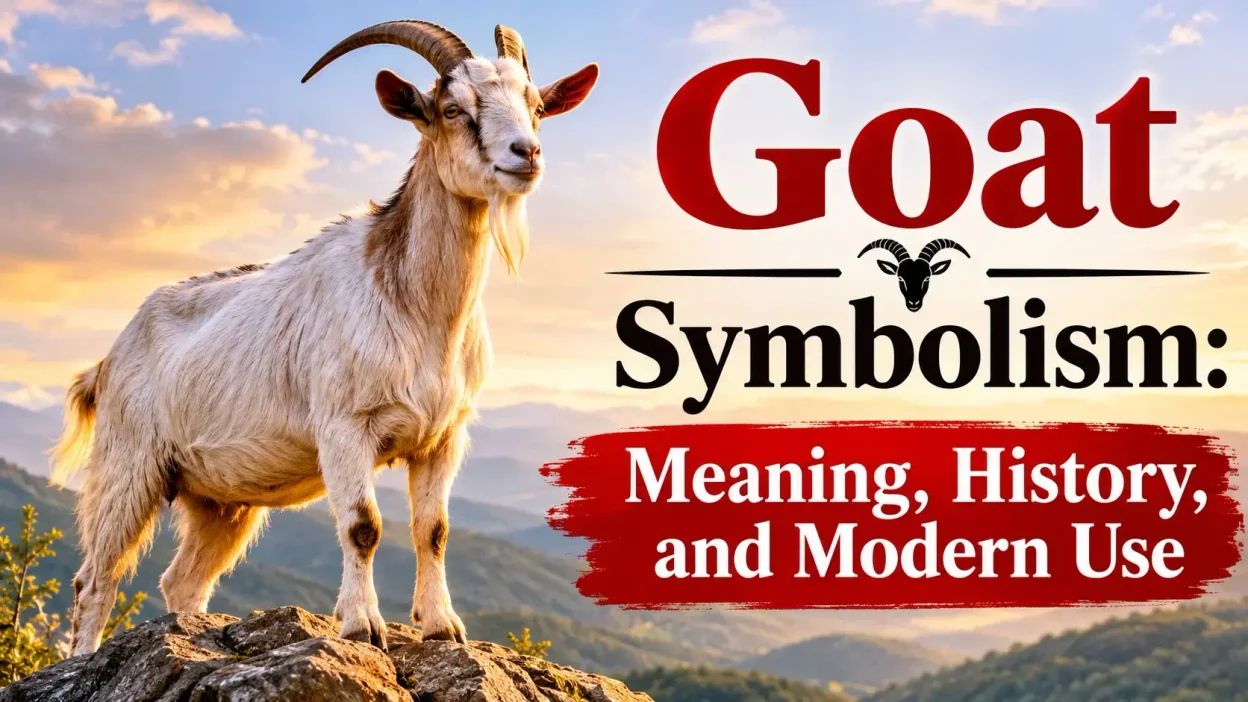
Goats have represented very different ideas across human cultures. In goat symbolism, the animal can stand for independence, determination, fertility, sacrifice, ambition, and even rebellion. Its meaning often depends on how it appears, the tradition connected to it, and the qualities people associate with its behavior.
Unlike animals that carry one familiar symbolic meaning, goats have a complicated reputation. They are valued as hardworking farm animals, admired for their ability to climb difficult terrain, and remembered in religious stories involving sacrifice and the removal of sin. In mythology, their horns, hooves, and energetic nature also connect them with wild landscapes and untamed instincts.
In the United States, goats appear in farm culture, sports conversations, religious imagery, tattoos, and popular expressions. The modern abbreviation G.O.A.T., meaning “Greatest of All Time,” has also given the animal a surprisingly positive place in contemporary language.
Understanding these different associations makes it easier to recognize why the goat can represent both admirable qualities and less favorable human characteristics.
Quick Answer: What Does Goat Symbolism Mean?
Goat symbolism commonly represents independence, determination, ambition, and the ability to overcome difficult challenges in modern American culture. Historically, goats have also been associated with fertility, prosperity, sacrifice, spiritual purification, wildness, and the tension between human instincts and self-control.
TL;DR: Key Meanings of Goat Symbolism
- Independence: Goats represent self-reliance and the willingness to follow an individual path.
- Determination: Their climbing ability symbolizes persistence through difficult situations.
- Abundance: Their historical role in agriculture connects them with fertility and prosperity.
- Sacrifice: Biblical traditions associate goats with atonement and the removal of wrongdoing.
- Rebellion: Mythological and religious imagery sometimes connects goats with untamed behavior.
- Excellence: American slang uses G.O.A.T. to celebrate the greatest person in a particular field.
1. What the Goat Represents as a Symbol
A goat is a domesticated hoofed mammal recognized by its horns, beard, strong legs, and ability to move across rocky landscapes. Different breeds have different horn shapes, coat colors, and physical characteristics, but certain features appear repeatedly in symbolic artwork.
Its physical appearance contributes to many traditional interpretations.
The horns can suggest strength, defense, confidence, and authority. Its sure-footed movement across steep surfaces makes it an image of determination and adaptability. Its beard sometimes gives it an association with maturity, masculinity, and experience.
The goat also has an interesting relationship with human communities. People have raised goats for milk, meat, fiber, and hides for thousands of years. Their usefulness has made them familiar symbols of survival, household resources, and agricultural life.
However, the animal is not always interpreted positively. Its reputation for stubbornness can represent resistance, inflexibility, or an unwillingness to accept guidance.
These qualities explain why the goat can communicate both personal strength and difficult behavior.
2. The Main Symbolic Meanings of Goats
The goat carries several major associations. Some come from its natural behavior, while others developed through religious stories, mythology, and cultural traditions.
Independence and self-reliance
Goats are often associated with independence because they can move confidently through challenging environments. Their ability to navigate steep terrain makes them useful symbols of people who prefer making their own decisions.
Determination and perseverance
A goat climbing a rocky hillside provides a natural image of persistence. It suggests that progress does not always require an easy route. Sometimes success comes from continuing forward despite obstacles.
Fertility and abundance
Goats reproduce relatively efficiently and have historically provided valuable agricultural resources. Their presence in farming communities connects them with livestock wealth, food security, and household prosperity.
Strength and confidence
Their horns and physical toughness contribute to associations with defense and assertiveness. A goat can represent someone who stands their ground when challenged.
Rebellion and untamed instincts
In some European religious and artistic traditions, goat imagery became associated with uncontrolled desire, wilderness, and opposition to established rules.
Sacrifice and responsibility
Biblical traditions give goats an important role in rituals involving atonement. This association connects the animal with responsibility, wrongdoing, forgiveness, and the consequences of human actions.
The meaning changes with the context. A goat on a farm, a goat in a religious painting, and a goat used as a sports-related emoji do not necessarily communicate the same message.
3. Ancient Origins of Goat Symbolism
Goats became important to human communities long before written symbolism developed.
Archaeological evidence places early goat domestication in Southwest Asia, particularly the Fertile Crescent, several thousand years ago. Their ability to survive in relatively difficult environments made them valuable to early agricultural societies.
They provided milk, meat, skins, and other materials. In communities where food supplies could be uncertain, owning healthy livestock represented practical security.
This economic importance gradually contributed to symbolic associations with abundance and prosperity.
Goats also appeared in ancient Near Eastern art. Animal imagery could communicate fertility, reproduction, protection, and agricultural productivity. Although not every animal depiction had a religious meaning, livestock imagery often reflected the importance of maintaining healthy herds and productive land.
In ancient societies, an animal that helped sustain a household could become more than a source of food. It could represent the stability of an entire family or community.
Goats eventually developed additional meanings through mythology and religious practices, creating the mixture of positive and negative associations that survives today.
4. Goat Symbolism in Ancient Greek Mythology
Ancient Greek mythology provides some of the most recognizable goat-related imagery.
One important figure is Pan, a nature deity associated with wilderness, shepherds, flocks, music, and rustic life. Pan is commonly portrayed with the legs, horns, and other physical characteristics of a goat.
His appearance connects him with landscapes beyond the organized world of cities and human settlements.
Pan represents the natural environment, animal instincts, and the unpredictable character of wilderness. His association with sudden fear also contributed to the modern word “panic.”
Goat-like creatures called satyrs also appeared in Greek mythology and art. They were commonly connected with Dionysus, the god associated with wine, festivity, and ecstatic celebration.
Satyrs were portrayed as energetic, impulsive, and pleasure-seeking beings. Their animal features emphasized the contrast between civilized behavior and uncontrolled appetites.
These figures helped establish the goat’s association with freedom, sexuality, wildness, and natural instincts.
However, Greek goat imagery was not simply negative. Pan also represented the countryside, music, pastoral life, and the natural world that supported human communities.
5. Goat Symbolism in the Bible and Christianity
Goats have several important appearances in biblical traditions, and their meanings depend on the passage.
One of the most significant examples comes from Leviticus 16, which describes the ancient Israelite Day of Atonement ritual.
Two goats were selected. One was designated as an offering to God, while the other was associated with Azazel. The high priest confessed the community’s sins over the second goat before it was sent away into the wilderness.
This practice became closely connected with the concept of the scapegoat.
The goat represented the symbolic removal of wrongdoing from the community. Rather than simply representing evil, it played a role in a ritual concerned with purification and atonement.
The English word “scapegoat” eventually developed a broader meaning: a person or group unfairly blamed for problems caused by others.
Christian interpretations also include the image of separating sheep from goats in Matthew 25:31–46. In this passage, the sheep and goats represent different responses to others, particularly the treatment of people in need.
The sheep are placed on the right and the goats on the left. This imagery contributes to the goat’s association with judgment and accountability in Christian interpretation.
It is important to distinguish these biblical passages from the claim that every goat represents Satan or evil. That interpretation is an oversimplification of a much broader religious history.
6. Why Goats Became Associated With the Devil
One of the most recognizable negative interpretations of goats comes from European religious imagery.
During parts of medieval and early modern European history, artists and religious writers used animal features to depict demonic figures. Horns, hooves, and other goat-like characteristics became recognizable visual elements in representations of the Devil.
Several factors contributed to this development.
First, earlier mythological figures such as Pan and satyrs already had goat-like features and associations with wilderness and sexual appetite. As Christianity spread through Europe, some older mythological imagery was reinterpreted through Christian ideas about temptation and spiritual danger.
Second, European demonological traditions increasingly associated goats with witchcraft and alleged nighttime gatherings of witches.
These associations influenced later paintings, illustrations, literature, and popular imagination.
In the nineteenth century, French occult writer Éliphas Lévi published a famous image of Baphomet, a symbolic figure with a goat-like head, human body, and additional symbolic features.
The image became influential in later esoteric movements and modern alternative religious imagery.
However, Baphomet should not be treated as a simple representation of the ordinary farm animal or as proof that goats universally symbolize evil. Lévi’s figure had a specific historical and philosophical context.
Modern uses of goat-headed imagery can also communicate rebellion, alternative identity, artistic provocation, or religious criticism.
7. Goat Symbolism in American Culture
In the United States, goats have a particularly varied cultural identity.
For rural communities, they are practical livestock associated with agriculture, food production, and self-sufficient living. Small farms and homesteads often keep goats because they can provide milk and help manage vegetation.
This everyday connection gives goats a relatively positive association with resourcefulness and independence.
Goats also appear in American sports culture, where the word G.O.A.T. has become one of the most recognizable expressions of praise.
It stands for “Greatest of All Time” and is commonly used for exceptional athletes, entertainers, and other public figures.
The expression became closely connected with Muhammad Ali’s reputation as “The Greatest.” His wife, Lonnie Ali, established Greatest of All Time, Inc. in 1992. Hip-hop culture and LL Cool J’s 2000 album G.O.A.T. helped popularize the acronym.
Today, Americans frequently use the goat emoji to celebrate outstanding performances.
There is also a contrasting historical American sports usage. Before the positive acronym became popular, a “goat” could refer to a player blamed for a team’s defeat.
This contrast is particularly interesting: the same animal-related expression can describe either a person considered the best or someone blamed for failure.
8. Spiritual Meaning of the Goat
In spiritual interpretations, goats can represent the relationship between personal freedom and responsibility.
Their ability to travel across difficult landscapes makes them useful symbols of perseverance. Some people interpret a goat as a reminder to trust their abilities and continue through uncertain situations.
Others connect the animal with grounding and practical survival because of its historical relationship with agriculture and household resources.
Goat imagery can also raise questions about personal instincts.
The animal’s connection with Pan and satyrs provides a historical foundation for interpreting it as a symbol of natural desires, freedom, and the less controlled aspects of human behavior.
In religious contexts, however, its meaning may be very different. Biblical references to goats can involve atonement, judgment, and accountability.
There is no single universal spiritual interpretation. A person’s religious background, cultural experience, and reason for using the image all influence its meaning.
A goat appearing in artwork or a personal spiritual practice should therefore be understood within its actual context rather than assigned an automatic supernatural message.
9. Positive and Negative Meanings of Goat Symbolism
The goat is an especially interesting symbol because its associations can point in opposite directions.
Its ability to climb steep surfaces can represent determination, while its reputation for stubbornness can suggest an unwillingness to compromise.
Similarly, its connection with natural instincts can represent freedom and authenticity in one context but uncontrolled behavior in another.
| Context | Positive Meaning | Negative Meaning |
|---|---|---|
| Natural behavior | Adaptability and determination | Stubbornness |
| Agriculture | Prosperity and survival | Dependence on limited resources |
| Greek mythology | Freedom and connection with nature | Impulsiveness and uncontrolled desire |
| Biblical traditions | Atonement and purification | Judgment and separation |
| Modern American culture | Excellence and achievement | Blame or failure |
| Personal symbolism | Confidence and independence | Rebellion without responsibility |
The important distinction is that negative interpretations do not cancel out positive ones.
A goat can represent someone who refuses to give up, but it can also describe someone who refuses to listen. The surrounding imagery and intended message determine which meaning is more appropriate.
10. Goat Symbolism in Different Cultures
Goats appear in many cultural traditions, although their interpretations are not identical.
Ancient Greek culture
Goats were connected with Pan, satyrs, rural life, wilderness, and the natural world. Their imagery also appeared in artistic representations of festivals and mythological stories.
Jewish tradition
Goats have an important place in the biblical description of Yom Kippur. The two-goat ritual involves sacrifice, confession, and the symbolic removal of wrongdoing.
Christian traditions
Goats appear in biblical imagery involving offerings, judgment, and the separation of the righteous from the unrighteous. Later European artistic traditions also contributed to their association with demonic imagery.
Islamic and broader Middle Eastern communities
Goats have historically been important livestock animals across many Muslim-majority societies. Their practical and cultural significance includes food, household resources, and participation in Eid al-Adha, when eligible livestock animals may be sacrificed as part of the religious observance.
African pastoral communities
In various African societies, goats have served as valuable household assets. Their role in ceremonies, marriage-related exchanges, and livestock ownership can connect them with wealth, social relationships, and community responsibilities. Practices differ considerably between ethnic groups and regions.
These examples show why it is inaccurate to assign one religious or cultural meaning to every goat image.
11. The Emotional and Psychological Meaning of Goats
Animals often become symbols because people recognize familiar human qualities in their behavior.
Goats offer several useful examples.
Their ability to navigate uneven ground can create feelings of admiration and confidence. A person who identifies with this quality may view the goat as a representation of persistence through difficult circumstances.
Their independent behavior can also appeal to people who value personal freedom. In this sense, the animal may communicate a preference for making individual choices instead of following social expectations.
However, the association with stubbornness can create a different emotional response.
Some people see stubbornness as determination, especially when someone refuses to abandon an important goal. Others interpret it as inflexibility when a person ignores reasonable advice.
The animal’s meaning can therefore reflect how someone views their own personality.
A goat image may communicate confidence, humor, ambition, independence, or a willingness to challenge expectations.
These are personal interpretations rather than established psychological diagnoses. An animal symbol cannot reveal someone’s personality without additional context.
12. What Different Goat Colors Symbolize
Goat colors can influence the impression created by an image, especially in tattoos, illustrations, decorative artwork, and modern spiritual designs.
However, color interpretations are not fixed cultural rules. They are often influenced by broader color associations.
White goat
White commonly suggests innocence, peace, cleanliness, and renewal in contemporary Western visual culture. A white goat can communicate simplicity, calmness, or a fresh beginning.
Black goat
Black goats can appear in artwork connected with mystery, rebellion, independence, and alternative aesthetics. Their association with darker religious imagery is also important in some European artistic traditions.
Brown goat
Brown is frequently associated with soil, agriculture, stability, and practical living. A brown goat can emphasize the animal’s connection with farming and nature.
Golden goat
Gold commonly suggests achievement, wealth, prestige, and excellence. A golden goat can work particularly well as a visual reference to the modern G.O.A.T. expression.
Gray goat
Gray can suggest maturity, neutrality, wisdom, and experience. In decorative imagery, it may create a quieter, more understated impression.
The actual meaning depends on the artwork. A black goat in a fantasy illustration, for example, may simply be an aesthetic choice rather than a religious statement.
13. Why People Choose Goat Tattoos and Jewelry
Goat imagery has become an interesting choice in personal style because it offers several possible interpretations.
Some people choose goat tattoos to express independence. The animal’s ability to climb challenging terrain makes it suitable for representing personal struggles, resilience, and the determination to achieve difficult goals.
Others choose it because of the G.O.A.T. expression.
A small goat tattoo can celebrate an athletic achievement, professional success, musical ability, or personal milestone. In this context, it is a statement of confidence and excellence.
More traditional designs may emphasize the animal’s connection with agriculture, family heritage, and rural living.
Goat-head designs, horned figures, and Baphomet-inspired artwork have different associations. They may communicate alternative religious identity, interest in mythology, artistic rebellion, or fascination with historical occult imagery.
Jewelry featuring goat horns or goat-shaped pendants can also function as a personal reminder of strength and perseverance.
Before choosing a design, it helps to understand the difference between a natural goat image, a mythological figure, and a religious or occult symbol. They may look similar but carry different cultural associations.
14. Goat Symbolism in Modern Media and Popular Culture
Modern entertainment has expanded the ways people encounter goats.
In sports discussions, the G.O.A.T. expression appears in interviews, advertisements, television coverage, online debates, and social media posts.
The goat emoji is frequently used to celebrate record-breaking achievements or recognize someone’s exceptional skills.
In comedy and internet culture, actual goats are often presented as stubborn, noisy, unpredictable, or unusually entertaining animals. These portrayals reinforce the familiar connection between goats and independent behavior.
Fantasy films, video games, and illustrated stories use goat-like creatures in different ways. Some designs draw on Greek mythology, while others use horns and hooves to create supernatural or intimidating characters.
Fashion and graphic design also use goat imagery. Depending on the design, the animal can communicate rural simplicity, athletic achievement, alternative identity, or an unconventional aesthetic.
One important modern distinction is that the G.O.A.T. expression does not depend on the historical religious meanings of the animal. Its positive meaning developed through a separate path in American sports and popular culture.
15. Common Misunderstandings About Goat Symbolism
Several misconceptions have developed because different traditions use similar goat imagery.
Misunderstanding 1: Every goat represents evil.
This is incorrect. The association with the Devil developed through particular European religious and artistic traditions. Other cultures connect goats with prosperity, food security, fertility, and natural life.
Misunderstanding 2: Goats always represent stubborn people.
Stubbornness is one familiar association, but it is not the animal’s only symbolic quality. Determination, independence, and adaptability are equally relevant interpretations.
Misunderstanding 3: Baphomet and ordinary goats have the same meaning.
Baphomet is a specific historical and esoteric figure. Its symbolism should not be automatically applied to photographs, tattoos, or illustrations of ordinary goats.
Misunderstanding 4: The G.O.A.T. expression comes from ancient mythology.
The modern American acronym means “Greatest of All Time.” Its development is connected with Muhammad Ali, hip-hop culture, and modern sports language, not an ancient mythological belief.
Misunderstanding 5: Every goat appearance has a spiritual message.
Sometimes a goat is simply an animal, a farm reference, a sports mascot, or an artistic choice. Its symbolic meaning depends on the creator’s intention and cultural setting.
Separating historical evidence from modern interpretation helps prevent misleading assumptions.
Frequently Asked Questions About Goat Symbolism
1. What does a goat symbolize spiritually?
A goat can represent independence, determination, survival, and the ability to overcome obstacles in personal spiritual interpretations. In religious traditions, its meaning may also involve sacrifice, purification, accountability, or judgment.
2. Is a goat a positive or negative symbol?
A goat can have both positive and negative meanings. It may represent ambition, resilience, and prosperity, while other traditions associate it with stubbornness, uncontrolled desires, or spiritual judgment.
3. What does a goat tattoo symbolize?
A goat tattoo commonly represents independence, confidence, perseverance, or personal achievement. Some people also choose goat imagery to express an interest in Greek mythology, alternative aesthetics, or the G.O.A.T. expression.
4. Why is the goat associated with Satan?
The association developed largely through European religious art and demonological traditions that used horns, hooves, and goat-like features to depict demonic figures. It was also influenced by the earlier mythological imagery of Pan and satyrs.
5. What does a goat represent in the Bible?
Goats appear in several biblical contexts, including offerings, the Day of Atonement, and the separation of sheep and goats in Matthew 25. Their meanings include sacrifice, atonement, responsibility, and judgment.
6. What does G.O.A.T. mean in American culture?
G.O.A.T. stands for “Greatest of All Time.” Americans use it to praise someone considered exceptionally successful or talented, particularly in sports, music, entertainment, and other competitive fields.
7. Does a goat symbolize strength and independence?
Yes. Its ability to move across steep, rocky landscapes makes it a natural representation of adaptability, determination, and self-reliance. These qualities are particularly common in modern personal and artistic interpretations.
Conclusion: The Lasting Meaning of the Goat
The goat represents a combination of independence, perseverance, ambition, fertility, sacrifice, and untamed instincts. Its meaning developed through everyday agricultural life, ancient mythology, religious traditions, and modern popular culture.
In the United States, the animal has an especially interesting identity. It can represent rural self-sufficiency, individual determination, alternative artistic expression, or outstanding achievement through the G.O.A.T. abbreviation. Older religious associations remain recognizable, but they are only one part of its cultural history.
Ultimately, goat symbolism is best understood through context. A goat climbing a mountain, appearing in a biblical illustration, or representing an exceptional athlete communicates a different idea. What connects these interpretations is the human tendency to see independence, strength, and the struggle to overcome challenges in the character of the animal.