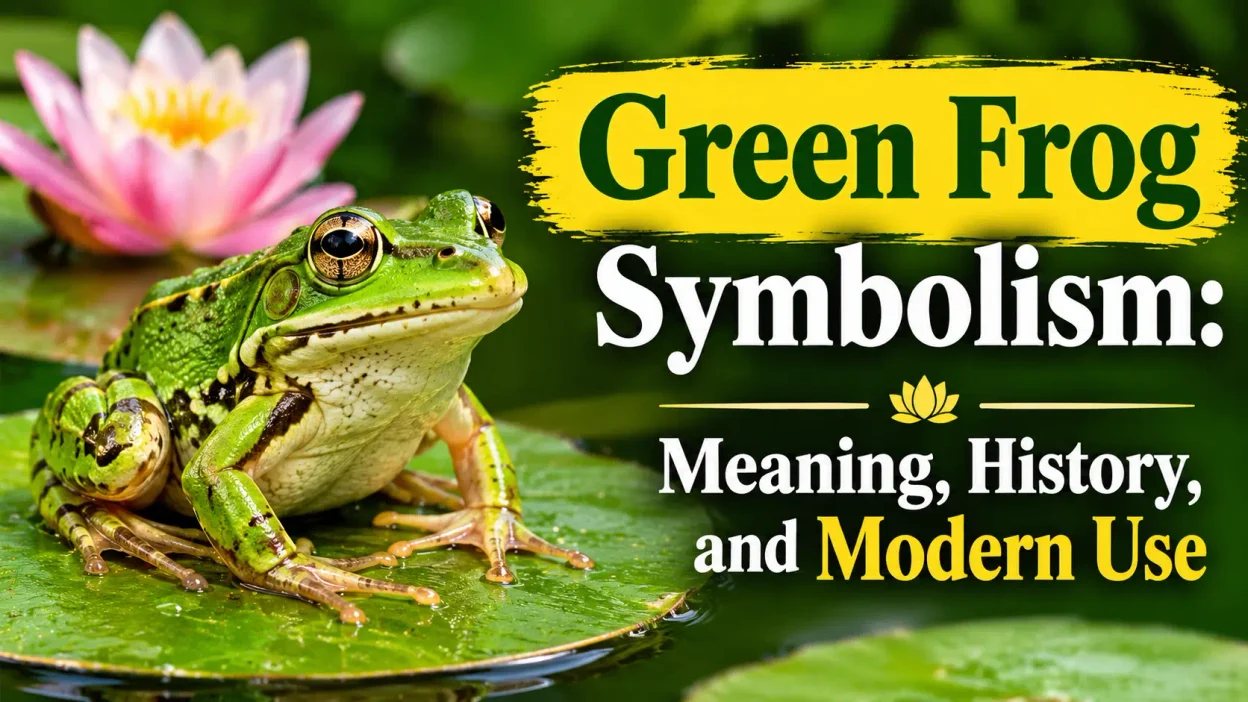
Green frogs are often associated with nature, renewal, growth, good fortune, and personal transformation. Their connection to ponds, rain, and changing seasons makes them familiar symbols of life and fresh beginnings. In the United States, people encounter green frogs in gardens, wildlife illustrations, children’s stories, decorative objects, tattoos, and popular culture.
The green frog has a recognizable appearance: a green body, smooth or slightly textured skin, prominent eyes, and strong hind legs. In nature, it is an amphibian that moves between aquatic and terrestrial environments. Its life cycle also involves a remarkable change, developing from an aquatic tadpole into an adult frog.
These natural characteristics help explain why frogs have acquired different symbolic meanings across cultures. Some traditions connect them with fertility and rebirth, while others associate them with rain, abundance, spiritual cleansing, or even danger. The color green adds another layer, commonly suggesting vegetation, health, balance, and new growth.
Understanding this symbolism requires looking beyond modern spiritual interpretations. Ancient religious beliefs, folklore, literature, environmental awareness, and American popular culture have all contributed to the way people understand the green frog today.
Quick Answer
Green frog symbolism commonly represents renewal, growth, good fortune, adaptability, and connection with nature in modern American culture. Historically, frogs have also been associated with fertility, rain, birth, and rebirth because of their aquatic habitat and remarkable life cycle.
TL;DR
- Green frogs commonly represent growth, renewal, and harmony with nature.
- Ancient Egyptian traditions connected frogs with fertility, childbirth, and rebirth.
- Their life cycle makes them recognizable symbols of personal transformation.
- American folklore and popular culture give frogs both positive and negative meanings.
- Green frog imagery appears in tattoos, jewelry, gardens, and decorative art.
- Modern environmental awareness connects frogs with healthy freshwater ecosystems.
1. What Makes a Green Frog Symbolically Recognizable?
A green frog is more than an animal with a particular color. Its physical characteristics contribute to the associations people make with it.
Green frogs are commonly associated with freshwater environments, including ponds, marshes, wetlands, and quiet streams. Their coloring helps them blend into vegetation, while their strong hind legs allow them to jump quickly between different surfaces.
Three natural features are especially important to their symbolism.
- Green coloring: Connects the animal with plants, springtime, vegetation, and natural growth.
- Aquatic habitat: Associates frogs with water, rainfall, emotional renewal, and the conditions that support life.
- Metamorphosis: Represents development, adaptation, and the transition from one stage of life to another.
These characteristics create a useful symbolic combination. A green frog can represent the ability to grow while remaining connected to one’s surroundings.
The American green frog (Lithobates clamitans) is also a real North American species, not simply a fictional creature or decorative image. Its familiar presence in freshwater habitats makes the symbolism especially recognizable to people who grew up near ponds and wetlands.
2. The Main Symbolic Meanings of Green Frogs
Although interpretations vary, several meanings appear repeatedly in modern discussions of frog symbolism.
Growth and renewal
The color green is strongly associated with new vegetation, spring, and the return of plant life after winter. A green frog naturally fits this imagery.
People may interpret it as a reminder that growth can happen gradually. A new job, a change in personal priorities, or the beginning of a different chapter can all be represented through this image.
Transformation and adaptability
A frog does not remain in one physical form throughout its development. It begins as an aquatic tadpole and gradually develops the body and abilities of an adult amphibian.
This makes it a recognizable symbol of personal change. It can represent learning new skills, adjusting to unfamiliar circumstances, or leaving behind an earlier version of oneself.
Good fortune and abundance
Frogs have been connected with fertility, rain, and agricultural abundance in several historical traditions. Modern decorative interpretations sometimes extend these associations to financial success and good luck.
However, the meaning depends on the cultural setting. A frog ornament purchased as a good-luck decoration does not necessarily carry the same meaning as an ancient religious amulet.
Balance and connection with nature
Because frogs depend on both aquatic and terrestrial environments, they can represent a relationship between different parts of the natural world.
Their presence in a symbolic design may suggest environmental awareness, respect for wildlife, or a desire for a more balanced lifestyle.
3. Ancient Egyptian Origins: Birth, Fertility, and Rebirth
One of the clearest historical examples of positive frog symbolism comes from ancient Egypt.
The Nile River played a central role in Egyptian agriculture and daily life. Seasonal flooding deposited fertile material across the surrounding land, supporting crops and replenishing the environment. Frogs became especially noticeable around these wet areas, where they appeared in large numbers.
Their abundance helped connect them with the renewal of life.
An important religious figure associated with this symbolism was Heqet, a goddess connected with childbirth, fertility, and regeneration. She was represented as a frog or as a woman with a frog’s head.
Frog-shaped amulets were also produced in ancient Egypt. Some were intended to provide protection associated with childbirth and fertility, while others were connected with the hope of rebirth after death.
The green or blue-green appearance of many Egyptian frog amulets added another visual association with vegetation, water, and renewal.
This history is important because it shows that the frog’s connection with new life was not invented by modern spiritual communities. It has identifiable roots in ancient religious art and material culture.
Nevertheless, ancient Egyptian beliefs should not be treated as universal meanings. Heqet belonged to a particular religious tradition, and her symbolism should be understood within that historical setting.
4. Why the Frog Became a Symbol of Transformation
The frog’s life cycle provides one of the strongest natural explanations for its symbolic meaning.
A typical frog begins life as an egg in water. After hatching, it becomes a tadpole with a tail and gills. During metamorphosis, it develops legs, changes its breathing system, and gradually becomes an adult frog.
This visible change makes the frog an accessible example of transformation.
Unlike an abstract image of personal growth, a frog demonstrates physical development in a way that is easy to observe. Children learn about metamorphosis in school, while adults may use the same process as a comparison for changes in identity, maturity, and life circumstances.
In modern American interpretation, this meaning can appear in several situations:
- A person beginning a new career after years in another profession.
- Someone recovering from a difficult period and rebuilding their life.
- A student moving from uncertainty toward greater confidence.
- A family adapting to a new home or major life change.
The frog does not suggest that every transformation is easy. Its development is gradual, and different stages require different conditions.
That makes it a practical symbol of change rather than an unrealistic promise of instant improvement.
5. What Green Adds to Traditional Frog Symbolism
The frog and the color green each carry their own associations. When combined, they create a more specific visual meaning.
The color green is widely connected with nature, growth, harmony, and renewal. These associations appear in American landscape design, environmental campaigns, seasonal decoration, and visual art.
A green frog can therefore suggest:
Natural growth: Its coloring connects it with healthy vegetation and living landscapes.
Fresh beginnings: Green is frequently used to represent spring, making the frog a suitable image for seasonal renewal.
Environmental awareness: The animal’s dependence on suitable freshwater habitats makes it relevant to conversations about ecological health.
Emotional balance: In decorative and artistic contexts, green can create associations with calm surroundings, stability, and harmony.
There is an important distinction here: not every meaning associated with green automatically belongs to the frog. Some interpretations come from the animal itself, while others come from the cultural use of color.
The combined image is especially effective because both elements point toward the natural world.
6. Green Frog Symbolism in the United States
In the United States, the green frog is generally understood through a mixture of wildlife familiarity, children’s entertainment, environmental education, and popular decorative imagery.
Unlike a national emblem or a formal religious symbol, it does not have one fixed meaning across American society.
Several settings help explain its modern interpretation.
Wildlife and outdoor experiences
For Americans who spend time fishing, hiking, camping, or visiting wetlands, frogs are familiar parts of outdoor environments.
A frog sitting beside a pond may suggest a healthy natural landscape, seasonal change, or the quiet life of a freshwater ecosystem.
Children’s education
Frogs appear frequently in American elementary science lessons because their development provides an accessible introduction to amphibians and biological change.
Their recognizable appearance also makes them useful characters in children’s books, classroom decorations, toys, and educational illustrations.
Environmental awareness
Frogs are particularly relevant to discussions about freshwater conservation. Their permeable skin and dependence on suitable aquatic and terrestrial habitats make amphibians vulnerable to environmental changes.
Consequently, frog imagery can communicate concern for wetlands, pollution, habitat protection, and biodiversity.
Home and garden decoration
Green frog statues, garden ornaments, ceramic figures, and pond decorations are common ways people incorporate frog imagery into outdoor spaces.
Some people choose them simply because they enjoy the animal’s appearance. Others associate them with luck, abundance, or a welcoming natural environment.
7. Green Frogs in Different Cultural Traditions
Frog symbolism is not identical across the world. Different communities have interpreted the animal according to their environments, religious beliefs, and storytelling traditions.
| Cultural context | Common association | Historical or cultural background |
|---|---|---|
| Ancient Egypt | Birth and regeneration | Connected with Heqet and the Nile |
| Mesopotamian traditions | Fertility and healing | Frog-shaped objects and associations with water |
| European folklore | Rain and transformation | Weather beliefs and traditional tales |
| Biblical tradition | Judgment and uncleanness | Frogs appear in Exodus and Revelation |
| Modern American culture | Growth and adaptability | Nature, education, entertainment, and decoration |
In some ancient Near Eastern traditions, frogs were connected with fertility, regeneration, and healing. Their relationship with water helped establish these associations.
European folklore also developed different interpretations. Frogs were sometimes associated with approaching rain because their activity often increased under wet conditions.
In East Asian traditions, frogs and toads appear in different stories and symbolic settings, including associations with the moon, prosperity, and good fortune. These traditions should not be combined into one universal interpretation, as particular meanings vary by region and historical period.
The main lesson is that the frog is a culturally flexible symbol. Its natural behavior provides a starting point, but human beliefs determine how that behavior is interpreted.
8. Biblical Meaning: Frogs as Signs of Judgment
The Bible presents frogs differently from the positive meanings found in ancient Egyptian traditions.
In the Book of Exodus, frogs appear as the second plague sent upon Egypt. They spread throughout the land, entering homes and affecting everyday life. In this account, the animals represent divine judgment and the consequences of Pharaoh’s refusal to release the Israelites.
Frogs also appear in the Book of Revelation, where frog-like unclean spirits emerge from the mouths of the dragon, the beast, and the false prophet.
These passages give frogs a negative religious association in certain biblical contexts.
However, the Bible does not establish green frogs as a separate spiritual category. The passages concern frogs generally, not a particular green species or the color green.
For Christian readers, this distinction matters. A green frog in a garden or nature illustration does not automatically represent evil, temptation, or a biblical warning.
The interpretation depends on the specific passage, artistic setting, and religious context.
9. The Frog in European Folklore and Fairy Tales
European storytelling introduced another familiar interpretation: the frog as a creature associated with unexpected transformation.
One of the best-known examples is the Brothers Grimm fairy tale The Frog King, published in their collection in 1812.
In the story, a frog becomes connected with a princess and eventually reveals a transformed identity. The familiar modern version often presents the frog as a prince who must overcome an enchantment.
The story helped establish the frog as an image of hidden potential and unexpected change in Western popular imagination.
A creature that initially appears unattractive or ordinary may have a different identity beneath its surface.
Another historical example comes from Aesop’s fable about the frogs who ask Zeus for a king. The story uses frogs to explore political judgment, dissatisfaction, and the consequences of demanding a different ruler without considering the outcome.
Together, these stories demonstrate that frogs have not always represented good fortune or positive change. They have also served as characters through which storytellers examine human behavior.
10. Emotional and Psychological Meaning
People often respond to animals through personal memories and emotional associations. The green frog can communicate different feelings depending on where someone encounters it.
Hope after a difficult period
Because frogs are associated with renewal and development, people may connect them with the idea of starting again.
Someone who has experienced a major personal change might choose frog imagery as a reminder that progress does not require remaining the same person.
Acceptance of change
The frog’s life cycle provides a visible example of development. Its symbolism can encourage people to accept that different stages of life require different abilities and responsibilities.
Simplicity and playfulness
Frogs frequently appear in cartoons, toys, and children’s illustrations. Their large eyes, unusual movements, and recognizable shape can create a playful impression.
In this setting, the green frog may communicate humor, friendliness, curiosity, or a relaxed attitude.
Environmental connection
For people who enjoy gardening, wildlife photography, or outdoor recreation, frog imagery can express appreciation for living ecosystems.
It may represent a preference for natural surroundings rather than a spiritual belief.
These interpretations are possibilities, not psychological diagnoses. A person’s choice of frog imagery cannot reliably reveal their personality or emotional condition.
11. Green Frog Symbolism in Dreams
Dream interpretations involving frogs are generally personal rather than universal.
A green frog appearing in a dream may reflect ideas about change, growth, nature, or something unfamiliar entering everyday life.
The surrounding circumstances often matter more than the animal itself.
- A frog jumping: Some people interpret this as movement toward a new opportunity or changing circumstances.
- A frog in clear water: It may suggest renewal, calmness, or a desire for emotional clarity.
- A frog in a garden: This can bring associations with growth, natural balance, or a developing personal situation.
- A frightened frog: It might reflect discomfort with change or uncertainty about something unfamiliar.
- A friendly frog: It may represent curiosity, playfulness, or a positive attitude toward a new experience.
There is no scientifically established meaning for seeing a frog in a dream. Dreams are influenced by memories, emotions, experiences, and individual associations.
For example, someone who grew up catching frogs near a pond may associate the animal with childhood happiness. Another person who fears amphibians may experience the same image differently.
Personal context is more useful than treating every frog dream as a prediction.
12. What a Green Frog Represents in Tattoos and Personal Style
Green frog tattoos can carry several different meanings, depending on the design and the person’s reasons for choosing it.
Some common interpretations include:
Personal transformation: A frog can represent a major life transition, a recovery period, or the decision to embrace change.
Love of nature: A realistic frog surrounded by leaves, flowers, or water can communicate an appreciation for wildlife.
Good fortune: A stylized frog may be chosen as a personal lucky symbol, particularly when paired with traditional prosperity imagery.
Playfulness: Cartoon frogs and humorous designs can express an informal personality or an interest in internet culture.
Environmental values: A frog tattoo may reflect concern for wetlands, amphibian conservation, and biodiversity.
The design can change the interpretation considerably. A realistic green frog beside a pond communicates something different from a fantasy frog wearing a crown or a cartoon frog with an exaggerated expression.
Some people also choose frog jewelry, pendants, embroidered clothing, and small accessories because the animal is visually distinctive.
There is no established rule that someone must believe in spiritual symbolism to wear a frog design.
13. Modern Pop Culture and the Green Frog
American entertainment has helped make green frogs recognizable beyond their natural environment.
One familiar example is Kermit the Frog, the green puppet character associated with The Muppets. Kermit is commonly connected with humor, creativity, entertainment, and an approachable personality.
His popularity has helped establish the green frog as a friendly and recognizable character in American entertainment.
Another example is Pepe the Frog, an internet cartoon character created by Matt Furie for his comic Boy’s Club in 2005.
Pepe initially circulated as a humorous online character. Different versions later developed into reaction images expressing sadness, amusement, frustration, and other emotions.
However, some versions were appropriated by racist and antisemitic online communities, particularly during the political conflicts surrounding the 2016 U.S. election. The Anti-Defamation League added Pepe to its hate-symbol database in 2016 while explicitly recognizing that many uses were not hateful.
This history is important because it demonstrates how an ordinary green cartoon frog can acquire meanings that have little connection to its original character.
The color and animal alone do not establish the political meaning of an image. Its specific design, accompanying messages, and surrounding context matter. ADL+1
14. Environmental Symbolism and the Importance of Real Frogs
One modern interpretation deserves particular attention: the green frog as a reminder of environmental responsibility.
Frogs depend on suitable habitats throughout their lives. Many species require clean or relatively healthy freshwater environments for breeding and development, while adults may also depend on nearby land habitats.
Their permeable skin makes them sensitive to environmental conditions. Habitat destruction, pollution, disease, invasive species, and climate-related changes can all affect amphibian populations.
This gives frog imagery a practical meaning in environmental education.
In the United States, green frog illustrations may appear in:
- Wetland conservation materials.
- School lessons about amphibians.
- Wildlife protection campaigns.
- Nature-center displays.
- Pond and freshwater habitat projects.
- Children’s environmental education.
A green frog used in these settings can represent the relationship between wildlife and the environments that sustain it.
It is worth distinguishing symbolism from ecology. Seeing one frog does not prove that an ecosystem is completely healthy. Different amphibian species respond differently to environmental conditions, and proper habitat assessment requires more than a single wildlife observation.
Nevertheless, the frog remains a useful visual reminder that freshwater ecosystems support interconnected forms of life.
15. Common Misunderstandings About Green Frog Symbolism
Several popular interpretations deserve clarification.
Every green frog represents good luck.
Not necessarily. Some people use frog decorations as good-luck symbols, but there is no universal cultural rule assigning that meaning to every frog.
Green frogs always represent money.
The association between frogs and prosperity appears in certain cultural and decorative traditions. However, financial success is only one possible interpretation.
A green frog is automatically a religious sign.
Frogs appear in several religious traditions, but their meaning depends on the specific belief system. A frog in an ordinary garden is not automatically a religious message.
All frog symbolism comes from ancient Egypt.
Ancient Egyptian religion provides an important historical example, but frog-related beliefs developed independently in different regions and communities.
Every cartoon frog carries the same political meaning.
This is particularly misleading in the case of Pepe. The original character and ordinary humorous versions should not automatically be confused with hateful adaptations.
The most reliable approach is to examine the particular image, its history, and the circumstances in which it appears.
16. How Green Frog Symbolism Has Changed Over Time
The frog’s symbolic history shows how one animal can represent different ideas across different periods.
In ancient Egypt, its connection with the Nile helped establish associations with birth, fertility, and regeneration. In other ancient societies, frogs were connected with rain, water, healing, and agricultural abundance.
Religious literature introduced contrasting meanings, particularly in biblical accounts where frogs could represent judgment or unclean spirits.
European fairy tales later popularized the frog as a figure of transformation and unexpected identity. Modern American culture expanded its role through children’s entertainment, environmental education, cartoons, and internet memes.
Today, the green frog can represent several ideas simultaneously:
- Natural growth and ecological awareness.
- Personal change and adaptability.
- Good fortune in certain decorative traditions.
- Humor and friendliness in popular entertainment.
- Religious or historical meanings within particular contexts.
The color green has strengthened its association with nature and renewal, but the animal’s meaning remains dependent on how people use and interpret it.
This evolution explains why there is no single interpretation that applies to every green frog image.
Frequently Asked Questions
1. What does seeing a green frog symbolize?
Seeing a green frog is commonly interpreted as a reminder of growth, renewal, adaptability, and connection with nature. The meaning may also depend on the circumstances in which the frog appears and the personal associations someone has with it.
2. Is a green frog a symbol of good luck?
In some cultural and decorative traditions, frogs are associated with prosperity, abundance, and good fortune. However, this is not a universal belief, and different cultures have developed their own interpretations.
3. What does a green frog symbolize spiritually?
In modern spiritual interpretations, a green frog can represent personal transformation, renewal, emotional balance, and new beginnings. These are contemporary interpretations rather than meanings shared by every religious tradition.
4. What does a green frog tattoo mean?
A green frog tattoo can represent personal growth, adaptability, environmental appreciation, or a humorous personality. Some people also choose it as a reminder of overcoming difficult experiences and accepting change.
5. What does a green frog represent in Christianity?
The Bible mentions frogs in the Egyptian plagues in Exodus and in the imagery of Revelation. These passages associate frogs with judgment and unclean spirits, but Christianity does not establish a universal negative meaning for every green frog.
6. Why are frogs associated with rebirth and transformation?
Frogs undergo metamorphosis, changing from aquatic tadpoles into adult amphibians. Ancient Egyptian beliefs also connected frogs with regeneration and new life, helping establish this association in historical symbolism.
7. Does a green frog in a dream mean something positive?
It can be interpreted positively as a symbol of growth, change, or a fresh beginning. However, dreams do not have fixed meanings, and personal memories and emotions are important when interpreting them.
Conclusion
Green frog symbolism brings together several recognizable ideas: renewal, transformation, natural growth, adaptability, and connection with the environment. Its meaning comes partly from the frog’s remarkable life cycle and partly from the cultural traditions that have used the animal to represent fertility, rebirth, rain, and abundance.
In American culture, the green frog appears in wildlife education, children’s entertainment, home decoration, tattoos, and digital media. Its meaning can be friendly and playful, environmentally focused, spiritually interpreted, or even controversial when particular cartoon images are used for political purposes.
Ultimately, the green frog is best understood as a flexible symbol rather than a sign with one universal message. Its strongest associations come from the natural processes it represents: growth takes time, change is part of life, and healthy environments make renewal possible.