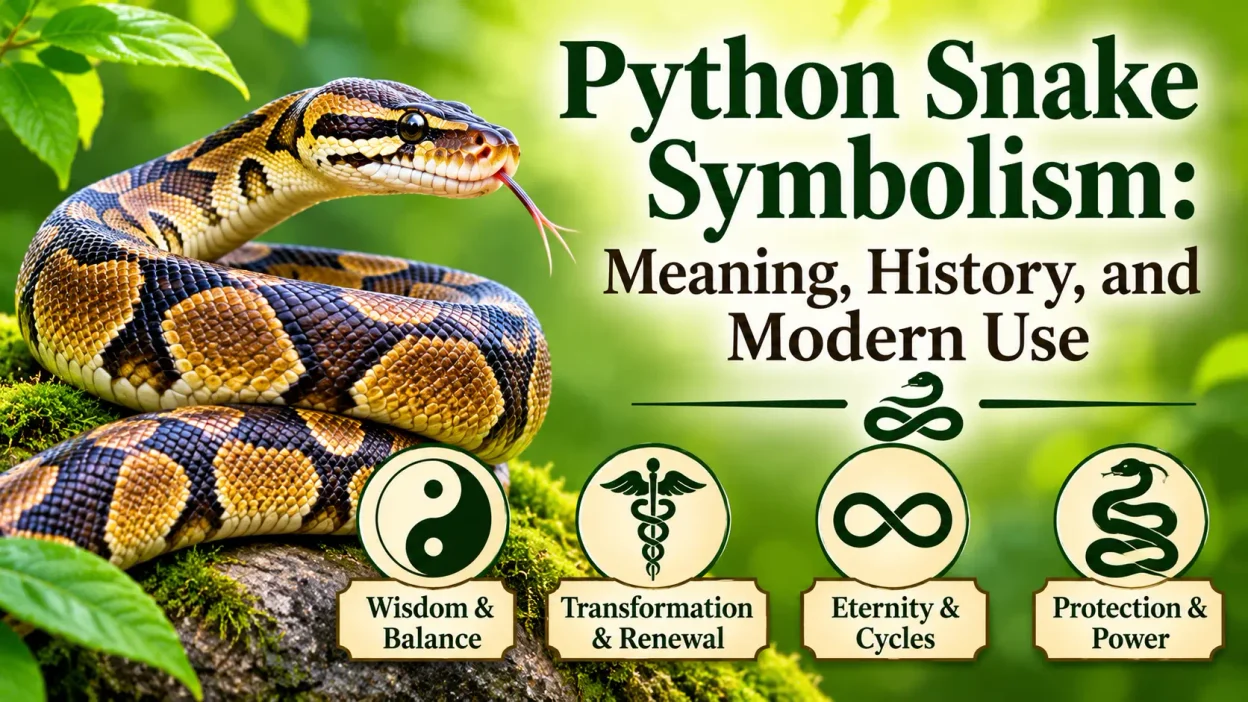
Python snake symbolism often centers on strength, patience, protection, and transformation. The python is a large, nonvenomous snake that relies on stealth, muscular power, and carefully timed action rather than venom. These characteristics help explain why people may interpret it as a symbol of quiet confidence, self-control, and the ability to overcome difficult circumstances.
Unlike symbols with a single established meaning, the python has no universal interpretation. Its significance depends on the culture, religious tradition, artistic context, and personal experience of the person interpreting it. In the United States, people may associate pythons with wildlife, personal strength, spiritual transformation, or the natural world’s ability to inspire both respect and fear.
Understanding the python’s symbolism requires looking beyond its size and appearance. Its behavior, place in mythology, and relationship with human communities all contribute to the meanings people attach to it today.
Quick Answer
Python snake symbolism commonly represents strength, patience, protection, transformation, and the ability to overcome challenges in modern American culture. Historically, large serpents have also appeared in religious traditions and mythology as guardians, formidable opponents, and figures connected with renewal, danger, and the natural world.
TL;DR
- Pythons commonly symbolize physical strength, patience, and controlled power.
- Their shedding skin connects them with renewal and personal transformation.
- Ancient serpent myths often portray snakes as guardians or formidable adversaries.
- American interpretations include wildlife respect, personal identity, and spiritual symbolism.
- Python tattoos can represent resilience, independence, protection, or personal change.
- The python’s meaning depends on its cultural and visual context.
1. What a Python Represents as a Symbol
A python is a large constricting snake found in parts of Africa, Asia, and Australia. Several species belong to the python family, including the reticulated python, Burmese python, and ball python. They differ in size, appearance, habitat, and behavior, so their symbolic associations are not always identical.
Pythons are recognizable by their long bodies, muscular build, patterned scales, and ability to coil around objects or prey. Their movement is often quiet and deliberate, and they can remain concealed for extended periods.
These physical characteristics provide the foundation for many symbolic interpretations.
Strength is one of the most immediate associations. A python can overpower animals larger than itself through constriction, making it a natural image of physical capability and determination.
Patience comes from its hunting behavior. Rather than constantly pursuing prey, a python may wait for a suitable opportunity before acting.
Transformation is associated with the shedding of its skin. Although shedding is a normal biological process rather than a symbolic act for the animal, people often interpret it as an image of leaving an old condition behind.
Protection and danger emerge from the python’s ability to defend itself and its position as a large predator. It can represent safety and security in one context, but a threat that must be respected in another.
These meanings are interpretations of the animal’s characteristics, not evidence that pythons possess human intentions or spiritual qualities.
2. The Difference Between Python and General Snake Symbolism
Python symbolism overlaps with broader snake symbolism, but the two should not be treated as identical.
Snakes appear in religious traditions, mythology, folklore, literature, and art around the world. Their ability to shed skin, move without limbs, and inhabit environments that humans may find unfamiliar has contributed to a wide range of interpretations.
Some traditions associate snakes with healing, fertility, wisdom, or renewal. Others connect them with temptation, danger, chaos, or death.
The python adds its own associations because of its size and constricting behavior. A small snake may suggest agility or caution, while a large python can suggest overwhelming strength, restraint, or the ability to hold something firmly.
For example, a person who chooses a python tattoo may want to communicate physical confidence or personal resilience rather than the broader spiritual meanings associated with snakes.
The distinction also matters when interpreting historical imagery. A serpent in an ancient religious painting may represent a specific deity, mythological character, or theological idea. It should not automatically be interpreted as a python simply because it has a long, coiled body.
3. Strength, Patience, and Controlled Power
The python’s most recognizable symbolic meaning is strength.
Unlike animals that depend on speed or venom, pythons use their muscular bodies to restrain prey. Their hunting strategy requires coordination, physical capability, and an opportunity to act.
This has made the python a useful image for people who associate strength with control rather than aggression.
A python may symbolize someone who does not need to demonstrate their abilities constantly. Its stillness can suggest confidence, while its physical power represents the capacity to respond when circumstances demand it.
Patience is closely connected with this interpretation. A python waiting for prey can become an image of someone who understands that immediate action is not always the best response.
In modern personal symbolism, this can relate to:
- Remaining calm during conflict.
- Preparing carefully before making an important decision.
- Developing strength through consistent effort.
- Avoiding unnecessary confrontation.
- Acting decisively when an opportunity arises.
The python can therefore represent the idea that restraint and capability are not opposites. A person can be patient without being passive and powerful without being aggressive.
4. Transformation and Renewal Through Shedding
Pythons periodically shed their outer skin as they grow and maintain healthy skin. The process is known as ecdysis.
For people, this natural process offers an easily understood image of change. The old outer layer is left behind, while the animal continues living in its existing body.
This makes the python a possible symbol of personal renewal, especially when someone is moving away from an earlier stage of life.
A python shedding its skin may represent:
- Leaving behind an outdated identity.
- Recovering after a difficult period.
- Developing new habits or beliefs.
- Accepting a major life transition.
- Making room for personal growth.
In American popular culture, this interpretation often appears in tattoos, artwork, and personal narratives about recovery or reinvention.
However, shedding does not mean that the snake becomes an entirely different animal. The biological process is part of its continued growth and survival.
That distinction can make the symbolism more meaningful. Transformation does not always require abandoning one’s identity. Sometimes it means developing while retaining the experiences that shaped who one is.
5. Ancient Serpent Symbolism and the Python’s Mythological Name
The word python has a connection to ancient Greek mythology, but the mythological creature and the modern animal are not interchangeable.
In Greek tradition, Python was a great serpent associated with Delphi. According to the best-known version of the myth, the god Apollo defeated Python and established his connection with the sacred site.
The story became part of the mythology surrounding Apollo and the Delphic oracle.
Python’s defeat can be interpreted as a struggle involving divine authority, the establishment of a new order, and the conquest of a formidable opponent. The serpent is not simply a representation of evil; its role belongs to a particular myth about power and the establishment of Apollo’s sanctuary.
The name of the modern python also comes through this ancient tradition.
The myth provides a historical association between the word python and a large, formidable serpent. It does not establish that every modern python symbolizes chaos, evil, or a defeated enemy.
The living animal has its own biological identity, and its symbolism varies according to the context in which it appears.
6. Python Symbolism in Ancient Egyptian and Greek Traditions
Ancient Mediterranean cultures did not assign snakes one fixed meaning. Serpents could appear as protectors, divine figures, guardians of sacred places, or dangerous opponents.
In ancient Egypt, the cobra was associated with Wadjet, a protective goddess connected with Lower Egypt and royal authority. The cobra image known as the uraeus appeared on royal crowns and represented the ruler’s protective power.
This is relevant to python symbolism because it shows how a large or dangerous-looking serpent could communicate authority and protection rather than simply fear. However, the Egyptian cobra was a different animal, and its religious significance should not be transferred directly to pythons.
In ancient Greek traditions, snakes were associated with several gods and sacred places. They could serve as guardians and appear in stories involving ancestry, death, and the relationship between humans and the divine.
The myth of Python at Delphi represents one particular form of serpent symbolism: a formidable creature whose defeat becomes part of a larger story about divine authority.
Together, these traditions demonstrate that serpents could represent both protective and threatening forces. The meaning depended on the creature’s role in the story or religious practice.
7. Python Snake Symbolism in the United States
In the United States, pythons are encountered in wildlife education, zoos, popular culture, the exotic pet trade, and discussions about invasive species.
As a result, American interpretations are often shaped by several overlapping ideas.
Strength and independence
The python’s physical power makes it an appealing symbol for people who value resilience, self-reliance, or personal independence.
A person may use a python image to represent the ability to endure difficult circumstances without relying on constant outside support.
Respect for nature
Pythons can also represent the complexity of wildlife. Their size and hunting behavior may inspire fear, but they also demonstrate the ecological role of predators.
For some Americans, the python represents the importance of understanding animals rather than judging them only by their appearance.
Caution and responsibility
The Burmese python has become associated with environmental concerns in South Florida, where established populations have affected native wildlife.
This has introduced another interpretation: the python can symbolize the consequences of human decisions about wildlife, including the release of nonnative pets.
The American meaning of the python is therefore not limited to personal strength. It can also involve environmental responsibility, respect for wildlife, and the consequences of human activity.
8. What the Python Symbolizes in Different Contexts
The same image can communicate different ideas depending on where it appears.
| Context | Common symbolic meaning | Important distinction |
|---|---|---|
| Personal tattoos | Strength, resilience, transformation | The wearer’s intention matters most |
| Wildlife photography | Respect for nature, survival | May be primarily an image of the animal |
| Mythological artwork | Conflict, guardianship, divine authority | Depends on the specific myth |
| Jewelry and fashion | Confidence, individuality, bold style | May have no spiritual meaning |
| Environmental discussions | Ecological balance, human responsibility | Often refers to invasive species |
| Personal spiritual practice | Renewal, patience, self-control | Interpretations vary between individuals |
This comparison helps explain why a python image should not be assigned a single meaning without considering its setting.
A coiled python on a piece of jewelry may communicate confidence or personal style. The same animal in an environmental campaign may represent an ecological problem.
9. Python Symbolism in Hindu and Other Religious Traditions
Snakes hold important places in several South Asian religious traditions, particularly Hinduism.
In Hindu imagery, serpent beings known as nagas appear in stories and religious art. They may be associated with water, protection, fertility, or the preservation of sacred knowledge.
The serpent Shesha, also called Ananta, is traditionally depicted as the cosmic serpent upon whom the god Vishnu rests. The image is associated with cosmic order and the vastness of existence.
Another important serpent figure is Vasuki, who appears in the story of the churning of the ocean. In that account, the serpent serves as a rope used by gods and other beings in their effort to obtain the nectar of immortality.
These stories demonstrate that serpents can occupy respected religious roles. They are not simply dangerous animals or symbols of destruction.
However, nagas are mythological beings, not zoological descriptions of python species. Hindu serpent symbolism should be understood within its own religious and cultural framework rather than treated as a universal explanation of python symbolism.
Other traditions also associate snakes with renewal, protection, or the natural world, but their meanings differ. There is no single worldwide religious interpretation of the python.
10. Why People Choose Python Tattoos
Python tattoos are often chosen because the animal’s shape and behavior provide a visually distinctive way to express personal identity.
A python can be depicted as coiled, moving, wrapped around an object, or positioned in a striking pose. These variations can change the meaning of the design.
A tightly coiled python may suggest restraint, readiness, or concentrated strength. A moving python may communicate progress, adaptability, or independence.
A python shedding its skin may represent a personal turning point. Someone who has completed a difficult period might choose this image to mark recovery or a change in identity.
Other people choose python tattoos simply because they appreciate reptiles, wildlife, or the animal’s appearance.
The design’s details also influence interpretation:
- A realistic python may emphasize wildlife appreciation.
- A stylized python may communicate individuality or artistic taste.
- A python combined with flowers may contrast physical strength with beauty or growth.
- A python surrounding an object may suggest protection, attachment, or control.
- A python with a skull may introduce themes of mortality or danger.
These are possible interpretations, not standardized meanings. The person wearing the tattoo determines its personal significance.
11. Python Symbolism in Dreams
Dreams involving pythons are sometimes interpreted as reflections of fear, pressure, change, or personal conflict.
A python’s size and constricting behavior may make it an image of feeling overwhelmed or restricted. Someone experiencing a demanding relationship, stressful workplace, or difficult decision might associate the animal with those circumstances.
Other people may interpret a python dream positively, especially if the snake appears calm or is shedding its skin.
In that setting, the python may represent patience, personal growth, or a change that is already underway.
There is no reliable universal dictionary that establishes what a python dream means. Dreams are influenced by personal memories, emotions, experiences, and ordinary mental activity during sleep.
A useful way to explore the dream is to consider what the python was doing and how the dreamer felt.
Was the snake threatening, peaceful, hidden, or simply present? Did the dream produce fear, curiosity, or relief?
These details can help a person reflect on their own associations without assuming that the dream predicts an event or carries a supernatural message.
12. Emotional and Psychological Meaning
The python can represent a mixture of attraction and fear.
Its physical power may inspire admiration, while its ability to constrict prey may make it unsettling. This combination gives the animal a symbolic range that extends beyond simple ideas of strength.
For some people, the python represents confidence and the ability to remain composed under pressure.
For others, it may represent an experience that feels difficult to escape. The image of a snake tightening its coils can be a metaphor for stress, obligation, or a relationship that has become restrictive.
The animal may also evoke curiosity about unfamiliar parts of nature. People who enjoy reptiles may see a python as an example of an animal that is misunderstood because of its appearance.
These responses are not contradictory. A person can respect an animal while remaining cautious around it.
Psychologically, the python’s symbolism often reflects how people understand their own relationship with control, vulnerability, and the unknown.
13. Negative Meanings and Common Misunderstandings
Python symbolism can include danger, fear, restriction, and overwhelming power.
These associations are understandable because pythons are predators capable of injuring people and other animals. Their physical strength should not be romanticized or treated as harmless.
However, several misunderstandings can distort their symbolism.
Pythons are not venomous
Pythons kill prey through constriction rather than venom. This distinguishes them from many other snakes, although it does not make them safe to handle.
A python is not automatically a symbol of evil
Some religious and cultural stories portray serpents as dangerous or adversarial. Those meanings belong to particular traditions and should not be applied to every snake or python.
Shedding does not mean immortality
The python’s ability to shed skin is sometimes used as a symbol of renewal. Biologically, however, shedding is a normal process that supports growth and skin maintenance.
A python is not always a symbol of control
Its constricting behavior may inspire this interpretation, but a person may choose the animal to represent resilience, wildlife appreciation, or personal transformation instead.
Python imagery does not establish a person’s beliefs
A tattoo, necklace, or decorative image cannot reliably reveal someone’s religious identity, personality, or intentions.
The meaning of the symbol should be interpreted with care rather than used to make assumptions about the person who displays it.
14. How Python Symbolism Has Changed Over Time
The python’s symbolic meaning has developed through several different kinds of human experience.
In ancient mythology, the name Python became associated with a formidable serpent defeated by Apollo. In other traditions, serpents served as protectors, divine figures, or guardians of sacred places.
Later interpretations increasingly reflected the animal’s physical characteristics. Its size suggested strength, its hunting behavior suggested patience, and its shedding suggested renewal.
In contemporary American culture, the python has acquired additional meanings through wildlife education, environmental concerns, tattoo culture, and popular entertainment.
The Burmese python’s presence in Florida has also made it an example of the complicated relationship between humans and wildlife. Its symbolism can now involve ecological responsibility as well as personal strength.
These changes do not mean that one interpretation has replaced another. Older religious and mythological meanings remain relevant within their cultural settings, while modern interpretations reflect contemporary interests and experiences.
The python is best understood as a symbol whose meaning develops through the relationship between the animal and the people interpreting it.
15. Frequently Asked Questions
What does a python symbolize spiritually?
A python may symbolize strength, patience, renewal, protection, or transformation in personal spiritual interpretations. These meanings are not universal, and the animal does not have one established spiritual meaning shared by all religions.
Is python symbolism positive or negative?
Python symbolism can be positive or negative depending on the context. It may represent resilience and controlled power, but it can also communicate danger, fear, or the feeling of being trapped.
What does a python tattoo mean?
A python tattoo may represent strength, independence, patience, personal transformation, or an interest in reptiles. Its specific meaning depends on the design and the intention of the person wearing it.
What does it mean when a python sheds its skin?
Symbolically, shedding skin is often interpreted as renewal, personal growth, or leaving an earlier stage of life behind. Biologically, it is a normal process that allows the snake to grow and maintain healthy skin.
Does a python symbolize wisdom?
A python may be interpreted as a symbol of wisdom because of its association with patience, observation, and deliberate action. However, wisdom is not a universal or historically established meaning for every python image.
What does a python represent in ancient Greek mythology?
Python was a great serpent associated with Delphi and the myth of Apollo’s establishment of his sanctuary. The story concerns divine authority and the defeat of a formidable opponent, rather than a universal meaning for modern python symbolism.
Is a python the same symbol as a cobra?
No. Pythons and cobras are different kinds of snakes, and their cultural associations can differ. For example, the Egyptian cobra was associated with the protective goddess Wadjet, while the mythological Python was connected with Apollo and Delphi.
Conclusion
Python snake symbolism commonly represents strength, patience, controlled power, and personal transformation. Its physical characteristics provide understandable reasons for these associations, while mythology and cultural traditions add other meanings involving protection, danger, and the relationship between humans and nature.
In the United States, the python can represent personal resilience, wildlife appreciation, environmental responsibility, or individual identity. Its meaning depends on whether it appears in a tattoo, religious image, environmental discussion, or personal interpretation.
The python’s symbolism is most meaningful when its context is taken seriously. Rather than treating it as a universal sign of good or evil, it is more useful to understand what the animal represents in a particular tradition or to the person who has chosen it as a symbol.