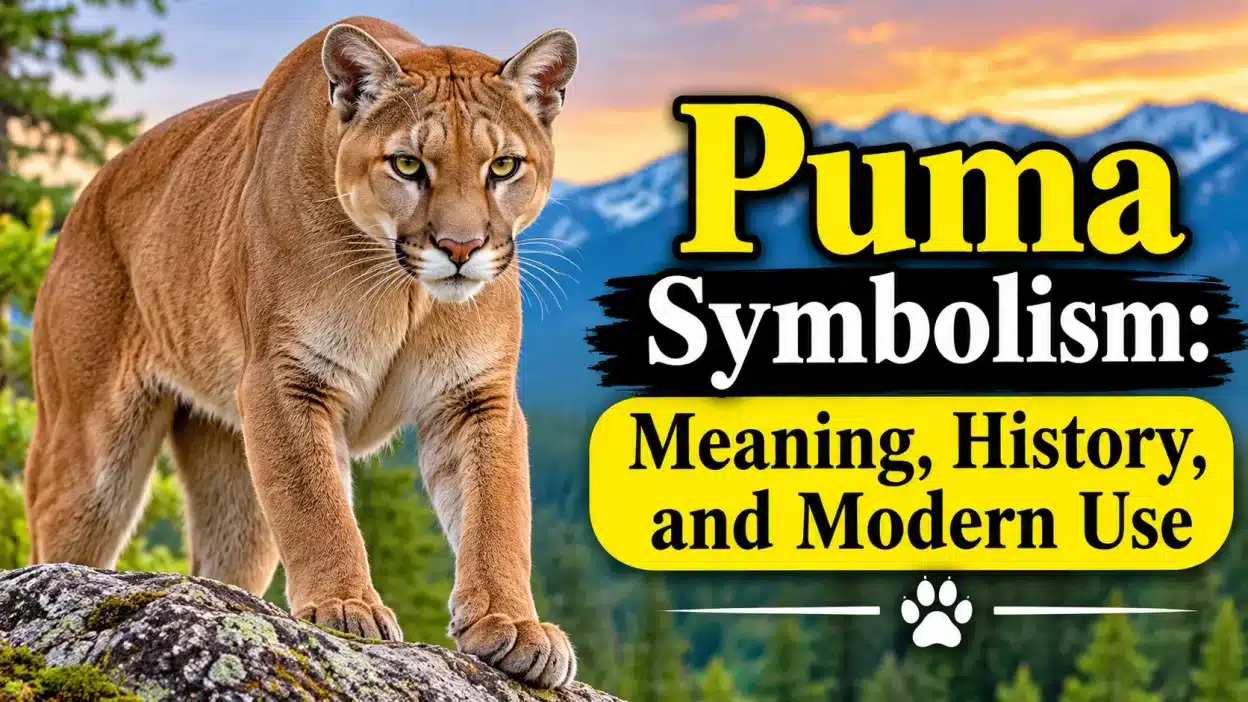
A puma is often associated with strength, independence, quiet confidence, and the ability to survive without relying on others. Puma symbolism draws much of its meaning from the animal’s natural behavior: it moves alone, observes its surroundings carefully, protects its territory, and relies on patience rather than unnecessary confrontation. Across different cultures, this large wild cat has also represented leadership, protection, wisdom, and a close relationship with the natural world.
Known throughout the Americas by names such as cougar, mountain lion, and mountain cat, the puma has occupied an important place in wildlife traditions and cultural storytelling. Its presence in mountains, forests, deserts, and other landscapes has made it a recognizable figure in the American imagination.
Today, people encounter the puma in wildlife photography, sports logos, tattoos, clothing, artwork, and conservation campaigns. Understanding its symbolism means looking beyond its reputation as a powerful predator and considering what its behavior and cultural history communicate.
Quick Answer
Puma symbolism commonly represents independence, strength, patience, leadership, and quiet confidence in modern American culture. Historically, the animal also held sacred associations with protection, earthly power, and the natural world in several Indigenous American and Andean traditions.
TL;DR
- Strength: Represents physical ability, resilience, and survival.
- Independence: Reflects self-reliance and comfort with solitude.
- Patience: Represents careful observation and strategic action.
- Protection: Connects with guardianship and responsibility.
- Leadership: Reflects authority without constant displays of dominance.
- Cultural history: Holds important spiritual associations in Andean and Indigenous traditions.
What Does a Puma Look Like as a Symbol?
The puma is a large, muscular wild cat with a relatively small head, rounded ears, a long tail, and a short coat that usually appears tan, brownish, or grayish. Its powerful hind legs help it jump, climb, and move across difficult terrain.
Unlike lions, pumas do not have large manes. Their appearance is comparatively simple, which makes their physical strength and alert movements especially noticeable.
As a visual symbol, the puma commonly appears in several forms:
- Standing puma: Suggests alertness, awareness, and readiness.
- Leaping puma: Represents movement, ambition, speed, and progress.
- Resting puma: Suggests patience, confidence, and control.
- Roaring or growling puma: Communicates protection, warning, and resistance.
- Mother puma with cubs: Represents care, family responsibility, and protection.
The animal’s silhouette is also easy to recognize. Its long tail and powerful body create a distinctive outline that works well in artwork, athletic branding, and decorative designs.
These physical qualities help explain why the puma is frequently chosen to represent organizations and individuals who want to communicate confidence and capability.
The Main Symbolic Meanings of the Puma
The puma does not have one universal symbolic meaning. Its interpretation depends on the situation, cultural background, and way the animal is represented.
However, several themes appear repeatedly in modern interpretations.
1. Independence and Self-Reliance
Independence is among the most recognizable meanings associated with the puma.
Adult pumas generally live alone, except during mating periods and when mothers are raising their young. They establish territories and depend on their own hunting abilities to survive.
This behavior makes the animal a natural symbol of self-reliance.
For Americans, the image often connects with personal independence, individual responsibility, and the ability to make decisions without constantly seeking approval.
A puma tattoo, for example, may represent someone who values personal freedom or has learned to handle difficult situations independently.
However, independence does not necessarily mean rejecting relationships. The animal also demonstrates that being capable on your own does not prevent you from caring for others.
2. Strength and Resilience
Pumas possess muscular bodies, strong hind legs, sharp senses, and the ability to adapt to different environments.
Their physical characteristics explain their association with strength and resilience.
Unlike symbols that represent strength through size or aggression, the puma suggests a more controlled form of physical and mental capability.
It can represent someone who has faced difficult circumstances and continued moving forward without needing to demonstrate their struggles publicly.
In modern American culture, this interpretation appears in athletic imagery, personal artwork, motivational designs, and sports mascots.
3. Patience and Strategic Thinking
Pumas are ambush predators. They often depend on concealment, careful observation, and well-timed movement when hunting.
Their hunting behavior provides a useful connection to patience and strategic thinking.
The animal does not need to chase every opportunity. It waits for conditions that give it a reasonable chance of success.
As a symbol, this quality can represent:
- Thinking before making important decisions.
- Recognizing the right moment to act.
- Avoiding unnecessary conflict.
- Preparing carefully before taking risks.
- Understanding when waiting is better than rushing.
For someone facing a difficult decision, the puma can represent the value of thoughtful action rather than impulsive reactions.
4. Leadership and Quiet Authority
A puma’s solitary lifestyle and ability to navigate challenging environments contribute to its association with leadership.
Its symbolism differs from that of a lion, which is frequently represented through royal imagery, crowns, and group identity.
The puma more often suggests individual capability and authority earned through experience.
It can represent a person who leads through judgment, confidence, and responsibility instead of demanding attention.
This interpretation is particularly relevant in modern designs that use wild animals to communicate professional confidence, athletic ambition, or personal identity.
5. Protection and Family Responsibility
Although adult pumas are usually solitary, mothers invest considerable time and effort in raising their cubs.
Young pumas depend on their mothers for food, protection, and learning essential survival skills. They may remain with their mothers for approximately 18 to 24 months.
This behavior creates another side of the animal’s symbolism.
A mother puma can represent:
- Protective parenting.
- Family loyalty.
- Courage during difficult circumstances.
- Responsibility for vulnerable people.
- The importance of teaching independence.
This meaning is especially appropriate for artwork depicting a female puma with her cubs.
It also challenges the assumption that an independent animal must be emotionally detached.
Ancient Roots and Early Cultural Symbolism
Pumas have lived across much of the Americas for thousands of years. Their presence in human storytelling developed through direct encounters with the animal, hunting traditions, spiritual beliefs, and observations of the natural environment.
There is no single historical origin for puma symbolism. Different communities developed their own interpretations, and those meanings should not be treated as interchangeable.
In some traditions, the puma represented a respected hunter. In others, it was connected with protection, danger, sacred authority, or the relationship between humans and the natural world.
The animal’s strength and ability to move through difficult landscapes made it a significant figure in many cultural settings.
Its symbolism also changed as communities experienced migration, colonial contact, changing religious practices, and modern wildlife conservation.
Puma Symbolism in Ancient Inca Culture
One of the clearest historical examples of puma symbolism comes from the Inca civilization of the Andes.
In Inca cosmology, three important animals were associated with different aspects of existence:
- The condor was associated with the upper or celestial world.
- The puma represented the earthly world.
- The serpent was associated with the inner or underworld.
Within this framework, the puma was connected with earthly life, strength, wisdom, and agility.
Its significance extended beyond religious storytelling. The animal also appeared in the visual and political imagination of the Inca world.
Cusco, the historic Inca capital in present-day Peru, is traditionally described as having been planned in the shape of a puma. Interpretations of this proposed city layout vary, so it should not be presented as an uncontested historical fact.
Nevertheless, the association demonstrates the animal’s importance in Andean cultural memory.
The puma was not simply an image of physical strength. It could also communicate authority, the organization of earthly life, and the relationship between people and their environment.
These associations remain an important part of understanding the animal’s historical symbolism.
Puma Symbolism in Indigenous North American Traditions
The puma, usually called a mountain lion or cougar in the United States, appears in the traditional stories of several Indigenous communities.
However, there is no single Native American interpretation of the animal. Beliefs differed between nations, geographical regions, and individual storytelling traditions.
Some traditions associated the mountain lion with hunting ability, bravery, protection, and guardianship.
For example, accounts of Zuni traditions describe the puma as a guardian associated with the northern direction. Other cultural accounts connect the animal with exceptional hunting ability and respect for its place among other animals.
Some Southwestern traditions also associated mountain lion vocalizations with warnings or death-related omens.
These differences matter. An animal regarded as a guardian in one tradition could be approached with fear or caution in another.
The puma’s place in Indigenous storytelling also reflects practical relationships with wildlife. Its hunting habits, territorial behavior, and interactions with human communities influenced how people understood it.
When using this symbolism today, it is important to distinguish documented cultural traditions from modern generalized claims about Native American spirituality.
What Puma Symbolism Means in the United States Today
In contemporary American culture, the puma is commonly interpreted through independence, athletic ability, courage, and survival.
The animal has a particularly strong connection with the American West, where mountain lions remain part of the natural landscape.
People may encounter pumas through wildlife documentaries, national parks, outdoor recreation, local news, and conservation campaigns.
Its presence in populated areas has also changed public attitudes toward wildlife.
A notable example is P-22, a mountain lion that became widely recognized after living in Los Angeles’s Griffith Park. His story brought attention to habitat fragmentation, wildlife crossings, and the challenges animals face when urban development separates natural habitats.
After his death, he was memorialized by members of the public and became an important symbol in conversations about protecting wildlife corridors.
This example shows that the puma can represent more than personal strength. In modern American life, it can also communicate environmental responsibility and the need to preserve natural spaces.
Puma Symbolism in Different Cultural Contexts
| Cultural or modern context | Common symbolic association | Important distinction |
|---|---|---|
| Inca civilization | Earthly power, strength, wisdom, and agility | Connected with Andean cosmology |
| Some Indigenous North American traditions | Hunting skill, guardianship, and protection | Meanings differ between communities |
| Modern United States | Independence, resilience, and athletic ability | Often influenced by wildlife and sports imagery |
| Contemporary tattoos | Self-reliance, courage, and personal identity | Depends on the individual’s experience |
| Conservation culture | Wildlife protection and ecological balance | Focuses on the living animal |
The puma’s symbolism also appears in other parts of South America.
In some Mapuche and Chilean local narratives, the animal has been associated with mountain authority, longevity, and the relationship between humans and wildlife.
These traditions demonstrate that puma symbolism is not limited to one religious or cultural system.
At the same time, cultural interpretations should be understood within their original settings rather than combined into one universal spiritual meaning.
The Emotional and Psychological Meaning of the Puma
The puma can communicate several emotional qualities because its behavior combines strength with restraint.
Confidence Without Attention
A puma does not depend on constant displays of dominance. Its natural behavior can suggest a person who feels secure in their abilities without needing frequent recognition.
This interpretation appeals to people who value quiet confidence and personal boundaries.
Comfort With Solitude
The animal’s solitary lifestyle makes it an understandable symbol for people who enjoy spending time alone.
In this context, solitude is not necessarily loneliness. It can represent reflection, independence, and the freedom to develop personal goals.
Courage During Uncertainty
Pumas live in environments that require adaptability. Their survival depends on recognizing danger, finding opportunities, and responding to changing conditions.
Symbolically, this can represent the courage to continue when circumstances are uncertain.
Emotional Control
The puma’s patient hunting behavior also connects with emotional restraint.
It can represent the ability to manage frustration, avoid unnecessary arguments, and choose a thoughtful response.
Psychologically, these are interpretations people attach to the animal. They are not scientific personality traits or evidence that people who identify with pumas share a particular temperament.
Why People Choose Puma Tattoos
Puma tattoos are often selected by people who want an animal design that represents strength without relying on traditional royal or aggressive imagery.
The specific meaning depends on the tattoo’s composition and the wearer’s personal story.
Common interpretations include:
A leaping puma: Often represents ambition, movement, progress, and taking opportunities.
A realistic puma portrait: Can communicate confidence, self-respect, and admiration for wildlife.
A puma with cubs: May represent parenthood, family protection, and responsibility.
A puma head: Often emphasizes alertness, courage, and determination.
A puma in a mountain landscape: Can connect the animal with wilderness, independence, and a personal appreciation of nature.
Some people also choose the design to represent a difficult period in their lives. The animal becomes a reminder that survival sometimes requires patience, flexibility, and the willingness to keep moving.
There is no official meaning attached to a puma tattoo. The wearer’s intention is more important than any generalized interpretation.
Puma Symbolism in Jewelry, Fashion, and Home Decor
The puma’s recognizable shape makes it suitable for many forms of visual design.
In jewelry, a puma pendant or engraved animal figure can represent confidence, freedom, or a personal connection with wildlife.
In fashion, the animal is frequently used to suggest speed, athleticism, and movement.
One important distinction is the difference between the animal itself and the PUMA sportswear company.
The German sportswear brand PUMA uses a leaping-cat logo that identifies its footwear, clothing, and accessories. The company’s recognizable mark has helped establish associations with athletic performance, sport, and contemporary fashion.
A person wearing a PUMA product is not necessarily expressing a personal belief about puma symbolism. They may simply like the brand, its design, or its products.
In home decor, puma imagery may appear in:
- Wildlife paintings and photography.
- Sculptures and decorative figures.
- Outdoor-themed room designs.
- Mountain and wilderness artwork.
- Animal-inspired wall prints.
A realistic puma image can give a room a connection to nature, while a simplified silhouette may create a more modern athletic appearance.
Puma Symbolism in Sports and Popular Culture
The puma is a natural choice for sports imagery because its physical abilities communicate speed, agility, and competitive determination.
American schools, athletic organizations, and sports teams sometimes use cougars or mountain lions as mascots.
The animal’s recognizable appearance makes it useful for uniforms, team merchandise, and promotional artwork.
In these settings, the puma generally represents:
- Competitive determination.
- Physical strength.
- Team identity.
- Athletic performance.
- The willingness to overcome challenges.
The PUMA brand has also contributed to the animal’s visibility in American popular culture.
Its leaping-cat logo, introduced in 1968, turns the animal’s movement into a recognizable visual identity.
However, a commercial logo and a historical cultural symbol are not the same thing. The brand’s meaning comes from its business identity and marketing history, while older cultural associations developed independently.
Spiritual Interpretations and Personal Signs
Some modern spiritual interpretations describe the puma as a symbol of independence, awareness, protection, or personal direction.
People who use animal symbolism in meditation, journaling, or personal reflection may associate seeing a puma with the need to trust their judgment or become more comfortable with independence.
Others interpret the animal as a reminder to protect personal boundaries and avoid unnecessary conflict.
These interpretations are personal rather than universal religious teachings.
Seeing a puma in a dream, photograph, or unexpected setting does not establish that a supernatural message has been delivered.
A more grounded approach is to consider what the animal represents to the individual.
For someone who values independence, it may encourage self-reliance. For a parent, it may bring attention to protection and responsibility. For someone facing a difficult decision, it may serve as a reminder to remain patient.
The meaning comes from the person’s reflection and circumstances, not from a fixed rule.
Positive and Negative Puma Symbolism
The puma is usually associated with positive qualities, but its symbolism can also include cautionary meanings.
Its role as a predator and its solitary behavior create a more complicated picture than a simple symbol of strength.
| Positive symbolism | More challenging interpretation |
|---|---|
| Independence | Isolation |
| Confidence | Excessive pride |
| Strength | Aggression |
| Patience | Emotional distance |
| Protection | Overprotectiveness |
| Leadership | Controlling behavior |
| Strategic thinking | Distrust or excessive caution |
These contrasting meanings are not contradictions.
Independence can become isolation when someone refuses all support. Confidence can become arrogance when it prevents a person from listening to others.
The puma can therefore serve as a reminder that strength is most useful when balanced with awareness and responsibility.
Its natural behavior should not be judged as morally good or bad. These positive and negative meanings are human interpretations rather than characteristics of the animal’s personality.
Common Misunderstandings About Puma Symbolism
Several misconceptions can make it difficult to understand what the animal actually represents.
All puma symbolism comes from Native American spirituality.
This is incorrect. Puma traditions developed across North, Central, and South America, and different communities assigned different meanings to the animal.
The puma and the African lion have identical symbolic meanings.
Although both are large cats, their cultural associations are not interchangeable. Lions are frequently connected with royalty and traditional heraldry, while pumas are more commonly associated with wilderness, independence, and adaptability.
A puma always represents aggression.
Pumas are predators, but their symbolism also includes patience, restraint, family protection, and careful decision-making.
Seeing a puma guarantees a spiritual message.
There is no universal evidence that a wildlife encounter predicts a particular event. Personal interpretations should be separated from factual claims.
The PUMA logo represents every historical puma tradition.
The sportswear company’s logo is a modern commercial design. Its meaning should not be confused with the animal’s older cultural and religious associations.
Understanding these differences allows people to appreciate the animal without simplifying its history.
How Puma Symbolism Has Evolved Over Time
The puma’s symbolic identity has changed as human relationships with wildlife and the natural environment have developed.
In earlier societies, the animal’s meaning was closely connected with direct encounters, hunting, geography, and spiritual beliefs.
In the Inca world, it held an important place in cosmological and political imagery. In some Indigenous North American traditions, it appeared in stories involving hunting, protection, and the natural order.
During later periods, changing settlement patterns and attitudes toward large predators influenced how people viewed the animal.
In parts of the United States, mountain lions were historically treated as threats to livestock and human safety. Hunting and habitat loss reduced their populations in many regions.
Modern conservation efforts have helped change this relationship.
Today, the puma can represent both a respected wild predator and the importance of preserving habitats where large animals can survive.
Its use in sports, fashion, and commercial branding has added another layer of meaning.
The animal now occupies several identities at once: a predator, a cultural figure, a conservation symbol, and an image of independence.
That evolution explains why different people can look at the same puma image and understand it in different ways.
Frequently Asked Questions
What does a puma symbolize spiritually?
In modern personal spirituality, a puma often represents independence, protection, awareness, and confidence. Some people use its image as a reminder to trust their judgment and maintain healthy personal boundaries.
Is a puma a symbol of strength?
Yes. Its muscular build, hunting abilities, and adaptability make it a recognizable symbol of physical strength and resilience. It also represents a controlled form of strength that depends on patience and observation.
What does a puma tattoo mean?
A puma tattoo commonly represents independence, courage, determination, and self-reliance. A design featuring a mother and cubs may instead emphasize family protection and parental responsibility.
What did the puma represent in Inca culture?
The puma represented the earthly world in Inca cosmology and was associated with strength, wisdom, and agility. It also held significance in the cultural and political imagination of the Inca capital, Cusco.
Is puma symbolism positive or negative?
It is generally positive, with associations such as confidence, independence, and protection. However, some interpretations also connect its solitary behavior with isolation or its strength with excessive aggression.
What does seeing a puma represent?
A personal interpretation may connect a puma sighting with independence, caution, or the importance of remaining aware of your surroundings. However, an actual sighting is a wildlife encounter, not proof of a supernatural prediction.
What is the difference between puma, cougar, and mountain lion symbolism?
Puma, cougar, and mountain lion are different common names for the same species, Puma concolor. Their symbolic meanings generally overlap, although local cultures and communities may use different names and attach distinct associations to the animal.
Conclusion
Puma symbolism brings together independence, strength, patience, protection, and confidence. Its natural behavior explains many of these associations, while its place in Inca cosmology and various Indigenous traditions adds important historical and cultural dimensions.
In the modern United States, the puma represents more than an impressive wild animal. It appears in sports, fashion, personal tattoos, wildlife conservation, and stories about the relationship between humans and nature.
Its most meaningful lesson is not simply to become stronger or more independent. It is to recognize when to act, when to wait, and when to protect what matters. The puma reminds us that genuine strength can be quiet, observant, and responsible.