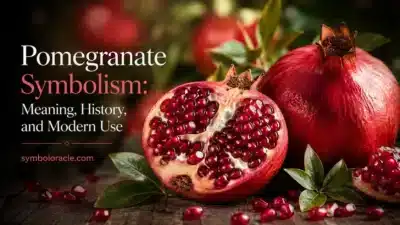
The pomegranite symbolism commonly associated with the fruit includes abundance, fertility, renewal, and the continuation of life. Its many seeds, vivid red color, and long history in religious art and mythology have also connected it with marriage, death, rebirth, prosperity, and spiritual hope.
The fruit itself is distinctive: a round, leathery-skinned fruit filled with clusters of jewel-like seeds. The standard English spelling is pomegranate, but the misspelled form “pomegranite” is sometimes used when people search for information about its symbolism.
Today, Americans may encounter pomegranates in food, holiday decorations, paintings, jewelry, tattoos, fashion, gardens, and wellness culture. Yet the meanings attached to the fruit did not begin in modern America. They developed across ancient Mediterranean, Middle Eastern, Persian, Jewish, Christian, and Islamic traditions.
Quick Answer
Pomegranite symbolism commonly represents abundance, fertility, renewal, and prosperity, especially because one fruit contains so many seeds. Historically, it has also been associated with marriage, death and rebirth, religious devotion, seasonal change, and hopes for continued life.
TL;DR
- Pomegranates commonly symbolize abundance, fertility, renewal, and prosperity.
- Ancient Greek traditions connected the fruit with Persephone and seasonal change.
- Jewish traditions associate pomegranates with righteousness and religious observance.
- Christian art often uses the fruit to represent resurrection and eternal life.
- Persian traditions connect pomegranates with celebration, prosperity, and renewal.
- Modern Americans use pomegranates in art, food, tattoos, jewelry, and decor.
What the Pomegranate Looks Like and Why It Matters
A pomegranate has a tough outer skin that protects hundreds of edible arils, or seed coverings, inside. When opened, the fruit reveals a dense arrangement of red or pink seeds surrounded by pale membranes.
That physical structure helps explain many of its symbolic associations.
Unlike a simple fruit with one central pit, the pomegranate appears almost overflowing with individual seeds. Historically, people could easily connect this visual abundance with fertility, reproduction, prosperity, and a plentiful household.
Its red color adds another layer. Red can suggest blood, vitality, passion, love, danger, or sacrifice depending on cultural context. In religious and artistic settings, the color of pomegranate seeds could therefore support interpretations involving both life and death.
The fruit also has an unusual contrast between exterior and interior. Its hard skin conceals a bright, intricate interior. Artists and storytellers have used that contrast to suggest hidden life, transformation, or something valuable protected beneath an ordinary surface.
What Pomegranates Commonly Symbolize in the United States
In contemporary American culture, the pomegranate is usually interpreted positively.
The most common associations include abundance, health, fertility, prosperity, renewal, and vitality. These meanings appear in home decor, botanical artwork, wedding designs, jewelry, tattoos, and seasonal displays.
The fruit can also represent generosity. A single pomegranate contains many seeds, making it a natural visual metaphor for having more than enough to share.
In wedding-related imagery, it can suggest fertility, a fruitful marriage, or the hope that a relationship will grow into a thriving family. That interpretation is more traditional than universal, however. Someone choosing a pomegranate tattoo or necklace may simply appreciate its appearance or its association with resilience and renewal.
The meaning therefore depends heavily on context.
| Context | Meaning in the USA | Common Associations | Notes |
|---|---|---|---|
| Home decor | Abundance and warmth | Harvest, prosperity, hospitality | Often used as botanical imagery |
| Weddings | Fertility and fruitful partnership | Marriage, family, growth | More traditional than universal |
| Tattoos | Renewal or personal growth | Rebirth, resilience, vitality | Meaning is highly personal |
| Religious art | Life and resurrection | Faith, sacrifice, eternal life | Depends on religious tradition |
| Food and wellness | Vitality and health | Nutrition, natural abundance | A modern cultural association |
Ancient Roots and Early Symbolism
The symbolic history of the pomegranate reaches back thousands of years across regions where the fruit was cultivated.
Ancient peoples encountered a fruit that was visually unusual, nutritionally valuable, and filled with numerous seeds. It became part of both everyday life and ceremonial imagery.
In the ancient Mediterranean and Near East, pomegranates appeared in art, jewelry, offerings, decorative objects, and religious contexts. Their symbolism was not identical everywhere, but fertility and abundance were recurring themes.
The fruit’s connection with life was especially easy to understand in agricultural societies. A plant that produces a large fruit packed with seeds could naturally become associated with reproduction and the continuation of a family or community.
At the same time, pomegranates acquired associations with death and the afterlife. This combination may seem contradictory today, but ancient symbolism often allowed one object to represent both sides of a life cycle.
The pomegranate could mean life because of its seeds and fertility, while also representing death because of its role in funerary traditions and underworld mythology.
The Pomegranate in Greek Mythology
One of the best-known symbolic traditions comes from the story of Persephone.
In Greek mythology, Persephone is taken to the Underworld by Hades. Her mother, Demeter, is associated with agriculture and the fertility of the earth. Persephone eventually returns to the world above, but after eating pomegranate seeds in the Underworld, she is required to spend part of the year there.
The story became closely connected with the changing seasons.
Persephone’s return was associated with renewed growth, while her time in the Underworld corresponded with the period when the earth appeared less productive. The pomegranate therefore became connected with a cycle rather than a single meaning.
It could represent life, death, separation, return, and renewal at the same time.
Archaeological and artistic evidence also shows pomegranates in Greek funerary contexts. This makes the fruit’s connection with Persephone more significant: it was not simply a decorative detail in a myth but part of a broader visual language involving mortality and regeneration.
This ancient tradition is one reason modern explanations of pomegranate symbolism often include both fertility and rebirth.
Pomegranate Symbolism in Judaism
The pomegranate also has an important place in Jewish tradition.
In the Hebrew Bible, pomegranates appear in descriptions of sacred objects and priestly garments. They were also associated with the agricultural richness of the land.
A later Jewish tradition holds that the pomegranate contains 613 seeds, corresponding to the traditional count of the commandments in the Torah. The exact number of seeds varies considerably from fruit to fruit, so this should be understood as a religious tradition rather than a botanical fact.
The symbolic point is more important than the literal count.
The many seeds can represent the fullness of religious obligation and the idea that righteousness involves many individual acts and responsibilities.
Pomegranates are also associated with Rosh Hashanah in many Jewish communities. They may be eaten as part of the New Year celebration, where they can represent hopes for blessings and good deeds in the coming year.
This gives the fruit a particularly clear connection with hope, renewal, blessing, and spiritual responsibility.
Christian Meanings of the Pomegranate
Christian art adopted and reshaped some earlier meanings of the pomegranate.
In medieval and Renaissance European art, the fruit sometimes appears in images of the Virgin Mary and Christ Child. Its many seeds could represent the unity of the faithful, while its red interior could suggest blood, sacrifice, or Christ’s Passion.
The fruit also became associated with resurrection.
That interpretation connects naturally with the pomegranate’s older symbolism of death followed by renewed life. Christian artists could use an established image of regeneration while giving it a specifically Christian theological meaning.
The pomegranate therefore appears in religious paintings, sculpture, textiles, and architectural decoration.
Its Christian meaning is not simply “fertility.” Depending on the artwork, it can point toward resurrection, the Church, sacrifice, unity, eternal life, or the promise of renewal.
Persian and Iranian Traditions
Pomegranates have a long cultural history in Persian-speaking regions and remain strongly associated with Iranian culture.
The fruit appears in celebrations surrounding Nowruz, the Persian New Year. It has traditionally been included among fruits and foods associated with the season, alongside other symbols of renewal and prosperity.
This makes the pomegranate especially suitable as a New Year image.
Its abundance of seeds can suggest prosperity, while its seasonal appearance fits the broader theme of beginning again. In Persian poetry and visual culture, pomegranates can also carry associations with beauty, love, fertility, and the richness of nature.
These meanings should not be reduced to one universal Persian interpretation. Persian culture has developed many different uses of the fruit across literature, food, art, celebration, and regional traditions.
Still, renewal and abundance are especially relevant when the fruit appears in New Year contexts.
Pomegranate Symbolism in Islam
The pomegranate is also mentioned directly in the Quran.
It is described among the fruits associated with God’s creation, and pomegranates are also mentioned in descriptions of gardens and divine provision.
This gives the fruit an important religious presence in Islamic culture, although interpretations can differ between communities and traditions.
It is more accurate to say that the pomegranate can evoke divine provision, beauty, creation, and abundance in Islamic contexts than to assign it one fixed symbolic definition.
Pomegranates have also had a long place in the culinary and artistic traditions of many Muslim-majority societies.
Their symbolic importance is therefore connected not only with scripture but also with centuries of cultural use across the Middle East, North Africa, Central Asia, South Asia, and surrounding regions.
Why the Pomegranate Represents Fertility and Abundance
The connection between pomegranates and fertility has a straightforward visual foundation.
One fruit contains a remarkable number of seeds. In cultures where agricultural fertility and family continuity were major concerns, such a fruit provided an obvious natural metaphor.
The symbolism can operate at several levels.
For a family, it can represent children and descendants. For agriculture, it can suggest productive land and a successful harvest. For a household, it can suggest plenty. For a marriage, it can symbolize hopes for a fruitful future.
But fertility does not always mean pregnancy.
In modern American usage, people may use the pomegranate to represent creative fertility, personal development, business growth, or the ability to produce something worthwhile.
That broader interpretation allows an ancient symbol to remain relevant without requiring people to adopt its older religious meanings.
Pomegranate Symbolism and Death, Rebirth, and Renewal
One of the most interesting features of the pomegranate is its ability to represent opposing ideas.
It can symbolize fertility and death.
That is not necessarily a contradiction. The fruit’s history often reflects the idea of a cycle: life produces new life, living things die, and new growth follows.
The Persephone story makes this especially clear. The fruit becomes part of a story about movement between the living world and the Underworld.
In Christian art, a similar visual object can point toward resurrection. In funerary traditions, it can accompany images connected with death and the hope of continued existence.
For modern readers, this makes the pomegranate an appealing symbol of survival after loss.
Someone might choose it after recovering from a difficult period, beginning again after a major life change, or remembering someone who has died.
The Emotional and Psychological Meaning of the Fruit
Symbolism is not a psychological diagnosis, and there is no universal emotional meaning attached to a pomegranate.
Still, certain qualities of the fruit can influence how people respond to it.
Its hard exterior can suggest protection. Its hidden interior can suggest private potential. Its many seeds can suggest complexity, abundance, or many possibilities contained within one life.
The act of opening the fruit can also become a useful metaphor for discovery.
Someone may see a pomegranate as a reminder that outward appearance does not necessarily reveal what exists inside. That interpretation works particularly well in personal artwork, journaling, tattoos, and decorative objects.
The red color can add emotional intensity, especially when the fruit is used in romantic or dramatic imagery.
Pomegranates in American Weddings and Celebrations
Pomegranates are not traditional symbols of every American wedding, but they appear in some wedding aesthetics because of their associations with fertility, abundance, love, and prosperity.
They may appear in floral arrangements, table settings, invitations, painted illustrations, or seasonal wedding menus.
The fruit is particularly well suited to autumn and winter designs because its rich red color works naturally with those palettes.
It can also be used as a metaphor for building a life together. Instead of focusing only on romantic love, the pomegranate can represent a household filled with relationships, experiences, shared responsibilities, and future possibilities.
That interpretation makes the fruit useful beyond strictly religious symbolism.
Pomegranate Tattoos, Jewelry, and Personal Style
A pomegranate tattoo can carry several meanings.
For one person, it may represent fertility or family. For another, it may symbolize recovery after hardship. Someone interested in Greek mythology might choose it because of Persephone. A Christian might associate it with resurrection. Someone connected to Persian culture might choose it as a reference to heritage or Nowruz.
The same applies to jewelry.
A pomegranate pendant can function as a cultural symbol, a personal reminder, or simply an attractive botanical design. Its meaning should not be assumed without considering the person wearing it.
In contemporary American tattoo culture, personal symbolism often matters more than a single traditional definition.
Pomegranates in Art, Fashion, and Home Decor
Pomegranate imagery works well visually because the fruit combines recognizable shape, strong color, and intricate internal structure.
Artists can depict the whole fruit, an opened fruit, a branch, flowers, or individual seeds. Each version can communicate something slightly different.
An unopened fruit can suggest potential and protection. An opened fruit emphasizes abundance and hidden richness. A branch with blossoms can emphasize growth and fertility.
In home decor, pomegranates often create an autumnal, Mediterranean, Middle Eastern, or botanical atmosphere. They can appear on ceramics, textiles, paintings, wallpaper, serving pieces, and seasonal arrangements.
The modern decorative use does not necessarily carry a religious meaning. Sometimes the fruit is simply valued for its visual connection with harvest and nature.
Common Misunderstandings About Pomegranate Symbolism
The biggest mistake is assuming that the pomegranate has one universal meaning.
It does not.
Its symbolism changes according to religion, region, historical period, artistic context, and personal interpretation.
Another common misconception is that every pomegranate symbol automatically means fertility. Fertility is historically important, but the fruit has also represented death, resurrection, religious devotion, prosperity, seasonal change, marriage, and divine provision.
The claim that every pomegranate contains exactly 613 seeds should also be treated cautiously. The number varies naturally, while the 613 association comes from Jewish religious tradition rather than botanical consistency.
It is also misleading to describe the pomegranate as a universal symbol of “good luck.” Prosperity and blessing are relevant in some traditions, but that does not make the fruit a universal luck charm.
How Pomegranate Symbolism Has Changed Over Time
The meaning of the pomegranate has expanded rather than simply replacing one interpretation with another.
Ancient Mediterranean cultures connected it with fertility, death, and seasonal cycles. Jewish traditions incorporated it into religious imagery and later holiday customs. Christian artists adapted it to themes of resurrection and spiritual life. Persian traditions connected it with celebration and renewal. Islamic cultures encountered it both as a scriptural fruit and as an important agricultural and artistic object.
Modern Americans often encounter the pomegranate outside those original settings.
It appears in supermarkets, health products, restaurants, clothing, artwork, social media photography, tattoos, and interior design.
As a result, the fruit can now communicate something as simple as “fall harvest” or “healthy food” alongside much older associations.
This is how symbols usually survive: their meanings accumulate rather than remaining frozen.
Why the Pomegranate Still Matters in Modern America
The pomegranate fits modern American culture because several of its traditional associations remain easy to understand.
Abundance is still desirable. Renewal is still meaningful. People continue to celebrate marriage, family, seasonal change, religious holidays, and personal transformation.
At the same time, Americans increasingly encounter cultural symbols across traditions. A person might learn about Persephone through mythology, encounter a pomegranate in Christian art, see it during a Jewish holiday, and then buy the fruit at a local grocery store.
The symbol can therefore move between religious, historical, artistic, and everyday settings.
Its continued popularity does not mean everyone interprets it identically. Rather, the pomegranate provides a flexible visual language for ideas that remain relevant: having enough, beginning again, preserving life, remembering the past, and hoping for what comes next.
Frequently Asked Questions
What does a pomegranate symbolize spiritually?
A pomegranate can symbolize abundance, renewal, fertility, resurrection, and divine provision depending on the religious tradition. Its spiritual meaning is not universal, so the surrounding culture or religious context matters.
What does a pomegranate symbolize in Greek mythology?
In Greek mythology, the pomegranate is closely associated with Persephone’s time in the Underworld. Because her return is connected with the seasonal cycle, the fruit can represent death, return, renewal, and the changing seasons.
What does a pomegranate tattoo mean?
A pomegranate tattoo can represent fertility, personal growth, resilience, rebirth, family, or cultural heritage. Its meaning is often personal, so the owner’s reason for choosing the design is more important than any single traditional definition.
What does the pomegranate symbolize in Christianity?
In Christian art, the pomegranate can represent resurrection, eternal life, sacrifice, and the unity of believers. It became especially prominent in European religious artwork depicting the Virgin and Child.
Is the pomegranate a symbol of fertility?
Yes, fertility is one of its longstanding symbolic associations. The fruit’s numerous seeds naturally encouraged connections with reproduction, abundance, family growth, and agricultural productivity.
Why is the pomegranate associated with abundance?
A single pomegranate contains many seeds packed inside one fruit, making it a natural visual metaphor for plenty. This physical characteristic helped establish associations with fertility, prosperity, generosity, and a fruitful life.
Does a pomegranate always have a positive meaning?
No. Although modern uses are often positive, the pomegranate has also been associated with death, the Underworld, mourning, sacrifice, and mortality. Its symbolism often depends on whether the context emphasizes life, death, or the transition between them.
Conclusion
Pomegranite symbolism centers on abundance, fertility, renewal, and the continuation of life, but its history is more complex than a simple list of positive meanings. Greek mythology connected the fruit with Persephone and the seasonal cycle, while Jewish, Christian, Persian, and Islamic traditions developed their own associations with religious life, prosperity, renewal, and divine provision.
In modern American culture, the pomegranate can function as both an ancient symbol and an everyday image. It can represent family, recovery, creativity, heritage, faith, seasonal change, or simply the beauty of nature.
Its lasting appeal comes partly from its physical form: one ordinary-looking fruit opens to reveal a remarkable abundance of seeds. That simple contrast gives the pomegranate a useful metaphor for life itself—what appears contained on the outside may hold far more within.