
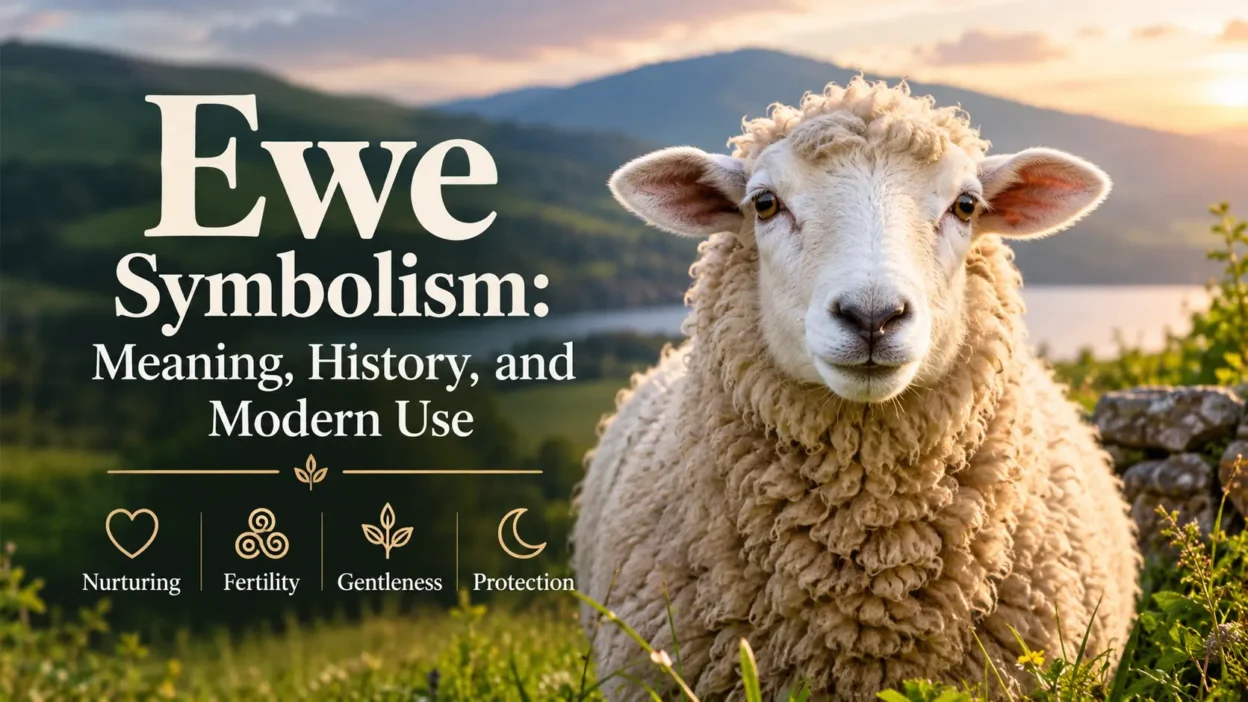
A ewe is an adult female sheep, but ewe symbolism goes beyond the animal itself. Because ewes are associated with motherhood, flock life, wool production, and the raising of lambs, they can represent nurturing, fertility, protection, patience, and continuity. In the United States, these meanings often appear through pastoral imagery, farming traditions, religious art, children’s stories, textiles, and personal symbolism.
The ewe is also important because it occupies a different symbolic position from a ram or lamb. A lamb often suggests innocence or vulnerability, while a ram can represent strength, assertiveness, or sacrifice. The ewe is more closely connected with motherhood, care, reproduction, and the work of sustaining a flock.
Understanding the symbol requires looking at both the animal’s real role and the meanings people have attached to sheep over time.
Quick Answer
Ewe symbolism commonly represents motherhood, nurturing, fertility, patience, protection, and community in modern American culture. Historically, female sheep were connected with pastoral life, food and wool production, family continuity, and religious imagery involving sheep and shepherds.
TL;DR
- Ewes commonly symbolize motherhood, care, fertility, and continuity.
- Sheep have ancient connections with pastoral life and religious imagery.
- American culture often associates ewes with farms, wool, family, and rural traditions.
- A ewe differs symbolically from a lamb because it represents maturity and motherhood.
- Religious interpretations often depend on the larger sheep-and-shepherd context.
- Modern uses include tattoos, art, nursery decor, textiles, and rural branding.
What Is a Ewe and Why Does That Matter Symbolically?
A ewe is a mature female sheep. She is usually distinguished from a ram, which is an adult male sheep, and a lamb, which is a young sheep.
That distinction matters when interpreting symbolism. A sheep shown as a generic flock animal can represent belonging or community, but an identifiable ewe with lambs naturally suggests maternal care.
The ewe’s real-life role has influenced these associations. Ewes can give birth to lambs, nurse them, and remain part of breeding flocks for years. Their wool also connects them to clothing, textiles, and household production.
As a result, the ewe can symbolize what sustains life rather than simply what begins it. The image is less about youthful innocence and more about maturity, responsibility, care, and continuity.
What Ewes Commonly Symbolize in the United States
There is no single official American meaning for a ewe. Its symbolism changes according to context.
Still, several associations appear naturally:
| Context | Meaning in the USA | Common Associations | Notes |
|---|---|---|---|
| Ewe with lambs | Motherhood and protection | Family, care, tenderness | Strong maternal image |
| Ewe in a flock | Community and belonging | Cooperation, family, social bonds | Emphasizes group life |
| Ewe on a farm | Work and provision | Agriculture, food, wool | Connected to rural life |
| White ewe | Gentleness and innocence | Peace, simplicity, purity | Often influenced by broader sheep imagery |
| Ewe in religious art | Care and spiritual belonging | Faith, guidance, protection | Meaning depends on the religious setting |
In contemporary American settings, the ewe is usually interpreted positively. Its associations tend to be domestic and relational rather than aggressive.
That makes it especially suitable for imagery involving family, children, rural life, caregiving, and peaceful surroundings.
Ancient Roots and the Pastoral World
Sheep have been domesticated for thousands of years, making them closely connected with early agricultural societies. Their wool, meat, milk, and reproductive value made them useful animals for communities that depended on livestock.
This practical importance helped create symbolic associations with provision and continuity.
A flock represented more than a collection of animals. It could represent wealth, household resources, and a community under the care of a shepherd. The female sheep was particularly important to the continuation of the flock because she produced the next generation.
This is one reason it is useful to avoid treating ewe symbolism as purely decorative. The underlying meaning developed partly from an observable fact: a healthy flock depended on reproduction, care, and protection.
Over time, real agricultural relationships became part of stories, religious imagery, literature, and visual art.
Ewe Symbolism in Biblical and Christian Traditions
Sheep occupy an important place in the Bible, although the specific symbolism of a ewe should not be confused with the broader symbolism of sheep.
Biblical imagery frequently uses sheep and shepherds to discuss guidance, vulnerability, community, responsibility, and spiritual care. The familiar image of the Good Shepherd presents a shepherd who protects and searches for his sheep. Early Christian art adopted this imagery extensively, including representations of the shepherd carrying a lost sheep.
The ewe itself is not always the central symbolic figure in these traditions. Often, the religious meaning belongs to the flock or sheep generally.
However, when a female sheep is pictured with young, viewers may naturally read additional ideas of motherhood, care, and protection into the scene.
Christian imagery also frequently distinguishes between the shepherd’s responsibility and the sheep’s dependence. This can give a ewe-and-lamb scene a layered meaning: family care on one level and spiritual care on another.
Motherhood and the Ewe’s Strongest Modern Meaning
Motherhood is one of the clearest symbolic associations of a ewe.
An adult female sheep with her lambs creates an immediately recognizable image of maternal responsibility. She represents an animal caring for young that depend on her for nourishment and protection.
For this reason, ewe imagery can appear in:
- family artwork
- nursery decoration
- children’s books
- baby announcements
- personalized gifts
- pastoral illustrations
- family tattoos
The symbolism does not necessarily suggest motherhood in a sentimental way. It can also represent the practical side of parenting: providing food, staying close to the young, protecting them, and helping them become independent.
That makes the ewe a useful symbol for both tenderness and responsibility.
Fertility, Birth, and Continuity
Because ewes are breeding females, they can symbolize fertility and the continuation of a family or community.
This association is especially strong in agricultural contexts where reproduction directly affects the future of a flock. More lambs mean the flock can continue and grow.
In symbolic use, however, fertility does not always mean pregnancy or childbirth. It can represent growth, renewal, productivity, and the continuation of a family tradition.
Someone might therefore choose ewe imagery to represent a new family generation, a successful transition between generations, or the desire to preserve something valuable.
This interpretation should be kept separate from generalized claims that every ewe symbol automatically means fertility. The meaning depends on how the animal is depicted and the context in which it appears.
Patience, Gentleness, and Quiet Strength
Ewes are often portrayed as gentle animals, which contributes to associations with patience and calmness.
Unlike the ram, which is commonly depicted with large horns and a more imposing physical presence, the ewe generally has a softer visual appearance. That difference influences how people read the animal.
A ewe can therefore symbolize a form of strength that is not aggressive.
Its strength is expressed through endurance, caregiving, adaptation, and persistence. This makes the animal useful in symbolism about people who protect others without seeking attention.
The idea is particularly relevant to modern interpretations of caregiving. Quiet responsibility can be meaningful even when it does not look dramatic.
The Ewe, the Flock, and the Meaning of Belonging
A ewe rarely exists symbolically in complete isolation. Images of sheep usually involve a flock.
This creates another important association: belonging.
A flock can represent family, community, shared identity, or social connection. At the same time, flock imagery can raise a more complicated idea: the tension between belonging to a group and maintaining individual identity.
That distinction matters in modern American culture.
A person may use sheep imagery because they value family and community. Another person might use it to reflect on the pressure to follow a group.
The traditional positive meaning of flock membership should therefore not be confused with the modern negative expression “sheep,” which is sometimes used to criticize people who supposedly follow others without thinking independently.
Why Ewes Became Connected With Wool and Provision
Sheep have long been valued for wool, and the ewe plays a direct role in maintaining sheep populations used for fiber production.
Wool adds another symbolic layer to the animal: provision through ordinary work.
The fleece can become clothing, blankets, yarn, rugs, and other useful goods. This connects sheep with warmth, shelter, craftsmanship, and household production.
American agricultural history preserves strong sheep-and-wool traditions. Sheep farming has existed across many parts of the United States, and wool production became part of rural economies and family farming practices.
The Library of Congress’s American Folklife Center documents sheep and wool traditions across American communities, including ranching, breeding, shearing, fiber work, and regional agricultural practices. This history helps explain why sheep imagery can still evoke rural labor and practical self-sufficiency in American culture.
Ewe Symbolism in American Rural Culture
In the United States, the ewe is particularly understandable within a rural or agricultural setting.
A ewe in a pasture may suggest:
- farming
- animal husbandry
- family livelihood
- rural independence
- seasonal work
- traditional craftsmanship
- connection to the land
These associations are not equally strong for every American. Someone raised in an agricultural community may see a ewe primarily as livestock, while someone encountering the animal through children’s literature may associate it with gentleness and family.
This difference is important.
Symbolism develops from lived experience. The same animal can be emotionally meaningful to one person and simply familiar farm life to another.
Ewe Symbolism in Folklore, Stories, and Children’s Culture
Sheep have appeared frequently in children’s stories, nursery rhymes, songs, and illustrations.
The cultural image of the sheep is therefore familiar to many Americans from childhood. Stories involving shepherds, flocks, lost sheep, and lambs helped establish sheep as recognizable characters representing innocence, vulnerability, belonging, or care.
The famous nursery rhyme involving Little Bo-Peep is one example of how sheep became part of American popular culture through inherited English-language traditions.
The Library of Congress also preserves nineteenth- and early twentieth-century American political cartoons that used sheep as metaphors for groups of people. In those cases, sheep could represent followers, voters, or people being led by someone else.
This demonstrates that sheep symbolism has never been limited to positive meanings.
Ewe vs. Lamb vs. Ram: Why the Difference Matters
People sometimes use sheep imagery as though every sheep carries the same meaning. The distinctions can be useful.
A lamb commonly suggests youth, innocence, vulnerability, sacrifice, or new life.
A ram is more often associated with strength, masculinity, determination, leadership, horns, and confrontation.
A ewe tends to emphasize motherhood, maturity, nurturing, fertility, continuity, and care.
These meanings overlap. Religious symbolism, mythology, artwork, and personal interpretation can change them.
Still, when someone deliberately chooses a ewe rather than a lamb or ram, the maternal and sustaining qualities are often especially relevant.
Emotional and Psychological Meaning of the Ewe
Symbolic animals can function as emotional shorthand. A ewe may communicate feelings that are difficult to express directly.
For some people, it can represent:
- feeling responsible for loved ones
- wanting to protect family
- valuing a peaceful life
- remembering a mother
- honoring rural roots
- finding comfort in familiar animals
- accepting a caregiving role
A ewe can also symbolize the emotional complexity of caring for others. Nurturing involves attachment, responsibility, patience, and sometimes worry.
That makes the ewe different from symbols that focus mainly on independence or personal power.
Its emotional center is relational: who depends on you, whom you protect, and what you help continue.
What a Ewe Tattoo Can Mean
A ewe tattoo can carry several personal meanings depending on its design.
A ewe standing alone might represent maturity, independence, rural identity, or connection to farming.
A ewe with lambs usually creates a stronger association with motherhood, family, protection, or remembrance.
A minimalist ewe can communicate simplicity and calmness, while a realistic farm scene may emphasize agricultural heritage.
Religious elements can add another interpretation, especially when the tattoo includes a shepherd, cross, flock, or biblical imagery.
Because tattoos are personal symbols, there is no universal interpretation. The person’s reason for choosing the image is ultimately more important than a dictionary-style meaning.
Ewe Symbolism in Jewelry, Decor, and Modern Design
The ewe is well suited to decorative uses because its shape is visually recognizable without being aggressive.
It may appear in:
- farmhouse decor
- nursery art
- ceramic figures
- woven textiles
- jewelry
- ornaments
- children’s clothing
- agricultural branding
- handmade crafts
In home decor, a ewe can contribute to a pastoral atmosphere. In nursery design, a ewe and lamb pair can suggest family and protection.
In jewelry, a small sheep or ewe charm can serve as a reminder of family, home, farming heritage, or personal values.
The meaning is often understated rather than ceremonial.
Common Misunderstandings About Ewe Symbolism
One common mistake is assuming that every sheep symbol has one fixed meaning.
It does not.
Sheep can symbolize innocence, obedience, vulnerability, sacrifice, wealth, agriculture, community, or spiritual belonging depending on context. A ewe adds a stronger maternal dimension, but even that is not automatic.
Another misunderstanding is treating biblical sheep imagery as if it were specifically about female sheep. Much biblical symbolism concerns sheep collectively or uses the relationship between shepherd and flock.
There is also a modern tendency to interpret “sheep” as a synonym for someone who blindly follows others. That usage exists in contemporary language, but it should not be projected backward onto every historical representation of a sheep or ewe.
Historical symbolism and modern slang are not the same thing.
How Ewe Symbolism Has Changed Over Time
The meaning of the ewe has shifted as people’s relationships with agriculture have changed.
In traditional farming societies, a ewe was first a valuable working animal. Her reproductive ability, wool, and place in the flock had direct economic importance.
Religious traditions then gave sheep broader symbolic roles involving guidance, dependence, sacrifice, community, and spiritual care.
Later, literature and children’s culture helped make sheep familiar symbols of innocence and gentleness.
Modern American culture adds another layer. For many people who do not work with livestock, the ewe is now encountered mainly through art, children’s stories, rural aesthetics, religious imagery, social media, and decorative design.
The animal has therefore moved from being primarily a practical agricultural resource to also being a cultural image of family, care, and pastoral life.
Why the Ewe Still Matters in Modern American Culture
The ewe remains recognizable because its basic associations are easy to understand without specialized knowledge.
A ewe with lambs immediately suggests a parent and child. A ewe within a flock suggests community. A ewe in a pasture suggests rural life. Wool suggests warmth and practical craftsmanship.
At the same time, the symbol can carry more personal meanings.
Someone with a farming background may see family history in a ewe. Someone choosing a tattoo may see motherhood. Someone using a ewe in nursery art may simply want an image associated with gentleness and care.
The modern meaning is therefore flexible while remaining grounded in the animal’s real characteristics.
Is Ewe Symbolism Positive or Negative?
Ewe symbolism is generally positive when the animal is presented in a maternal, pastoral, or family setting.
Common positive associations include care, fertility, patience, family, provision, belonging, and protection.
Negative interpretations usually arise from the broader symbolism of sheep rather than from the ewe specifically. For example, sheep can sometimes represent passivity, conformity, vulnerability, or unquestioning obedience.
Context determines which meaning becomes dominant.
A ewe protecting lambs communicates something very different from a political cartoon depicting a flock as followers. The animal stays the same, but the surrounding narrative changes the symbol.
Frequently Asked Questions
What does a ewe symbolize spiritually?
A ewe can symbolize care, protection, motherhood, and belonging within religious or spiritual imagery. In Christian contexts, its meaning may connect with the broader symbolism of sheep, shepherds, guidance, and spiritual community.
What does a ewe and lamb symbolize?
A ewe and lamb commonly symbolize motherhood, family protection, nurturing, and the relationship between generations. The image can also represent continuity because the older animal protects and sustains the younger one.
What does a ewe tattoo mean?
A ewe tattoo may represent motherhood, family, rural heritage, patience, fertility, or personal responsibility. The meaning becomes more specific when the design includes lambs, a shepherd, religious imagery, or agricultural elements.
Is a ewe a symbol of fertility?
It can be. Because a ewe is a mature female sheep involved in reproduction and raising lambs, it naturally lends itself to symbolism involving fertility, birth, growth, and family continuity.
What is the difference between ewe symbolism and lamb symbolism?
Ewe symbolism usually emphasizes maturity, motherhood, care, and continuity. Lamb symbolism more often emphasizes youth, innocence, vulnerability, new life, or sacrifice.
Does a ewe symbolize obedience?
Not necessarily. Sheep in general have sometimes been used to symbolize following or conformity, but a ewe does not automatically represent obedience. In many contexts, her symbolism is more closely connected with motherhood and care.
What does a white ewe symbolize?
A white ewe may combine the traditional associations of motherhood and nurturing with ideas of peace, gentleness, simplicity, or purity. These additional meanings usually come from the color white rather than from the ewe itself.
Conclusion
A ewe represents more than simply a female sheep. Its symbolic associations grow from the animal’s real role in family groups, reproduction, pastoral life, wool production, and care of young. In modern American culture, ewe symbolism most often points toward motherhood, nurturing, protection, fertility, community, and continuity.
Its meaning becomes clearer when the ewe is distinguished from other sheep imagery. A lamb emphasizes youth and vulnerability, while a ram often carries associations with strength and assertiveness. The ewe occupies a different space: mature, sustaining, protective, and closely connected with the continuation of family and community.
That combination explains why the ewe remains useful in religious imagery, rural traditions, children’s culture, personal art, tattoos, and modern design. Its symbolism is strongest when it reflects the actual qualities people have observed in the animal rather than assigning it an exaggerated or universal meaning.


